Interior project workflow: stages, optimizations, and mistakes

Many business owners and real estate investors enter their first interior design project with a simple idea in mind: you decide what you want, a designer creates the plans, the execution team builds it, and it's done. The reality is that a custom interior project functions more like a living organism, with interdependent phases that influence each other. A wrong decision made during the concept stage can generate serious additional costs during execution. In this guide, you will understand the actual structure of the workflow, what happens in each stage, how the approach differs for HoReCa spaces, and how to manage the budget and risks throughout the entire process.
Key Ideas
|
Subject |
Details |
|---|---|
|
The workflow is not always linear |
Adaptability increases efficiency and reduces risks in any interior project. |
|
Detailed documentation matters |
Clear documentation prevents major issues and optimizes execution. |
|
HoReCa has its own rules |
Projects for high-traffic spaces require distinct flow testing and operational optimizations. |
|
Budget and reserves |
Budget and reserve management must be treated as a permanent part of the workflow. |
What the workflow of a custom interior design project means
The term "project workflow" describes the logical and interdependent sequence of stages through which a space passes, from a raw idea to a finished and functional environment. It is not about a list of tasks you check off one by one. It is rather the backbone of the entire endeavor, the structure that holds together design decisions, technical planning, team coordination, and cost control.
A custom interior project differs fundamentally from generic approaches precisely because of this backbone. When you buy a standard furniture package or hire a "turnkey" fit-out company without a custom project, you receive a predefined solution that may or may not correspond to your operational needs. Custom design, on the other hand, always starts from the specific context: who the users of the space are, how they circulate, what they need to feel, what they need to do more efficiently.
A typical workflow for custom interior design projectsbegins with setting objectives and moves through concept, then detailed design, including plans and MEP (mechanical, electrical, and plumbing), before execution. This sequence is not arbitrary. Each phase produces documents and decisions that feed into the next phase.
Here is an overview of the four main phases:
|
Phase |
Main deliverables |
Risks if omitted |
|---|---|---|
|
Setting objectives |
Project brief, constraints, preliminary budget |
Wrong direction, costly iterations |
|
Concept |
Mood board, color palette, visual scenarios |
Execution without a clear identity |
|
Detailed design |
Technical plans, MEP, material schedules |
Execution errors, budget overruns |
|
Execution and coordination |
Finished space, on-site adjustments |
Improvisations, compromised quality |
The importance of clear technical documentation cannot be overstated. A complete technical file, with dimensioned plans, execution details, and material specifications, means the execution team knows exactly what to do without requesting clarifications at every step. This reduces errors, shortens the duration of the work, and protects the budget.
Managementof risk in the design phaseis an active stage, not a passive one. You identify problematic scenarios before you reach the construction site, not when the cost of remediation is three times higher.
Understandingthe workflow of an interior design projecthelps you know exactly what questions to ask, what documents to request, and how to evaluate whether things are moving in the right direction. Otherwise, you are entirely dependent on what your design team tells you, without your own frame of reference.
"A well-documented interior design project is not a luxury. It is the tool that transforms an abstract vision into a functional, budget-controllable space."
Custom projects work precisely becausethe role of the architector interior designer is not limited to aesthetics. He or she coordinates a complex system of technical decisions, relationships with suppliers, and execution teams, all in service of a clear objective.
Detailed stages: from concept to execution
Once we have the workflow structure, we analyze the concrete steps that make the difference between a predictable result and improvisation.
1. Brief and objectives stage
Everything starts with a serious conversation about context. What type of business will operate in the space? How many employees or clients will circulate daily? What is the brand identity, and what experience do you want the space to convey? The answers to these questions form the project brief, the reference document against which all subsequent decisions are evaluated.
2. Design concept
The concept includes a mood board, color palette, lighting, and materials, as well as visual scenarios through which the space gains a clear direction before any line is drawn on the plan. It is not a mere collection of beautiful images. It is a strategic decision about how the space will look and function.
3D renderings and mock-ups play an essential role in this stage. They allow the client to "see" the space before execution and to validate decisions or adjust them without additional costs. A change of direction in the concept phase costs hours of work. The same change during execution can cost tens of thousands of euros.
3. Detailed design
This is the most technical stage and, in our experience, the most underestimated by clients. It includes:
- Furniture plans with precise dimensions
- Sections and execution details for each custom element
- Electrical and MEP (mechanical, electrical, plumbing) schematics
- Quantity take-offs and material specifications
- Technical data sheets for involved suppliers
|
Document |
Role in the project |
Impact if missing |
|---|---|---|
|
Dimensioned furniture plan |
Guide for execution and procurement |
Sizing errors |
|
MEP schematics |
Coordination of installations |
Technical conflicts on site |
|
Quantity take-offs |
Accurate budgeting |
Incomplete estimates, surprises |
|
Material technical data sheets |
Correct supplier selection |
Inappropriate substitutions |
4. Execution and coordination
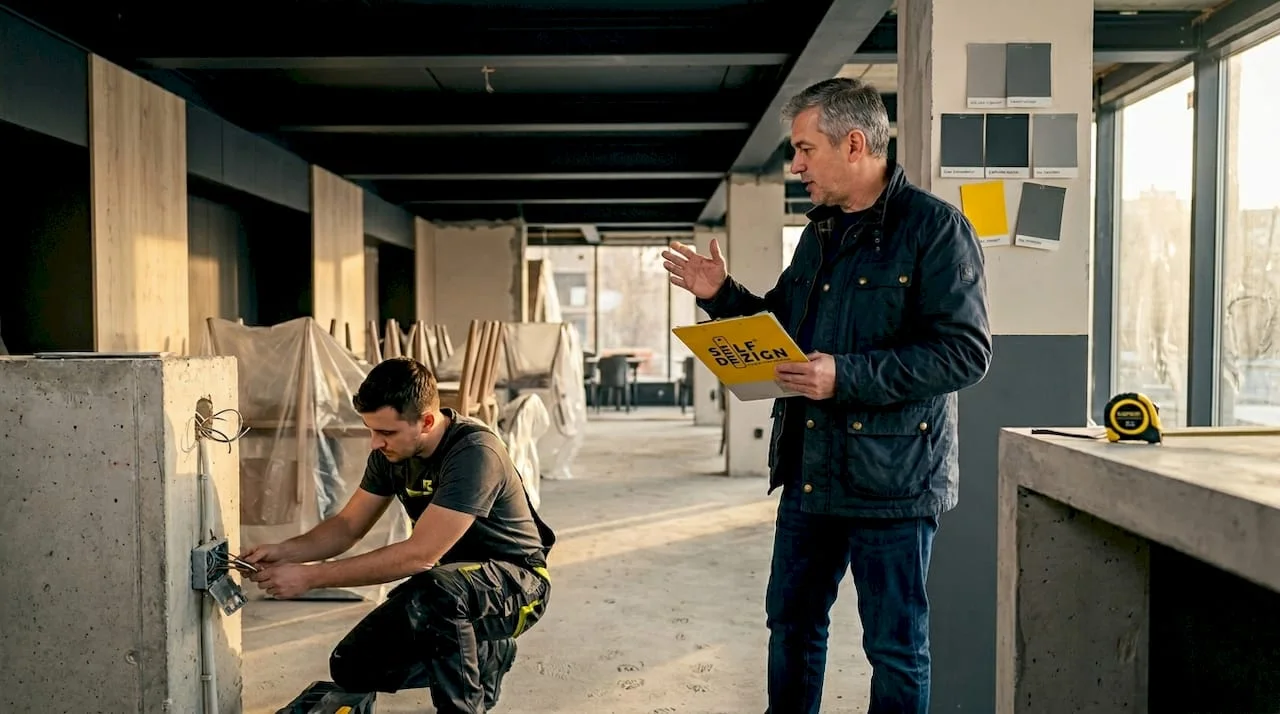
Even the best technical file does not guarantee perfect execution without active coordination. On-site adjustments are inevitable. The actual structure differs from plans, suppliers deliver late, and execution teams have specific questions. The project coordinator manages these moments without letting quality suffer.
Professional tip: Establish in the design contract who has the authority to approve on-site changes and the monetary limit up to which these can be made without formal approval from you. This clarity avoids costly bottlenecks.
You can see details aboutthe stages of residential interior designcustomized, but the basic logic also applies to commercial projects, with the necessary adaptations. Andthe benefits of custom interior design for businessesbecome visible precisely when each stage is completed correctly.
Particularities for the HoReCa sector and high-traffic spaces
After going through the usual stages, it is useful to identify what changes when the space must meet the specific requirements of HoReCa.
A restaurant, café, or hotel is not just a beautiful space. It is an operational machine where design directly influences revenue. The number of tables in a restaurant determines the maximum possible turnover per shift. The distance between the bar and the service area influences delivery times and customer satisfaction. These details do not appear in residential projects and are not visible if you do not know where to look for them.
What is different in HoReCa projects:
- Functional zoningis more complex: the reception area, service area, production area (kitchen), storage area, and technical areas must function as an integrated system.
- The operational flowof staff must not intersect the customer flow at critical points.
- Materialsmust be selected not only for aesthetics but also for resistance to high traffic, ease of cleaning, and compliance with sanitary regulations.
- Lightingserves both the ambiance for the customer and the functionality for the staff, often in the same areas.
HoReCa design functions like a laboratoryof flows and service times. Optimizations for 10-15 minute service times in a high-traffic context can make the difference between a profitable business and one that loses customers due to waiting. This is not an exaggeration; it is a reality confirmed by operators who have redesigned spaces and measured the results.
Testing with mock-ups
In a serious HoReCa project, mock-ups are not optional. You can build a section of the bar or service area in full scale, using temporary materials, to test if the heights, distances, and workflow are correct. The cost of a mock-up is small compared to the cost of redesigning after execution.
Professional tip: Involve operational staff in testing mock-ups. An experienced waiter will identify in 10 minutes problems that a designer might miss if they are not familiar with the team's daily routines.
Optimization for multifunctional zones
Modern HoReCa spaces often have areas that function differently throughout the day: a brunch space in the morning can become a workspace for freelancers at lunch and a cocktail bar in the evening. This multifunctionality must be explicitly planned in the flow, not left to improvisation.
|
Criterion |
Residential Project |
HoReCa Project |
|---|---|---|
|
Design Priority |
Comfort and personal aesthetics |
Operational functionality + customer experience |
|
Materials |
Medium durability, aesthetics |
High resistance, easy sanitization |
|
User flow |
2-6 people |
Dozens or hundreds of people daily |
|
Concept testing |
3D renderings |
Physical mock-ups + flow simulations |
|
Main risk |
Aesthetic dissatisfaction |
Direct operational losses |
Specialized consultancy ininterior design for commercial spacescan make the difference precisely in this type of project, where the stakes are twofold: a space that looks good and one that generates profit.
Budget, contingency, and risk management in the interior project workflow
Starting from the importance of adapting the workflow for each context, we arrive at the issue of resources: budget and risks.
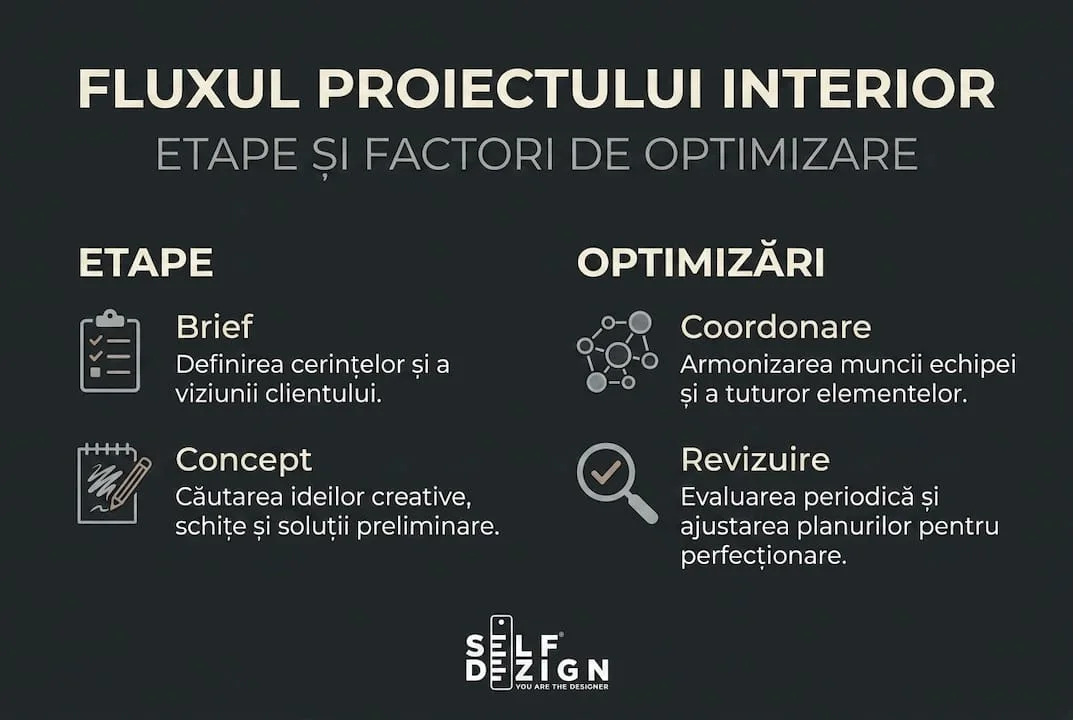
The budget of a customized interior design project is not a figure set at the beginning and ignored until the end. It is a living document that evolves with the project. The budget and contingencies for unforeseen events are treated as an integral part of the project mechanics, not as a separate column you consult only when problems arise.
How to build a correct budget:
- Initial estimateis made based on the brief and the surface area, with an indicative cost per square meter for the type of project and desired finish level.
- Detailed estimateappears after the completion of technical design, when you know exactly what materials, quantities, and labor are required.
- Contingency reserveis typically between 10% and 15% of the total budget. It is not a reserve fund for whims. It is a realistic protection against actual site conditions: hidden structures that complicate execution, material price variations, changes requested by the client during execution.
Periodic budget reviews
A 3-6 month project should have at least two to three formal budget review points: at the end of the design phase, halfway through execution, and before the final stages. These moments help you identify deviations before they become irreparable problems.
Professional tip: Ask the design team for a monthly financial status report against the estimate. If this request seems unusual to them, it is a sign that you are not on your first project with a team that lacks clear processes.
"A budget without a contingency is not a budget. It is a wish."
The connection between clear documentation and risk minimization is direct. When every execution detail is documented and approved, the construction team does not interpret, but executes. Uncontrolled interpretations on site are one of the main sources of budget overruns and compromised quality.
What happens when unplanned changes occur
Design changes during execution are costly for several cumulative reasons: already completed labor may become unusable, ordered materials may no longer be suitable, deadlines shift, and penalties may arise. Therefore,project risk managementdoes not mean eliminating any changes, but creating a clear system through which changes are evaluated, approved, and documented before implementation.
If you want to better understand whatan interior design project costsfor different types of spaces, concrete data helps you calibrate expectations and negotiate better with suppliers.
Why the ideal workflow does not exist: what I learned from real projects
There is a natural tendency to present the workflow of an interior project as a perfect map: follow the steps, get the result. In reality, none of the projects I have coordinated went exactly according to the initial plan. And that does not mean planning has no value, but rather that its real value lies in something other than perfect execution.
Rigorous planning provides you with a reference framework against which you can measure deviations and make quick decisions. Without it, any problem becomes a crisis. With it, the same problems become targeted decisions with clear solutions.
I have seen office projects where testing a single workstation mock-up led to a complete redesign of the natural lighting distribution, resulting in significant savings compared to the initial solution. I have seen HoReCa projects where a seemingly minor modification to the service flow increased operational capacity by 20% without any structural changes.
The uncomfortable truth is this: almost no real project adheres 100% to the initial plan. Materials change, deadlines slip, the client discovers during execution that they want something else. The teams that manage these moments well are those with clear decision-making and coordination processes in complex projects and a culture of transparency with the client. Not perfect, but adaptable and communicative.
Do you need help with your interior project?
If the workflow and challenges of the interior project have become clear to you, here is what you can do next with specialized help. At SelfDezign, we work with business owners, investors, and managers in the HoReCa sector who want to understand exactly what they receive at each stage, not to be surprised by costs or timelines. Whether you needoffice interior designfor an efficient workspace, or you want to go throughthe practical steps for a customized business project, our team starts from the real context of your business. You will also discover the concrete business benefits that come from a strategically designed space.