
Transforms the clinic experience with efficient interior design

Many clinic owners invest considerably in state-of-the-art medical equipment, but patients still leave with a feeling of discomfort or confusion. The reason is not the quality of the medical act, but the way the space is thought and organized.Clinic Interior Designit directly influences the patient's progress, the level of stress and the confidence he/she gains towards the clinic, before arriving at the doctor's office. This article explains step by step how to approach clinic design as a tool for real efficiency, not as a simple aesthetic choice.
The main findings
|
Punct |
Detalii |
|---|---|
|
Multidisciplinary integration |
The design of the clinic must combine aesthetics with functionality, flow and infection control for maximum efficiency. |
|
Evidence-based approach |
Using real data and post-implementation assessment brings measurable results for patients and staff. |
|
Intuitive wayfinding |
Easy orientation in space reduces patient stress and increases team operational efficiency. |
|
Involvement of specialists |
Working with IPC experts and medical designers optimizes patient safety and experience. |
Why Clinic Design Matters More Than You Think
There is a persistent myth among clinic managers: that interior design is all about choosing the colors on the walls, furniture or decorative plants in the waiting room. In reality,clinical interior designis the invisible structure that determines whether a patient feels safe or anxious, whether staff are working efficiently or wasting time due to a poorly thought-out layout.
Think of the clinic space as the backbone of an organism. If it is not correct, nothing else works well, no matter how good the other components are.
“Medical design, including patient journey, waiting areas, and general fitting, is treated as a component influencing experience and efficiency, not just aesthetics.”
Elements with proven impact on a patient's condition include much more than visible surfaces:
- Natural and artificial lightingregulates cortisol levels and reduces anxiety in waiting spaces
- Layout-uldetermines how easily the patient orientates from the entrance to the designated office, without asking three times where to go
- Acoustic privacyin the reception area reduces the discomfort of patients who have to communicate sensitive data in front of other people
- Surface materials and texturesinfluences the perception of cleanliness and clinical safety
A space without aholistic cabinet designis not a neutral space. It's a space that works against your clinic. Patients feel confused, cramped, and inconsistent, even though they can't name it. And the first impression counts enormously in the decision to return or recommend the clinic to others.
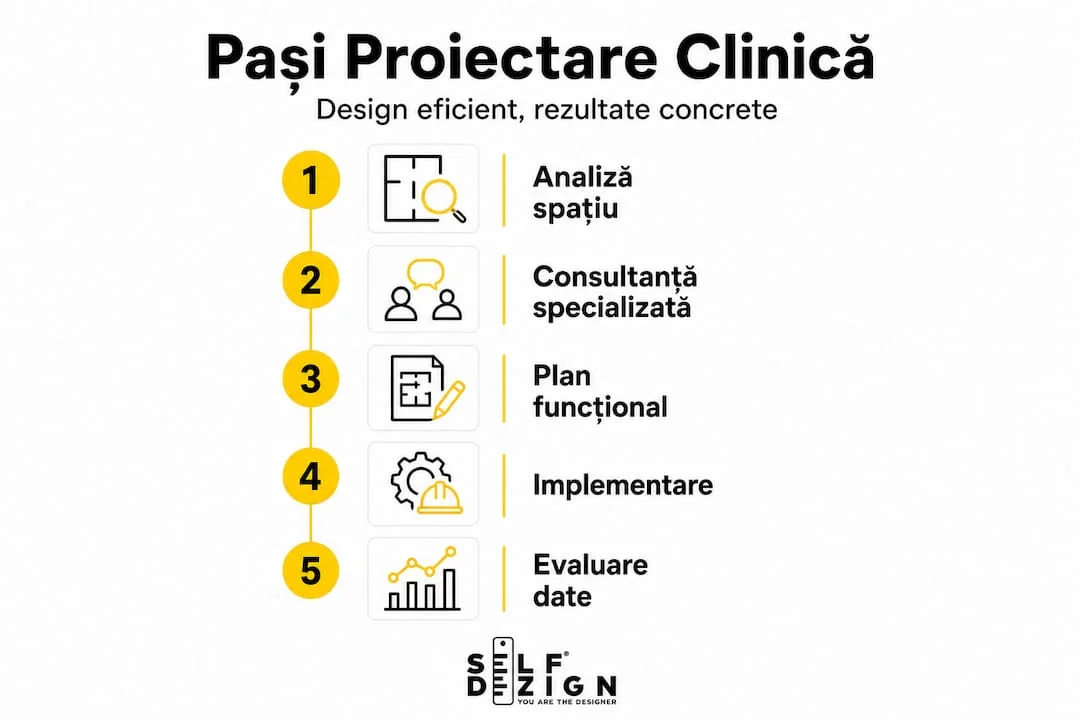
Process Integration: Steps to Performant Clinical Design
Once you understand that design is not a finishing detail but a strategic tool, it becomes essential to know how to approach the process correctly. The order of the steps is not optional; it is what determines whether your investment will produce real results or just a beautiful space in the photos.
- Mapping of actual patient flows.Before any sketch or visual concept, you need to understand how patients actually move around the clinic. Where do they get crowded? Where do they get lost? Where does the friction between the medical staff and those on standby occur?Wayfinding frequently failswhen the design starts from the signage and ignores the data about actual flows and friction points.
- Consultation of medical personnel and patients.Employees who work daily in the space know the real problems: too narrow corridor, wrongly positioned reception, lack of transition space before the office. Patients, in turn, can provide valuable insights into what makes them feel safe or unsafe.
- Collaboration with IPC (Infection Prevention and Control) experts from the design phase.Infection control is not an added compliance requirement at the end. It is a design component that dictates the choice of materials, the positioning of sanitizing stations and the configuration of clean circuits versus contaminated ones.
- Elaboration of the design concept based on collected data.Only after you have a clear picture of the real flows and needs can you build a concept that solves the identified problems. You can deepeninterior project flowto understand how each stage articulates itself.
- Post-employment implementation and evaluation.The design doesn't end when the construction teams leave. Evaluating the results after the space is actually used is essential to identify what works and what needs to be adjusted.
Professional advice:Do not treatclinical design consultancyas a luxury. It is the stage that can save you tens of thousands of euros in subsequent corrections and gives you clarity before committing any resource.
Patient-centered design: from wayfinding to infection control
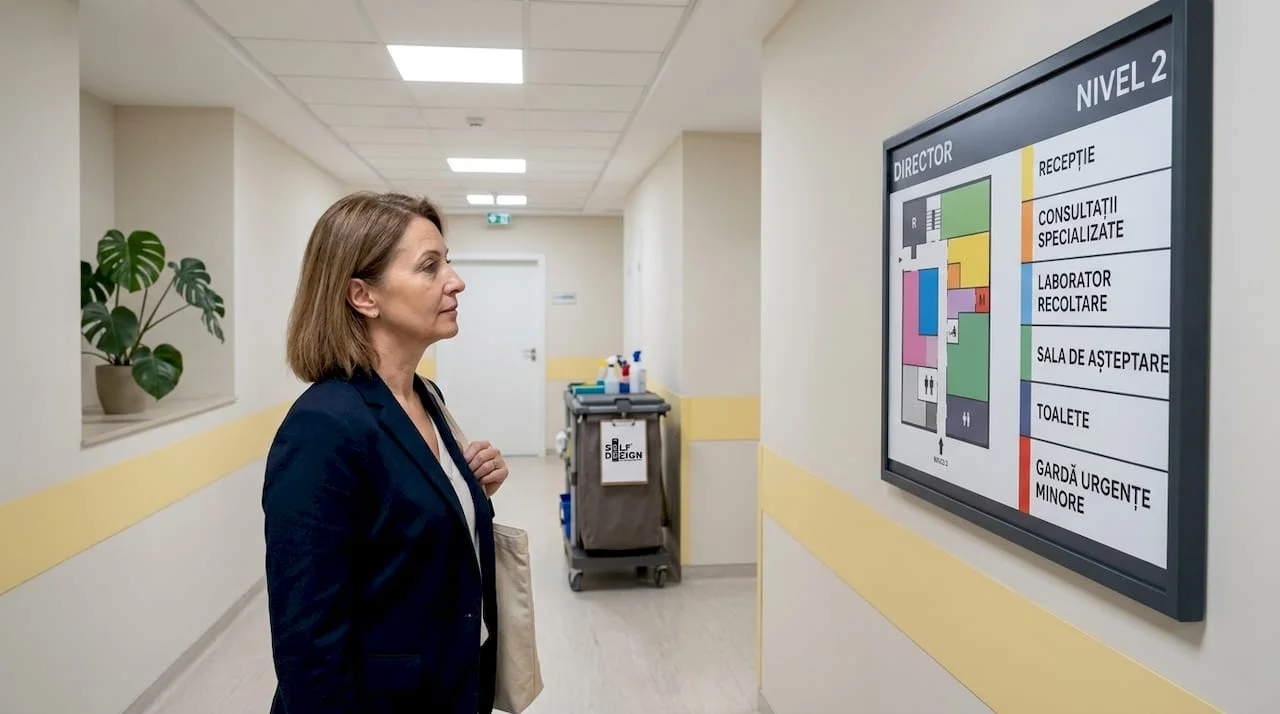
Now that we know the key steps, let's see concretely how the design becomes the engine of the daily operation of the clinic and the protective fence for patient safety.
Wayfinding-ulis the term describing a space's ability to guide people intuitively from one point to another. In a clinic, a bad wayfinding means patients who miss appointments, staff who waste time explaining directions and extra pressure on reception.Spatial design influences navigationthrough visibility and connectivity, and recommendations include repositioning key elements in more visible and accessible places.
|
Design element |
Traditional approach |
Integrated approach |
|---|---|---|
|
Wayfinding |
Panels and arrows added after completion |
Designed flows from scratch based on data |
|
Reception |
Centrally placed for overall visibility |
Positioned based on actual friction points |
|
Infection control |
Solutions added at the end (wall-mounted dispensers) |
Antimicrobial materials, separate circuits, designed from the concept phase |
|
Iluminat |
Uniform, energy-efficient neon |
Area-differentiated lighting: relaxing on standby, functional in the cabinet |
|
Acoustics |
Ignored or carpeted |
Architecturally integrated sound-absorbing panels |
Infection control is perhaps the component most frequently ignored in medical design projects in Romania. IPC principles must be integrated into planning, design and construction, with consultation and involvement of IPC experts in the key stages of the project. This means that choosing finishes, flooring materials or type of ventilation are not purely aesthetic or budgetary decisions, but medical decisions.
The repositioning of receptions and nursing stations is another concrete example. A front desk placed at the entrance, but without visibility to the main corridors, creates operational blindness: staff cannot see if a patient needs help, cannot anticipate crowding, and cannot effectively manage flow.Architect's rolein this context goes far beyond aesthetics: it is he who translates operational needs into spatial configurations that work.
Design validation and optimization: concrete measurements and results
The effectiveness of an implemented design is not evaluated with the naked eye and is not guessed from the satisfaction of the first week. There are clear methodologies that allow you to measure whether the space is working as intended and where there is room for improvement.
Post-occupancy assessment (POE)is the process by which you measure the performance of a space after it is actually used by patients and staff.Environmental elements can be evaluatedand enhanced by POE methodologies, linking design to prevention of respiratory problems, stress and mental impact in outpatients.
Here's what you're specifically aiming for in a post-employment assessment:
|
Indicator |
What you measure |
Instrument |
|---|---|---|
|
Patient satisfaction |
Comfort level and orientation |
Short questionnaires on exit |
|
Orientation times |
How long does it take to get from the entrance to the office |
Direct observation or digital data |
|
Incidence of infections |
Rates of nosocomial infections per ward |
Medical data correlated with design areas |
|
Staff stress |
Exhaustion level related to the environment |
Regular anonymous questionnaires |
|
Flow efficiency |
Travel bottlenecks and downtimes |
Observation and mapping |
Evidence-based design (EBD)works exactly like a clinical trial: you start with a hypothesis, implement the solution, collect data, and adjust. Frequently applied in health buildings, EBD has demonstrated measurable impact on reducing infections, decreasing reaction times, and increasing patient satisfaction.
The concrete results of a data-driven design include reducing patient stress through calibrated lighting and well-thought-out waiting spaces, decreasing the risk of infections through integrated designed circuits and materials, and improving staff response times through strategically placed stations.
Professional advice:Integrate post-employment assessment as a contractual step in any medical design project, not as a voluntary option. This is the only way you can prove that investing in design has brought concrete results, not just a more visually pleasing space. You can access more details aboutinterior design servicesfor clinics to understand how this stage is structured.
Why most clinics don't get the promised results and how to make a difference
Here is a perspective that few consultants say directly: most design projects for clinics fail not visually, but functionally. It looks good in the photos, but in the first six months of operation the same flow problems, the same frustrations of the patients and the same stress of the staff appear.
The why? Because the design was treated as a finishing project, not as a real problem solving project. Soothing colors and ergonomic furniture were chosen, but no one asked the medical staff where an operational blockage occurs most frequently. No one has watched an anxious patient move from an unfamiliar clinic.
Benefits of custom designdo not come from the application of standard formulas of "modern medical space". They come from understanding the specific context of each clinic, the typology of patients, and how staff actually work. A pediatric clinic has entirely different wayfinding needs than an imaging center or an outpatient surgery clinic.
Role of the Design Consultantin this process is not to impose a style, but to ask the right questions and translate the answers into design decisions. The difference between a working clinic and one that looks good lies precisely in this ability to listen before designing.
The real challenge for managers and clinic owners is to accept that a well-done medical design project takes longer and costs more than a quick renovation. But the investment is recovered through patient satisfaction, loyalty, reducing operational errors and decreasing staff stress, which has a direct impact on the quality of the medical act.
How SelfDezign can help you create a modern clinic
If you want to implement everything you've learned, the next step is to work with a team that treats medical design as a strategic process, not as a decorating session. SelfDezign is experienced in designing spaces forefficient medical facilities, with a focus on understanding real flows, integrating functional requirements and creating spaces that reflect the identity of your clinic. Starting from the concept to the coordination of the implementation, the team approaches each project starting from the specific needs of the beneficiary. You can consultinterior design consultancy guideto understand what the process looks like in detail, or you can directly explore the clinical design projects in the portfolio to see concrete examples.