Medical furniture standards: what the law requires in Romania
The verification of the conformity of medical furniture in Romania is made by reference to national normative acts, such as the orders regulating the sanitary authorization and the cleaning procedures, and to the harmonized SR EN/ISO standards that support the safety of the product. Before acceptance, ask the supplier for the declaration of conformity and the data sheet, with clear references to the standards applied. Without these documents, you do not have a solid basis for accepting furniture in a medical space.
In summary:
- For the acceptance of medical furniture, it is essential to request and check the declaration of conformity and the data sheet with clear references to the applied SR EN/ISO standards.
- National and European rules require that the furniture used in sanitary facilities comply with sterilization, bioassessment and electrical equipment standards, according to Order 914/2006, Order 1.761/2021 and EU Regulation 2017/745.
- The data sheet must cite concrete standards for sterilization, biological evaluation, electrical equipment and packaging, and compliance with these standards automatically confers compliance.
- In the choice of furniture, the durability of materials, resistance to disinfectants, and cleaning facilities such as continuous surfaces and removable components must be considered in order to comply with hygiene rules.
- The verification of conformity and the integration of furniture into the project must be carried out from the technical design phase, in order to avoid additional costs and subsequent non-conformities.
SelfDezign
selfdezign.ro
Design compliant medical spaces
SelfDezign integrates concept, technical design and implementation coordination for medical clinics and private practices.
National and European legal framework applicable to medical furniture in Romania
A practice, clinic or hospital cannot choose furniture based on purely aesthetic criteria. There is a normative framework that defines what an authorized medical space means, and furniture is part of this framework, even if it is not itself a medical device.
Three benchmarks basically organize compliance verification:
- Order 914/2006 and its annexes set out the licensing rules for hospitals, including the minimum facilities by wards and types of cabinets, available on legislative portalement
- Order No. 1,761 of 3 September 2021 approves the technical rules for cleaning, disinfection and sterilization in sanitary units, with direct requirements for biocidal products used on furniture surfaces, according to the text published by Legislatieement
- R ègl ement (UE) 2017/745 on medical devices emphasizes the role of harmonized standards as a means of demonstrating the conformity of products used in the sanitary environment, as evidenced by The text of the Regulationement
The furniture itself is not always classified as a medical device, but directly interacts with regulated procedures: sterilization, disinfection, instrumentation storage. Therefore, the data sheet of an instrument cabinet or examination table must mention compatibility with the procedures imposed by Order 1. 761/2021, not just the dimensions and material.
The responsibility is clearly divided: the supplier issues the compliance documentation and the data sheets, and the operator of the sanitary unit checks these documents before acceptance and archives them for sanitary authorization controls. A serious supplier is not frightened by this demand, because the documentation is part of his production process, not an arbitrarily imposed additional standard.
Technical standards SR EN/ISO to be followed in the data sheet
The technical data sheet of a medical furniture product should cite concrete standards, not vague formulations such as "manufactured according to European norms". ASRO publishes and sells the relevant SR EN and ISO standards and their catalogue in BS-01/2025 provides helpful examples for guidance.
A few categories are worth watching closely:
- Sterilization standards, such as those governing vapour sterilizers, relevant to the furniture and equipment in the sterilization rooms.
- ISO 10993, the series of standards on the biological evaluation of medical devices, applicable to materials that come into contact with the patient or instrumentation.
- IEC 60601 and the family of standards for electromedical equipment, relevant when furniture integrates electrical components such as motorized examination tables.
- Standards for packaging and sterility preservation, useful for sterile instrumentation storage cabinets and shelves.
You can check a specific standard directly in aSRO store, where you can find the description and availability of the document. When a supplier cites a harmonized standard, the product benefits from a “presumption of conformity”: it is considered to comply with the essential safety requirements without the need for separate additional tests, as long as the standard is applied correctly and in full, not selectively.
Practical requirements for furniture hygiene and maintenance
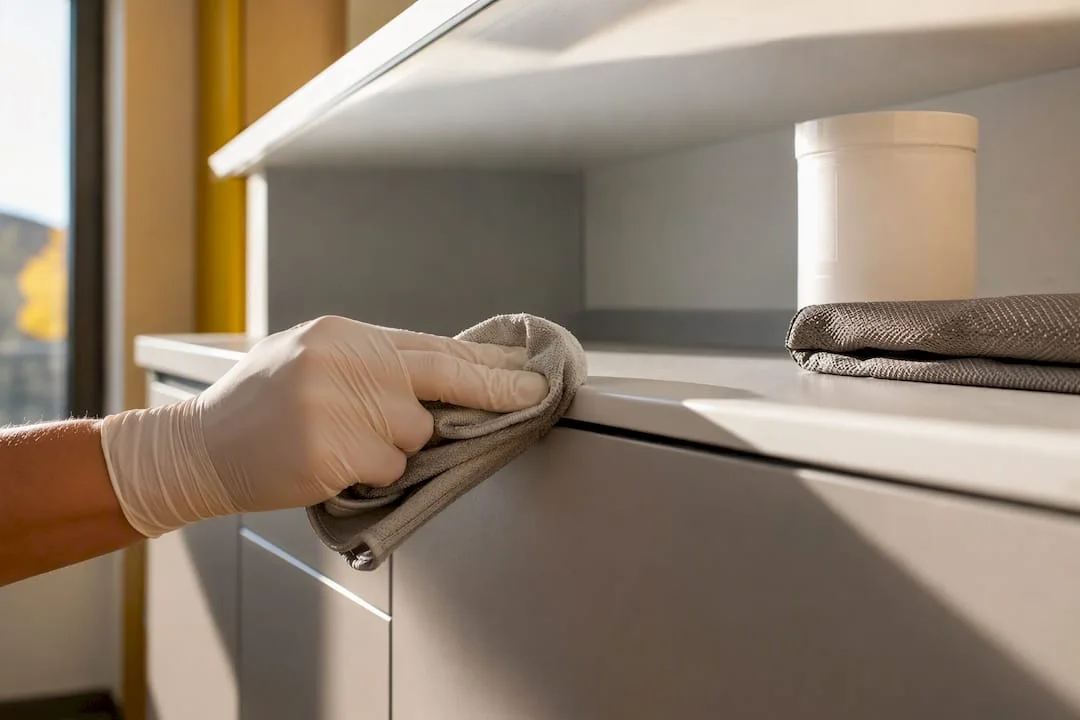
A well-chosen medical furniture is not just judged by how it sits in a photo, but by how simply it can be cleaned and disinfected on a daily basis. Several practical criteria differentiate between a suitable product and one that becomes an operational problem:
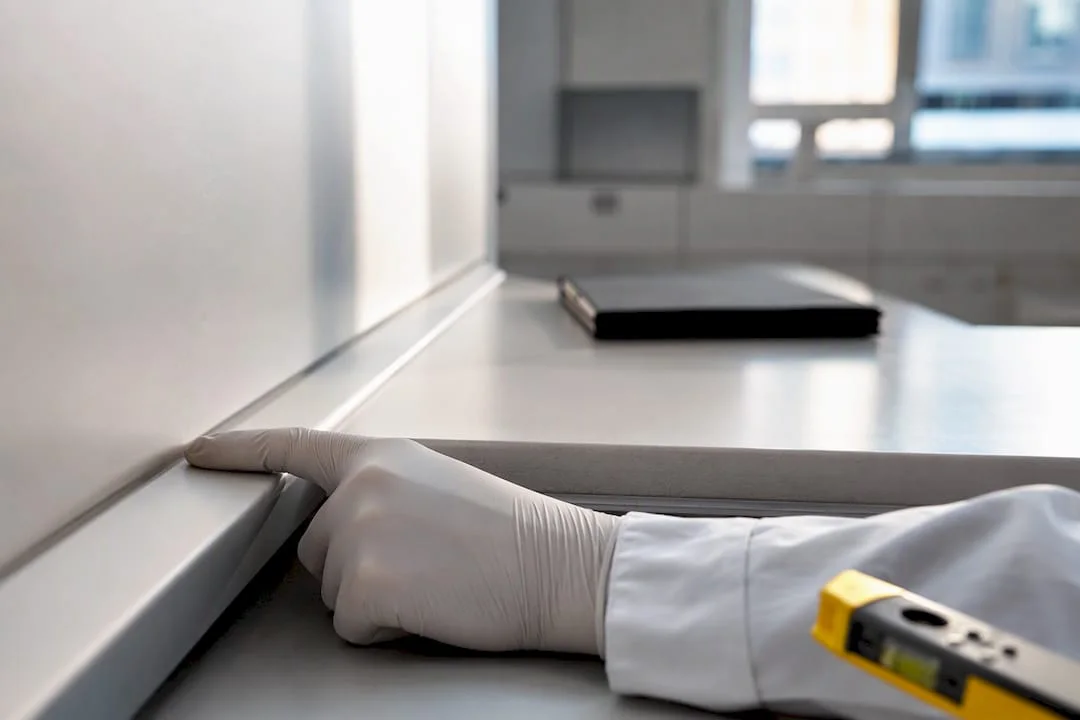
- Continuous surfaces, no exposed joints, reduce areas where dirt or moisture can accumulate.
- Materials resistant to approved biocidal products must be explicitly confirmed by the manufacturer, not assumed from the general type of finish.
- Removable rails, handles and castors facilitates access for complete disinfection, including in less visible areas.
- Cleaning instructions delivered by the manufacturer must indicate exactly which substances and concentrations are compatible with the finish.
These criteria are not only commonsense recommendations, they directly support the obligations imposed by Order no. 1.761/2021, which establishes cleaning, disinfection and sterilization procedures for public and private sanitary units, as detailed in legislative portal. A piece of furniture that does not support the disinfection protocol of the unit becomes practically unusable, no matter how well built.
Internally, these requirements translate into clear policies: a cleaning protocol by type of furniture and a maintenance register that records the frequency and products used. Without these documents, the healthcare unit cannot prove, upon inspection, that the furniture is maintained according to the rules.
Dimensions, minimum amenities and their impact on furniture solutions
The rules for hospitals and practices are not limited to hygiene, but also set out minimum amenities that directly determine what furniture can be chosen for each room. The annexes of Order 914/2006 contain lists of mandatory equipment and endowments for different types of sections, including for emergency situations.
Some concrete examples show how these requirements influence design:
- Location of the washbasin in a consulting room requires a minimum of free space and distance from fixed furniture, which automatically eliminates certain compact configurations.
- Minimum cabinet areas of certain specialties limits the size of storage furniture that can be installed without blocking circulation.
- Minimum emergency amenity requires the presence of specific spaces and furniture, which cannot be omitted from space saving.
The designer and the beneficiary check these requirements as early as the design theme phase, not after the furniture has already been chosen. A clinic that skips this step risks finding, during assembly, that the chosen parts do not match the space approved for sanitary authorization.
Materials, finishes and durability: what samples and data you require
A medical furniture lives under constant pressure: daily disinfectants, heavy weights, frequent handling. The choice of material is not made from the catalogue, but based on testable parameters that the supplier must be able to document.
Ask for facts, not general descriptions:
- Resistance to chemical agents., specifically tested for biocidal substances used in the facility's protocol, not just “common cleaning products”.
- Declared antimicrobial properties, when the manufacturer mentions them, they must be supported by a test report, not just a commercial label.
- Mechanical durability, expressed by the number of usage cycles or wear ratios, especially relevant for moving parts, such as adjustable tables.
Professional advice: Always ask for the complete test report, not just its conclusion: a data sheet stating “disinfectant resistant” without the mentioned test method does not protect you from a compliance check.
The warranty, in the sanitary context, is not limited to manufacturing defects. A well negotiated contract also clarifies what happens if the finish degrades faster than the data sheet indicates, under the disinfection protocol declared by the unit.
Purchase checklist: documents, samples and samples before assembly
Reception of medical furniture should not be the time when you discover gaps in the documentation. A structured procurement process prevents this situation:
- Request from supplier, together with the tender, the EC declaration of conformity or equivalent documentation and the data sheet with explicit references to the applied SR EN/ISO standards.
- Check in Quotation if there are certificates or test reports issued by accredited laboratories, not just commercial quality claims.
- Request physical samples of finishes, especially for surfaces that will frequently come into contact with disinfectants.
- Request cleaning and service instructions before delivery, to integrate them into the unit's internal protocol.
- Prepare an acceptance document confirming the correspondence between the delivered product, the documentation received and the requirements of the design theme.
The product documentation, together with the test reports from accredited laboratories, remains among the most effective samples that you can request before purchase, according to the provisions of Order 1. 761/2021. A detailed guide about design steps for a doctor's office shows how this check integrates into a larger project, starting from establishing functional areasement
Practical integration into the project: coordination of furniture with the theme of medical engineering
The compliance documentation has no isolated value, it must be coordinated with the technical design of the space. The medical engineering theme, a pre-design document, defines the equipment and interface points for each piece of furniture, as required by the rules on the design of ambulatory units, according to the legislative portal.
In practice, this coordination solves problems that otherwise only occur during assembly:
- Position of sockets and technical routes must be confirmed before ordering fixed furniture, not adjusted after delivery.
- Exhaust systems and disinfection spaces often determines the size and position of instrumentation storage cabinets.
- Interfaces between furniture and installations must be explicitly imposed in the design theme, not assumed to be compatible.
Professional advice: Ask for functional tests during assembly, not just a visual check: a tool cabinet that does not exactly match the air exhaust route can generate retrofit costs higher than the price difference between suppliers.
A clearly defined medical engineering theme from the beginning avoids exactly this type of costly changes, as the dedicated guide shows setting up clinics in 2026ement
Author's Perspective: Priorities in Design and Compliance for Healthcare Spaces
If I were to reduce everything to a single priority, I would say: hygiene and functionality always come before aesthetics, not because aesthetics do not matter, but because a medical space that does not support the disinfection protocol technically becomes non-compliant. Durability and visual coherence are built after this first filter, not in parallel with it. I recommend to any decision maker to pass the compliance documentation through the filter of several specialists, medical, technical and design, before signing the order.
Toni
Specialized services for furniture integration according to the norms
Translating the norms into functional furniture solutions, correctly coordinated with the installations, is exactly the area where interior design for medical clinics provided by SelfDezign brings clarity. The technical design and implementation coordination take into account the medical engineering theme from the first concept, not as a further adjustment.
For decision makers who need a punctual assessment, consultancy with written conclusions provides a formal document, useful for internal discussions or for substantiating the purchase decision.
Surse
The quoted normative acts can be found in full on the legislative portal, the text of Regulation (EU) 2017/745 on EUR-Lex, and the SR EN/ISO standards in the ASRO catalogue.