
What is project implementation: complete guide 2026

Project implementation is the process by which the approved plans and the allocated budget are transformed into concrete, measurable and verifiable deliverables. This stage is the backbone of any project approach: without a disciplined execution, the best plan remains only an intention on paper. Whether it's an EU-funded project, a private investment or an infrastructure extension,implementation processfollows the same fundamental principles: contracting, execution, monitoring, reporting and completion. Understanding these stages is not an advantage, but a condition for the real success of the project.
What is project implementation and what it entails in practice
The definition of project implementation covers the entire cycle of transformation of an approved plan into tangible results, respecting the established deadlines, budget and performance indicators. The technical term established in project management is<g id="1">Execution Phase</g>, and in the context of grants, this phase also includes the administrative procedures specific to the relationship with the Managing Authority.
The implementation of a project involves contracting and signing agreements, conducting public or private procurement, actual execution of activities, submitting requests for reimbursement and completion with reporting and audit. Each of these components has its own strict procedural requirements and deadlines. Ignoring any of them can compromise the entire project, not just an isolated stage.

The duration of implementation varies between 1 and 2 years for small projects and can reach 5 to 7 years for large infrastructure projects with EU funding. This variability means that realistic planning of human and financial resources is not optional, but decisive for the viability of the entire endeavor.
What are the main steps in implementing a project?
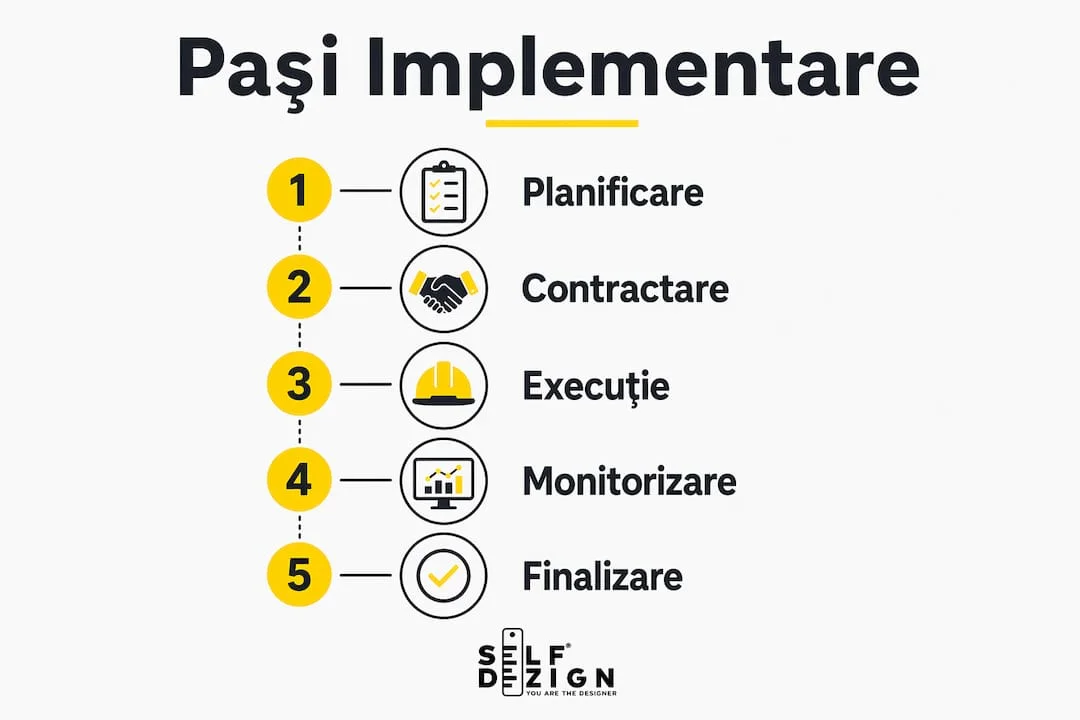
The stages of project implementation follow a sequential logic, but in practice they partially overlap and require simultaneous management. Here is the standard structure, applicable to both grant and private projects:
- Contracting and signing agreements.The project becomes official by signing the financing contract or agreement with the investor. This stage establishes the legal framework, obligations and rights of all parties involved.
- Procurement proceduresThe selection of suppliers, contractors and service providers is made according to the applicable rules, whether it is public procurement legislation (Law 98/2016 in Romania) or internal procedures for private projects. Errors at this stage generate the most frequent bottlenecks and appeals.
- Execution of activities.This is the phase where the project team actually produces the planned results: builds, arranges, delivers services or implements systems.Implementation is the longest stageof the project, where the control of the flow of information and the motivation of the team become critical success factors.
- Refund requests.In projects with EU funds, the reimbursement mechanism involves the initial expenditure of the funds by the beneficiary, followed by the financial request to the Managing Authority, accompanied by supporting documents verified before payment. This means that the beneficiary must have sufficient own resources to pre-finance the activities.
- Completion, reporting and durability period.The project is formally closed through the final implementation report, financial and technical audit, and delivery of deliverables. There follows a durability period, usually 3 to 5 years, during which the beneficiary must maintain the results obtained.
Tip: Prepare the procurement file at least 60 days before the planned deadline. Complaints and clarifications requested by bidders consume time that the project plan rarely foresees.
How is effective implementation ensured?
Efficiency in the execution of a project does not come from the intensity of effort, but from the quality of coordination.Success in implementationdepends on the seamless link between phases and the involvement of a single project manager who follows the project continuously. This is the essence of integrated management: a single thread of responsibility that crosses all stages, from initial technical analysis to final handover.
The responsibilities of a project manager in the implementation phase cover several plans at once:
- Coordination of activitiesaccording to the approved timetable and quick adjustment when deviations occur
- Monitoring of performance indicatorsto detect deviations before they become structural problems
- Relationship with the Managing Authorityor with the Investor, including regular reports and change requests
- Team and Subcontractor Management, with a focus on synchronizing deliveries and preventing bottlenecks
- Continuous updating of the risk registerThe concomitant use of heparin anticoagulation may contribute to bleeding.risk managementdoes not stop after planning, but must be a continuous process throughout the implementation
The Project Manager simultaneously coordinates the activities, monitoring the indicators and the relationship with the authorities, adopting quick measures for adjustments and ensuring quality and compliance with deadlines. This structural multitasking is why projects without a dedicated manager experience significantly higher failure rates.
Tip: Establish a weekly internal reporting rate, even for small projects. A 30-minute meeting with the team, based on a standardized status report, prevents the accumulation of unaddressed issues.
What are the common challenges in project implementation?
Challenges in project implementation are largely predictable. Getting to know them in advance is the first step towards their effective management.
- Blockages in procurement procedures.Incomplete documentation, unclear selection criteria or appeals submitted by bidders may delay execution for months. The impact spreads throughout the project calendar.
- Cash-flow pressure.Cash flow discipline is the key to implementation in grant projects, as reimbursement comes after expenses and requires sufficient own resources. Organizations that underestimate this requirement end up stopping activities for lack of liquidity, not for lack of approved funding.
- Insufficient documentation and audit trail.Without a well-organized system of archiving supporting documents, the risk of rejection of reimbursement requests increases significantly, affecting the financial flow of the entire project.
- Dealing with implementation as execution only. A frequent mistakeis treating the implementation exclusively as execution, without correctly linking the phases, which causes time and cost control problems. Execution without overview produces deliverables that are not articulated coherently.
- Poor coordination between teams.When multiple subcontractors work simultaneously, timing of deliveries becomes a major source of friction. Strict control and stage timing prevent cost increases and delays, allowing for effective coordination of teams and subcontractors.
The most costly problems in implementation do not occur suddenly. They accumulate in silence, in the absence of a monitoring system to detect them in time.
What tools and techniques support rigorous implementation?
Planning and monitoring the implementation of a project benefits from concrete tools, not good intentions.Logical planning and risk analysisare essential to demonstrate the realism of implementation and the team's ability to manage challenges.
|
Instrument |
MAIN USAGE |
Concrete benefit |
|---|---|---|
|
Gantt chart |
Time planning of activities |
View dependencies and critical timelines |
|
Risk Register |
Identification and monitoring of risks |
Early intervention before materialisation |
|
Audit trail |
Archiving of supporting documents |
Compliance with financial verifications |
|
Weekly Status Report |
Monitoring internal progress |
Deviation detection in real time |
|
Responsibility Matrix (RACI) |
Clarifying roles in the team |
Elimination of ambiguities and double responsibilities |
The Gantt chart, used by tools such as Microsoft Project, Asana, or Smartsheet, turns the calendar of tasks from a static document into a decision tool. When an activity slips over time, the diagram immediately shows which other activities are affected and what room for manoeuvre there is.
The risk register is not a document to be checked at the beginning of the project. It is updated every reporting cycle with new identified risks, revised probabilities and verified mitigation measures. This discipline transforms risk management from a formality into a real competitive advantage.
Tip: Organize project documents into a folder structure that mirrors the exact structure of reimbursement requests. When it's time to deposit, you won't waste time searching for documents - you'll find them exactly where you expect them to be.
Structured communication with all parties involved, includingconstruction project management, involves clear periodic reports, minutes of meeting and a unique channel of official communication with the funding authority. This discipline reduces the risk of divergent interpretations and decisions made based on incomplete information.
What I learned from years of coordinating complex projects
If I were to summarize what separates projects that succeed from those that get stuck, the answer is not the budget or the team. It is the continuity of vision throughout the implementation.
We have seen well-funded projects fail in the execution phase because no one has followed the coherence between what was planned and what was actually being built. And I saw projects with limited resources completed exemplary, because the project manager treated each stage as a part of a whole, not as a separate task to check.
The most underestimated aspect of implementation is documentation. Not because it is interesting in itself, but because the lack of it costs real: rejected reimbursement claims, unfavorable audits, disputes with contractors. We've worked with teams who've spent months redoing folders that they should have built right from the start. Documentary discipline is not bureaucracy. It is protection.
Another thing I have constantly noticed: proactive communication with the funding authority or the investor makes the difference between a project that receives support in difficult times and one that receives sanctions. No one expects a complex project to be perfect. Everyone expects to be informed in time.
If you are at the beginning of a project or in the middle of a difficult one, my recommendation is simple: invest inintegrated project managementbefore investing in execution. Structure saves more time and money than any other decision you can make.
How can a well-designed space support the implementation of a project?
The implementation of a project is ultimately carried out in a physical space. The project team office, the coordination room, the space where decisions are made and documents are archived are not secondary details. They directly influence the quality of work, internal communication and daily efficiency of the team.
At SelfDesign, we designteam workspaceswho understand that a well-thought-out office reduces operational friction and supports focus in critical phases of a project. We do not apply standard formulas. We analyze the real context of the organization, the objectives of the project and how the team actually works, before proposing any solution. If you want to understand what acoordination workflowapplied to an interior design project, you can find concrete details on the SelfDezign blog.