
What Client Needs Analysis Means: 2026 Guide

Client needs analysis is the process by which a business identifies the real requirements of its clients, beyond assumptions and intuitions. The established term in specialized literature is 'customer needs analysis' or, in Lean Startup methodologies, 'customer discovery'. The process combines qualitative interviews, behavioral data from CRM systems, and satisfaction indicators to build an accurate picture of what clients truly need, not just what they say they want. For business owners and managers, understanding this process makes the difference between an offer that sells and one that stays on the shelf.
What Does Client Needs Analysis Mean and How Does It Work?
Client needs analysis is a structured process of collecting and interpreting information about clients' real problems, expectations, and behaviors. It is not an opinion survey and not an internal brainstorming session. It is a method of validating market reality through direct contact with the people who buy or could buy your product or service.
The process starts with a simple question: what problem are we really solving? The answer does not come from the boardroom, but from conversations with clients, analysis of usage data, and observation of real behavior.Needs Analysis Before Designis, in any field, the foundation on which correct decisions are built.

The Lean Startup methodology popularized the concept of 'customer discovery' precisely because teams tend to build products based on unvalidated assumptions. Needs analysis breaks this pattern. It turns assumptions into data and data into decisions.
What Are the Main Methods of Client Needs Analysis?
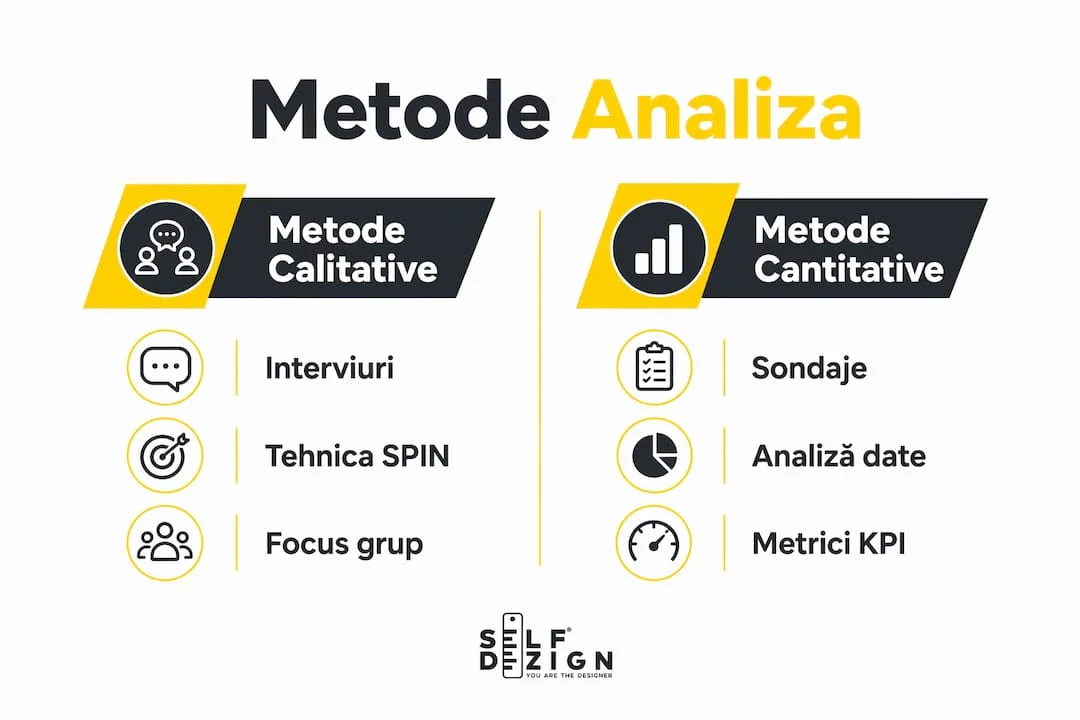
Needs analysis methods fall into two main categories: qualitative and quantitative. Each offers a different type of understanding, and combining them yields the clearest results.
Qualitative Methods
Individual interviews are the most effective tool for discovering real needs.8–10 qualitative interviewsper client segment are sufficient to identify recurring patterns in user behavior. This number may seem small, but patterns emerge quickly when questions are formulated correctly.
The SPIN (Situation, Problem, Implication, Need-payoff) technique structures the conversation so that the client articulates the consequences of their problem themselves. The 5W (Who, What, When, Where, Why) technique completes the picture with context and motivation. Both are effective tools in highlighting the client's perceived needs and benefits in structured conversations.
Open-ended questions are the backbone of any quality interview. 'How do you solve this problem now?' says more than ten closed-ended questions combined.
Quantitative Methods
- CRM data analysis: purchase history, frequency of contact with customer service, and retention rate provide clear signals about satisfaction and frustrations.
- Structured surveys: useful for validating patterns discovered in interviews, not for discovering them.
- Online behavior analysis: pages visited, time spent, drop-off points. Modern companies use CRM and behavior monitoring to personalize offers and increase campaign relevance.
- Direct feedback: reviews, support emails, social media comments. All these are raw data waiting to be interpreted.
Our advice: Always separate formative questions from sales questions. Formative questions explore current behavior and problems. Sales questions test interest in your solution. Mixing them in the same interview compromises data quality.
Why Is Detailed Analysis of the Client's Real Needs Important?
The difference between a business that grows and one that stagnates is often simple: one knows what its clients want, the other assumes. Assumptions cost. They lead to products launched too early, campaigns that don't resonate, and budgets spent on features no one uses.
Needs analysis eliminates this waste. It replaces opinion with data and intuition with validated patterns.The process continues after product launch to maintain competitiveness and market adaptability. This is a critical distinction: needs analysis is not a pre-launch stage, but an ongoing process.
An often overlooked aspect is the emotional component. Clients don't just buy functionality. They buy safety, prestige, trust, comfort. Emotional components are as important as technical functionalities in the perception of needs. An office space, for example, must not only be functional. It must convey professionalism and support organizational culture.
“Raw data without context is useless. Strategic interpretation of data is the key to effective decisions. A client who complains about slow delivery may actually be signaling a communication problem, not a logistics one.”
Performance indicators confirm the value of the analysis. Constant monitoring of client satisfaction and retention rate is essential in adjusting the offer. Businesses that ignore these indicators only discover problems when clients have already left.
How to Integrate Needs Analysis into Your Business Strategy?
Needs analysis does not work as an isolated project. It works as a cycle. You collect data, interpret it, adjust the offer, measure results, and repeat the process. This iterative approach is the only one that keeps pace with market changes.
Steps of a Complete Analysis Cycle
- Clearly segment clients. Not all clients have the same needs. A procurement manager in a corporation has different priorities than an entrepreneur who has opened their first office. Segmentation allows prioritizing needs and allocating resources correctly.
- Collect data from multiple sources. Interviews, CRM, direct feedback, online behavior. Data analysis includes direct feedback, social media, purchase history, and customer service interactions. No single source provides the complete picture.
- Identify patterns, not exceptions. One dissatisfied client is an exception. Ten clients with the same frustration are a pattern that requires action.
- Prioritize needs by impact. Not all identified needs deserve equal resources. Prioritize based on frequency, intensity, and impact on the purchase decision.
- Integrate insights into the offer. Adjust the product, service, communication, or delivery process based on collected data.
- Measure and repeat. Retention rate, NPS (Net Promoter Score), and number of referrals are indicators that confirm whether adjustments have worked.
How Integration Looks in Practice
Data SourceWhat It RevealsWhere It AppliesQualitative interviewsFrustrations, motivations, contextProduct development, sales messageCRM dataPurchase behavior, frequencySegmentation, personalized campaignsPost-sale feedbackSatisfaction, recurring issuesService improvement, retentionOnline behavior analysisDrop-off points, real interestUX, content, offerModern behavioral analysis technologies, including AI-based tools, allow anticipating preferences and quickly adapting marketing strategy. This does not replace direct contact with the client, but complements it with data at scale.
Our advice: Market validation through interviews, surveys, and prototyping reduces the risk of failed launches. Validation methods are the cheapest form of insurance for any business.
What Are the Most Common Mistakes in Client Needs Analysis?
Mistakes in needs analysis are costly precisely because they seem harmless at the time they occur. Here are the most common pitfalls and how to avoid them.
- Confusing the interview with selling. The question 'Would you buy this product?' yields inconclusive answers because people tend to be polite. Behavioral questions like 'How do you solve the problem now?' are much more valuable. The objective of the interview is to understand the problem, not to sell the solution.
- Decisions based on individual opinions. A single convincing interview does not validate a direction. Needs analysis is a cyclical process precisely to avoid conclusions based on isolated opinions. Patterns emerge from volume, not exceptions.
- Ignoring the emotional component. Managers focused on technical specifications often miss the real reasons for the purchase decision. A client who chooses a more expensive supplier often does so because they feel safer, not because the product is objectively superior.
- Abandoning analysis after launch. The market changes. Client needs evolve. A one-time analysis quickly becomes irrelevant. Continuous analysis is the only way to stay relevant.
- Questions that induce favorable answers. 'How useful do you find feature X?' assumes the feature is useful. Neutral questions produce more honest data.
Our advice: Record the interviews (with the participant's consent) and reread the transcripts after a few days. The temporal distance helps identify patterns you missed during the conversation.
Active Listening Is the Competitive Advantage You Underestimate
I have worked with enough management teams to observe a recurring pattern: everyone knows they must listen to clients, but few do it systematically. Needs analysis is treated as a checkbox, not as a decision-making tool.
What surprised me most in projects where analysis was done correctly is that the obvious solutions before interviews often turned out to be wrong. Clients cannot always articulate the ideal solution, but they can accurately describe the context of their problem. Observing this context, not just listening to statements, is where real differentiators are born.
The emotional component is systematically underestimated. A workspace is not just a collection of desks and lights. It is the environment where people make decisions, collaborate, and represent the company in front of clients. When personalized interior design starts from the real needs of the team and the brand, the result is visible in productivity and in the perception of clients who enter that space.
My practical recommendation: treat needs analysis as a living process, not as a document to archive. Revisit it quarterly. Compare what you learned with what has changed in your clients' behavior. The difference between what you thought you knew and what you discover each time is exactly the space where competition can overtake you.
— Toni
How SelfDezign Supports Needs Analysis in Interior Design Projects
At SelfDezign, every project begins with a stage of understanding the context, not with visual proposals. Before any sketch, the team identifies the real objectives of the space: how people work, how they receive clients, what the brand conveys, and what does not work in the current configuration. This approach is applied both in high-performance workspaces for companies and in commercial, medical, or residential projects. The result is not a generically beautiful space, but a space that supports the activity and identity of each client. If you want to understand what this process looks like in detail, needs analysis before design is the first step we take together.