
Why a needs analysis comes before design

Have you ever reached the end of a project and felt that the space looks good but does not work the way it should? Or had a client ask for major changes during construction, when the cost of corrections exceeded any planned budget? These situations are not accidents. They are the direct result of skipping the needs analysis before design, a common mistake in interior design and architecture practice. Why a needs analysis before design is not optional, but the foundation successful projects are built on, is exactly what this article is about.
What a needs analysis is and its role in design
A needs analysis is not a questionnaire with a few questions sent by email. It is an iterative process through which the client's subjective wishes are translated into objective technical requirements that can solve the space's real problems. A client who says "I want a big sofa" is actually expressing a functional need: "I need to host 6 people without blocking circulation." The designer's role is to uncover that real need, not to carry out the literal wish.
Without this stage, the project starts on an unstable foundation. Design decisions are made on assumptions, not on a real understanding of the context. The result is spaces that look impressive in renders but that skip the discovery phase and become inefficient in daily use, generating unforeseen extra costs.
The importance of a needs analysis shows clearly in three critical areas:
- Aligning the vision: The client and the designer start with the same understanding of the project's goals, not with parallel interpretations.
- Clarifying constraints: The real budget, deadlines, technical restrictions and applicable regulations are identified from the very start.
- Preventing costly changes: Changes requested later, during construction, are exponentially more expensive than those identified at the brief stage.
Skipping this stage does not save time. On the contrary, it turns the project into a series of reactive corrections instead of a coherent, predictable process.
The stages of a needs analysis: from conversation to brief
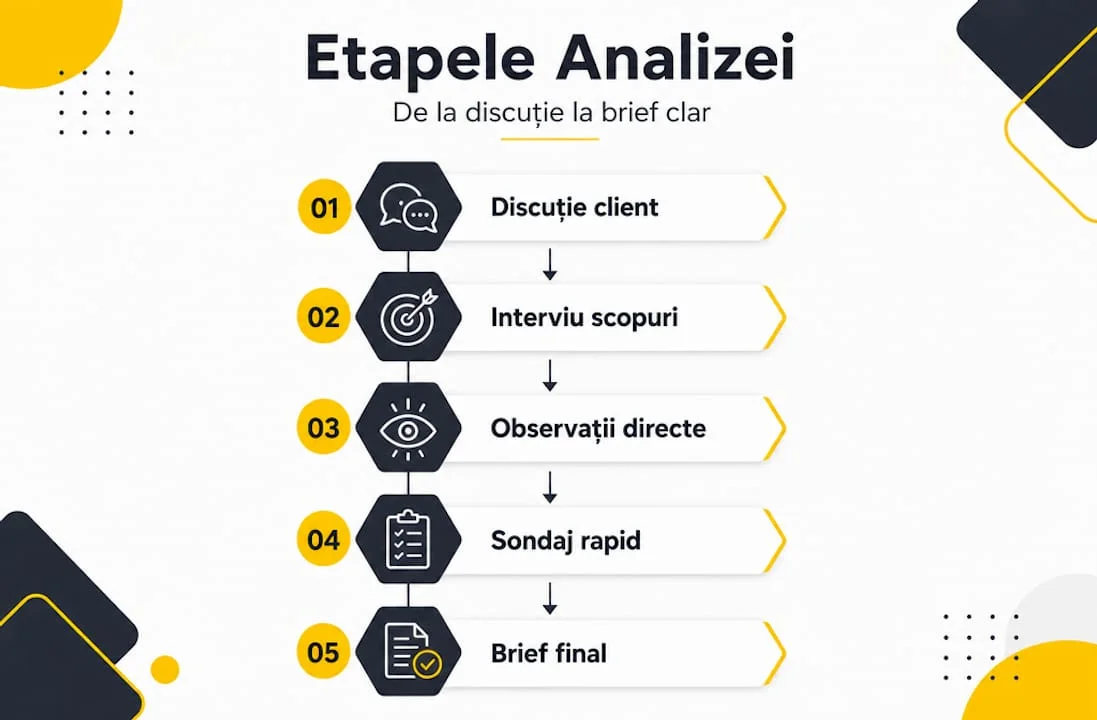
A rigorous needs analysis follows a clear structure. The standard process includes five essential stages, each with its own role in building a solid project.
- The discovery meeting. The first conversation is not about styles or materials. It is about context: who uses the space, how, at what times and with what goals. Good questions at this stage are not "what colors do you like?" but "how should someone feel when they walk into this space?" or "what is not working now and is affecting your business?"
- The detailed questionnaire. A structured record of the answers gathered verbally. A good questionnaire covers user profiles, activity flows, functional priorities, visual references and budget constraints. It is not a standard form, but a tool adapted to the type of project.
- The site visit. No analysis is complete without directly observing the physical space. Natural light, real proportions, structural problems and the relationship between areas cannot be understood from a CAD plan. This visit can disprove assumptions and reveal opportunities the client did not mention.
- The alignment workshop. For complex projects (offices, commercial spaces, clinics), a workshop with all the decision-makers involved is useful. Priority conflicts between departments or partners are better resolved before design than in the middle of construction.
- Signing the brief. The final document is not a formality. It is the contractual basis of the shared understanding. Updating and signing the brief at each major stage prevents later drift and keeps everyone aligned throughout the project.
Pro tip: Treat the brief as a living document, not as a form signed once and filed away. Review it with the client at every major decision and record the changes in writing. This simple practice eliminates most "that is not what I asked for" situations.
Needs analysis methods are not limited to qualitative ones. Combining interviews with surveys and direct observation gives a complete perspective, reducing speculation and grounding design decisions in real data.
The concrete benefits of a needs analysis
We often talk about needs analysis as a best practice. But the numbers tell a clearer story. Fixing a problem in the design phase costs 10 times less than during construction and 100 times less than corrections after completion. In other words, every hour invested in a needs analysis can prevent dozens of hours of later corrections.
"A professional brief is not a bureaucratic document. It is the cornerstone of all future design decisions, and it strengthens the client's trust in the designer they work with."
The benefits of analysis before design translate directly into the quality of the client relationship and the profitability of the project. Here is a summary of the most important ones:
|
Area of impact |
Details |
|---|---|
|
Lower costs |
Changes identified before design cost 10 times less than during construction |
|
Meeting deadlines |
Clear goals reduce iterations and allow realistic scheduling |
|
Preventing scope creep |
A signed brief limits unexpected new requests that destabilize the project |
|
A relationship of trust |
The client feels heard and that the designer truly understands their context |
|
Predictable results |
Clear alignment reduces unpleasant surprises at completion |

Preventing scope creep deserves special attention. New requests that come up during construction are not always made in bad faith by the client. They are often the result of an incomplete brief that did not explore the real needs well enough from the start. A rigorous needs analysis process dramatically narrows this window of uncertainty.
How to put a needs analysis into practice
You already know a needs analysis is necessary. The practical question is how to build it into your professional process without turning every project into an academic documentation exercise.
A few principles that work in practice:
- Prepare the client for the conversation. Before the meeting, send a short set of reflection questions, not a formal questionnaire. The goal is for them to come ready to talk about goals and context, not favorite colors.
- Listen to what is not said. Clients often describe symptoms, not the real problems. A client asking for "more storage space" may actually be expressing a need for visual order or a clearer flow. Ask "why" at least twice.
- Document right after the meeting. Do not let your notes go cold. Write a summary of the discussion within 24 hours and send it to the client for confirmation. This practice catches misalignments early.
- Use a mix of tools. For complex projects, combine face-to-face interviews with structured questionnaires and on-site observation for a complete picture of the needs.
- Clearly define what is not part of the project. A good brief includes both what will be done and what will not. Clear boundaries protect both the client and the design team.
Pro tip: The most common mistake is not the lack of a questionnaire, but the lack of a conversation about goals before talking about solutions. Reserve the first 20 minutes of any meeting exclusively for "why" and "for whom," before opening any plan or visual reference.
The client's business clarity is the raw material of a good brief. The designer's responsibility is to translate it into technical requirements, not to generate it themselves. This distinction completely changes the dynamic of the professional relationship.
My perspective after years of projects
I have seen projects that started with enthusiasm and ended with blame. And almost every time, when I analyzed what went wrong, the answer was the same: the needs analysis was superficial or completely missing.
The hardest part is not doing the needs analysis. It is resisting the temptation to jump straight to solutions. Clients often come with visual references, Pinterest images and ideas about materials. And you, as a professional, feel the natural urge to respond with proposals. But that moment of quick response is exactly the trap that costs you later.
What I have learned over time is that the best projects did not start with the most spectacular initial renders. They started with the clearest briefs. Spaces that work, that support the users' real activity and that stand the test of time always start from a deep understanding of the context.
I have worked on office projects where the first concept was completely revised after we spent a day observing how the client's team actually works, not how the manager believed the team works. That day changed everything. It changed the flows, the furniture types, the zoning and even the budget allocated by category.
A brief treated as a living document is not bureaucracy. It is the project's shared memory. Without it, every stage means renegotiating reality. With it, the project moves forward coherently, even when inevitable changes come up along the way.
My recommendation for any professional: allocate at least 15% of a project's total time to the analysis phase. Not as a formal obligation, but as a conscious investment in the quality of everything that follows
How SelfDezign works with needs analysis
At SelfDezign, a needs analysis is not a box to tick before opening the design software. It is the first and most important layer of any project, whether we are talking about a high-performing office space, a medical clinic or a restaurant. Our process starts with understanding the client's real context: who uses the space, how, with what goals and under what constraints.
Before any visual proposal, the SelfDezign team builds a detailed brief, validated together with the client, which becomes the foundation for all later decisions. If you want to see what the stages of a custom interior design project look like, from analysis to implementation coordination, you will find detailed resources on our website. Or you can start directly with a preliminary, no-commitment conversation, in which we clarify together the goals and priorities of your project.