
Stages of Custom Interior Design: Complete Guide

Many spaces seem personalized at first glance, but in reality they tick momentary trends or copy formulas seen on social networks. The result? An interior that doesn't really reflect the brand, support the actual flow of users, or create the experience the owner imagined. The difference between a truly customized space and one that only looks good in pictures lies in the observance of clear, integrated stages, strategically designed from objectives to finishes. This guide presents each step in detail, with concrete examples and practical recommendations.
The main findings
|
Punct |
Detalii |
|---|---|
|
STRATEGIC PLANNING |
The essence of a successful design lies in thorough preparation, evaluation of the brand and space users. |
|
Functional zoning |
Clear separation of spaces maximizes the comfort and efficiency of each type of user. |
|
Consistent materials and branding |
Careful choice of materials and visual coherence in all areas convey professionalism and identity. |
|
Feedback and adaptation |
Constantly checking and adapting the design keeps the space functional and up-to-date. |
How to prepare for your custom interior design
Starting from the importance of the strategy, I will detail the actual stages for the implementation of the customized interior design. Before any sketch or mood board, you need to answer some essential questions. Without clear answers to them, any subsequent decision risks being improvised.
Definition of Objectivesis the first real step. It's not enough to say “I want something modern and stylish. “ You have to determine what functions the space performs, who uses it, how much time users spend in it, and what emotion or perception you want to induce. A creative team office has completely different needs than a waiting room in a dermatology clinic or a fine dining restaurant.
Brand Identity Assessmentcomes right after. The colors, fonts, materials and communication tone of your brand must also be found in the space. If the brand conveys professionalism and discretion, but the reception is decorated with noisy elements and saturated colors, there is a contradiction that customers feel, even if they do not verbally formulate it.
Identification of user flowsis perhaps the most underestimated element in smaller projects. Who enters, where they travel, where they stop, where they need privacy? Compliantpatient experience strategy, medical spaces and med-spa treat interior design as a flow strategy, with a focus on reception, waiting areas, consultation, treatment and recovery, with the explicit reduction of “stress points.“ The same principle applies, adapted, in any commercial or office space.
|
Preparation element |
Key question: |
PRACTICAL EXAMPLE |
|---|---|---|
|
Functional targets |
What activities are carried out on a daily basis? |
Consultations, sales, coworking |
|
Brand Identity |
What emotion does your brand convey? |
Calm, innovation, elegance |
|
User flows |
Where do people travel naturally? |
Entrance, reception, private areas |
|
Priority areas |
What area makes the first impression? |
Reception, entrance hall |
You can go throughpractical steps for businessto structure this stage before the first discussion with the designer.
The most important areas to prioritize in the preparation phase are:
- Reception or entrance area, because it forms the first impression
- Main circulations, because they are used by all users
- Work or consultation areas, because they influence the performance
- Spaces for relaxation or waiting, because it manages stress and time perception
Professional advice:Take photos of the space at different times of the day and see where people naturally stop, where blockages occur, and what areas are avoided. This informal analysis gives you real data before you spend on the consultant.
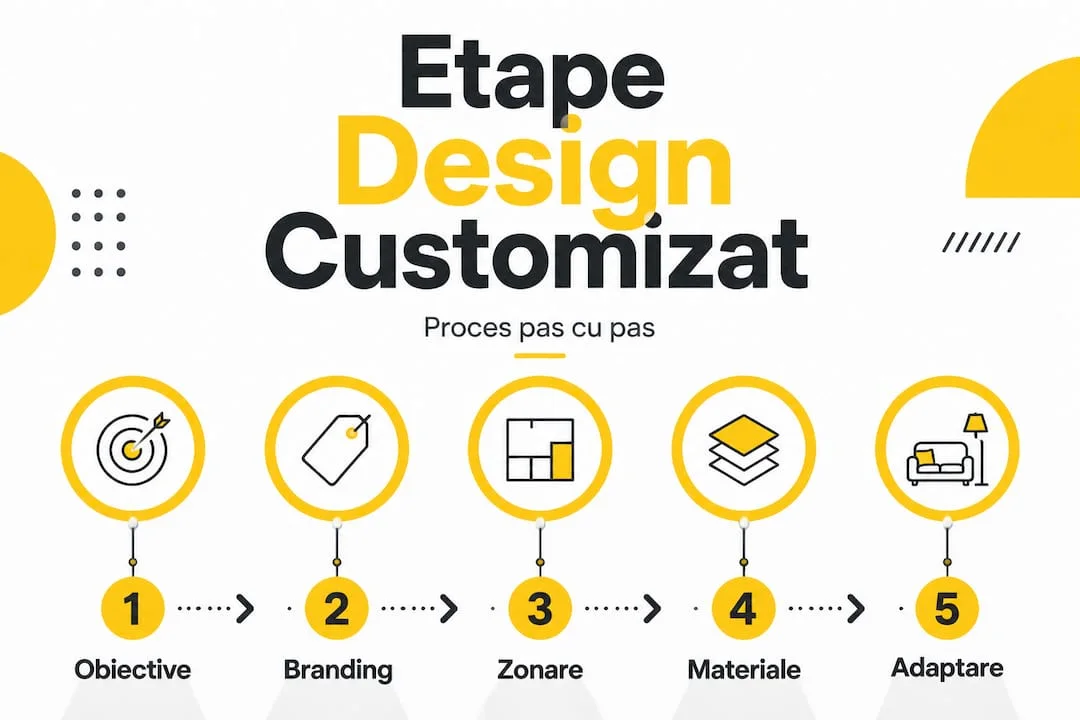
The concrete stages of customized interior design
After preparing and structuring the objectives, here is how the implementation of the actual stages goes. A custom interior design project is not a purchase list. It's a logical process, with each stage building on the previous one.
- Initial analysis of space and contextinvolves measurements, daylight analysis, identification of structural constraints and understanding of the local context (neighborhood, type of customers, competition).
- Development of conceptis the stage where the visual and functional direction of the space is established. The concept is not a decorative style, but the internal logic of all subsequent decisions.
- Drafts and zoning planstranslating the concept into space. Flows, functional distances and relations between areas are established here.
- Selection of materials and finishescomes after the zoning is validated, not before. Materials should serve the functions of the zones, not vice versa.
- Progressive implementationinvolves coordinating execution in logical steps to avoid costly reversals and site bottlenecks.
- Final check and adjustmentis the stage where the space is evaluated under real conditions of use, with real users.
The major difference between a standard and a custom approach appears most clearly in zoning and routes. According to spatial planning for clinics, functional customization means that zoning and routes, including route separation for privacy, shape the user experience, not just aesthetic decisions.
|
Criteriu |
Standard approach |
Customized approach |
|---|---|---|
|
Zonare |
Generic, by standard models |
Adapted to actual user flows |
|
Trasee |
Improvised or copied |
Designed for privacy and efficiency |
|
Materiale |
Trend Chosen |
Related to wear and brand |
|
Visual Identity |
Applied at reception |
Integrated throughout the space |
|
Feedback |
Absent or informal |
Structured and integrated in adjustments |
You can see how this process applied to medical facilities works in detail byclinical design consultancy, where each stage is adapted to the specific requirements of medicine.
Professional advice:Do not skip the concept stage to get to the finishes faster. The concept is the backbone of the project. Without it, every subsequent decision becomes an improvisation, and the end result will look just like this.
Understandingbenefits of custom interior designcompared to generic solutions, you will be able to argue internally the budget necessary for a correct approach.
Selection of materials and finishes: criteria and practical examples
Once the zones and flow are established, the choice of materials and finishes that support both the image and functionality of the space follows. This stage is more complex than it seems, because it involves decisions that will affect the space over the term of 7 to 15 years.

Correlation of materials with the brand and actual wearis the main criterion. A law office can use solid wood and natural stone, materials that convey stability and seriousness, but a pediatric clinic needs washable surfaces, rounded corners and colors that reduce anxiety. There are no good or bad universal materials, there are good or bad choices in the context.
Conform branding principles for clinics, patients are looking forsafety and professionalismfrom the first minutes, which means that the materials, colors and finishes of the reception and hallways transmit messages before any employee speaks.
The essential criteria for the selection of materials are:
- Sustainability in relation to daily trafficof the space, including resistance to chemical cleaning in clinics
- Color matching with brand palette, not just general aesthetics
- Realistic maintenance, i.e. how easy it is to maintain surfaces under real conditions of use
- Acoustic impact, often ignored because hard materials amplify noise and increase stress
- Physical safety, especially in clinics or spaces frequented by the elderly
Common mistakes in material selection occur when treating commercial space as residential. Laminate flooring looks good at home, but in a doctor's office or high-traffic reception it will deteriorate in two years. Similarly, textile upholstery in waiting areas in clinics creates real hygiene problems, even if aesthetically attractive.
For offices,furniture materialsplays an important role in the balance between aesthetics and resistance to intensive daily use.
Periodic refreshing of the space, every 3 to 5 years, is a smart practice. It does not necessarily involve a complete renovation, but updating the visible elements: textures, accessories, graphics and lighting. This maintains the perception of professionalism without major costs.
Professional advice:Always test material samples in the real light of the space, not in the showroom. Colors and textures behave differently in natural versus artificial light, and a wrong choice based on a sample seen in ideal conditions can be costly.
You can find more details about choosing specific materials forinterior design for medical clinics, where functionality and aesthetics must coexist without compromise.
Applying brand identity throughout the interior
The selection of suitable materials paves the way for the consistent implementation of the brand identity throughout the space. And here comes one of the most common mistakes: branding applied only at the front desk or at the main window.
Brand identity is not an entryway decoration. It is a visual and sensory system that must work along the entire path of the client or patient, from the entrance to the payment area or exit. Colors, fonts applied to signage, tone of materials, and even lighting all contribute to a consistent experience.
"Consistency of branding throughout the entire interior path, from reception to cabinets, hallways and printed materials, is the main determinant of trust. Brand identity cannot be limited to reception." (How to set up a clinic: branding details that will make a difference)
The constant visual elements to be applied coherently throughout the space include:
- Colour paletteapplied to walls, furniture, accessories and graphics
- Fonts & Typographyused on signage, signs and information materials
- Distinctive graphicsof the brand, adapted to the scale of the space
- Texture and finisheschosen to reflect brand values (modern, natural, classic, technical)
- Iluminatul, which can reinforce or destroy any visual branding effort
A concrete example: an aesthetic medicine clinic with a brand oriented towards discretion and luxury can use neutral tones, indirect lighting, signage with subtle metallic letters and furniture with clean lines. If the secondary hallway or toilet area is visually neglected, the entire branding effort is undermined in the eyes of customers.
You can deepen the strategy of applying visual identity in spaces through ainterior branding guidewhich explains step by step the logic of visual coherence.
Verification of results and continuous adaptation
After implementing the key steps, it is essential to constantly check their effectiveness for long-term results. A space is not a finished product. It is a living system that evolves with the business and its users.
Methods for verifying the effectiveness of a custom interior design include:
- Short questionnaires for real users, with questions about comfort, easy orientation and perception of space
- Post-implementation flow analysis, observing whether projected routes are used naturally or bypassed
- Informal interviews with internal team, which observes daily the behavior of customers or patients
- Comparison of waiting times or satisfaction levelcompared to the period before the renovation
- Comparative photosperformed 6 months and one year after implementation, to observe wear and potential problems
According to the medical experience strategy, reducing "stress points" is a measurable goal, not just an aesthetic intention. If patients get lost, if waiting areas seem crowded, or if staff have difficulty organizing their workflow, there are clear signs that the design needs to be adjusted.
Periodic adjustments do not mean failure. It means you treat the space as an active business tool. You can learn more about this adaptive approach throughholistic cabinet design, a concept that integrates functionality with long-term user experience.
What no one tells you about custom interior design
After going through all the steps, it's important to understand what really makes the difference in custom interior design. And the truth is a little uncomfortable.
Many projects tick off all the steps described above and still don't feel truly personalized. The why? Because real personalization doesn't mean choosing your favorite items from the catalog. It means adapting the space to the micro-habits, cultural subtleties, and real behaviors of your specific users, not a generic user.
A designer can deliver an impeccable technical project with all the milestones followed, but if he hasn't spent time observing how the team works or how the real customers of the space behave, the result will be correct but cool. Sterile. No authentic identity.
Mistakes often arise from rigidity. A design too perfect, too controlled, leaves no space for real life. Users also feel it intuitively. Truly memorable solutions come from a real collaboration between the designer, the beneficiary and the users, not from a one-way process from the office to the site.
We, at SelfDezign, noticed in our portfolio that the most successful projects, in Bucharest or other European cities, had one thing in common: the client was actively involved at each stage of decision, not just at the final validation. Thisinsight into interior brandingradically changes the quality of the final results.
Real customization means the courage not to copy what works elsewhere and the discipline to understand what works exactly for you.
Transform your space with experts in custom interior design
If you've gone through this guide and recognize the challenges you face in it, you already have an important advantage: you know where most of them go wrong. SelfDezign offers space diagnostics, customized concept and full implementation coordination for commercial, residential and medical spaces, both in Romania and in Europe. Whether you're managing aoffice interior designor looking for solutions for a projectresidential interior design, our team always starts from your real goals, not trends. Contact us for a preliminary discussion or explore the portfolio and free resources available on the site.