

Custom Interior Design: Practical Steps for Business

Business spaces that look like any other send a clear message to customers and employees: no one has really thought of them. A generic office, a clinic without personality or a commercial space without visual identity not only does not impress, but can directly affect brand perception and purchasing decision. The process ofcustom interior designchange this equation, turning a neutral space into an active tool for communicating your company's values. In this article you will discover every stage of this process, from the initial analysis to handing over the keys, with all the decisions and details that make the difference.
Story Highlights
|
Punct |
Detalii |
|---|---|
|
Correct brief |
A detailed brief ensures complete alignment between your vision and the space obtained. |
|
Visual planning |
Moodboards and 3D renderings help you visualize the result before the actual investment. |
|
Efficient budgeting |
Early decisions and professional selection of materials avoid wasting money and time. |
|
Implementation without surprises |
Careful site management and final adjustments guarantee a perfectly functional space. |
Initial analysis: brief, business needs and brand definition
Any successful project starts with a simple but essential question: what does this space need to do for you and the people who use it? The answer doesn't come from a five-minute conversation. It comes from a structured process of gathering information, which we callbriefingAi/J(11,11R.

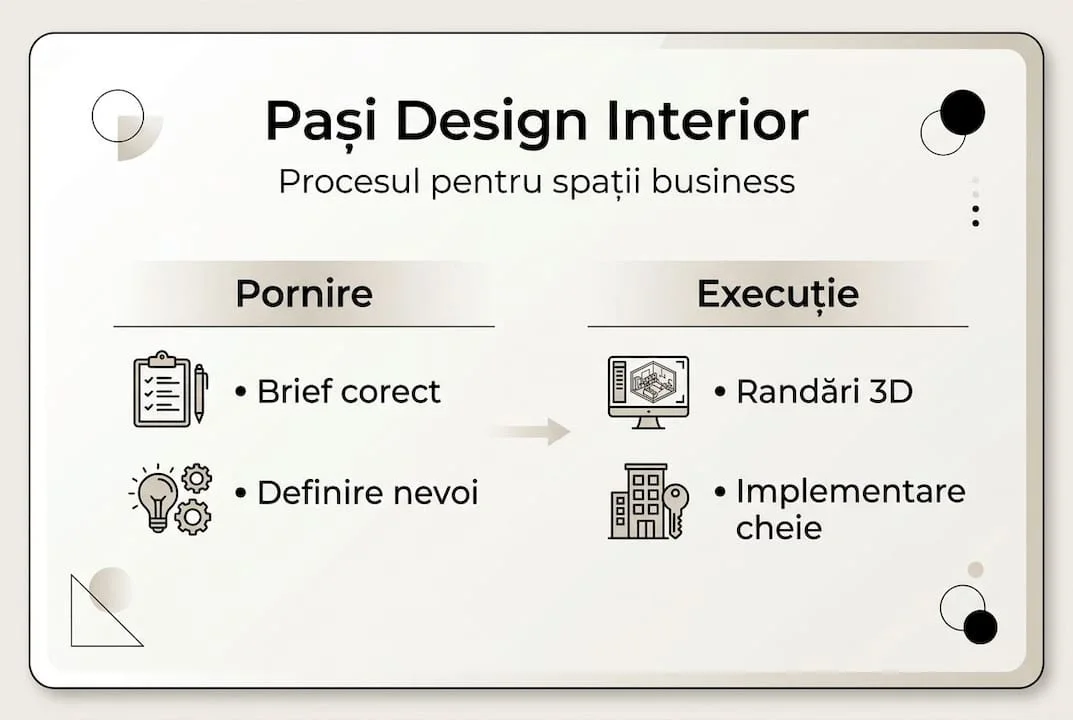
Standard Interior Design Processinvolves 6 main stages, and the initial analysis is the foundation on which all the others are built. Without it, any design decision risks being made in vain.
What a complete brief should contain for a business or medical space:
- Functions of the space: how many areas are needed, how people move through them, what activities are carried out simultaneously
- Target audience: who enters the space, what expectations they have, what emotions do you want to convey to them
- Brand identity: company values, existing color palette, visual communication tone
- AVAILABLE BUDGET: not as rigid limit but as solution calibration parameter
- Technical constraints: building structure, existing facilities, specific rules (especially for clinics)
- Time horizon: when the space should be ready and what are the highest priority stages
One aspect that many business owners underestimate is the involvement of the team in this phase. Managers, doctors or employees who will work in the space daily have valuable insights that a designer cannot guess. A dentist knows exactly what the flow between the waiting room and the treatment room should be like. An office manager knows where team communication bottlenecks occur. This information is not details, it is the invisible architecture of space.
Another common mistake is separating brand identity from design decisions. Physical space is, in fact, the most concrete point of contact of the brand with the customer.Commercial interior design consultancyit starts from precisely this correlation: what your space is transmitting now and what it should be transmitting.
Professional advice:Prepare a list of at least three spaces you admire and three that you consider inappropriate for your brand before your first meeting with the designer. This visual reference saves hours of discussion and quickly aligns expectations.
Concept development: moodboards, 3D renderings and planning
Once the strategic directions are clarified, the next step is when ideas become visible and concrete. This is, for many business owners, the moment when the project gets real life.
Concept and moodboards are the second essential stage of the interior design process, and their role is to translate brand values into a coherent visual language. A moodboard is not a collection of beautiful images. It is a visual argument that justifies every choice of color, texture, shape, and light.
For business premises,creating moodboardsinvolves a rigorous selection of references that simultaneously reflect the desired aesthetics and required functionality. A law office communicates differently than a creative studio, even though both can use the same neutral palette.
3D renderings bring a concrete advantage at this stage: they eliminate ambiguity. When you see your space rendered in three dimensions, with real materials, lights, and proportions, you can make informed decisions before any item is purchased or mounted. This significantly reduces the risk of costly changes later.
|
Instrument |
Parent Role |
Key advantage |
|---|---|---|
|
Moodboard |
Visual and chromatic direction |
Quick alignment with customer |
|
Outline CP Plan |
Functional organization of the space |
Identification of flow problems |
|
3D Render |
Realistic view of the result |
Validation before execution |
|
Concept presentation |
Justification of design choices |
Informed and assumed decisions |
Functional planning is just as important as aesthetics. In a medical clinic, circuits must separate the flow of patients from that of staff. In an office, concentration areas should be soundproofed from collaboration areas. These decisions are not optional, they determine whether or not the space works in real life.
Iterative feedback at this stage is normal and healthy. It does not mean that the process has failed, but that the dialogue is working. The owner brings the perspective of the business, the designer brings the perspective of the space, andexamples of design conceptscan serve as a common reference point for vision alignment.
- Validate moodboard before switching to renderings
- Require at least two concept variants to be able to compare
- Involve key team members in feedback sessions
- Document in writing the decisions taken at each round of review
Technical design and choice of materials: what you can't skip
Once the concept has been visually validated, the focus shifts to technical details and the choice of optimal resources. This is the stage where beauty meets engineering.
A complete technical project contains partition plans, furniture plans, execution details for custom elements, electrical and lighting diagrams, finishing plans and exact specifications for each material. Without these documents, the execution becomes an expensive improvisation exercise.
Material selection and budgeting is the fourth stage of the process, and the decisions made here have a direct impact on the total costs and lifespan of the space. A wrongly chosen material for heavy traffic can look perfect in the first month and disastrous after a year.
For commercial and medical premises, the material selection criteria include:
- Resistance to heavy traffic: floors, work surfaces, handles and frequent contact areas
- Ease of maintenance: especially in clinics, where sanitization is a legal requirement, not a preference
- Required certifications: materials with low VOC emissions, resistant to disinfectants
- Consistency with the visual concept: materials must support, not contradict, the aesthetic direction
- Long-term value for money: higher initial cost can be justified by sustainability
|
Criteriu |
Commercial Space |
Medical clinic |
|---|---|---|
|
Flooring |
Scratch-resistant, easy to clean |
Non-slip, disinfectant resistant |
|
Mobilier |
Durable, reflects the brand |
Ergonomic, easy to sanitize |
|
Iluminat |
Product/Experience Focus |
Neutral light, no harsh shadows |
|
Wall finishes |
Washable paints, durable wallpaper |
Antibacterial panels, special paints |
Turnkey projects save time and budgetprecisely because decisions are taken early and documented correctly, eliminating site improvisations. You can accurately estimatedesign costswhen you have a complete technical project, not based on vague estimates.
Professional advice:Always ask for written technical specifications for the proposed materials, not just physical samples. One material may look identical to another but have a three times shorter lifespan.
Implementation and adjustments: coordination, control and turnkey delivery
The technical preparation stages complete the solid basis for the start of the execution. Watch how you get the project done without any unpleasant surprises.
The implementation and coordination of the site, followed by the final support and finishing adjustments, are the last two essential stages of any interior design project. And, paradoxically, they are the stages where most projects lose quality if there is no dedicated coordinator.
How does on-site coordination work for a business or medical space:
- Execution order planning: installations are made before finishing, not vice versa
- Coordination of sub teams: electricians, installers, painters and furniture fitters must work in logical sequence
- Verification of compliance with the design: each executed element is compared with the technical specifications
- Documentation of changes: any change towards the project is noted and evaluated as an impact
- Quality inspections by stages: problems discovered early cost ten times less than those discovered at the end
“A well-coordinated project does not mean a smooth project. It means a project where problems are solved before they become crises.“ This is the difference between a space delivered on time and one that drags on for months.
Mid-project changes are technically and budgetary reviewed before being approved. Changing a partition wall in the execution phase may seem minor, but it can affect the installations, the delivery time and the total budget. Therefore,management of interior projectsis a distinct competency, not an automatically included bonus.
For clinics, there is an additional layer of complexity: separate flows for staff and patients must also be observed in the execution phase, not just on paper.The role of the interior architectbecomes crucial precisely in these situations, where technical details and specific norms must be reconciled with the aesthetic vision.
Handing over a turnkey space means you walk through the door and can start working right away. No leftover material boxes, no unfinished sockets, no deferred finishing details. This is the right standard, not a luxury.
Market Insights: Why the Result Matters More Than the Process
Completing an interior design project marks a key moment for any business. However, there are lessons from the market that few say openly.
The biggest risk is not a poor concept or a wrongly chosen material. It's making important decisions too late. When you change the direction of the concept after the technical project is ready, the cost is not only financial, it is also time and energy of the team. Early mistakes, corrected early, cost incomparably less than those discovered at handover.
The second thing that the market constantly confirms: the spaces that work well are those where functionality and aesthetics were thought out simultaneously, not sequentially. A beautiful space that does not work operationally quickly becomes a source of frustration for the team and customers.
True customization isn't just about carefully chosen colors or custom furniture. It means that space solves real problems of your business.Role of the Design Consultantis precisely to translate business objectives into space decisions. Every detail, from the height of a counter to the position of a socket, can make the difference between a space that supports productivity and one that sabotages it.
Next step: choose an experienced partner in custom interior design
If you have come to the conclusion that a customized space is the differentiator of your business, working with experts can make the difference between an average project and one that is actively working for you. SelfDezign offers a complete approach, from concept to implementation, with specific experience inoffice interior designand medical spaces. Each project starts from the customer's real goals, not from standard formulas or momentary trends.SelfDesign Consultingshortens decision time, reduces execution risks, and ensures that every choice serves the brand and the people in the space. The first step can be a preliminary discussion, without commitments, to clarify priorities and estimate realistically what your project entails.