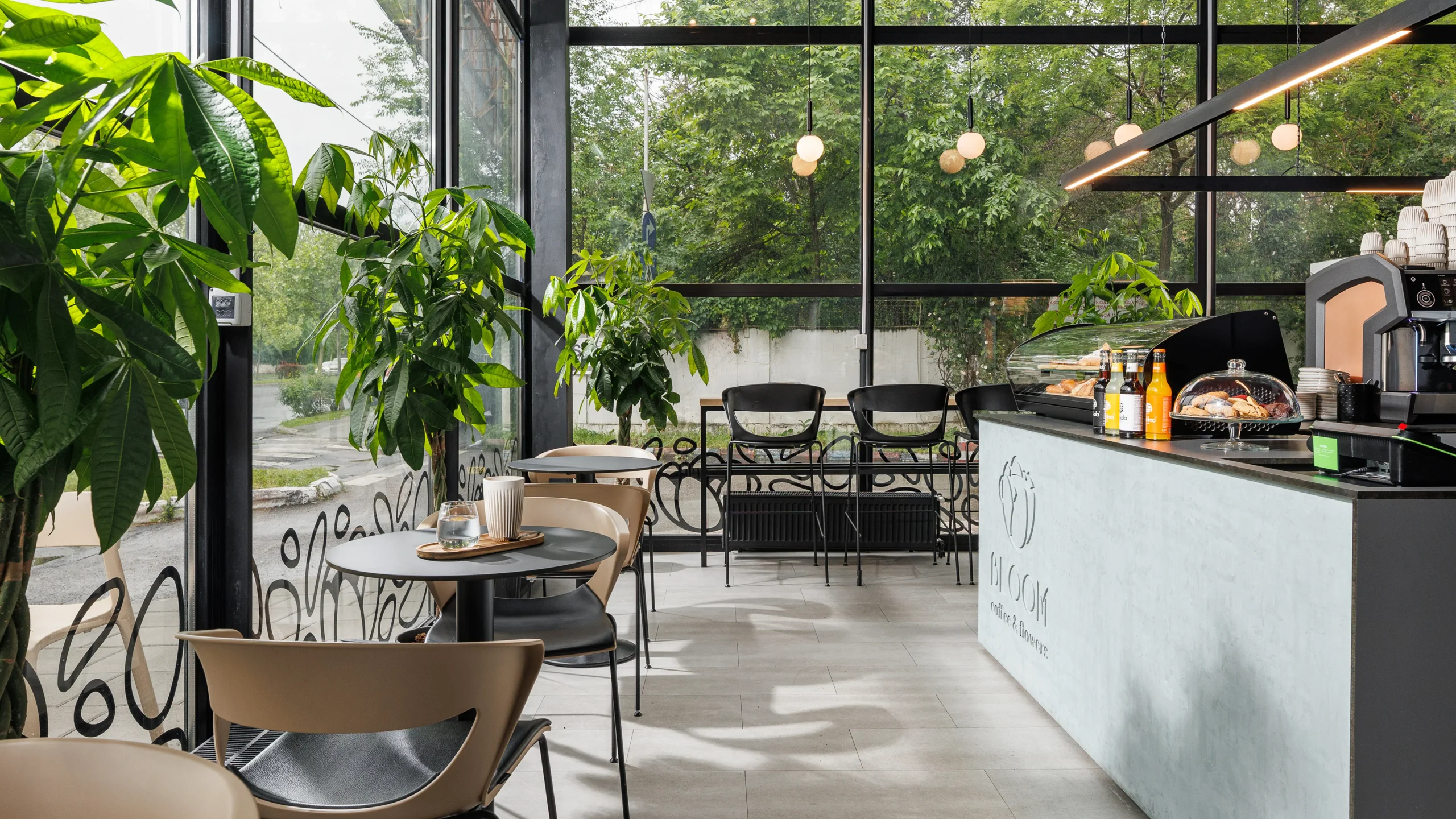
Practical guide to interior design for commercial spaces

The interior design of a commercial space is not merely an aesthetic exercise. It is the tool through which your brand speaks to customers before any employee utters a word. In an increasingly competitive European market, the difference between a space that retains customers and one that is immediately forgotten can lie precisely in how every detail is conceived, from the circulation flow to the lighting and material selection. This guide provides you with concrete steps, essential principles, and practical solutions to transform any commercial space into a real business tool.
Key Ideas
|
Subject |
Details |
|---|---|
|
Visible brand identity |
Tailored interior design creates a distinct and memorable experience for customers. |
|
Efficient customer flow |
Choosing the correct layout optimizes circulation and increases product exposure. |
|
Practical sustainability |
Durable materials and renewable energy reduce costs and ecological impact. |
|
Immersive technology |
Integrating digital elements makes the space appealing and modernizes the brand. |
|
Verification and adaptation |
Monitoring results and feedback enable effective post-implementation adjustments. |
Needs assessment and project preparation
Before choosing colors, furniture, or materials, you must know exactly what you want to achieve from your space. It sounds simple, but in practice, many business owners skip directly to the execution phase without answering the fundamental questions. Who are your customers? How do they move through the space? What behaviors do you want to encourage?
Customer flow analysis is the starting point. Think of the space as a living organism: the circulation flow is its circulatory system. If it is blocked or poorly directed, the entire organism suffers. A fashion store with a narrow central aisle will generate frustration, not sales. An office with poorly defined work zones will decrease productivity, not increase it.
What to include in the requirements list
Before anycommercial interior design consultancy, prepare a requirements document covering:
- Primary functionality: Do you sell products, offer services, or combine both?
- Traffic volume: How many customers pass through the space daily, during peak hours?
- Visual brand identity: Do you have an established brand guide or are you about to develop one?
- Accessibility requirements: Ramps, adapted signage, clear pathways for people with disabilities
- Flexibility: Do you need a space that can be easily reconfigured for events or seasonality?
|
Type of space |
Main priority |
Specific requirement |
|---|---|---|
|
Small store |
Maximum multifunctionality |
Modular furniture, adjustable shelving |
|
HoReCa space |
Experience and atmosphere |
Layered lighting, acoustics |
|
Showroom |
Product display |
Free circulation, neutral background |
|
High-traffic space |
Material durability |
Contract-grade flooring, easy-to-maintain surfaces |
According to specialists incommercial space designsmall spaces require maximum multifunctionality, high traffic demands durable materials, and inclusion through ramps and adapted signage is not optional, but an essential condition of responsible design.
Professional tip:Always choose contract-grade materials for high-traffic areas. These are designed for intensive commercial use and last two to three times longer than standard residential materials. In the long run, the higher initial investment is quickly offset by reduced replacement and maintenance costs.
Another frequently overlooked aspect is accessibility. A commercial space that cannot be navigated by a person in a wheelchair or a customer with a stroller loses real customers every day. Accessibility does not mean aesthetic compromise, but intelligent design.
Fundamental design principles for commercial spaces
Once you have defined the list of needs, the next step is applying the principles that transform requirements into functional space. There are several general rules that remain valid regardless of the business type or geographic location.
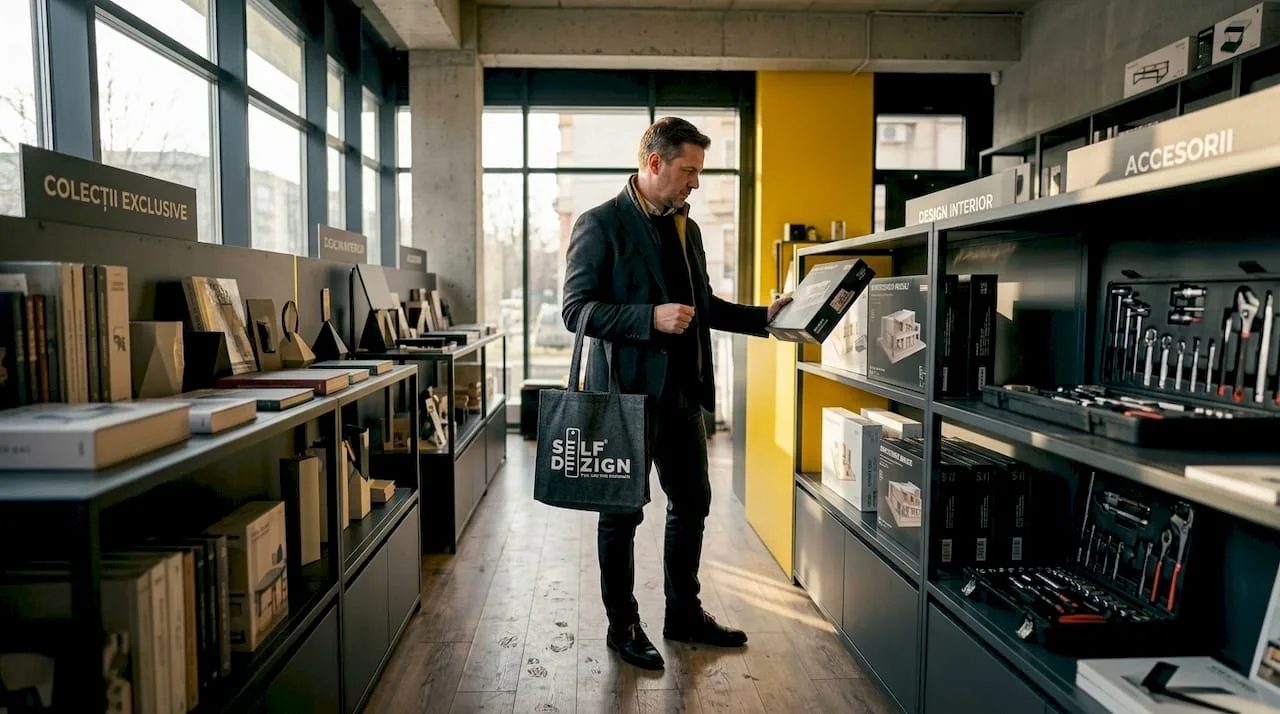
Layout types and their impact
Common layoutsfor commercial spaces are divided into three main categories, each with its specific advantages:
|
Layout |
Description |
Suitable for |
|---|---|---|
|
Serpentine |
Guides the customer along a fixed path, with maximum exposure |
Outlet stores, IKEA, museums |
|
Free-flow |
Allows spontaneous exploration, without a predefined path |
Boutiques, concept stores |
|
Grid |
Organized in regular rows, maximum efficiency |
Supermarkets, pharmacies, warehouses |
Choosing the wrong layout is one of the most costly mistakes a commercial space manager can make. A grid layout in a luxury boutique will communicate efficiency, not exclusivity. A free-flow layout in a supermarket will create confusion and decrease shopping speed.
Steps for efficient flow design
- Mapping the natural path: Observe how customers move through the space before any intervention. Are there routes they spontaneously prefer?
- Identifying dead zones: Corners and areas far from the entrance receive the least traffic. Decide whether to activate them or allocate them for storage.
- Strategic placement of key products: High-margin products are placed in high-traffic points, not on the main shelves.
- Corridor width: Minimum 90 cm for comfortable circulation, 120 cm in high-traffic areas.
- Decompression zone: The first 1 to 2 meters from the entrance should not contain products or commercial messages. Customers need a moment for orientation.
Acommercial space design consultantcan make the difference precisely at this stage, when layout decisions have the greatest impact and are the hardest to correct later.
Professional tip:Integrate removable panels and rail-based shelving systems instead of fixed furniture. The flexibility you gain allows you to reconfigure the space for seasonal campaigns without additional renovation costs. This is an investment that pays for itself multiple times over the duration of a lease.
Lighting is also a fundamental principle, not a finishing detail.The value of interior designalso lies in how lighting can define zones, create visual hierarchy, and guide the customer's attention toward the most important products or services.
Space personalization: brand, lighting, and technology
General principles give you structure. Personalization gives you identity. And identity is what makes customers return.
Modular furniture as a branding tool
Current trends in commercial designconfirm that spatial flexibility through modular furniture on wheels and removable panels, strategic layered lighting with general, focused, and decorative components, and immersive technology through interactive screens and augmented reality represent the dominant directions for modern commercial spaces.
Modular furniture does not mean your space will look improvised. On the contrary, well-chosen modular systems can be extremely visually refined and can communicate a sophisticated brand. The key is coherence: all modular elements must adhere to the same visual vocabulary defined in the design concept.
Layered lighting: more than just seeing well
Lighting is perhaps the most underutilized personalization tool in commercial spaces. There are three essential layers:
- General lighting: Ensures uniform visibility throughout the space. Avoid harsh shadows and large variations in intensity.
- Accent lighting: Directs attention to specific products, promotional areas, or brand elements.
- Decorative lighting: Creates atmosphere and communicates the brand's personality. A statement chandelier or a neon sign with the brand's message can become iconic elements.
Commercial spaces with strategically implemented lighting record an increase in the time customers spend in the space by up to 30%, which translates directly into higher sales.
Immersive technology: experience, not gadgets
Interactive screens, augmented reality applications, and digital signage systems are not just marketing trends. They are personalization tools that can adapt the customer experience in real time.
A furniture store that allows customers to view products in their own homes via AR reduces purchase decision anxiety and increases conversion rates. A HoReCa space with interactive digital menus can change the offering based on time of day or season without printing costs.
Professional tip:Before investing in immersive technology, test scenarios with accessible AR tools. There are mobile applications that allow presenting a design concept to clients or partners before execution. This reduces the risk of misunderstanding and saves time and money during the approval phase.
Connecting all these elements,commercial space brandingdoes not mean placing the logo everywhere. It means building an environment where every detail, from the floor texture to the light temperature, communicates the same values that your brand promises in its external communication.
Sustainability and results verification
After completing the personalization, a stage follows that many treat superficially: verifying that the space truly functions and does so in an environmentally responsible manner.
Why sustainability is no longer optional
European clients in 2026 consider the sustainability values of the brands they interact with. A commercial space that uses recycled materials, low-consumption LED lighting systems, and energy from renewable sources does not just make an ecological gesture. It makes a brand statement.
The BREEAM Excellent certificationobtained by Designer Outlet Parndorf is a concrete example: the space recorded a 30% reduction in electricity consumption and 100% availability for electric vehicle charging. This is not only an ecological performance but also a significant reduction in long-term operational costs.
"Sustainability is not an additional cost, but an investment in the future of your business. BREEAM or LEED certified spaces attract higher-quality tenants and clients and have significantly higher market values."
Sustainable materials for commercial spaces
- European contract-grade furnituremade from FSC-certified or recycled materials
- Flooring made from natural or recycled materials: natural linoleum, bamboo, ceramic with high recycled content
- LED lighting systemswith motion sensors and automatic intensity adjustment
- Paints and finishes with low VOC emissions(volatile organic compounds)
- Energy management systemsintegrated with automation for heating, cooling, and ventilation
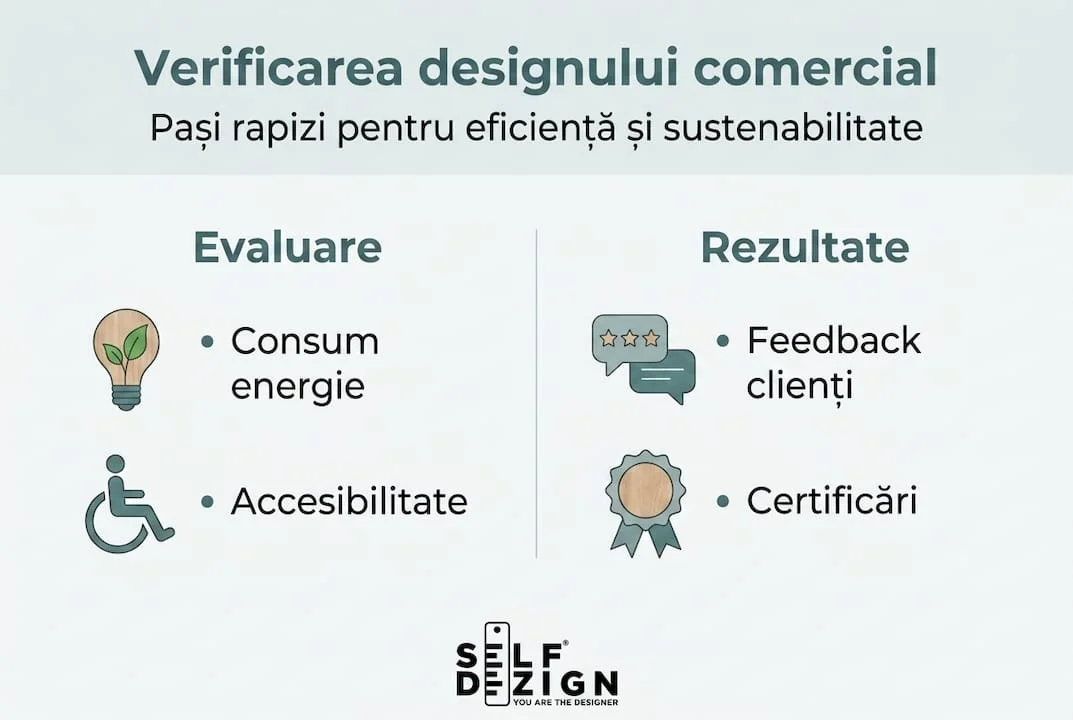
How to verify the project works
|
Evaluation criterion |
Measurement method |
Verification interval |
|---|---|---|
|
Energy consumption |
Comparison of bills before and after |
Monthly, first 6 months |
|
Customer flow |
Heatmapping or direct observation |
At 30 and 90 days |
|
Client feedback |
Surveys, reviews, NPS |
Monthly |
|
Accessibility |
Accessibility audit |
At implementation and annually |
|
Sales per square meter |
Comparative sales reports |
Quarterly |
The advantages of sustainable interior designare most clearly visible in this concrete data. A space that looks good but consumes resources inefficiently or generates negative client feedback is not a successful space, no matter how beautiful it appears in photographs.
What real success looks like in commercial interior design: the vision and lessons of specialists
In our practice of designing commercial spaces, we have observed a recurring pattern: owners who invest the most in the needs assessment phase are the ones who achieve the best results in the end. Not because they have more money, but because they make better decisions at every subsequent stage.
One of the frequent mistakes we see is ignoring the natural flow of clients. Many managers design the space according to their own logic, not according to the client's actual behavior. The result: beautifully arranged areas that no one sees and missed points of interest.
Another mistake is treating post-implementation review as optional. A commercial space is not a photograph. It is an organism in constant interaction with the people who use it. Staff feedback, from those who spend the most time in the space, is often the source of the most valuable information for optimization.
The real value of interior design is not seen on opening day. It is seen in the months and years that follow, in client loyalty, in operational efficiency, and in the identity that the brand builds through its physical space. This is the criterion by which any investment in design is worth judging.
Professional tip:Involve the staff in the feedback process after any major change. Employees notice details that clients do not verbalize and that designers cannot anticipate from blueprints. A 30-minute session with the team, one month after implementation, can bring to light minor adjustments with major impact.
Discover advanced commercial interior design solutions
If you have gone through this guide and feel that your commercial space deserves a more structured and personalized approach, the SelfDezign team can be the right partner for this process. We work with commercial space owners and managers from Romania and Europe, from concept to implementation, avoiding standard formulas and trendy solutions that do not reflect the true identity of each brand. You can exploreinterior design services for workspaces, consult the complete guide to interior design consultancy, or discoverbranding strategies for commercial spacestailored to your specific objectives.