
Interior space branding: a guide for businesses

TL;DR:
- Interior branding creates memorable experiences and conveys the brand's values within the space.
- Proper implementation requires analysis, creative concept and collaboration with specialists for consistency.
- Space personalization differs for retail, residential and medical, adapting branding to specific needs.
Many business owners invest significantly in renovations and new furniture, yet their space still doesn't convey a clear identity. Clients walk in, look around and don't understand what the company does, what its values are or why they should return. The problem isn't the budget or aesthetic taste. The problem is the absence of strategically conceived interior branding. This guide explains what interior space branding truly means, how it is implemented step by step and how it is adapted for offices, residential spaces or medical clinics, so that every design decision serves a clear purpose.
Key Takeaways
|
Point |
Details |
|---|---|
|
Smart interior branding |
Integrating visual identity creates memorable experiences and increases the value of the space. |
|
Effective methodologies |
The right steps include analyzing the space, developing the creative concept and collaborating with specialists. |
|
Personalization adapted to the space |
Interior branding differs for commercial, residential and medical spaces through solutions specific to the type of use. |
|
Avoiding mistakes |
Avoid pitfalls by ignoring visitor flow and the lack of collaboration with experts. |
What interior space branding means
Starting from the initial challenge, let's clarify what interior space branding entails and why it differs from simple aesthetic decoration.
Environmental branding represents the integration of the brand's visual identity into physical spaces to create memorable and consistent experiences. In other words, it's not just about beautiful colors or expensive furniture. It's about how a person feels in your space and what message they receive without reading a single word.
Traditional interior design focuses on functionality and aesthetics: proportions, light, materials, comfort. Interior branding adds an extra layer, that of identity. Think of the difference between a restaurant that looks good and a restaurant that immediately tells you whether it's casual or fine dining, whether it serves local or international cuisine, whether it caters to families or professionals. This difference comes from branding, not from design itself.
The distinctive elements of interior branding include:
- Colors aligned with the brand's identity palette, applied consistently on walls, furniture and accessories
- Logo and graphics integrated into the space without looking forced, but as a natural part of the architecture
- Materials that convey the brand's values: raw wood for authenticity, metal for modernity, soft textiles for comfort
- Signage and wayfinding that is, the system of signs and markers that guide visitors and communicate the brand's personality
- Lighting as a tool for emotion and directing attention
The impact on clients and employees is concrete. A space that is consistent from a branding standpoint increases client trust, reduces anxiety in medical contexts and amplifies employees' sense of belonging. It's not a luxury. It's an investment in how people perceive and remember your business.
A well-definedinterior design concept is the backbone of any interior branding project. Without it, the choices of colors, materials and furniture remain arbitrary, no matter how expensive they are. And space personalization is precisely the process through which the concept becomes tangible reality, adapted to the real needs of your business.
Keep in mind: Interior branding doesn't mean putting the logo on every wall. It means creating a space where the brand's identity is felt in every detail, from the texture of the chairs to the way light falls on the reception desk.
Methodologies and steps for implementing interior branding
Now that we've clarified what interior branding represents, the methodology and concrete implementation steps follow.
The key methodologies include the initial analysis of the space and visitor flows, developing the creative concept, integrating visual identity elements, signage, wayfinding and collaborating with specialized architects and designers. Each step has a precise role and cannot be skipped without visible consequences.
Here is the structured process:
- Space and flow analysis Before any visual decision, you need to understand how people move through the space. Where do they stop? Where does crowding occur? What is the first visual point of contact? This analysis dictates where you place the branding elements with the greatest impact.
- Defining the interior branding concept Starting from the brand's existing visual identity (colors, fonts, tone of communication), a concept specific to the space is built. It doesn't copy the brand manual, but translates it into the three-dimensional language of architecture.
- Integrating identity elements Colors, shapes and materials are selected and applied consistently. A law firm will use noble materials and a sober palette. A creative studio will play with contrasts and unexpected textures. The choice isn't about personal preference, but about the message you want to convey.
- Signage and wayfinding The signage system must be functional and reflect the brand's personality. A medical clinic needs clarity and visual calm. A furniture showroom can use creative signage to guide the buying experience.
- Collaboration with specialists Effective interior branding requires collaboration with interior designers and architects who understand both aesthetics and brand strategy. Choosing the wrong team is one of the most costly mistakes possible.
Professional tip: Before choosing a designer, ask to see previous projects from the same type of space as yours. An excellent residential designer may not have the necessary experience for a clinic or a corporate office.
|
Stage |
Estimated duration |
Main responsible party |
|---|---|---|
|
Space and flow analysis |
1-2 weeks |
Designer, architect |
|
Branding concept |
2-3 weeks |
Designer, client |
|
Visual elements integration |
4-8 weeks |
Designer, suppliers |
|
Signage and wayfinding |
1-2 weeks |
Graphic designer, producers |
|
Implementation coordination |
Variable |
Project manager |
Branding personalization in commercial, residential and medical spaces
Now we'll see how interior branding adapts across various types of spaces, because a universal solution doesn't exist.
Each type of space has its own rules, its own audience and its own expectations. Personalizing spaces for the brand doesn't mean applying the same principles everywhere, but understanding the specific context and making decisions accordingly.
Commercial spaces: offices, receptions, showrooms
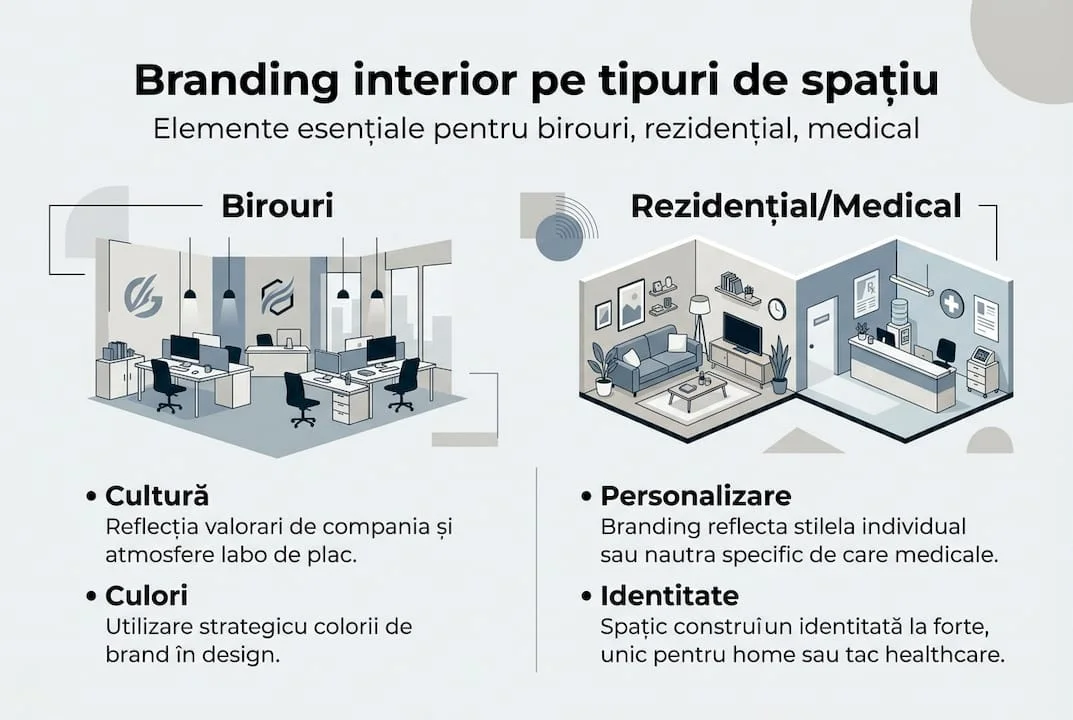
In an office, interior branding communicates organizational culture. A company that promotes collaboration will avoid isolated individual offices and invest in well-defined common areas. The reception is your business's calling card, the first place where the client decides whether to trust you. Showrooms must create an immersive experience in the product's universe, not just display merchandise.

Residential spaces: personal style and identity
In residential interior design, branding translates differently. We're not talking about a corporate brand, but about the owner's personal identity. The materials, colors and objects chosen must reflect the values and lifestyle of the person living there. A residential space with consistent branding doesn't look like a furniture showroom, but like a place that belongs to someone specific.
Medical spaces: professionalism, safety and calm
Clinics and medical offices have specific requirements. Branding elements for clinics include personalizing receptions, offices and waiting rooms, with an emphasis on safety and professionalism. Colors must reduce patient anxiety. Graphics must be clear and calm. Materials must allow easy sanitization without sacrificing aesthetics.
- Offices: emphasis on organizational culture, clear zoning, strong visual identity at reception
- Showrooms: immersive experience, product at the center, branding as narrative backdrop
- Clinics: warm or neutral colors, clear signage, easy-to-maintain materials
- Residential: personal identity, stylistic consistency, comfort as priority
|
Type of space |
Main priority |
Key branding elements |
|---|---|---|
|
Offices and receptions |
Organizational culture |
Logo, corporate colors, zoning |
|
Showrooms |
Product experience |
Lighting, materials, signage |
|
Medical clinics |
Safety and professionalism |
Calm colors, unified graphics, hygiene |
|
Residential |
Personal identity |
Materials, objects, lifestyle |
Professional tip: If you want to better understand personalization costs before starting a project, consult dedicated resources to avoid unpleasant budget surprises.
Common mistakes and how to avoid them in interior space branding
Practice shows that interior branding isn't exempt from pitfalls. Here are the main mistakes and how to avoid them.
- Ignoring visitor flow Many business owners focus on how the space looks in photos, not on how it works in reality. If branding elements are placed in spots no one passes through, the investment is wasted. Flow analysis is the first step, not an option.
- Inappropriate choices of materials and colors A color that looks good on screen can be overwhelming on a 4-meter wall. An elegant material in the catalog can be impossible to maintain in a high-traffic space. Testing in a real context is mandatory.
- Superficial collaboration with specialists Interior branding isn't a project you can fully delegate and forget. It requires your active involvement in the key stages. Effective methodologies include initial analysis, collaboration with architects and consistent integration of visual identity, not rushed decisions.
- Disregarding the brand's visual identity It frequently happens that the physical space looks completely different from the website or marketing materials of the same company. This inconsistency creates confusion and erodes client trust.
- Treating branding as a finished project Interior branding doesn't end at the inauguration. The space must evolve along with the brand. Ignoring this need for adaptation leads to spaces that look outdated within a few years.
Solutions for each mistake:
- Do the flow analysis before any placement decision
- Test materials and colors in the real space, not just in samples
- Get actively involved in the briefing with designers and architects
- Make sure your designer knows your company's brand manual
- Plan periodic updates of branding elements
Keep in mind: A correct branding concept isn't a list of aesthetic preferences. It's a strategic decision that must withstand time and remain consistent across all of your business's communication channels.
If you also want to understand the less-discussed technical aspects, such as fire safety and interior branding in the context of fire safety regulations, or if you want to explore best practice resources for your projects, detailed information is available.
What isn't said about interior space branding
There's a persistent confusion we observe in practice: business owners think interior branding means big logos and loud colors. In reality, the most powerful brand spaces are those where the identity is felt, but not aggressively seen. It's the difference between a space that shouts and one that convinces.
Interior branding is a long-term investment, not a project with an expiration date. The small details, the texture of a wall, the way light falls on a material, the height of a counter, make the difference between a memorable space and one forgotten immediately after leaving. These details don't appear in any standard brief.
Another ignored reality: effective interior branding requires flexibility. Your brand will evolve. The space must be able to evolve too, without being demolished and rebuilt from scratch. Planning this flexibility from the start, in collaboration with designers, is what separates good projects from excellent ones.
Interior branding with SelfDezign – Solutions for your space
If you want interior branding applied professionally, SelfDezign offers personalized solutions for each type of space, from concept to implementation coordination. The team understands that each project has a unique context and that standard formulas don't work when we're talking about identity.
You can explore dedicated solutions for offices and corporate spaces, where interior branding supports organizational culture, or for residential spaces where personal identity becomes architecture. If you work in HoReCa, discover how branding for restaurants and hotels can turn your clients' experience into a real competitive advantage. The first step can be a preliminary discussion to clarify objectives, with no commitments.
Recommended
- Interior designer collaboration guide: business and investments
- Fire safety in interior design: How to combine fire protection with your company's brand
- SelfDezign Blog | Guides and best practices in interior design
- What is an interior design concept | SelfDezign
- What is digital branding? A med spa owner's guide
2026 trends in interior space branding
Branding through interior design is gaining importance over traditional advertising. 2025 studies show that 73% of consumers associate service quality with the aesthetics of the physical space:
- Architectural storytelling — brand narratives are translated into materials, textures and layouts that communicate the company's values without a single written word.
- Photogenic experiences — spaces deliberately designed to be shared on social media, creating organic advertising through visitors.
- Omnichannel consistency — physical design reflects digital identity: the same colors, fonts and emotional tones from the website and app are found in the space.
- Olfactory and acoustic branding — designers integrate ambient scents and sonic design as extensions of visual identity.
Frequently asked questions about interior space branding
What does branding an interior space mean?
Branding an interior space means consistently applying your company's visual identity and values to every physical element of the space: colors, materials, lighting, furniture and graphics. The goal is for a client who walks in to immediately recognize your brand and feel the emotions you want to convey.
How much does branding a commercial space cost in Romania?
The cost varies depending on surface area and complexity. A small commercial space (50-100 sqm) can be transformed starting from EUR 5,000-10,000 for consulting and basic materials. A complete project with integrated visual identity for a restaurant or clinic starts from EUR 15,000-30,000. The investment pays off through increased brand recognition and perceived value.
How does interior branding differ from ordinary decorating?
Decorating pursues aesthetics, interior branding pursues strategy. A decorated space looks good; a properly branded space communicates clear messages, guides client behavior and strengthens loyalty to the business. The difference shows in the numbers: spaces with consistent branding record client retention rates 20-30% higher.
How often should I update my space's branding?
A minor visual refresh (graphic materials, accent colors) is recommended every 3-5 years or with every major corporate rebranding. A complete renovation with brand redesign is justified when market positioning changes or after 8-10 years of intensive use. SelfDezign offers periodic audits to identify the optimal moment for such a project.
Can interior branding increase sales?
Yes, directly and measurably. Retail design studies show that visually consistent spaces increase average order value by 15-25% compared to non-branded spaces. In HoReCa, ambiance influences the time a client spends and additional spending. Investment in interior branding has a documented ROI across all commercial sectors.