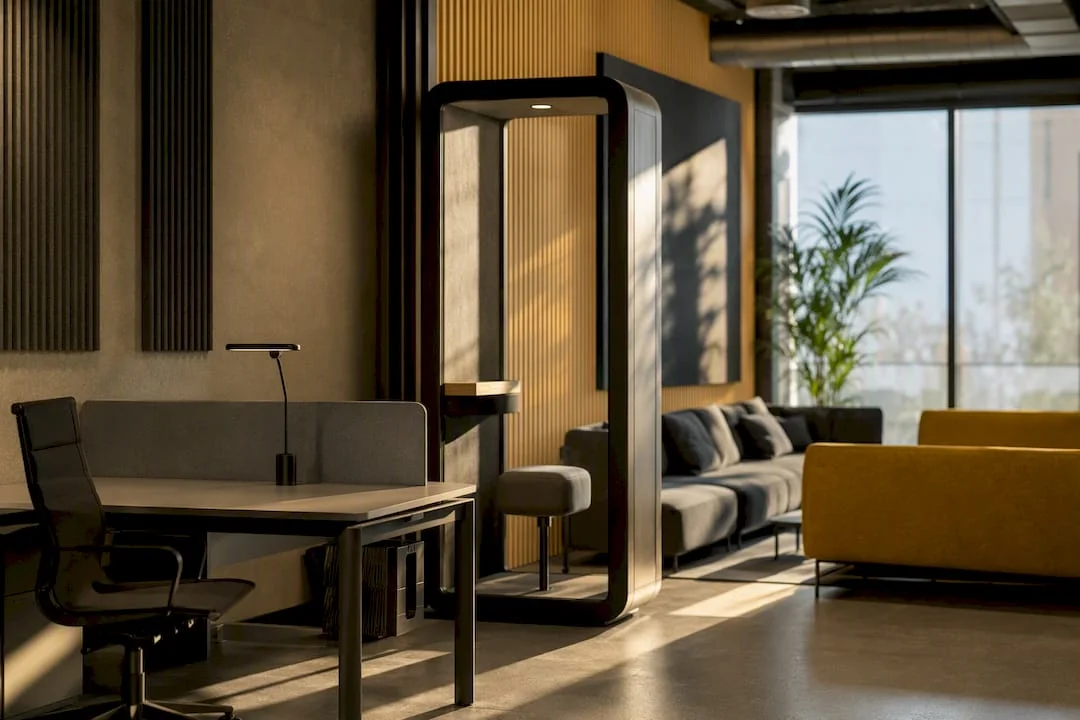
Build Your Interior Space Identity Step by Step

When it comes to a brand's identity in space, the first impulse is to think about logos, colors, and fonts. It's easy to see why, because these elements are visible, tangible, and easy to control. But spatial identity transforms the brand's message from a static graphic element into a living experience, felt by every visitor or employee who walks through the door. In this article, you will understand how this transformation works and what concrete steps you can take to build a space that authentically communicates your brand's values.
Key Ideas
|
Topic |
Details |
|---|---|
|
Space Identity Communicates the Brand |
The experience created by the space influences perception and connection to the brand. |
|
Spatial Sequence Creates Atmosphere |
The order and organization of spaces define belonging and a distinct architectural signature. |
|
Strategic Implementation, Clear Steps |
Transforming the brand into space succeeds through audit, storytelling, and measuring effects. |
|
Identity as a Continuous Process |
The brand evolves with the built space and the community. |
From Visual Identity to Spatial Identity
There is a fundamental difference between putting the brand's logo on the wall and creating a space that breathes that brand. Visual identity—logo, color palette, typography—remains on the surface. It is necessary, but not sufficient. When a client enters a commercial space or an employee arrives at the office, what truly impacts them is not the color on the walls, but how light falls on materials, the order in which spaces unfold, and the feeling that this place was designed for them.
Brand identity translates into a dynamic space that allows storytelling of values, beyond graphic elements. This means the space becomes an actor in the brand's story, not just a neutral background. Think of a restaurant that champions sustainability: if it uses reclaimed wood, live plants, and filtered natural light, the message is conveyed through every surface, without anyone having to read it from a sign.
Do you want to understand more deeply how interior space branding works in practice? Or perhaps you want to first clarify what an interior design concept means before moving forward. Both are solid starting points.
The Difference Between Visual Identity and Spatial Identity
|
Element |
Visual Identity |
Spatial Identity |
|---|---|---|
|
Medium |
Screen, paper, banner |
Materials, light, volume, flow |
|
Mode of Perception |
Visual, instantaneous |
Sensory, progressive |
|
Duration of Impact |
Seconds |
Minutes, hours, long-term memory |
|
Flexibility |
Easy to change |
Involves investment and planning |
|
Message Conveyed |
“This is our brand” |
“This is our experience” |
Elements that build an authentic spatial identity include:
- Materials chosen not for appearance, but for the emotional associations they generate (raw wood suggests authenticity, polished concrete suggests precision and modernity)
- Spatial Composition i.e., the ratio of full to empty, high to low, open to intimate
- Details that are not visible at first glance, but create a diffuse sense of quality and attention
- Light, which is perhaps the most powerful tool for creating atmosphere and guiding attention
A well-designed space does not shout the brand's identity. It whispers it, and people feel it without knowing exactly why.
The Role of Spatial Sequence in Creating Identity
Spatial sequence is essentially the story you experience when traversing a space from entrance to final destination. Think about how you feel when entering a luxury hotel: the tall lobby, the cool but luxurious materials, the path to reception—all are calculated. It is not accidental, but spatial direction.
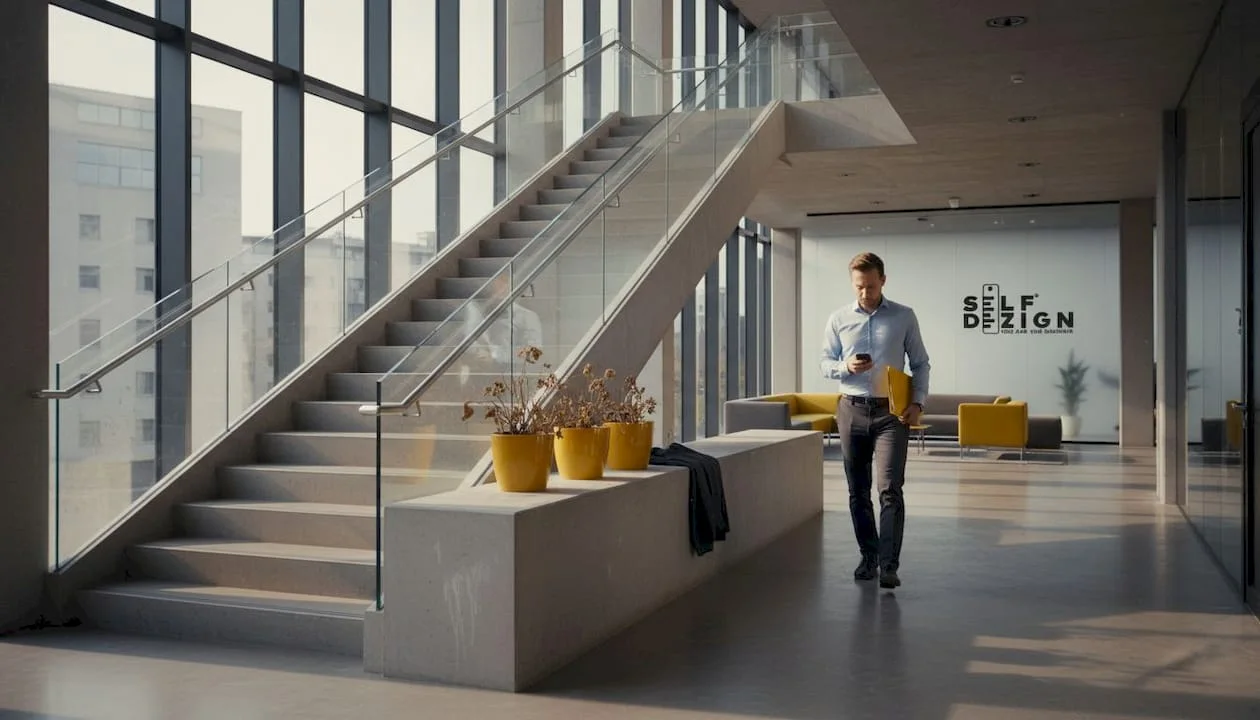
Spatial sequence creates orientation, belonging, and architectural signature. This is the invisible infrastructure of a space's quality. An office where employees pass through a relaxing transition zone before reaching their actual desks will generate a different mental state than one where you enter directly into an open space from the street.
Find out how the architect's role in interior projects manages this orchestration of sequence and understand why the value of interior design is not measured only in square meters furnished.
How to Build a Spatial Sequence with Clear Identity
- The Entrance is the zero moment of the story. It must announce the character of the space without exhausting it. A medical clinic entrance, for example, should convey calm and professionalism from the first step.
- The Transition Zone is that intermediate space that helps the user detach from the outside and adapt to the new context. It can be a corridor, an anteroom, or even a simple change in ceiling height.
- The Main Space is where the central activity takes place. The brand's identity should be felt most strongly here, through proportions, materials, and light.
- Secondary Zones or support areas, such as waiting lounges, restrooms, or visibly accessed storage spaces, are not minor details. They confirm or refute the message received in the main space.
- The Exit leaves the last impression. Many designers ignore it, but a client who leaves through a cluttered corridor quickly forgets the pleasant experience before.
Data on the Impact of Spatial Sequence
|
Type of Space |
Effect of a Well-Thought-Out Sequence |
Effect of a Neglected Sequence |
|---|---|---|
|
Retail |
Average visit time 20-30% higher |
Disoriented customers, quick exit |
|
Office |
Increased productivity, less stress |
Confusion in workflow |
|
HoReCa |
Optimized table turnover, high satisfaction |
Perceived longer wait |
|
Medical Clinic |
Reduced patient anxiety |
Amplified stress, negative perception |
Spatial sequence is not a luxury of large projects. It is the mechanism by which any space, small or large, can convey a coherent and memorable identity.
Implementation Methodology: From Audit to Impact Measurement
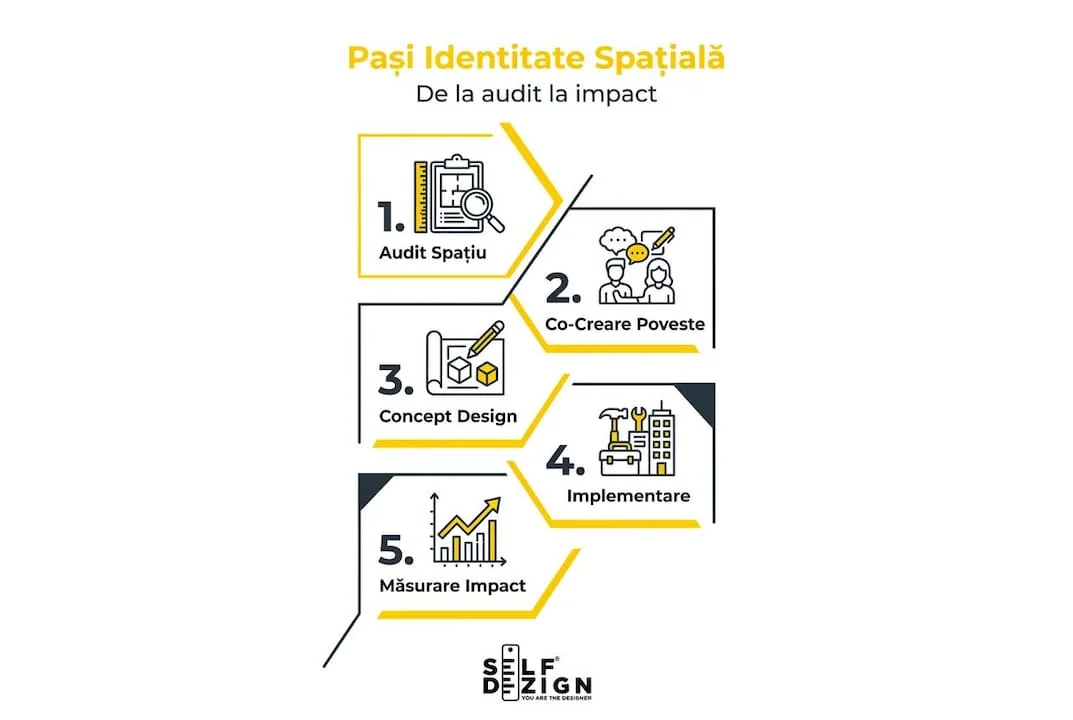
You know you want a space that reflects your brand's values. But where do you start? The process is not linear and does not reduce to choosing colors and furniture. The recommended methodology involves structured steps, from audit to measuring real impact, including KPIs such as dwell time, NPS, and employee retention.
Concrete Implementation Steps
- Brand and Space Audit: Before any design decision, you must understand what your brand currently communicates and what gap exists from declared values. You audit both existing visual materials and the physical space, including user flows, friction points, and memorable moments.
- Narrative Co-creation: Together with the design team, you define the story you want the space to tell. It is not about deciding whether you want “industrial or Scandinavian style,” but about establishing what emotions and values the user should experience in the space.
- Prototyping Key Areas: Before investing in execution, you test concepts in the highest-impact areas, usually the entrance and main space. This can mean mock-ups, detailed 3D visualizations, or even physical mock-ups.
- Technical Detailing and Execution: Every decision, from the type of door handle to the floor texture, is documented and connected to the initial narrative.
- Staff Training: Staff working in the space must understand the intention behind the design choices. An employee who knows why the reception is arranged that way will communicate more authentically with clients.
- Impact Measurement: You use KPIs established from the start to evaluate whether the space performs as expected.
Professional Tip: Do not skip the narrative co-creation step thinking that “the story is obvious.” I have seen technically excellent projects that failed to create a coherent identity because no one explicitly formulated what message needed to be conveyed.
Relevant KPIs for Space Identity
Few business owners measure the impact of spatial identity. Here are some useful metrics:
- Dwell time (time spent in space): in retail and HoReCa, longer time directly translates to higher sales.
- NPS (Net Promoter Score): how much clients recommend the experience in your space.
- Employee retention: employees in a space that reflects company values tend to stay longer.
- Return frequency: loyal customers return partly for the spatial experience, not just for the product or service.
A space that generates loyalty is more valuable than one that generates admiration. Admiration fades; loyalty returns.
Delve deeper into the topic in the article about custom interior design for business and discover the long-term benefits of custom interior design.
Long-Term Framework: Coherence Between Brand, Architecture, and Community
Interior space identity is not a project with an endpoint. It is a living system that must evolve with the brand and the community it serves. The identity of a project can be conceived as a long-term framework, not just as a visual marketing layer applied at the end.
This perspective is more valuable for real estate investments or brands with multiple locations. If you open a second or third space, the identity must remain recognizable without becoming a clone. Coherence does not mean uniformity.
Professional Tip: Document design decisions as principles, not as rigid technical specifications. “Natural light takes priority over artificial light” is a principle. “Spotlights are 3000K” is a specification. Principles survive renovations; specifications do not.
Elements of a Long-Term Spatial Identity Framework Include:
- Rhythm of facades and structural elements visible, creating a recognizable architectural signature
- Signage system integrated into architecture, not added later as a compromise solution
- Base material palette, with the possibility to introduce local or seasonal variations without losing coherence
- Quality standards of detail, i.e., how connections, corners, and finishes are treated, remaining constant regardless of location
- Maintenance and update protocols, ensuring the space ages gracefully and does not degrade over the years
Explore further resources in the guide on interior branding to understand how these principles apply in real projects.
What Nobody Tells You About Interior Space Identity
There is a comfortable illusion in the business world: if you chose a good designer and approved an attractive mood board, the space's identity will come naturally. From our direct experience with commercial, office, and HoReCa projects, this is exactly the mistake that costs the most in the long run.
Investment in invisible details—those the client does not consciously see but feels—is what separates a functional space from a truly memorable one. A good rhythm of proportions, a well-managed transition between zones, acoustics appropriate to the activity. None of these appear in any presentation photo, but they are responsible for the feeling of “I want to come back here.”
Projects without clear spatial identity do not fail spectacularly. They simply do not grow. The brand remains anonymous in its own space. Clients come, consume, and leave without a defining impression. Employees work without feeling that the place belongs to them too.
The most counterintuitive result we have observed is the link between spatial coherence and employee retention. An office that reflects the company's declared values—not just those in HR presentations—generates a sense of organizational authenticity. Employees perceive that “what we see and experience matches what we are told.” This is perhaps the deepest function of spatial identity: it does not sell, does not attract, but confirms and builds loyalty.
How does this reality affect your investment decision? Simply put: the budget allocated to spatial identity is not an image cost, but an investment in your organization's coherence. Learn more about the values of interior design to understand why this distinction matters.
Discover How to Implement Your Space's Identity with SelfDezign
Now that you understand the foundation of interior space identity, you can take the next step with professional support. At SelfDezign, we work with business owners and real estate investors across Europe to create spaces that authentically reflect each brand's values and objectives. Whether you need a high-performance office design to support productivity and organizational culture identity, consultancy for commercial spaces, or a custom residential design, we approach each project starting from your real context and objectives. Contact us for a preliminary discussion and clarify with us the priorities and the right direction for your space.