
Holistic Design for Clinics: Harmonious and Efficient Spaces

Many medical clinic owners believe that a "well-appointed" space means clean furniture, easy-to-sanitize surfaces, and a logo on the wall. But your patients don't perceive design with their eyes. They feel it the moment they walk through the door, with every breath, with every minute spent in the waiting room.Holistic Designcombines medical functionality with emotional comfort and overall harmony, transforming a simple treatment space into an environment that reduces anxiety, increases trust, and makes patients return.
Key Ideas
|
Subject |
Details |
|---|---|
|
Holistic Design = Harmony |
A holistic approach leads to functional and relaxing medical spaces for all users. |
|
Empathy and Personalization |
Adapting the space to the target audience maximizes comfort and efficiency. |
|
Essential Sensory Elements |
Light, acoustics, and natural materials transform the atmosphere of any clinic. |
|
Common Mistakes to Avoid |
Neglecting the patient experience and modularity leads to cold and inefficient spaces. |
What is Holistic Design for Clinics
If you've heard the term "holistic design" and were left with the impression that it's about plants, crystals, and scented candles, you're not alone. The confusion is common. In reality, holistic design for medical clinics is an integrated approach that views every element of the space as a piece of a coherent whole.
"Holistic design looks at the patient experience in its entirety, not just the functional aspect of the space."
Think of your clinic as a living organism. Every part, from the color of the walls to the texture of the chairs, from the light temperature to the ambient sound, influences how the patient feels. When these elements work together, the space "breathes." When they don't, patients feel a tension they can't explain, but which they associate with your medical experience.
The holistic approach is based on a few essential principles:
- Total User Experienceis the number one priority, not just operational efficiency
- Functionality and Aestheticsare not opposites, but mandatory partners
- Safety and Cleanlinessare integrated into the design, not added later
- Personalizationreflects the medical specialty and the specific audience of the clinic
- Sensory Comfortcovers light, sound, temperature, and texture
If you want to better understand whatclinical design consultancylooks like in practice, the first step is to understand that holistic design is not an aesthetic fad. It is a strategy with measurable results in patient satisfaction and retention.
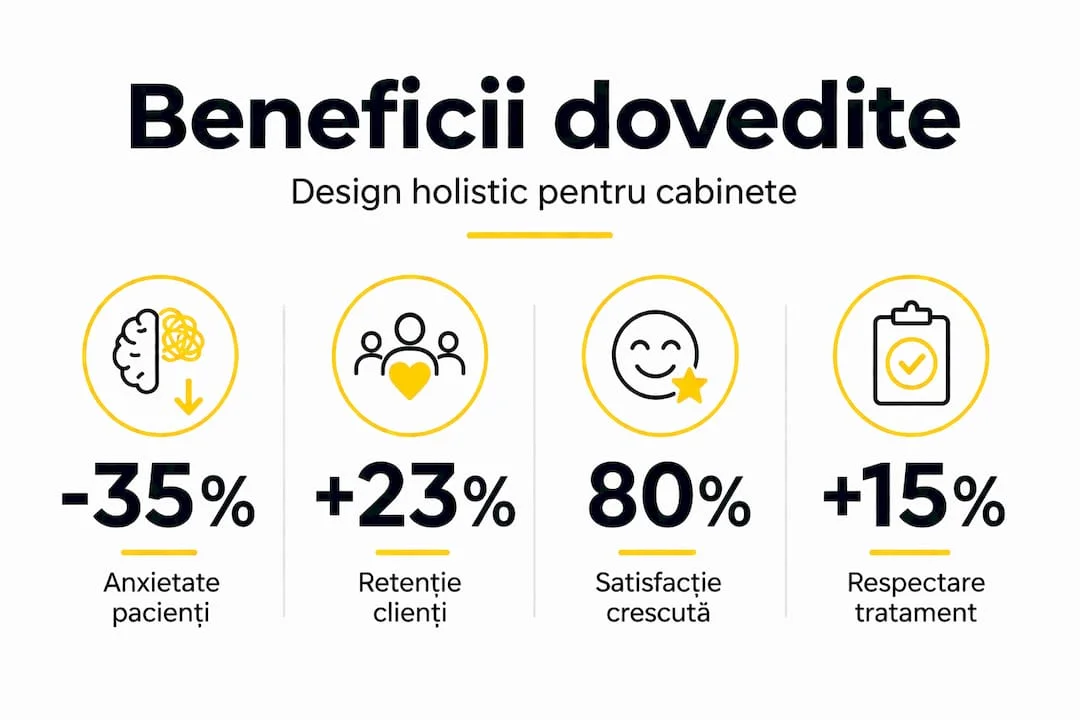
Documented benefits include reduced anxiety before procedures, increased treatment compliance, a better perception of medical competence, and higher recommendation rates. All of this starts with how your space looks and feels.
The Basic Principles of Holistic Design
Now that you know what holistic design is, let's see what makes it work. There is no universal formula, but there are clear principles that, when applied correctly, transform any practice.
Methodologies such as empathy with usersand multidisciplinary collaboration define the success of holistic design. Here is what these principles look like in practice:
- Empathy with the user.Before any design choice, you must understand who comes into your practice. A pediatric practice needs vibrant colors, play areas, and low chairs for children and parents. A sports orthopedics practice communicates something else: energy, dynamism, robust materials. A psychiatry or psychology practice needs calm, neutral tones, and acoustic privacy. Empathy is not a technique; it is the starting point.
- Design thinking aligned with the brand.Your practice is also a brand. Patients compare, recommend, and judge not only your medical competence but also how they feel in your space. Holistic design aligns the visual and sensory experience with the message you want to convey. Are you a premium practice? An accessible and friendly one? One specialized in a specific age group? The answer influences every design choice.
- Multidisciplinary collaboration.The best results occur when architects or designers work together with psychologists, ergonomics specialists, and sometimes even epidemiologists to manage patient flow and reduce infection risk. This collaboration ensures the space not only looks good but functions well at all levels.
- Prototyping and adaptation.Holistic design does not end at the opening. Medical spaces must be evaluated periodically: Are patients complaining the waiting room is too noisy? Is the staff having difficulties with the circulation flow? These are signals that the design needs adjustments. Flexibility is a virtue, not a sign of weakness.
- Compliance with sanitary standards integrated into the design.Easy-to-clean surfaces, antibacterial materials, and flow separation should not look institutional. Good design integratessanitary standards into the designwithout sacrificing the atmosphere.
Professional advice:Before any redesign decision, spend a day observing how patients and staff move through the space. Note where congestion forms, where the light is poor, where the sound becomes disturbing. These observations are worth more than any furniture catalog.
Key elements for efficient and welcoming medical spaces
Principles are the foundation. The physical elements are what patients see, hear, and feel. Integrating sensory elements such as light, sound, textures, and plants can completely transform the medical experience. Let's analyze them one by one.
|
Element |
Main impact |
Practical example |
|---|---|---|
|
Natural light |
Reduces cortisol, improves mood |
Large windows, translucent curtains |
|
Directed artificial lighting |
Visual comfort, spatial orientation |
Warm-temperature bulbs in the waiting room |
|
Pastel colors |
Calms, reduces anxiety |
Sage green, warm beige, pale blue |
|
Natural plants |
Biophilic effect, air purification |
Low-maintenance plants: pothos, ficus |
|
Controlled acoustics |
Intimacy, comfort |
Sound-absorbing panels, zonal carpeting |
|
Warm materials (wood, textiles) |
Humanizes the clinical space |
Wood paneling, cushions on chairs |
|
Flexible partitioning |
Intimacy and adaptability |
Sliding walls, modular screens |
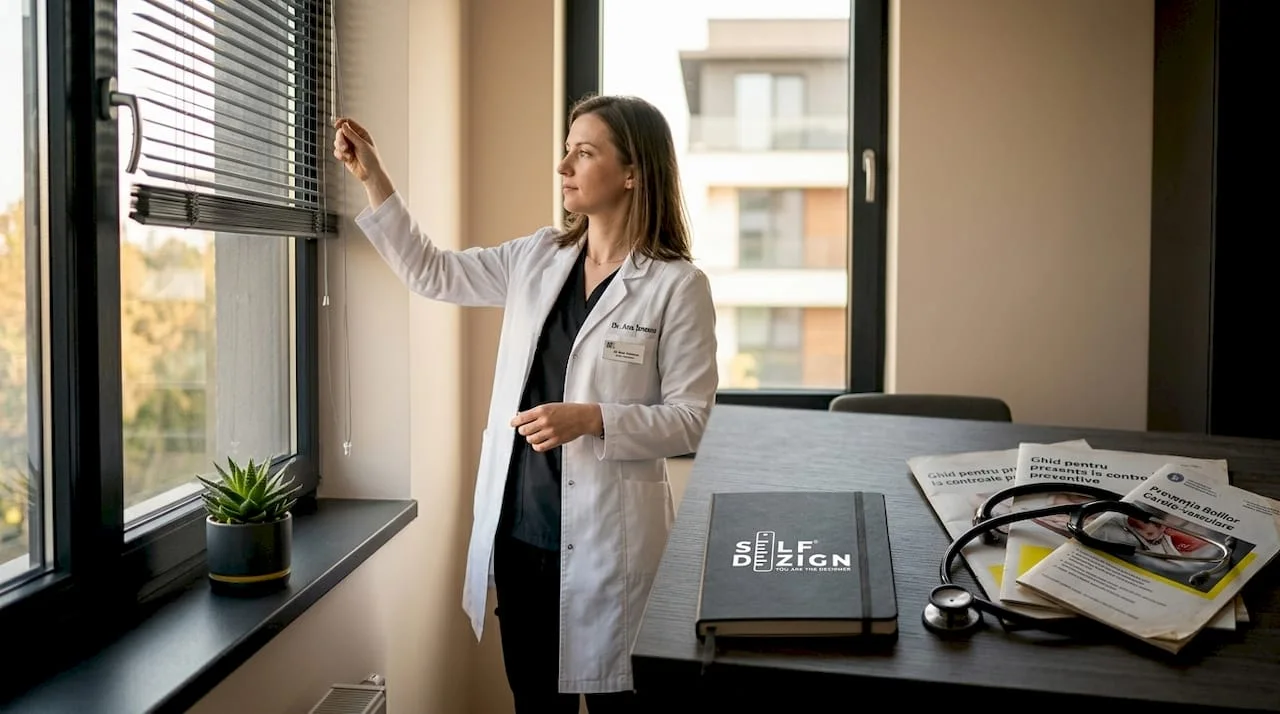
Light is probably the element with the greatest impact and the most often neglected. A clinic with cold, bright neon communicates "old hospital" even if the furniture is new. A clinic with warm, directed light, with a visible natural light source, communicates "safety" and "care."
Colors follow a similar logic. Pastel colors are not an arbitrary aesthetic choice. They influence the autonomic nervous system. Pale green and light blue have a demonstrated effect in reducing heart rate and blood pressure in waiting environments. It's not philosophy. It's applied physiology.
Natural plants add a biophilic element, a term that describes people's instinctive connection with nature. A few well-chosen plants in the waiting room not only look good but reduce the perception of waiting time and alleviate stress.
Professional advice:If the budget is limited, prioritize light and acoustics. These are the elements that patients feel most strongly, even if they don't verbalize them directly.
You can see what it looks like in realityexamples of modernized clinicsthat apply these principles. The difference from a standard clinic is immediately visible, not because it's more expensive, but because it's more thoughtfully designed.
Flexible partitioning is essential, especially in small clinics. Sliding walls or modular screens allow transforming a single space into multiple functional areas—the waiting room, reception area, and consultation area—without permanent construction.Clinical design servicesinclude precisely this type of solution adapted to real spaces, not the ideal ones from catalogs.
How to apply holistic design in your clinic: steps, solutions, and mistakes to avoid
The theory is clear. But how do you move to action, especially when you have a functional clinic, a defined budget, and don't want to close for months for renovation? Here is a structured approach.
- Analyze your target audience.Who are your predominant patients? What age are they? What fears do they bring with them? A pediatric dentistry clinic and an adult dentistry clinic can be in the same building, but they need completely different design approaches.
- Set clear priorities.You can't do everything at once. Prioritize based on immediate impact: perceived cleanliness and hygiene come first. Next is acoustic comfort, then light, then overall aesthetics.
- Implement modularly.Changes don't have to be total. You can start by replacing the lighting, adding some sound-absorbing panels, and rearranging the waiting area. Each step adds value.
- Test and adjust.Ask for explicit feedback from patients and staff after each change. A simple 3-question questionnaire can reveal valuable information.
|
Clinic type |
Design priority |
Common mistake |
|---|---|---|
|
Small clinic (under 40 sqm) |
Modularity, light |
Overloading with furniture |
|
Dental office |
Acoustic comfort, privacy |
Ignoring sound anxiety |
|
Premium clinic |
Visual coherence, premium materials |
Aesthetics without functionality |
|
Pediatric office |
Colors, play areas, safety |
Design too "adult" |
Practical examples show that integrating relaxation areas or biophilic design increases patient retention and creates a community around the practice. Clinics that invest in patient experience no longer rely exclusively on advertising. Satisfied patients become ambassadors.
Professional advice:Avoid the mistake of copying a design seen online without adapting it to your context. An office with large windows facing the street has completely different needs than one on the third floor of a building.Advantages of customized designover standard solutions are precisely this adaptation to reality.
Why most clinics miss the essence of holistic design
There is a trap many clinic owners fall into: they confuse compliance with quality. They check off sanitary regulations, buy new furniture, paint the walls white, and consider the job done. Technically, everything is correct. Sensorially and emotionally, the space remains cold.
What is missing is not budget. It is the courage to personalize. To choose a color that says something about your values. To invest in good acoustics, which seem invisible but which patients feel deeply. To add a biophilic element that is not in any sanitary regulation but makes the waiting room feel human.
Qualitative improvements in retention and satisfaction start precisely from these seemingly insignificant details. A patient who feels good in your office does not come only because you are professionally good. They also come because your space conveys that you respect them as a person, not just as a medical case.
There is another systemic problem: many owners treat design as a one-time event, not as a continuous process. They set it up once, at opening, and never revisit the subject for years. Meanwhile, patients evolve, needs change, and the office remains stuck in 2015.
Holistic design does not mean renovating every year. It means being attentive to signals and making smart adjustments when needed. An added plant, a mounted acoustic panel, a changed lighting system. These small interventions, applied consistently, build a space that evolves alongside your practice.
Think oftransforming the medical spacenot as an expense, but as an investment with direct returns in the number of loyal patients and the perceived value of your services. An office that looks and feels premium justifies premium rates and attracts patients who appreciate quality.
Transform your office with professional design solutions
If after reading this article you feel you know what you want but don't know where to start, you are exactly where you need to be. The next step does not have to be a total renovation. It can be a consultation where you clarify priorities, establish what can be done now and what is planned for the medium term.
At SelfDezign, we work with medical office owners who want more than a functional space. They want a space that works for them, attracts patients, reduces operational friction, and communicates professionalism at every visual contact. Explore thedesign consultancy guideto understand what our process looks like, or discover how we approach other types of spaces in our portfolio ofoffice interior design. The first step is a discussion, without obligation, where we understand your context and real objectives.