
Examples of Interior Design Project Objectives: A Practical Guide

One of the most common roadblocks at the start of an interior design project is not a lack of ideas, but a lack of objectives. You know you want something beautiful, functional, perhaps even sustainable. But when a designer asks you, 'What do you want to achieve with this space?', the answer comes with difficulty. Examples of interior design project objectives exist in all types of projects, from apartments to offices, but their clear formulation makes the difference between a project that delivers and one that disappoints. This guide offers you a framework, concrete examples, and practical tools to define your vision with precision.
1. Fundamental Categories of Objectives in Interior Design
Before listing examples, it's worth understanding how objectives are grouped in an interior design project. Not all objectives are of the same type, and mixing them without a clear structure creates confusion for both the client and the designer.
There are four main categories:
- Functional objectives:maximizing usable space, accessibility for all family members, ergonomics of work or rest areas
- Aesthetic objectives:creating atimeless aestheticthat won't fall out of fashion after three years, stylistic harmony, personalization through meaningful objects
- Sustainability objectives:using natural materials, maximizing natural light, energy efficiency through integrated solutions
- Experiential objectives:the emotional impact of the space, the well-being it induces, the quality of the relationship between the occupant and their space
A less discussed but highly relevant aspect:objectives can be adaptedaccording to the psychological profile of the client. A 'Creator' profile needs a space that stimulates creativity and is permissive with temporary disorder, while a 'Hero' profile works better with clear, hierarchical spaces, with deadlines and visible lists. This perspective fundamentally changes how you formulate and prioritize objectives.
Professional tip: Don't list objectives like a Christmas wish list. Group them by category and identify, for each category, at most two or three real priorities. A project with 20 equal objectives actually has no objective at all.
2. Examples of Objectives for Residential Projects
Residential spaces are the most personal, and precisely for this reason, objectives must be more specific than 'I want it to be beautiful.' Here is a list of interior design project objectives for homes, formulated in a useful way:
- Optimizing natural light:introducing blackout curtains in the bedroom for sleep control and strategic mirrors in the living room to amplify existing natural light
- Creating multifunctional zones:transforming the dining room into a space that simultaneously functions as a home office and relaxation area, with furniture that allows quick transition between the two uses
- Maximizing storage:custom furniture for difficult areas (under stairs, in corners, in niches) combined with standard pieces where space allows, to keep the budget balanced
- Integrating natural materials:solid wood, stone, and natural fiber textiles that bring warm textures and contribute to a calm atmosphere
- Reducing noise:discreet sound-absorbing panels integrated into the design, dense-structure carpet in the bedroom, insulation solutions for shared walls with neighbors
Each of these objectives says something about how you want to live in the space, not just how you want it to look.A balanced designbetween proportions, lighting, and object selection makes the difference between a mundane space and one that truly feels like your own.
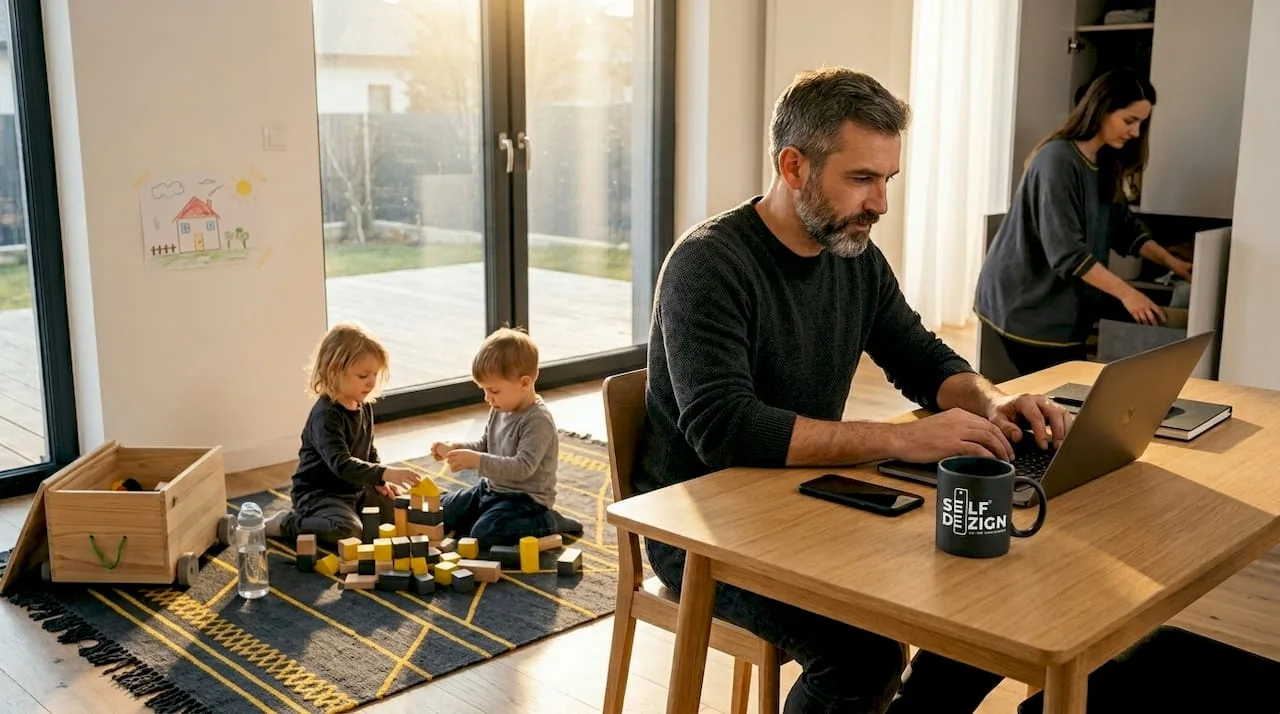
A concrete example: a family with two young children and an adult working from home will formulate completely different objectives compared to a childless couple who travels frequently. The first set of objectives will prioritize material durability, storage, and space flexibility. The second will prioritize aesthetics, atmosphere, and ease of maintenance.
3. Examples of Objectives for Commercial Spaces and Offices
Commercial projects have a different stake: the space must support an activity, convey a brand message, and be efficient for those who use it daily. The objectives no longer refer to personal comfort, but to the performance of an entire system.
Here are examples of specific objectives for this type of project:
- Clear circulation flow:defining logical routes for clients and employees, without bottlenecks, especially in high-traffic spaces such as receptions, restaurants, or showrooms
- Ergonomics for employees: relaxation areas and clear circulationthat reduce fatigue and increase concentration, adjustable chairs and desks, lighting that does not cause eye strain
- Coherent visual identity:the colors, materials, and graphic elements in the space must be an extension of the brand, not a free interpretation of it. A client entering your office should recognize the same aesthetic they see on the website or in communication materials
- Layered lighting:general lighting for functionality, accent lighting to direct attention, ambient lighting to create the desired mood in each area
- Dedicated zones for creativity and breaks:studies show that office spaces that include well-thought-out relaxation areas directly contribute to employee satisfaction and retention
An office designed without clear objectives tends to become a space that looks good in photos but frustrates the people working in it.The architect's rolein such projects is precisely to translate the organization's objectives into concrete spatial decisions, from office placement to the choice of acoustic materials.
4. Comparison of Objective Types by Space
Not all objectives are suitable for every type of project. The table below summarizes what to prioritize based on the space context:
|
Objective Type |
Residential Project |
Commercial Space / office |
Horeca / retail |
|---|---|---|---|
|
Functional |
Storage, bedroom ergonomics, zoning |
Circulation flow, office ergonomics |
Maximum capacity, service efficiency |
|
Aesthetic |
Personalization, natural materials, warm atmosphere |
Brand identity, visual coherence |
Immediate visual impact, memorability |
|
Sustainable |
Energy efficiency, durable materials |
Certifications, low energy consumption |
Recyclable materials, minimal footprint |
|
Experiential |
Well-being, emotional connection |
Productivity, employee motivation |
Customer experience, dwell time |
The real challenge is not to choose a single type of objective, but to balance them. Sustainability-oriented projects use wood, stone, and color palettes inspired by nature, but without sacrificing functionality. Aesthetics and well-being are not in opposition. They are, in fact, complementary when the project starts with well-defined objectives.
A common mistake is to overload the aesthetic category at the expense of the functional one. Spaces that look good in photos but don't work in real life are a symptom of this imbalance. The solution is to give each category a realistic weight from the briefing phase.
Professional tip: If you don't know how to prioritize, use a simple scale from 1 to 5 for each category. The sum of the scores quickly shows you where the real priorities of your project lie.
5. How to Formulate Effective Objectives: The SMART Method Applied to Design
A good objective is not just an intention. It is a statement that can be verified at the end of the project. The SMART method, adapted to the context of interior design, works as follows:
- Specific: Not 'I want more light,' but 'I want the bedroom to benefit from at least 4 hours of direct natural light in the morning, by reconfiguring the curtains and adding a large mirror on the wall opposite the window'
- Measurable: Define a success criterion. It can be a dimension, a color temperature of the lighting, a number of storage spaces, or a maximum budget per room
- Achievable: Check if the objective is feasible given the existing structure, budget, and available timeline. A good objective takes constraints into account, not ignores them
- Relevant: The objective must respond to a real need, not a trend. Setting SMART objectives is more effective when it starts from the real way you live or work in the space, not from what you saw on Instagram
- Time-bound: Set clear stages. 'Living area completed by the end of the third month' is an objective that can be tracked, adjusted, and checked off
Flexibility is as important as precision. An interior design project takes months, sometimes years. Along the way, needs change, budgets adjust, priorities reconfigure. Good objectives are clear enough to provide direction, but flexible enough to allow adjustments without destabilizing the entire project. You can learn more aboutproject stage managementin interior design to understand how objectives integrate into the real coordination process.
6. How to Involve All Stakeholders in Defining Objectives
The objectives of an interior design project do not belong to a single person, especially when the space is used by multiple people or when there is an investor, a manager, and an operational team. Defining objectives through a participatory process produces better results than a brief written by one person.
In a residential project, this means discussing with all family members, including children, if the space affects them. In a commercial project, it means involving both management and the employees who will use the space daily. Often, the most valuable information comes from those who know the existing space's friction points best.
Careful planninginvolves balancing the aesthetic aspect with the practical one, efficient use of space, and integration of relaxation and storage areas, all defined together with the beneficiaries. It is not an exercise in democracy, but one in clarity. The more information goes into the brief, the fewer corrections appear at the end.
7. Common Mistakes in Setting Objectives for an Interior Project
Even with the best intentions, certain recurring patterns sabotage the process from the start. It's worth knowing them:
- Vague or emotional objectives without practical anchoring: 'I want to feel good at home' is a starting point, not an objective. It must be translated into concrete decisions: what generates the well-being? Light? Order? Texture of materials? Absence of noise?
- Unresolved contradictory objectives: 'I want a minimalist space and at the same time full of personal objects' creates a tension that, if not explicitly resolved, will generate frustration throughout the project
- Ignoring the budget as a variable of objectives: The budget is not separate from the objectives. It is a constraint that defines which objectives are achievable and in what order. The mix between custom furniture and standard pieces is a classic example of an objective that takes the budget into account without compromising quality
- Copying objectives from other projects: What worked for a 200-square-meter office in a multinational corporation does not automatically apply to a 40-square-meter studio. Context matters more than formula
What We Think About Objectives in an Interior Design Project
We have seen hundreds of projects started with enthusiasm and concluded with disappointment. And if I had to identify a single common factor in projects that did not deliver, it would be the absence of clear objectives at the start.
Not because the designers weren't good. But because no one really knew what was being measured at the end. When objectives are missing, success becomes subjective and any decision becomes debatable.
What I have observed over time is that the most successful projects are not necessarily those with the largest budget or the most talented designer. They are those where the client could clearly answer two questions: 'What problem does this space solve for me?' and 'How do I know it has been solved?'
I recommend to everyone planning a project to allocate a separate session, before the first meeting with the designer, just to write down their own objectives. Without filters, without thinking about feasibility, without censoring. Only then, in dialogue with the specialist, those objectives are refined, prioritized, and become a real brief.
A space that reflects who you are is not born from trends. It is born from clarity.
— Toni
How Selfdezign Helps You Define the Right Objectives
At Selfdezign, the process begins before any line is drawn on paper. We understand that an efficient interior project starts from a clear brief, not a mood board. Therefore, the first stage of collaboration is dedicated exclusively to clarifying objectives: what the space must do, for whom, at what pace, and with what measurable result.
If you are planning a residential project, you can explorethe steps of a personalized projectto understand how the process is structured from objectives to delivery. For workspaces, theoffice interior designservices include precisely this stage of defining performance and visual identity objectives. Whether you are at the beginning of your journey or already have a partial vision, a preliminary discussion with the Selfdezign team can help you transform intentions into clear project directions.
Can I modify objectives during an interior design project?
Yes, flexibility is part of a healthy project process. Objectives can be adjusted when new budget, structural, or time constraints arise, provided that the changes are documented and agreed upon by all stakeholders involved in the project.