
Design Objectives Prioritization Method: Guide for Specialists

The design goal prioritization method is the process of identifying, ordering, and treating a project's goals differently based on their impact, effort, and relevance to the end result. Without this structure, interior design and space management projects become exercises of intuition, not decision. Industry-proven methods such as ice/RICE, MOSCOW, and the weighted decision matrix turn a list of intentions into an executable plan. The difference between a project delivered on time and one stuck in repeated revisions often lies exactly here: in the clarity with which the team knows what really matters and in what order.
What are the main prioritization methods in design and project management?
Three methods dominate current practice in prioritizing design goals: ice/RICE, MoSCoW, and the weighted-score decision matrix. Each responds to a different type of problem and works best in specific contexts.

Ice and RICE: Quick prioritization based on quantifiable criteria
The ice method evaluates each goal in three dimensions:Impact(what effect it produces),Confidence(how sure we are of the estimate) andEase(how easy it is to implement). The final score is the product of the three values. RICE adds a fourth criterion,Reach(how many people or areas of the project are affected), which makes it more suitable for projects with multiple end-users or large areas.
Ice/RICE METHODrecommends working sessions of 30–60 minutes and limiting to a maximum of 3 active priorities in execution. This limitation is not arbitrary. When the team simultaneously pursues more than 3 major goals, the attention is fragmented and the delivery speed visibly decreases.
MoSCoW: aligning your team around what matters
MoSCoW Methodclassifies tasks into four categories:Must(mandatory)ShouldrecommendedCould(optional) andWon't(excluded from the current iteration). Its main value is not the technique itself, but the conversation it generates. When a customer and an interior design team have to decide together what falls into the Must category, differences in expectations quickly emerge. MoSCoW makes them visible before they become problems.
This method works great in the brief and concept phases, whenclassification of tasksMust/Should/Could/Won't help to quickly align between the client and the project team.
Weighted Score Decision Matrix: for complex decisions
Decision Matrixuses 5–8 criteria with different weights to compare goals or solutions to each other. Each criterion receives a weighting (e.g. functionality counts 30%, aesthetics 20%, budget 25%), and each option receives a score on each criterion. The product between score and weight, summed on all criteria, gives an objective ranking.
This method is best suited when the team has to choose between several concept variants or when the customer has conflicting requirements that need to be explicitly weighed.
Quick comparison between methods
|
Method |
Best Context |
Time needed |
Number of criteria |
|---|---|---|---|
|
ICE |
Quick Priorities, Small Team |
30 - 60 min 1 mL/min |
3 |
|
RICE |
Multi-user projects |
45–90 min |
4 |
|
MoSCoW |
Client-team alignment, brief phase |
30 - 60 min 1 mL/min |
4 categories |
|
Weighted Matrix |
Complex decisions, multiple options |
60–120 min |
3 - 15 3-6 3 - 4.8 |
INFORMATION: Do not combine two methods in the same prioritization session. Choose one according to the type of decision and apply it completely. Premature hybridization produces confusion, not clarity.
How do you apply a goal prioritization method in practice?
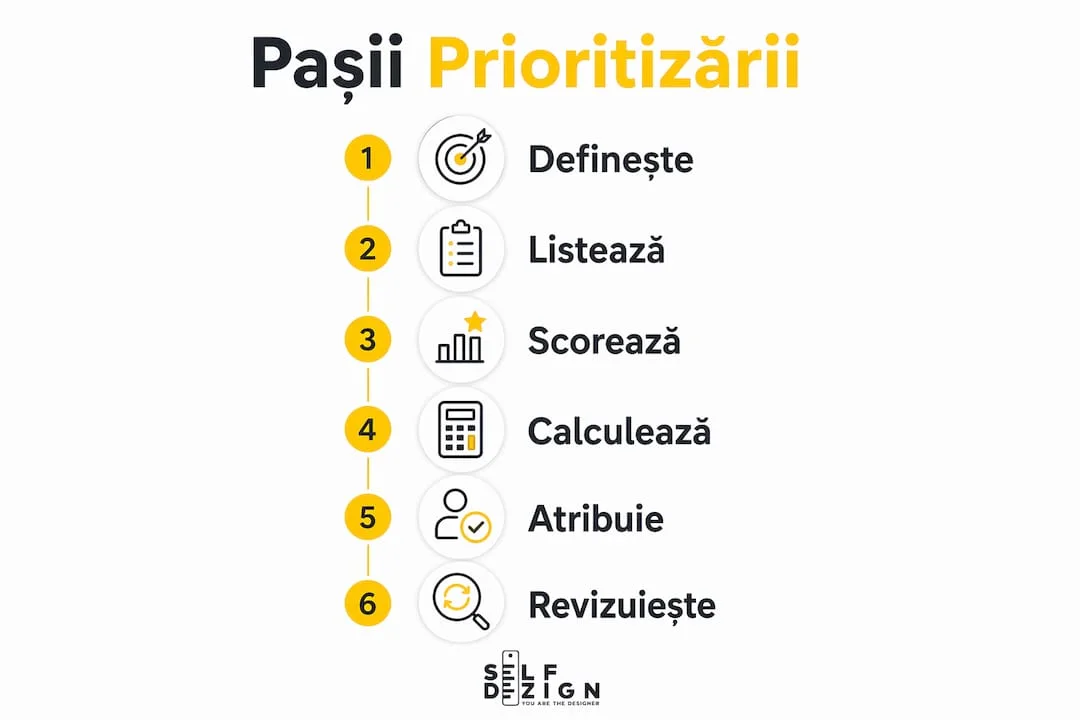
The concrete application of a prioritization method follows a logical sequence. The steps below use the ice matrix as an example, but the logic also applies to the other methods.
1. Define criteria and units of measurement
The first step is to determine what each criterion means in the context of your project. “Impact” is not the same for a residential design project and a HORECA space. For a restaurant, the impact can be measured in the number of seats won or in the reduction of the serving time. Defining the effort unit in hours or man-days is crucial. Without a common unit, the evaluation becomes subjective and the team ends up comparing apples with oranges.
2. Lists all goals and limits the backlog
Write down all possible project goals without initial filtering. Then limit the list to a maximum of 10 active initiatives. A longer backlog does not produce more value. Produces more indecision.
3. Score each goal by each criterion
Use a scale of 1 to 10 for each criterion. Score independently, before team discussion, to avoid the influence of dominant opinions. Differences in score between team members are valuable information, not calculation errors.
4. Calculate the final score and view the matrix
|
Obiectiv |
Impact |
EfortNo part of the present article or article 28 shall be construed so as to interfere with the liberty of individuals and bodies to establish and direct educational institutions, subject always to the observance of the principle set forth in paragraph 1 of the present article and to the requirements that the education given in such institutions shall conform to such minimum standards as may be laid down by the State.inversii r,7) |
Tru |
Ice Score |
|---|---|---|---|---|
|
Reception area redesign |
9 |
6 |
8 |
432 |
|
Color palette update |
5 |
9 |
9 |
405 |
|
Add architectural lighting |
8 |
4 |
7 |
224 |
|
Reconfiguration of circulation flow |
7 |
3 |
6 |
126 |
The ice score is calculated by multiplying the three values. High score and low effort goals are clear priorities. Those with low score and high effort fall into the Won't category for the current iteration.
5. Assign Owner, Term and Definition of Done
Without designated owner and deadline, the matrix remains a theoretical exercise. Each final priority must have a responsible person, a delivery date, and a clear definition of what “done” means. Definition of Done (DoD) can be simple: “The technical plan approved by the customer and submitted to the contractor by May 15. "
6. Review priorities after each major milestone
Prioritization is not a single act. At the end of each project phase, the team reviews the list and adjusts the scores based on new information. An objective that seemed minor can become critical after the site visit.
INFORMATION: Use an Impact × Visual Effort matrix (a simple four quadrant graph) to present your customer's priorities. Visualization eliminates abstract discussions and speeds up the decision.
What common mistakes occur in prioritizing design goals?
Prioritization mistakes are not rare. They are systematic and occur in almost any project that does not have an explicit priority management process.
- Undefined or subjective criteria.When the team scores the “impact” without having previously determined what impact means in the context of the project, each person evaluates something else. The result is a score that reflects opinions, not reality.
- Too many simultaneous priorities.If your Must list has 12 items, you don't have a prioritization method. You have a wish list renamed. Effective execution requires focus, and focus requires limits.
- Confusing effort with importance.A goal that is difficult to implement is not automatically important. And an easy-to-check goal is not automatically minor. Effort and importance are separate dimensions and must be evaluated separately.
- Absence of bridge to execution.Prioritizing without owner, deadline and Definition of Done remains a fruitless exercise. The matrix filled in and left in the file does not produce any effect in the project.
- No or poorly structured feedback.When the customer does not receive a clear framework to express their opinion, feedback becomes vague and difficult to integrate.A structured briefand clear milestones reduce the need for revisions and align expectations from the start.
- Negotiating scores based on opinion, not evidence.Scores in the decision matrix must be supported by previously agreed data or criteria. When a team member changes a score because he "feels" otherwise, the whole exercise loses its objectivity.
The most common bottleneck I see in design projects is not the lack of good ideas. It is the lack of clear agreement about what matters most and in what order. Prioritization solves exactly that.
How does prioritization support the business objectives of a design project?
Prioritizing design goals is not an internal team exercise. It is the tool through which the design becomes relevant to the business.
Design without a clear strategybecomes a decoration, not a business tool. This distinction is fundamental. A HORECA space that looks good but doesn't support the serving flow or maximize the number of seats misses the customer's real goal. An aesthetic office, but which does not facilitate collaboration or concentration, does not produce value for the organization.
Alignment between design and business goals
Effective prioritization starts with understanding the customer's business objectives, not aesthetic preferences. The right questions are: What should this space do? How do we measure success? What happens if we don't achieve this goal? The answers to these questions define the prioritization criteria.
- Structured brief and clear milestonesreduce revisions and align expectations. Unwell-built design briefis the first prioritization tool of any project.
- Design ROI frameworkshelps justify prioritization decisions towards the customer or the management of the organization.ROI calculation for UX and designincludes affected users, estimated percentage improvement, and revenue per user or visitor.
- Clear milestonesturns prioritization from a document into a work pace. Each stage has a defined objective, a responsible and an acceptance criterion.
- Regular review of prioritiesensures that the project remains aligned with the reality of the site or changes in the customer's context.
Integrate prioritization into team culture
Prioritization works best when it is not an isolated event but a regular practice. Design teams that review priorities at each major stage deliver faster and with less internal conflict. The reason is simple: everyone knows what's next and why.
One indicator of caution in working with any design vendor is too fast delivery with no clarification questions. The speed without investigation suggests that the solution was prepared in advance, not built on the actual needs of the project. Proper prioritization requires time for understanding, not immediate execution.
What I Learned About Prioritization After Years of Design Projects
Prioritizing goals is the topic on which everyone has an opinion, but few have a process. I've seen teams using sophisticated arrays and still delivering projects stuck in overhauls. I also saw teams working with a simple list of Must/Should/Won'ts and delivering on time, with satisfied customers.
The difference was not the method. It was the discipline with which the team respected the limits it had set for itself.
The hardest thing about prioritizing isn't calculating an ice score. It is to say “no” to a goal that seems important but does not occur in the current iteration. This decision requires courage and clarity, not a mathematical formula.
We have noticed that projects that are going well have an explicit moment of alignment at the beginning, when the customer and the design team determine together what enters the Must and what remains for later. This moment doesn't take long. It takes 30–60 minutes. But save weeks of revisions and circular discussions.
Another thing I learned: prioritizing without execution is philosophy. Any matrix, any score, any method remains ineffective unless there is an owner, a term and a clear definition of what "done" means. This is the bridge that most teams miss.
My practical recommendation: choose a method, apply it completely, respect the limits you have set, and review at each major stage. Disciplined simplicity beats unapplied complexity at any time.
— expertise offered by ToniBuniașu
How SelfDezign supports goal prioritization in interior design projects
SelfDezign works with clients from different sectors, frompremisesand offices up tohORECA PROJECTSand residential housing, precisely because each type of space has distinct business objectives that require a different prioritization. The SelfDesign process starts with understanding the real context of the project, not with predetermined solutions. Structured briefing, clear milestones and periodic review of priorities are part of how the team manages each project. If you want to understand what a coordination workflow applied to an interior design project looks like, or how to build a brief that reduces revisions, SelfDezign provides the framework and experience for both.