Laminate vs engineered wood flooring: how to choose
The essential difference: engineered wood flooring has a top layer of natural wood, which can be sanded and reconditioned; the laminate is a composite product with a printed decorative layer, placed over an HDF core. Choose engineered wood for authenticity and long-term investment, laminate for budget and high-traffic spaces.
In summary:The laminate has a printed decorative layer and a melamine wear layer, making it more accessible but sensitive to moisture and premature wear in the lower classes.Engineered wood flooring offers superior stability due to its multi-layer construction of natural wood and can be refinished by sanding if the wear layer is thick enough.In high traffic and tight budget areas, laminate with high AC class and good sealing at joints demonstrates its advantages, while for long-term durability and repair, engineered wood flooring is the better choice.Both types require careful maintenance, avoiding excess moisture, and correct installation and acclimatization are essential for an optimal service life.The choice of material must take into account the installation method, compatibility with underfloor heating and aesthetic impact, depending on the size and brightness of the space.
SelfDezign
Choose the right flooring for your space
SelfDezign designs custom interiors, from concept and technical design to implementation coordination.
What is laminate flooring: structure and standards
Laminate flooring is a composite product, not wood in the strict sense. Below the surface you find a rigid HDF core, over which a decorative printed layer is applied, visually reproducing the texture of the wood, followed by a wear layer of melamine resin, responsible for scratch and abrasion resistance, according to technical description of the components. Abrasion performance is measured by the AC class, defined by the standard EN 13329, the technical reference for testing these floors.
- Melamine wear layer stops superficial scratches but says nothing about moisture behavior.
- The printed decorative layer determines the final look, from oak shades to stone textures.
- The HDF core gives the product rigidity but remains sensitive to stagnant water at joints.
A high AC class means better resistance to abrasion and impact, not impermeability. An AC5 laminate can succumb to moisture just like an AC3 if the joints are not sealed properly.
What is engineered wood flooring: layers and refinishing
Engineered wood flooring, sometimes called three-layer parquet, is natural wood organized on several layers with perpendicularly oriented fibers, a construction that provides superior dimensional stability to solid wood. The visible layer is of noble essence, and the base layer takes over the mechanical stresses of the support.
- The thickness of the wear layer decides how many sandings the floor supports during its lifetime.
- The opposing fibers between the layers reduce the natural movements of the wood to moisture variations.
- Acclimation of at least 48 hours before installation is essential for final stability.
For refinishing by sanding, what matters is the thickness of the wear layer, listed in the product data sheet. The thinner the layer, the higher the risk of sanding through it in a single pass.
Advantages and disadvantages: what decides the choice
The direct comparison between the two products only makes sense according to the criteria that matter to you: immediate budget, long-term cost, maintenance, and indoor air health.
- Initial cost favors laminate, generally more affordable as a purchase price; engineered wood flooring approaches the cost of solid wood, according to indicative price comparison.
- Long-term cost can reverse the advantage: engineered wood refinished by sanding avoids complete replacement, while the worn laminate must be completely replaced.
- Resistance to heavy traffic is the strength of high AC class laminates, suitable for commercial areas or homes with pets.
- Vulnerability to moisture affects both products by HDF core or by natural wood, but it is managed differently: sealing at joints for laminate, protection and ventilation for engineered wood.
- Emissions of volatile organic compounds depend on the adhesives and resins used in manufacturing, a criterion also covered in the JRC review of EU Ecolabel criteria for wood-based floors.
Professional advice: When the budget is tight but the space has heavy traffic, a laminate with high AC class and sealed joints performs better than a cheap engineered wood floor with a thin wear layer.
Aesthetic and sensory aspect in the choice of material
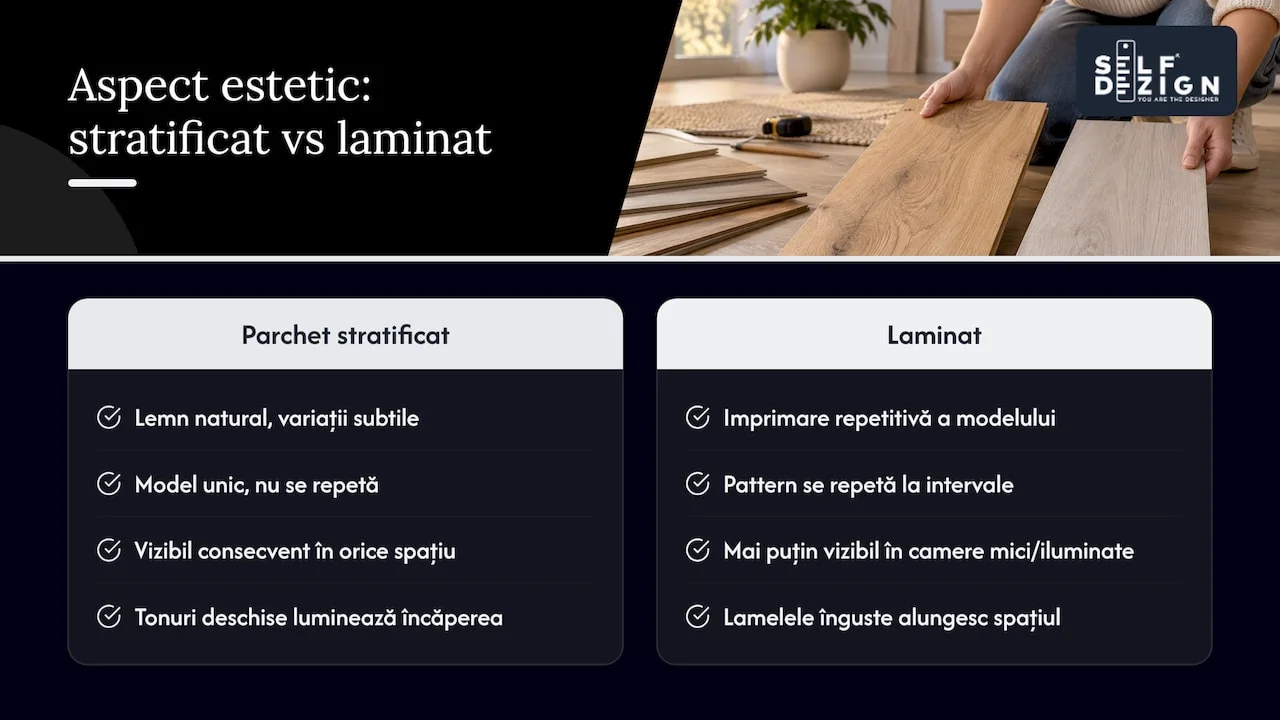
The difference is felt most clearly on contact: the natural wood of engineered flooring has subtle variations of hue and reflection, while the laminate print repeats the pattern at visible intervals. In a small and well-lit room, this repetition is less noticeable, but in large spaces or with raking light it becomes obvious.
The choice of hue and pattern should be correlated with the size of the room: light tones visually open up a narrow space, and a narrow-plank pattern lengthens the perception of length. For projects where visual coherence is maintained over the long term, engineered wood remains the safer investment, because natural wood ages evenly, while laminate printing cannot be renewed.
Durability, traffic and floor life cycle
The AC class remains the primary indicator for abrasion, but it says nothing about impact or prolonged wetting behavior. A high-grade laminate resists daily scratches well, but a strong impact can crack the decorative layer if the HDF core does not have the right density.
The thickness of the wear layer, not the AC class, determines whether an engineered wood floor can be refinished, and a sufficiently thick wear layer makes the difference between a floor that can be restored to its original appearance and one that needs to be replaced after the first visible degradation.
The actual life cycle depends on maintenance and traffic type. In an office with constant traffic, a high-performance laminate can last for years without major interventions, while a well-maintained engineered wood floor can go through several reconditioning cycles before being permanently replaced.
Maintenance and cleaning for every type of flooring
Both products are easy to clean, but they tolerate moisture and aggressive products differently.
- For laminate, use a well-wrung damp cloth and avoid water puddles when washing.
- For engineered wood, choose cleaning solutions specially formulated for wood, without ammonia or bleach.
- Avoid wet mops or vapor appliances on both types, as excess moisture affects both the HDF core and natural wood.
- Fine scratches, localized discoloration or swelling at joints are signals that the floor needs repair or, in the case of engineered wood, sanding.
Preventive maintenance, with mats at the entrances and protections under the furniture, visibly prolongs the interval between interventions, regardless of the material.
Installation, acclimatization and common installation errors
The correct installation matters as much as the choice of material.
- Let the flooring acclimatize in the room at least 48 hours before installation, especially for engineered wood, where natural wood reacts to humidity and temperature.
- Check the leveling of the support before installation: the differences in level cause noise and premature wear at the joints.
- Choose between floating and glued installation depending on the type of traffic and compatibility with underfloor heating.
- Leave expansion joints at the walls and at the crossings between the rooms, in order to avoid bulging or detachment of the boards.
The most common errors come from haste: installation without acclimatization, insufficient joints or ignoring the manufacturer's instructions for the recommended substrate.
Underfloor heating compatibility
Both types can be mounted over underfloor heating, but the heat transfer depends on the thickness of the product and the installation type, which is confirmed by technical comparison guides. Ask the supplier for the thermal resistance coefficient of the product and check the manufacturer's instructions on the maximum permissible surface temperature. Glued installation directly on the screed generally provides more efficient heat transfer than floating installation, especially for engineered wood.
SelfDezign perspective: flooring as a project decision, not just of material
The choice between laminate and engineered wood is not made in isolation from the rest of the project. A medical clinic needs surfaces resistant to disinfectants and constant traffic, an office requires durability in daily use, and a HORECA space requires high mechanical strength in the serving areas. We recommend consultancy when the project has specific technical, sanitary or heavy traffic requirements, where the material decision directly influences the long-term maintenance cost.
— the SelfDezign team
An alternative: advice on the choice and implementation of the flooring
If you want a decision based on the real context of your space, not just a generic comparison between materials, interior design consulting brings technical clarity before you buy.
- We evaluate the traffic, humidity, and technical requirements of the space to recommend the right material.
- We provide technical installation details and supervise execution to avoid errors that reduce floor life.
- We structure the recommendation according to the available budget, without standard solutions copied from one project to another.
For remotely coordinated HORECA projects, SelfDezign Remote provides a similar decision path without physical presence on site. You can see the full range of services on SelfDezign services page.
Sources
The EN 13329 standard defines testing for laminate flooring. The JRC documents and European regulations provide context on the classification and sustainability of materials.
- Laminate vs engineered wood flooring
- EN 13329 Laminate flooring - Aminoplastic thermosetting resin-based surface layer elements
- Revision of the European Ecolabel Criteria for: WOOD-, CORK-, AND BAMBOO-BASED FLOOR COVERINGS
- Engineered wood flooring versus laminate flooring. Differences and similarities