How to set your design budget: 2026 guide

The design budget is the total amount allocated to the services of design and coordination of an interior space, distinct from the costs of execution, finishes and furniture. Knowing how to set the right design budget from the start avoids the most common errors that block projects by half: underestimating fees, ignoring the reserve for unpredictables, and confusion between the cost of design and the cost of the layout itself. In Romania, in 2026, the interior design market has reached a level of maturity that allows clear and structured estimates, and the available data make planning more precise than ever.
How to calculate the cost of interior design services in 2026
Interior design services don't have a one-time price. They are structured on levels of complexity, and each level delivers something else. Understanding these levels is the first real step in planning your design budget.
|
Service type |
Indicative price range |
|---|---|
|
Punctual advice |
400 – 600 Ron/hour |
|
Simplified design |
1,200 – 2,500 Ron |
|
Full 3D rendering design |
3,500 – 6,000 Ron |
|
Premium project with implementation support |
Ron 6,000 – 12,000 |
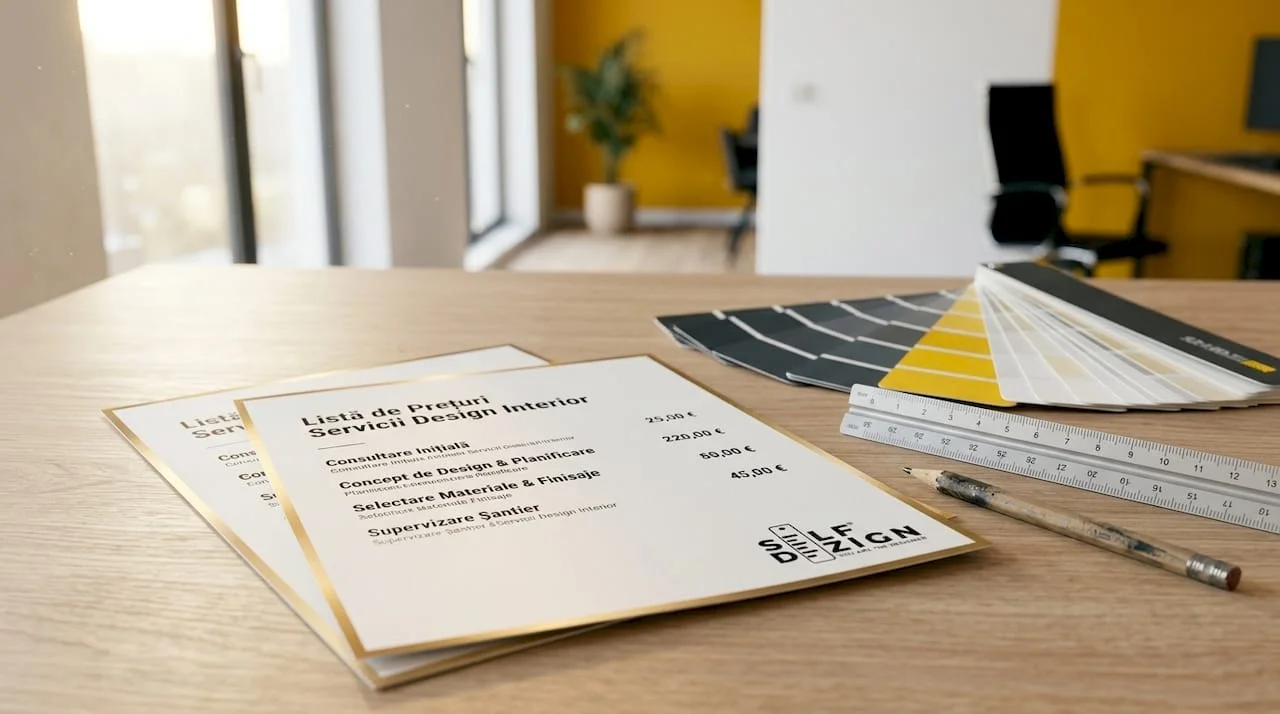
Aceste interior design ratesvaries depending on the area of the space, the functional complexity and the experience of the design team. A 200 sqm office with specific technical requirements will cost differently than a 60 sqm apartment with simple layout. Complexity does not necessarily mean large area, but the number of technical, coordination and detail decisions that the project involves.
There is one distinction that many customers ignore at first:design budgetcovers the designer's fee, i.e. thinking, documenting, designing and coordinating. The execution budget covers materials, finishes, furniture and workmanship. The two do not overlap and cannot be substituted. Their separate treatment in planning is a condition for a project that ends without surprises.
Tip: Always ask for a detailed quote on deliverables, not a global price. Knowing exactly what you're getting at each stage, you can compare real deals and negotiate with clarity.
The variables that most influence the final cost are: the usable area, the number of rooms with different functions, the level of detail of the technical documentation and the degree of involvement of the designer in the implementation phase. An 80 sqm residential project with full support can reach 8. 000 – 10. Ron 000 for the Design Fee, before any material purchase.
How to split your total fit-out budget
The structure of a complete fit-out budget follows a verified percentage logic in practice. The total budget is divided as follows: 3 – 5% for design services, 20 – 25% for finishes, 50 – 60% for furniture and equipment, 15 – 20% for labor. This structure is not a rigid rule but provides a useful frame of reference for any type of project.
|
Categorie |
Recommended Percentage |
Remark |
|---|---|---|
|
Services of design |
3% 5% |
Designer fee, design, coordination |
|
Finisaje |
20–25 |
Floors, plywood, paints, carpentry |
|
New furniture and equipment |
50 60 |
Fixed furniture, lighting fixtures, household appliances |
|
workmanship |
15 - 20 % |
Execution, assembly, installations |
|
Reserve for the unpredictable |
Minimum 5% |
Mandatory buffer, treated separately |
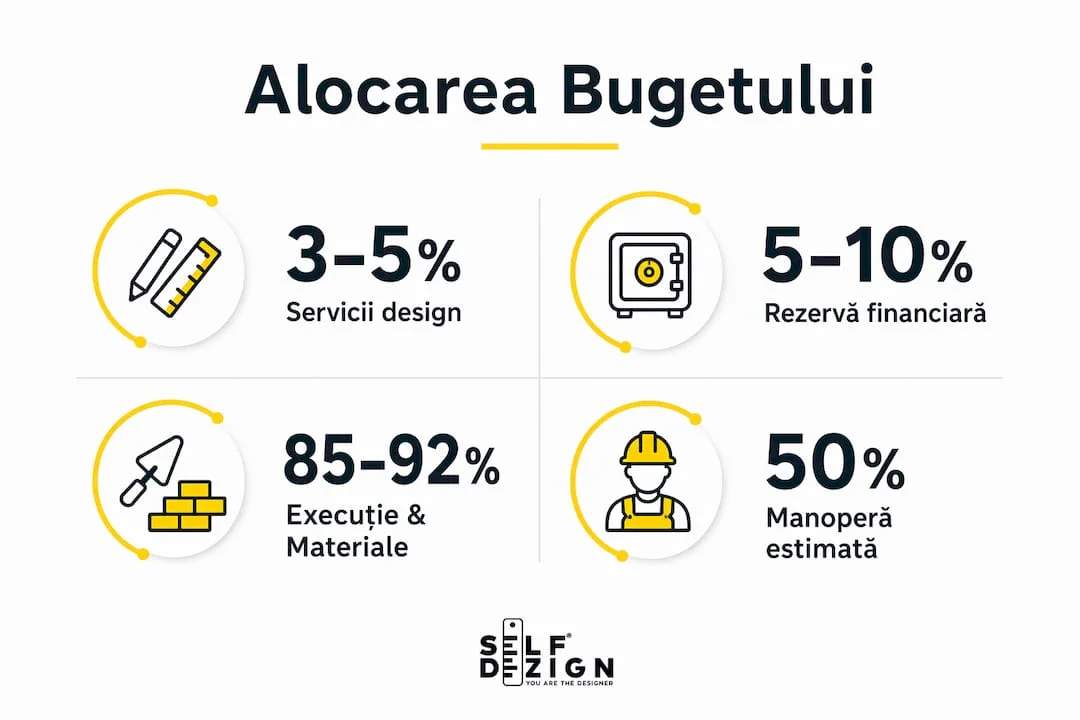
The financial reserve deserves special attention. A reserve of 5 – 10% of the total budget is not a luxury, but a strategic component. For a project of 100. 000 EUR, that's 5. 000 – 10. EUR 000 kept separate, untouched until unforeseen circumstances arise: prices changed by suppliers, additional works discovered on site or decision changes in the execution phase. Without this buffer, projects reach compromises that affect the final quality.
Tip: Treat the reserve as a separate budget line, not a vague “in case” amount. Assign it explicitly in planning and use it only for real, documented situations.
Labor allocation is the most often underestimated category. Many owners and project managers calculate materials carefully, but forget that the erection, installations and finishes applied cost as much or more than the materials themselves.Inclusion of workmanshipin the initial budget, not as a subsequent addition, prevents financial bottlenecks in the execution phase.
What practical tips help you avoid going over budget
Budget control isn't about spending as little as possible. It means spending correctly, in the right order, on the items that matter most in the long run.
Here's a prioritization order verified in practice:
- Permanent finishes(flooring, plywood, carpentry) are the most expensive to change later. Invest more here and less in easily replaceable decorative elements.
- Iluminatulhas the greatest visual impact relative to cost. A well-thought-out lighting system transforms a space more than any new furniture.
- Textiles & Plantsare the category with the best cost/impact ratio. Unimpact visual refreshcan cost between 460 and 590 Ron and completely changes the perception of a space.
- Mobilierulcan be purchased by instalments. You don't have to buy everything at once. Step-by-step planning allows you to adjust your budget without compromising on quality.
- Household appliances and equipmentare chosen after the space is functionally defined, not before.
Frequent errors that lead to budget overruns are predictable and avoidable:
- Changing decisions after execution has started generates double costs for disassembly and restoration.
- The lack of a detailed technical design leads to improvisations on site, each with an additional cost.
- Buying materials without verifying compatibility with the project results in waste or repeated purchases.
- Negotiating the total price without understanding what the offer includes leaves room for unpleasant surprises at the end.
Blocking the list of deliverablesand limiting the number of rounds of revisions are two of the most effective budget control tools. Each additional round of changes is time and money-consuming for both the designer and you.
Tip: Determines from the beginning how many rounds of revisions are included in the contract. Two or three rounds are enough for a well-driven project. More than that usually indicates that the initial brief was not clear enough.
What tools and methods help estimate your budget
The basic formula for estimating the fit-out budget is simple and functional:area × cost per square meter + reserve of 10 – 15%.Estimation methodadjusts to project complexity and market price fluctuations, but provides a realistic starting point for any type of space.
|
Space type |
Estimated cost per sqm (complete layout) |
Remark |
|---|---|---|
|
Standard apartment |
400 – 700 EUR/sqm |
Medium finishes, functional furniture |
|
Premium apartment |
800 – 1.500 EUR/sqm |
Superior finishes, custom furniture |
|
Commercial / office space |
300 – 600 EUR/sqm |
Depends on technical and brand requirements |
|
HoReCa |
500 – 1,200 EUR/sqm |
Complex installations, resistant materials |
Online budget calculators are useful for quick estimates, but they don't replace real space analysis. Before you set any figure, you need accurate measurements, a clear understanding of the space's functions, and a preliminary list of necessary interventions. A computer gives you an interval. A designer gives you a plan.
Adapting the budget according to the chosen style is often ignored. A minimalist style with quality natural materials can cost more than an eclectic interior with mixed pieces. Style doesn't determine cost. The quality of the materials and the complexity of the execution determine the cost.
Tip: View updated price guides for the Romanian market before signing any contract. Prices have adjusted significantly in 2025-2026 and two-year old estimates can be misleading.
A concrete example: for an apartment of 75 sqm in Bucharest, with medium to superior finishes, the total fitting budget is between 45. 000 and 75. EUR 000. Of this, the design fee is 1. 500 – 3. 750 EUR, i.e. exactly the 3 – 5% that, correctly invested, can save 20 – 30% of the total costs by avoiding mistakes in execution.
Key Topics
An effective design budget is built on three pillars: clear separation of design and execution costs, correct percentage allocation by category and mandatory inclusion of a reserve for unpredictables.
|
Idee |
Detalii |
|---|---|
|
Separation of budgets |
Treat the design fee and execution budget as distinct lines in planning. |
|
Percentage structure |
Allocate 3 – 5% design, 20 – 25% finishes, 50 – 60% furniture, 15 – 20% workmanship. |
|
Required reserve |
Keep a minimum of 5-10% of your total budget as a contingency buffer. |
|
Prioritization of investments |
Invest more in permanent finishes and lighting, less in changeable decorations. |
|
Deliverables control |
Block the list of deliverables and the number of revisions before signing the contract. |
Why the design budget is actually a strategic decision
We worked with clients who came with well-thought-out budgets and with clients who came with a round figure and the hope that it would be enough. The difference between the two categories is not necessarily financial. It's clarity.
The most common bottleneck I see is not the lack of money, but the lack of a clear structure before it starts. Customers who know what they want, who have defined deliverables, and who have booked a real buffer complete projects on time and on budget. Those who improvise along the way invariably reach compromises that they regret.
“One thing I often say: the design budget is not an administrative expense. It is the tool through which all other expenses become more efficient. A well-done technical design eliminates execution errors, reduces waste of materials and gives you clarity in every purchase decision. Without it, you buy twice and build twice.
I recommend anyone to treatphased planningnot as a formality, but as a real map of the project. Each stage has its own costs, its own timetable and its own decisions. When you know this from the beginning, budget is no longer a source of stress. It becomes a control tool.”
Toni
How SelfDezign can help you plan correctly
SelfDezign works with business owners, project managers and investors who want to know exactly what they are investing in before signing anything. The SelfDezign team does not deliver catalog solutions. Delivers projects built on an understanding of context, real goals, and available budget.
If you have an office space, restaurant, clinic, or residential space and you want to know what budget you really need,office design servicesand commercial of SelfDezign include initial consultancy, technical design and implementation coordination. The first step is a clear conversation about what you want to achieve and what resources are available to you. The rest is built from there.