
Custom design: how to increase the value of your space

The business world has already understood that a generic interior space no longer convinces anyone. 71% of buyers expect a high level of personalization when interacting with a brand or choosing a space, whether we're talking about an office, a restaurant, or a medical clinic. This means that interior design is no longer an aesthetic detail, but a strategic decision. In this article, we explain why personalization truly matters, how it influences client perception and the market value of a space, and what concrete steps you can take if you want real results.
Key Ideas
|
Topic |
Details |
|---|---|
|
Personalization differentiates |
A personalized interior design transforms the space into a memorable and recognizable market imprint. |
|
Market expectations are rising |
Clients and investors demand spaces that reflect identity and offer a unique experience. |
|
Long-term benefits |
Personalized spaces add value and increase retention and attractiveness rates. |
|
Structured implementation |
Adopting a personalized design involves clear steps from analysis to practical implementation. |
The values brought by personalized design in business and real estate
Personalization does not mean choosing a favorite color for the walls. It means building a space that speaks for you, that communicates the values and personality of your business before anyone says a single word. This seemingly subtle difference has concrete and measurable effects.
A personalized space immediately sets a business apart from generic alternatives. Think of two restaurants in the same neighborhood: one decorated with catalog furniture, neutral paintings, and standard lighting; the other designed around a coherent concept, with carefully chosen materials and a narrative thread visible in every corner. The client remembers the second one and recommends it further. This is the direct impact ofthe benefits of personalized interior design on your business.
Personalized interior design, aligned with the brand identity or the owner's style, differentiates the space and makes it easier to recognize by clients, future residents, or buyers. This recognition is not accidental, but the result of deliberate choices in concept, materials, colors, and functionality.
Here are some concrete benefits that personalization brings in business and real estate:
- Clear differentiation from competitors, including in saturated markets where visual appeal becomes a selling point
- Increased market value of a commercial or residential space, which directly reflects in higher rents or better sale prices
- Client loyalty, because a well-thought-out space creates comfort and a memorable experience that people want to repeat
- Authentic brand reflection, from the color palette to the choice of finishes, everything supporting a unified message
- Functional efficiency, because a design based on the real needs of users optimizes flows and reduces daily friction
"A space does not need to be beautiful in general, but it needs to be right for you and for those who use it. This is the difference between decorating and design."
The value of personalized investments in interior design is reflected not only in aesthetics but also in the longevity of the space. A strategically designed space withstands time better than one copied from a passing trend. And for a real estate investor, this means they won't have to reinvest every few years to maintain the property's attractiveness.
Professional tip: If you are the owner of a commercial space or an office, ask the design team to explain how each visual choice supports a concrete business objective. If there is no clear answer, the design is not truly personalized.
Exploring furtherpersonalization in interior design, you will understand that it is the backbone of a successful project, not an optional addition.
Personalization as a response to current client expectations and market trends
If the advantages are clear, we still need to see what expectations the current market concretely has. The demand for unique experiences has grown significantly in recent years, and the interior design sector is no exception.
According to McKinsey research cited in the industry, 71% of buyers expect personalization when interacting with a brand or choosing a product or service. And when this expectation is not met, the frustration is real and leads to losing the client.
|
What clients seek |
What personalized design offers |
|---|---|
|
Memorable experience |
Coherent concept, adapted to identity |
|
Functional spaces, not just beautiful |
Design based on real needs |
|
Clear brand identity |
Consistent visual vocabulary |
|
Long-term value |
Sustainable choices, not trend-driven solutions |
|
Differentiation from competitors |
Deliberately built uniqueness |
These data are not abstract. A retailer investing in a personalized space gains not only visibility but also the time a client spends in the store, which directly translates into sales figures. An office designed around the real needs of the team increases productivity and reduces staff turnover. A personalized residential space sells or rents faster and at better prices.
"Clients no longer seek a generic space. They seek a place that understands their lifestyle or way of working."
If you want to identify the real expectations for your owninterior design project in commercial spaces, follow these steps:
- Define your target audience. Who are the people who will use or visit the space? What values and preferences do they have?
- Identify your brand values. What do you want your space to communicate? Innovation, tradition, accessibility, exclusivity?
- Collect direct feedback. Ask existing clients what they like and what bothers them in similar spaces.
- Analyze the competition. Not to copy, but to identify opportunities for clear differentiation.
- Establish functional priorities. What must work best in your space, regardless of aesthetics?
These steps transform a discussion about design from a conversation about aesthetic preferences into a strategic process. And this is precisely the difference between a mediocre result and one that adds real value.
What personalized design looks like: examples, differences, and results
Knowing the trends, let's see the real difference between personalization and classic approaches. Concretely, how does personalized design manifest in practice, and why are the results so different from standard solutions?
Let's take three examples from different typologies.
Office: A technology company working in a hybrid system has completely different needs than a law firm. The former needs areas for spontaneous collaboration, active relaxation spaces, and dynamic lighting. The latter requires privacy zones, an aesthetic that conveys seriousness and stability, and materials that reduce noise. A standard design applied to either will be functional at a minimal level but will not support the organizational culture and will not impress clients.

Retail: A luxury goods store using the same type of shelving and lighting as a mass-market store instantly loses credibility. Personalization here means that every element, from the distance between products to the light temperature, supports the perception of exclusivity.
Residential: An apartment intended for short-term rental, designed with a coherent concept and memorable details, attracts better reviews and higher occupancy than a standardly furnished one.Added value through design is directly reflected in the occupancy rate and the price per night.
|
Criterion |
Personalized design |
Standard design |
|---|---|---|
|
Starting point |
Needs and identity of the beneficiary |
Catalog solutions, generic trends |
|
Visual result |
Unique, coherent, recognized |
Neutral, interchangeable |
|
Functionality |
Optimized for real users |
Generic, acceptable for anyone |
|
Market value |
Increased, sustained over time |
Mediocre, perishable |
|
User experience |
Memorable, personalized |
Adequate but anonymous |
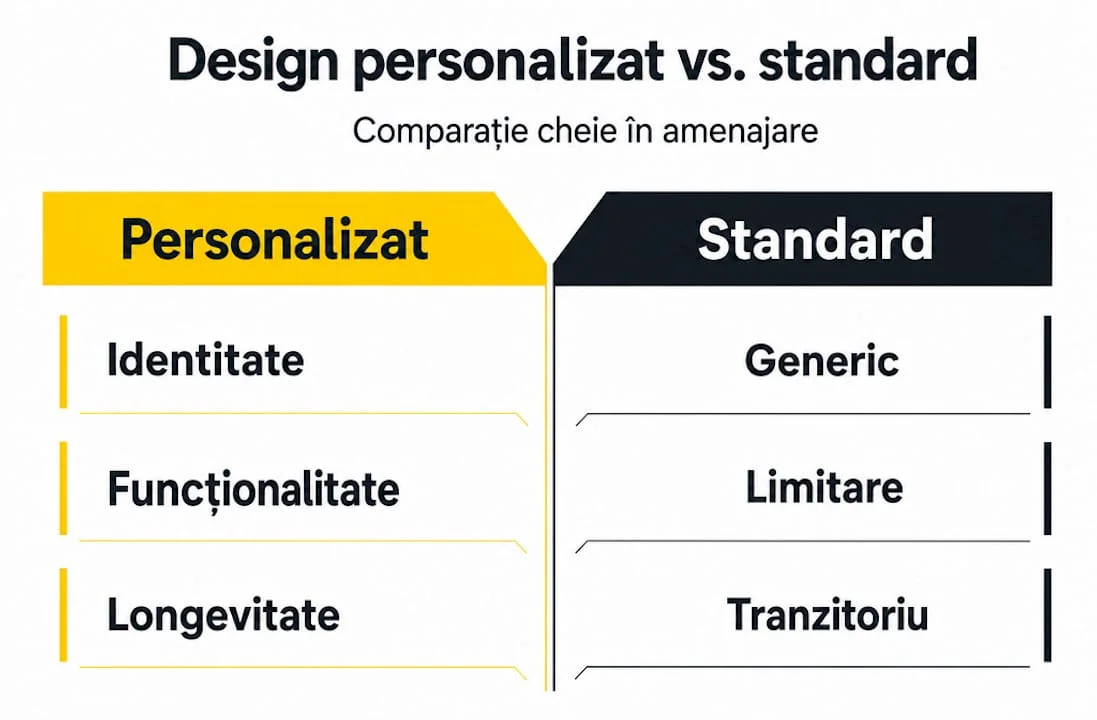
Design does not start from generic or copy-paste solutions, but from the real needs of the beneficiary, resulting in a unique spatial identity. This approach is what separates truly successful projects from those that look good in photos but do not work in reality.
There are alsopersonalization solutions at the level of constructive elements that can fundamentally transform the appearance and functionality of a space, from carpentry to integrated architectural details.
Professional tip: Before signing with a design team, ask these questions: How have you understood my brand identity? What solutions do you propose specifically for my context? Can you show examples of projects similar to my objectives? The answers will immediately tell you whether you are working with a team that personalizes or one that copies.
Essential steps for choosing and implementing a personalized design
Now that you know what personalized design means and looks like, you will discover how it is put into practice. The process is not complicated if you know what to look for, but it has clear stages that you cannot skip without consequences.
An interior design that creates a coherent aesthetic universe does not start from generic solutions, but from the real needs of the beneficiary. This is the premise you must start from as well.
Here are the essential steps, in the order they matter:
- Context and objective analysis. Before any discussion about aesthetics, it must be clear what you want to achieve. Do you want to increase sales? Attract premium tenants? Improve employee experience? Each objective directly influences design decisions.
- Initial consultation with a specialized team. This is not an optional stage. A well-conducted discussion with an experienced designer clarifies priorities, identifies real constraints, and establishes a realistic budget. By followingthe steps for personalized design, you will avoid many costly decisions.
- Defining the design concept. The concept is the "recipe," not the list of ingredients. It explains why a certain type of lighting, a certain material, or a certain spatial configuration supports your objectives. A good concept can be explained in a few clear sentences.
- Technical design. This includes execution plans, material specifications, technical solutions for installations, and construction details. Without solid technical documentation, implementation will be chaotic and costly.
- Implementation coordination. A design team involved in coordinating the work ensures that what was planned on paper is correctly translated into reality.Interior design project management is as important as the concept phase.
- Final evaluation and adjustments. After completion, an objective evaluation of the space against the initial objectives clarifies what worked and what can be improved.
The most common mistakes made by business owners are:
- Ignoring the analysis stage and jumping directly to aesthetics
- Choosing a designer based on a single project seen online, without verifying compatibility of approach
- Changing the concept during implementation, which generates additional costs and visual inconsistencies
- Underestimating the importance of on-site coordination
Risk management in design is a stage often ignored by owners, but essential to avoid unpleasant surprises during execution. Good risk planning can save between 10% and 20% of the total project budget.
Professional tip: Treat the design project as a business project, with clear objectives, deadlines, and well-defined budgets. Not as a free creative activity. This mindset completely changes the quality of results.
Why personalization remains the solution for the future: the SelfDezign perspective
There is a widespread idea that personalization is a passing fad, a trend that will fade. At SelfDezign, we do not believe that. In fact, we believe that ordinary articles about interior design tell only half the story.
Personalization does not mean choosing your favorite color for the sofa. It means that your space is aligned with your business strategy and values. This is a fundamental difference. An office that reflects the company culture retains talent better than any additional salary package. A commercial space designed around the actual buyer behavior sells more than one decorated according to the year's trends.
In a volatile economic context, such as that of Europe in the 2020s, personalized spaces offer a concrete advantage: they cannot be quickly copied by competitors. A standard formula can be replicated in a few weeks. An authentic concept, built on the identity of a specific brand, cannot be imitated without becoming a parody.
Real challenges exist, and we do not minimize them. Personalization involves longer design time, a higher initial budget, and a greater degree of involvement from the beneficiary. It is not a comfortable process for everyone. But the rewards are proportional: a space that lasts over time, attracts and retains, and functions as a selling point in itself.
What ordinary articles do not say is that personalization puts the greatest stress not on the designer, but on the client. You need to know who you are, what you want to convey, and what your real objectives are. Good design brings clarity to the surface where it exists, or exposes confusion where it does not. That is precisely whythe perspective on personalization that we promote always starts from an honest conversation about objectives, not from a catalog of options.
Personalization is not a fashion. It is a strategic tool. And those who understand this now have a real advantage over those who will realize it later.
Looking for personalized design for your space? Discover SelfDezign
At SelfDezign, we work with business owners and real estate investors from Romania and Europe who want more from their spaces. Whether it is an office, a commercial space, a restaurant, or a residential project, our approach always starts from your real objectives, not from catalog solutions. If you have read this article and feel that your space could do more for your business, you are in the right place. Explore ourinterior design for offices orresidential interior design services and discover what a project truly designed for you can look like. The first step can be a preliminary discussion, with no commitment, where we clarify priorities and possibilities together.