
Adaptive design: flexible solutions for modern spaces

Many business owners or real estate investors hear the term "adaptive design" and immediately associate it with websites that resize on a phone. This confusion is surprisingly common, but in the context of physical spaces, things are completely different.Adaptive versus responsiveis a distinction that belongs mainly to the digital world, not the world of bricks and mortar. If you are the owner of a commercial, hospitality, or residential space and want to understand how truly adaptive design can transform the value and functionality of your property, you are in the right place.
Key Ideas
|
Subject |
Details |
|---|---|
|
Clear Definition |
Adaptive design means the functional and aesthetic adaptation of a space for current and future needs. |
|
Added Value |
Applying adaptive principles can increase a property's value, comfort, and attractiveness. |
|
Sustainable Solutions |
Through adaptive reuse, buildings extend their lifespan and become more environmentally friendly. |
|
Do Not Confuse Concepts |
Adaptive design and responsive design are not the same thing – each has distinct applicability. |
|
Strategic Investment |
Specialized consulting maximizes the potential of adaptive design in any project. |
What Adaptive Design Means in Interiors
Adaptive design applied to physical spaces means the ability of a space to reconfigure itself and respond to the changing needs of users, without losing quality, comfort, or identity. It is not about furniture that "looks good in any corner," but about strategic thinking applied from the design phase, which makes the space remain relevant and functional in the long term.
The fundamental principles of adaptive design in interiors can be summarized as follows:
- Physical and functional flexibility:mobile partitions, open structures, and durable finishes allow reconfiguration without costly demolitions.
- Preservation of valuable elements:the aesthetic identity of a space, whether it involves historical elements or business branding, is preserved and integrated into the new function.
- Improvement of livability and comfort:natural light, ventilation, and accessibility become priorities, not compromises.
- Adapting function to the real context:an office that today houses 50 employees can be rethought tomorrow for 20, without becoming unusable.
The difference from responsive design in the physical sense is that adaptive design in interiors does not react automatically to external stimuli, but is deliberately planned to allow change. It is like building a flexible spine for a body: the structure remains, but movement becomes possible.
"A good space is not the one that looks perfect today, but the one that remains functional and attractive in five, ten, twenty years."
The role of the architect in interiorsis essential in implementing this concept, because adaptability is not improvised after plans are finalized. It is built from scratch, in the concept and technical design phase, through intelligent decisions regarding structure, materials, and usage flows.
Why invest in adaptive design: benefits for businesses and residential
Once the term is clear, it is time to discover what concrete gains this approach brings. And we are not talking about abstract advantages. We are talking about money, time, and real market value.
Increasing property valueThis is one of the most direct benefits. A space that can be quickly converted or reconfigured attracts more potential buyers or tenants and justifies a higher price. European real estate investors have already understood that properties with a high degree of adaptability withstand market changes better.
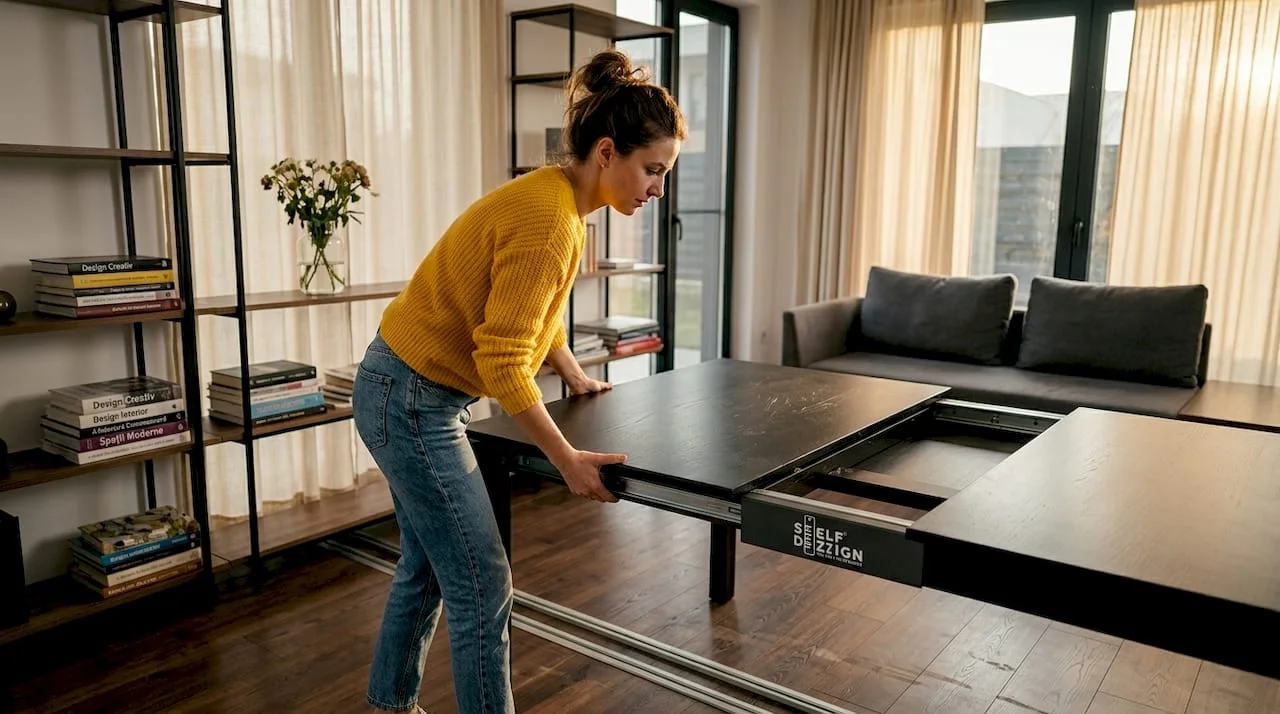
Sustainabilityrepresents a second major advantage.Sustainability indoorsdoes not only mean eco-friendly materials, but also extending the lifespan of a space through intelligent adaptation, thus reducing the need for new construction and resource consumption.
Here are some concrete examples of benefits:
- Offices converted into residential:the demand for living spaces in central areas of major European cities has driven the transformation of office buildings into modern apartments, with reduced structural costs compared to building from scratch.
- Reconfigured hotels:hotel spaces that have adapted their rooms for mixed use, such as serviced apartments, have increased occupancy rates by up to 30%.
- Modular commercial spaces:stores with a modular layout can quickly transition from retail to showroom or event space without major additional investments.
A highly relevant form for investors isadaptive reuse(reutilizarea adaptată): transforming an existing building from one use to another, with minimal interventions, improving comfort,light and ventilation.
Professional tip:Plan for adaptability from the project concept phase. The cost of integrating an adaptive design from the start is 3 to 5 times lower than the later conversion of a rigid space. Discuss 10- and 20-year usage scenarios with your designer or architect, not just today's function.
The benefits of acustomized design for businessesmultiply when adaptability is integrated into the overall vision of the space, not treated as a last-minute add-on.
Adaptive reuse: successful transformations in Europe
Let's see how these benefits translate into real projects. Europe is fertile ground foradaptive reuse, precisely because the existing built stock is vast, and demolition and reconstruction from scratch are often costly and impossible from a built heritage perspective.
Adaptive reuse as a sustainable solutionfor urban development is not a passing trend, but a logical necessity. European cities have millions of square meters of underutilized buildings that can be revalued through intelligent interventions.
A representative example is the One North Lofts project, described as "Adaptive. Retrofit": a former office complex transformed into residential spaces, with minimal structural interventions, preserving original architectural elements and dramatically improving living quality by optimizing access to natural light and ventilation.
What makes such a project work? A few success criteria are consistently repeated:
- Minimal structural interventions:the more you preserve of the existing structure, the lower the costs and the shorter the execution timelines.
- Maximizing comfort:light, air, acoustics, and accessibility are not details, but foundations of a livable space.
- Preserving historical and aesthetic identity:The original elements, whether industrial columns, exposed brick, or high ceilings, become assets, not obstacles.
- Integration of smart technology:Climate control systems, lighting, and security are easier to integrate during the conversion phase than later.
|
Project |
Conversion type |
Key results |
|---|---|---|
|
One North Lofts (Europe) |
Offices → Residential |
Reduced costs, preserved identity, increased livability |
|
Textile factory → Boutique hotel |
Industrial → Horeca |
Strong brand, authenticity, unique experience |
|
Port warehouse → Commercial spaces |
Infrastructure → Retail/Offices |
Heritage reuse, increased market value |
|
Bank building → Medical clinic |
Commercial → Medical |
Efficient functional adaptation, optimized flow |
Before launching such a project,commercial design consultancyis the step that makes the difference between a profitable project and one that exceeds the budget. Likewise, if you have a residential space in mind,personalized residential designstarts from a deep understanding of your needs, not from applying a universal template.
Creating anadaptive interior conceptis the process through which all these elements are coherently linked, giving the space a functional and aesthetic identity that is sustainable.
Adaptive vs responsive design: how not to confuse the concepts
The difference between adaptive and responsive design is essential for making informed decisions. Confusing the two terms can lead to faulty planning, wasted budgets, and unrealistic expectations.
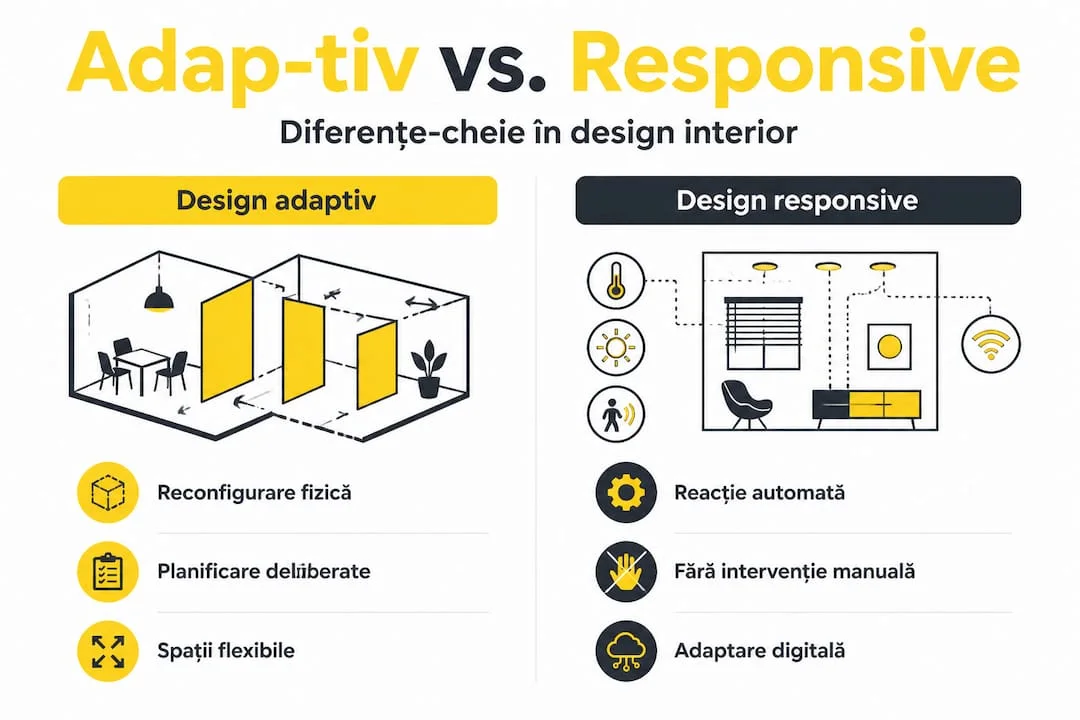
The terminology of adaptive versus responsive belongs primarily to digital design: responsive means a website fluidly readjusts to any screen size, while adaptive involves predefined layouts for specific breakpoints. Neither of these mechanics applies directly to physical spaces.
In the context of interior spaces, confusion arises when owners ask for "a responsive space," meaning one that "adapts automatically." The reality is that physical spaces do not reconfigure themselves; they are deliberately designed to allow reconfiguration. This is an important distinction, and ignoring it can lead to costly mistakes.
Here is how the two approaches compare in the context of a physical space:
|
Criterion |
Adaptive design (physical spaces) |
Responsive design (digital) |
|---|---|---|
|
Mechanism |
Deliberate planning for reconfiguration |
Automatic adaptation to screen size |
|
Flexibility |
Physical, through structure and furniture |
Visual, through code and layout |
|
Cost of change |
High initial investment, low future costs |
Development costs |
|
Long term |
Relevant over 10 or 20 years |
Relevant over 2 or 5 years |
|
Identity |
Preserved and evolved |
Adapted to the device |
A few common mistakes generated by this confusion:
- Purchasing "modular" furniture without a space strategy:furniture modularity means nothing if the space structure does not allow effective reconfiguration.
- Removing load-bearing walls without structural analysis:the desire for "open and adaptive space" without consulting a specialist can compromise safety and exponentially increase costs.
- Neglecting technical infrastructure:electrical, ventilation, and plumbing systems must be designed adaptively from the start, otherwise any later reconfiguration involves major interventions.
- Confusing adaptability with minimalism:an empty space is not necessarily adaptive; a well-designed space can be aesthetically rich and yet extremely flexible functionally.
Professional advice:Before deciding on the approach for your project, ask yourself: "What can change in this space in five years?" If you don't have a clear answer, it means you need a strategy session with a designer or architect, not a furniture list. The impact on long-term sustainability depends precisely on this strategic clarity from the first phase.
About adaptive design: our perspective
The experience we have accumulated in projects for offices, Horeca spaces, clinics, and residential has shown us something contradictory to what is commonly said in the market: most failures in adaptive projects do not stem from a lack of budget or technology, but from a lack of a clear long-term adaptability strategy. Clients come with a vague desire for "flexible space" and expect the designer to magically solve it. But flexibility is not a style; it is a structural and functional decision made long before choosing the wall color.
Another myth we frequently encounter is that adaptive design sacrifices the identity of the place. On the contrary. The most successful projects we have seen or created are those where adaptability and the strong character of the space coexist. A restaurant that can transform a section into a private space for events does not lose its atmosphere; on the contrary, it becomes more valuable and memorable.
The success of an adaptive project essentially depends on real collaboration between architects, interior designers, and the client. It is not siloed work.Workflow in adaptive projectsshows that the best results occur when the client actively participates in defining future usage scenarios, and the project team translates these scenarios into coherent technical and aesthetic solutions.
We believe that adaptive design is not a luxury reserved for investors with huge budgets. It is a design mindset, available at any scale, as long as it is approached with seriousness and long-term vision.
Discover customized adaptive design solutions with SelfDezign
At SelfDezign, we approach each project starting from understanding your real context and long-term objectives, not from applying standard formulas. If you have an office that needs to be rethought, a Horeca space that needs to attract a new customer segment, or a residential property you want to adapt for mixed use, our team has the experience and methodology to turn these objectives into concrete solutions. Explore our solutions forinterior design for offices,adapted residential solutionsorinterior design for Horecaand discover how a well-thought-out concept can make the difference between a space that works today and one that brings value for decades.