
Sustainability in interior design: real benefits for businesses

TL;DR:
- Sustainability in interior design optimizes costs and increases the value of spaces.
- Certified materials and certifications such as LEED, BREEAM, and WELL are essential for efficiency.
- The circular economy and furniture reuse bring long-term financial and image benefits.
Sustainability in interior design is no longer an aesthetic fad reserved for brands with green pretensions. Energy savings of up to 27% are already documented in commercial and office spaces that have coherently integrated sustainable principles. If you are a business owner or real estate investor, this means lower operational costs, happier tenants, and a higher market value for the property. This article shows you concretely how sustainability works in interior design, which materials and certifications truly matter, and how to turn a higher initial investment into a long-term competitive advantage.
Key Takeaways
|
Point |
Details |
|---|---|
|
Validated materials |
Choose eco-friendly materials with authentic certifications to reduce carbon footprint and ensure optimal health. |
|
Applied circularity |
Reuse and recycle furniture to maximize ROI and gain real competitive advantages. |
|
Measurable savings |
LEED, BREEAM, and WELL certifications ensure energy savings and premium rents, increasing the value of any property. |
|
Avoid greenwashing |
Verify the traceability of materials and collaborate only with partners who can prove real sustainability. |
What sustainability in interior design means and why it matters
Sustainability in interior design is not limited to using decorative plants or choosing "natural" colors. It is a structured strategy covering four essential dimensions: materials safe for health, energy efficiency, ergonomics for users and long-term business logic.
Concretely, a sustainable space involves deliberate choices at every stage of the project, from selecting suppliers to how the space will be used and maintained over 10 years. If you want to better understand how such a project is built from scratch, the concept of interior design is the right starting point.
Here is what sustainability applied in a real way involves:
- Certified materials (FSC for wood, low-VOC for paints and adhesives) that reduce exposure to harmful substances and improve indoor air quality
- Biophilic design, meaning the integration of natural elements (natural light, vegetation, organic textures) that increase productivity and reduce occupant stress
- Efficient energy systems, including smart LED lighting, optimized thermal insulation, and occupancy sensors
- Life cycle strategy for furniture and finishes, so that future replacements are simple and have minimal impact
Eco-friendly materials (FSC, low-VOC) reduce the carbon footprint and improve the perceived quality of the space, which translates directly into client and employee satisfaction.
For real estate investors, the relevance is even more direct. Certified or sustainably designed spaces attract higher-quality tenants, justify higher rents, and have lower maintenance costs. Following interior design trends for 2026, sustainability is no longer a niche option, but a basic market expectation.
Eco-friendly materials and criteria for smart selection
Material selection is where sustainability becomes tangible or remains just a marketing promise. There is a huge difference between a material that seems ecological and one that can be verified and certified.
|
Material |
Main benefits |
Risks to avoid |
|---|---|---|
|
FSC-certified wood |
Full traceability, durability |
Suppliers without documentation |
|
Bamboo |
Rapid growth, good resistance |
Adhesives with formaldehyde |
|
Natural textiles (linen, hemp) |
Biodegradable, premium look |
Dyeing with toxic substances |
|
Low-VOC paints |
Healthier indoor air |
False labels, greenwashing |
|
Recycled materials (glass, metal) |
Waste reduction, visual uniqueness |
Variable quality without certification |
FSC-certified wood, bamboo, and low-VOC paints reduce the carbon footprint and can be verified through clear supplier documents. Trust in the quality of secondary materials is an essential criterion in any serious circular project.
What to check concretely at purchase:
- Visible and verifiable certifications: FSC, Cradle to Cradle, GREENGUARD, Oeko-Tex
- The product technical sheet which includes chemical composition and VOC emissions
- Material origin: where it comes from, how it was processed, how far it was transported
- Warranty and durability: a sustainable material must last over time, not be replaced frequently
Greenwashing is a real problem in the industry. A label with green leaves and the word "eco" means nothing without documentation. Look for suppliers who can prove the source of materials with documents, not just verbal promises.
Professional tip: Always ask for the product performance declaration and check whether the certification is issued by an independent accredited body, not by the manufacturer itself. You can consult sustainable construction trends to understand which standards are becoming the norm in Europe.
For a realistic budget estimate, consult information about the costs of eco-friendly materials before making purchasing decisions.
Circular principles and furniture reuse: how ROI increases
The circular economy applied in interior design means that a space is no longer conceived as a one-time investment, but as a system that can adapt, be refurbished, and be reused over time. This is the difference between a project that costs and one that pays off.
Concretely, a circular process looks like this:
- Auditing the existing space to identify which furniture and finishes can be kept or refurbished
- Refurbishing and repositioning pieces with aesthetic and functional potential
- Selective purchasing of new materials, prioritizing those with a long lifespan
- Documenting components to facilitate future replacements or recertifications
- Planning disassembly from the design phase, so that materials can be recovered at the end of their life cycle
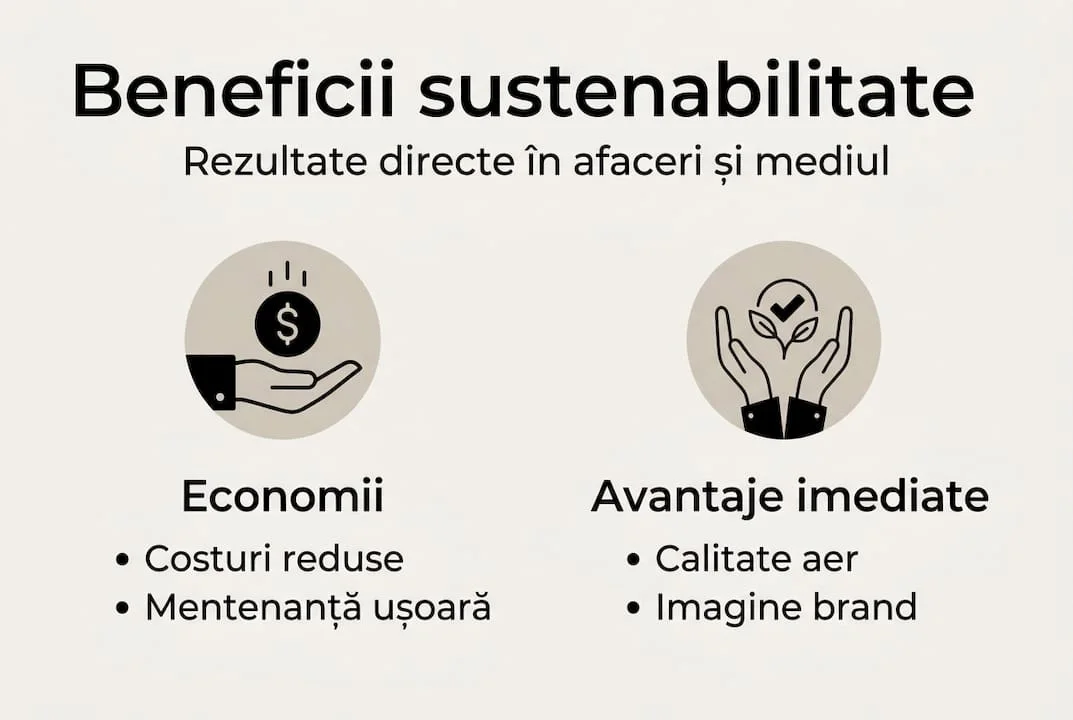
Reusing 30% of furniture and materials as a circularity principle brings measurable economic efficiency. A restaurant that refurbishes existing chairs and tables instead of replacing them completely can save between 15% and 25% of the fit-out budget.
|
Type of intervention |
Estimated savings |
Visual impact |
|---|---|---|
|
Furniture refurbishment |
15-25% compared with full replacement |
High, with brand story |
|
Reusing metal structures |
10-20% of total cost |
Medium, requires reprocessing |
|
Flooring reuse |
8-15% of budget |
Variable, depends on condition |
|
Lighting refurbishment |
5-12% of budget |
High with LED upgrade |
For commercial and horeca spaces, circularity brings an additional advantage: the brand story. End clients appreciate the authenticity of a space with character, not one decorated with identical catalog pieces.
Professional tip: Keep a digital register of all reused components, with photos and technical specifications. This greatly simplifies the certification process and demonstrates commitment to sustainability with concrete data, not statements. You can explore more ideas about the concept of circular fit-out for your space.
Energy efficiency and measurable results: certifications, savings, and advantages
Sustainable certifications are the tool through which sustainability becomes a negotiation argument, not just good intentions. In Europe, the three most relevant for commercial and residential projects are:
- LEED (Leadership in Energy and Environmental Design): the most globally recognized, with emphasis on energy efficiency and indoor environmental quality
- BREEAM (Building Research Establishment Environmental Assessment Method): a strong European standard, with assessment across multiple categories
- WELL: focused exclusively on occupant health and well-being, ideal for offices and premium retail spaces
LEED, BREEAM, and WELL certifications bring measurable savings of over 24-27% in energy consumption and allow owners to request premium rents compared with conventional spaces.
The real difference compared with a non-certified space is not only ecological. A WELL-certified office, for example, reports employee retention rates up to 11% higher, which for an owner means stable long-term tenants. A BREEAM-certified commercial space can justify rent 5-10% higher than the local market average.
Concrete benefits for owners and investors:
- Reduced operational costs (energy, water, maintenance)
- Access to green financing and preferential rates
- Higher resale value
- Increased attractiveness for quality tenants
- Reduced risk of rapid property depreciation
An important note: not every space can be transformed 100% sustainably without significant infrastructure investments. Old buildings, for example, may require costly structural interventions to meet the energy efficiency standards required by certifications. The realistic approach is to prioritize interventions with the best cost-benefit ratio.
Myths, challenges, and common mistakes in sustainable interior design
Even with clear arguments in favor of sustainability, there are fears and misconceptions that block the investment decision. We address them directly.
The most common myths:
- "Sustainable is expensive and I can't afford it" — The initial cost may be higher, but it is amortized through operational savings in the medium term. The budget difference compared with a conventional project is often 10-20%, not 50-100% as is believed.
- "Eco materials look rustic or improvised" — False. Bamboo, natural stone, reclaimed wood, and certified textiles can create luxury spaces with authentic character.
- "Sustainability is only for new buildings" — Circular principles and eco materials apply just as well in renovations and refurbishments.
- "Any product with a green label is sustainable" — Greenwashing is real and frequent. Always verify the documentation.
- "I can't certify a small space" — Certifications are not reserved only for large commercial projects.
"Sustainability does not limit aesthetics, it can improve it," says Unsustainable Magazine, highlighting that the natural imperfections of authentic materials add character and visual uniqueness.
Practical solutions for every challenge:
- For initial cost: prioritize interventions with rapid ROI (lighting, insulation, furniture reuse)
- For greenwashing: work with designers who have direct relationships with certified suppliers
- For traceability: document every purchase with the technical sheet and certificate of origin
- For scalability: implement gradually, starting with the areas with the greatest energy impact
To plan the budget correctly from the start, consult resources about budgeting a sustainable project before hiring the design team.
From the SelfDezign team's perspective: real sustainability is not about compromises
After working on sustainable projects for commercial, horeca, and office spaces, we have noticed a constant pattern: the clients who achieve the best results are not those with the largest budget, but those who understand that sustainability starts from functionality, not from materials.
A space with bamboo on the walls and smart LEDs, but with poorly thought-out circulation flow, is not sustainable. It is ecologically decorated. The difference is essential.
Clients who integrate circularity and certifications into their business logic see a higher ROI than traditional approaches, not because they spent more, but because they spent more intelligently. Selecting verified suppliers, documenting components, and long-term planning are the real tools of sustainability.
Our practical recommendation: before any purchasing decision, ask the design team to justify every material choice in terms of lifespan and total cost of ownership, not just initial price. You can check how this translates into real costs by consulting information about design efficiency for different types of spaces.
Do you want a sustainable, clear, and efficient solution? Collaborate with SelfDezign
If you have made it this far, sustainability is probably no longer an abstract idea for you, but a business decision you want to make correctly. The SelfDezign team works with business owners and real estate investors in Romania and Europe to transform commercial spaces, office design, horeca, and residential environments into spaces that function well, look good, and cost less over time. Our processes are transparent, materials are verified, and implementation is coordinated from concept to completion. If you want to find out concretely what can be done for your space, start with a free consultation and we will establish priorities together.
Recommended
- Interior designer collaboration guide: business and investments
- SelfDezign Blog | Guides and best practices in interior design
- interior design project price | SelfDezign Blog Articles
- Interior design trends 2025 | SelfDezign
- Top Benefits Of 3D Visualization For Architects
2026 trends in interior design sustainability
Sustainability has moved from trend to mandatory requirement for companies with ESG reporting. Data from the USGBC 2025 report shows that certified green spaces reduce operational costs by 15-20% in the first five years:
- LEED and BREEAM certifications become a competitive advantage — large multinational companies refuse to lease or open branches in buildings without green certification.
- Circular economy in furniture — recovering and reusing materials from previous fit-outs reduces costs by 25-40% and the project's carbon impact.
- Local biocomposite materials — Romanian producers of sustainable materials (linen, hemp, FSC-certified wood) offer competitive alternatives to imports in 2026.
- Indoor air quality monitoring — IoT sensors integrated into the project provide real-time data on CO₂, humidity, and particulates, with a direct impact on employee productivity.