
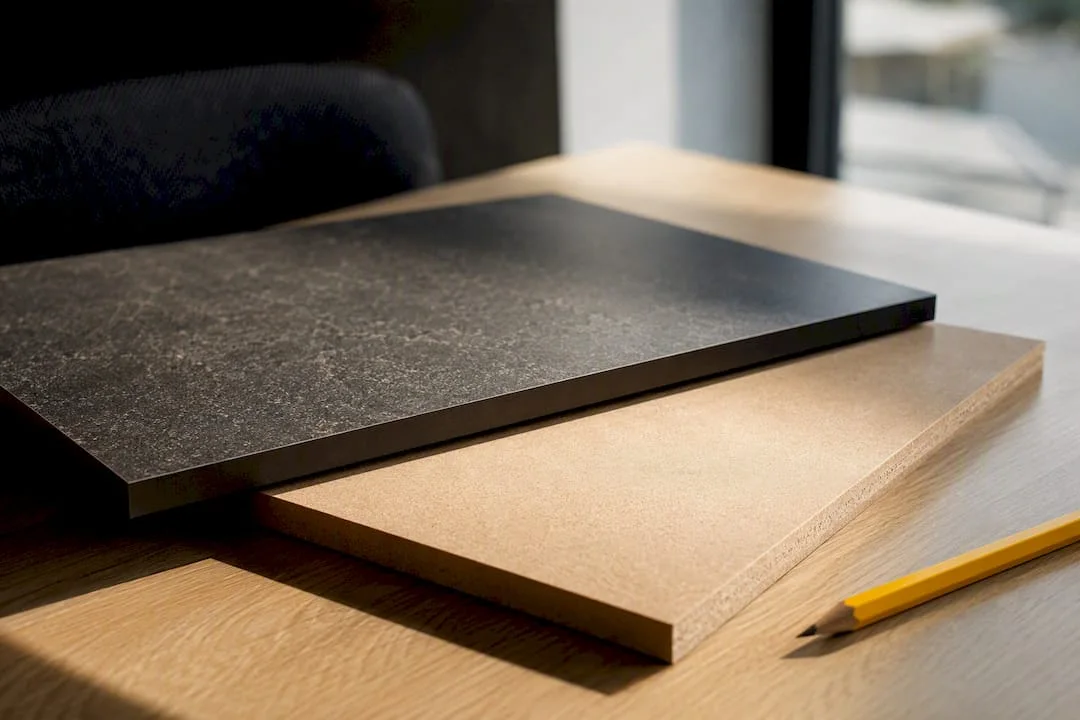
7 scenarios that decide when to choose HPL or MDF in furniture and furnishings
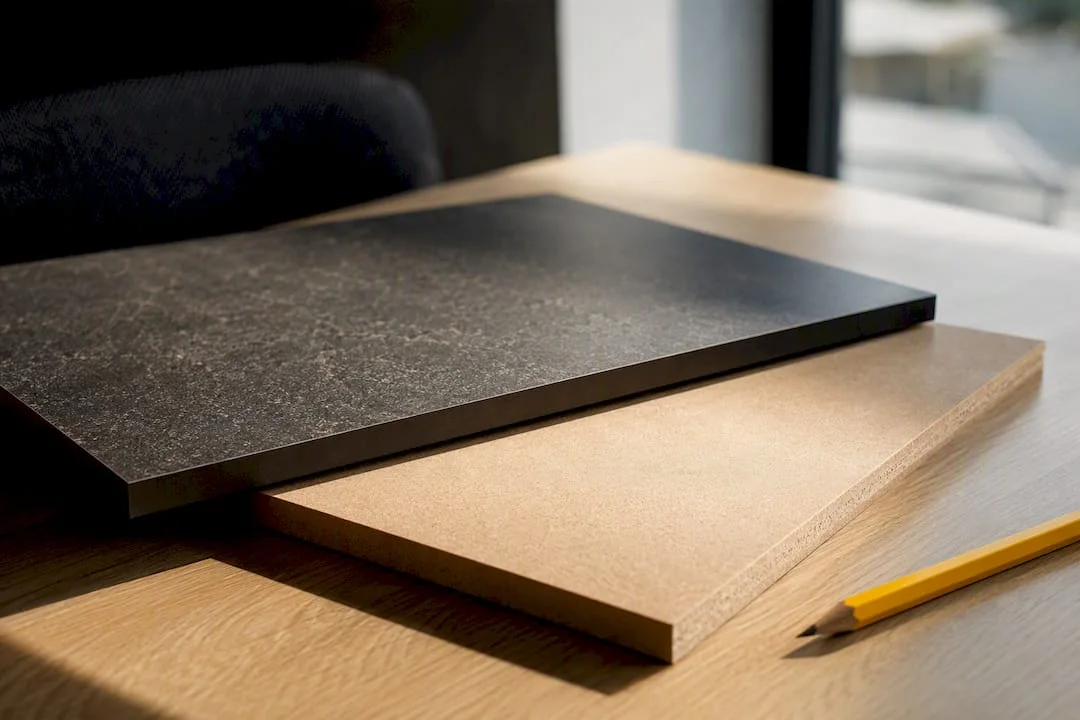
For exposed surfaces, areas with heavy traffic or moisture, the right choice is HPL. For dry elements with fine details and painted fronts, MDF remains the more suitable solution. The difference does not depend on which material is "better", but on what the space requires: surface resistance or freedom of processing. The rest of the article explains exactly where you draw the line.
In summary:
- For surfaces exposed to moisture or heavy traffic, HPL compact offers superior strength and durability than MDF.
- MDF is recommended for painted fronts or decorative elements, but requires correct bandaging to avoid swelling of the edges when in contact with water.
- The choice of material depends on the demands of the space, not on which is "better", and practical execution decides the longevity of the investment.
- Recommended thicknesses for HPL in heavy traffic projects start at 12 mm, while MDF for furniture is typically between 16 and 19 mm.
- In areas with moderate humidity, treated water-repellent MDF may be an acceptable solution, but in wet areas, HPL remains the preferred option for durability.
HPL vs MDF: Quick comparison on criteria that matter
Before choosing a supplier or specifying a material in the specification, it is worth seeing how the two materials behave on the criteria that actually influence the outcome of a project.
|
Criteriu |
HPL |
MDF |
|---|---|---|
|
Durability/Fatigue |
High scratch and impact resistance, ideal for heavy traffic |
Moderate; surface degrades faster without protective finish |
|
Moisture resistance |
Very good, especially compact HPL with phenolic core |
Weak; irreversibly swells if the edge is not protected |
|
Ease of processing |
Limited; cutting and milling requires specific tools |
Excellent; easy milling, rounding and painting |
|
Aesthetic appearance and finishes |
Wide range of textures and decors, uniform appearance on large surfaces |
Ideal for painting varnish, matt or painted finishes |
|
original cost |
Higher per square meter |
Smaller at purchase |
|
Application Recommendation |
Countertops, sanitary partitions, high-traffic furniture |
Painted fronts, dry interior furniture, decorative elements |
|
Edge/finish requirements |
Requires professional banding or compact HPL edge |
Mandatory banding on any edge exposed to moisture |
A few remarks are worth keeping in mind from this picture:
- HPL wins decisively at durability and behavior in wet environments, but the actual performance depends on the quality of the edges:poorly made edges and joints allow water to enterno matter how good the laminate is.
- MDF gains in processing and initial cost, but loses all advantage if the cut edge remains unprotected in wet areas.
- No material “solves” the edge problem on its own. Execution decides if the investment lasts over time.
MDF: composition, when to use it and what to check
MDF (medium density fiberboard) is a panel made of resin-pressed wood fibers, more homogeneous and easier to process than classic chipboard. HDF is the higher density version, used where you need additional mechanical strength, for example on edges or laminate floors.
The practical advantages are clear: it is milled, rounded and painted like a fake solid wood, without visible fiber that would complicate a lacquered finish. The initial cost is lower than HPL, which is why it remains the preferred option for painted kitchen fronts or furniture with complex shapes.
The limitations are equally clear. MDF is not waterproof naturally and the cut edge absorbs moisture and irreversibly swells if not properly bandaged. On large panels, the structural capacity decreases without frames or stiffening structures.
- Water-repellent MDF (green, treated version) is mandatory in bathrooms, kitchens or areas with high humidity.
- Always ask for the data sheet for density, emission class and moisture resistance before confirming the order.
Professional advice: When requesting water-repellent MDF, check on the data sheet the inflation value at 24 hours in water (percentage of thickness). A value well above the standard declared by the manufacturer is a signal that the board does not correspond to the promised class.
HPL: variants, performance and what the correct installation requires
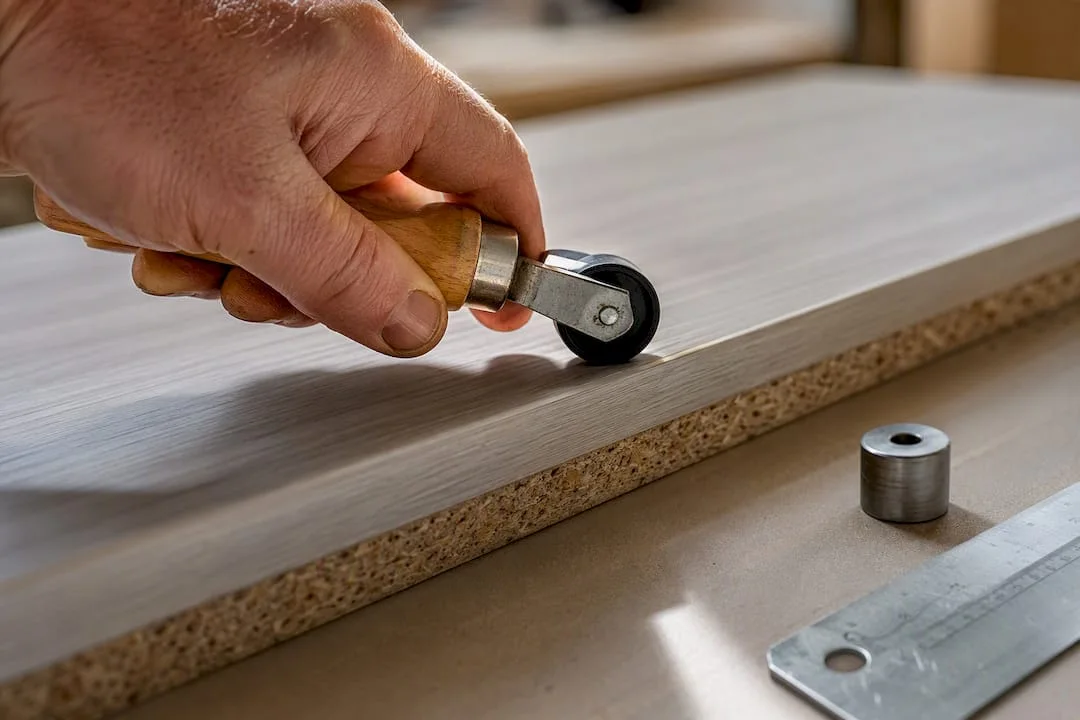
There are two distinct types of HPL, and the confusion between them generates most of the project problems. The first is the decorative laminate obtained by pressing at high temperatures and pressures the resin impregnated paper layers, applied on a substrate such as MDF or CHIPBOARD. The second is the compact HPL, a solid, self-supporting panel with an impregnated core all over the section.
The difference is not cosmetic. The compact HPL with phenolic core is fully waterproof throughout its thickness and specialist sources recommend it for sanitary partitions, laboratories and permanently wet areas. HPL bonded to MDF provides the same hard surface and resistance to scratches and stains, but the edges remain vulnerable if bonding is not tight.
- The HPL surface resists frequent cleaning well, making it suitable for commercial kitchens and high-traffic areas.
- The correct substrate and the banding executed by an experienced carpenter make the difference between a countertop that lasts 15 years and one that detaches in two.
- In areas with constant splashing, the compact HPL reduces the risk of edge infiltration, which the glued variant cannot completely eliminate.
Practical variants and applications: concrete project scenarios
The decision is made scenario by scenario, not at the material level in the abstract; for a practical comparison between materials for interior doors, seewhat type of doors are best for the interior. Here's how the HPL vs MDF distinction basically translates into current projects:
- Kitchen or bathroom countertop.Choose HPL, ideal compact, for water resistance and impact. Acrylic taping on the edges prevents infiltration at the joint areas with the sink.
- Furniture fronts painted, matte or varnish.Choose MDF. The homogeneous surface absorbs the varnish evenly, without the porosity of a laminate.
- Sanitary partitions or partitions in public spaces.Choose compact HPL with recommended minimum thickness of 12 mm for repeated impact resistance.
- Commercial furniture with heavy traffic (receptions, counters).Choose HPL for direct contact areas; painted MDF can complement the less exposed sides.
- Shelves and office fixtures without exposure to moisture.MDF is sufficient and more economical, especially on parts with milled shapes.
- Professional kitchen cabinets (horeca).HPL on work areas, MDF painted on decorative fronts in splash-free areas.
- Limited budget, but moderate damp area.Water-repellent MDF with quality acrylic banding may be an acceptable compromise, but it does not replace HPL in areas with constant splashing or high traffic.
What specifications to ask for when bidding: thicknesses, edges and certifications
A well-written material specification prevents most problems discovered only during assembly. Recommended thicknesses vary by application: 12 to 18 mm for sanitary partitions with compact HPL, 8 to 10 mm for interior decorative elements. For MDF, the standard thickness for furniture fronts is between 16 and 19 mm, with 22 mm variants for structural parts.
The type of edge matters as much as the base material. PVC is economical and suitable for dry areas, ABS better withstands impact and temperature, and acrylic offers the best sealing on water-exposed countertops. For highly stressed edges, a full-section colored HPL core eliminates the visible splice line, a detail that observer customers immediately notice.
- Ask for the data sheet of the laminate, with density, abrasion resistance class and moisture behavior.
- Ask for the humidity test report, especially for commercial or medical projects where hygiene is critical.
- Check formaldehyde emissions certification (class E1 or E0), mandatory for residential and medical spaces.
- At the reception, ask for a sample cut to the edge: checking the cross-section is the fastest way to distinguish genuine HPL from a foil panel labeled wrong.
For countertops and exposed surfaces, industry sources show that HPL, especially with phenolic core or compact variant, offers the lowest total cost of ownership over the life of the part, due to its durability and low maintenance.
Maintenance, cost and durability over time
The initial investment in MDF is lower, but the total cost changes radically if the part stays near the water without adequate protection. HPL costs more on purchase, but recovers the difference through longer service life and minimal maintenance.
- HPL: wiping with neutral detergent, no abrasives; does not require periodic lacquering.
- Painted MDF: requires lacquer touch-ups at 3 to 5 years in traffic areas, more often in kitchens.
- Service life in commercial environments: HPL can last 10 to 15 years without visible degradation; painted MDF requires more frequent surface renovation.
- Refurbishment makes sense on MDF (grinding and repainting); on damaged HPL, panel replacement is usually more effective than repair.
SelfDezign perspective: integrating material into concept and execution
At SelfDezign, the choice between HPL and MDF is not made in isolation from the rest of the project. We look at three criteria: how exposed the part is to moisture and traffic, how complex the geometry is (milled fronts, round corners) and how often the respective surface will be used on a daily basis.
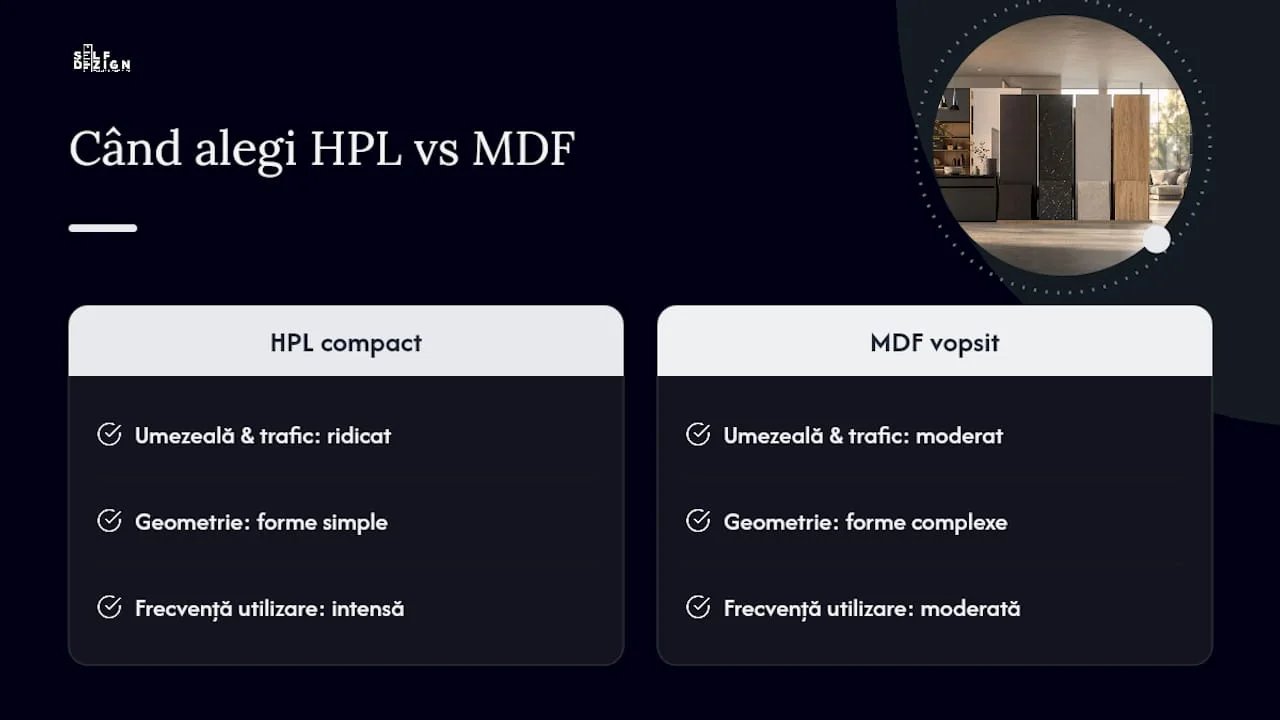
In commercial and hospitality projects we usually recommend HPL compact for countertops, counters and partitions, because the customer cannot afford to resume the work in two years. In residential or office projects with moderate traffic, painted MDF remains the right choice for custom fronts and furniture, where aesthetics and freedom of form matter more than extreme water resistance.
What we deliver specifically to the customer: a technical detail book with the exact material and thickness specifications, site checks at the board reception and direct coordination with the carpenter for correct banding and edge mounting.
Toni
How SelfDezign helps you choose and specify the right material
Beyond the choice of material, the correct execution depends on a well-written technical specification and coordination on site, two things that many project owners underestimate.technical designturns the choice of HPL vs MDF into a clear specification, with thicknesses, types of edge and certification requirements set before the work starts, not discovered after assembly.
For commercial projects, offices or hospitality spaces, our team ofoffice interior designcoordinate directly with suppliers and carpenters to ensure material specifications are met on site, not just on paper. If your project is residential, the service ofresidential interior designcovers exactly this type of decision, from the visual concept to the final technical specification. If you want to avoid a wrong choice of material that is only discovered at the reception, talk to us about your project before signing the offer with the carpenter.