Tile vs roll carpet: which one to choose for your office
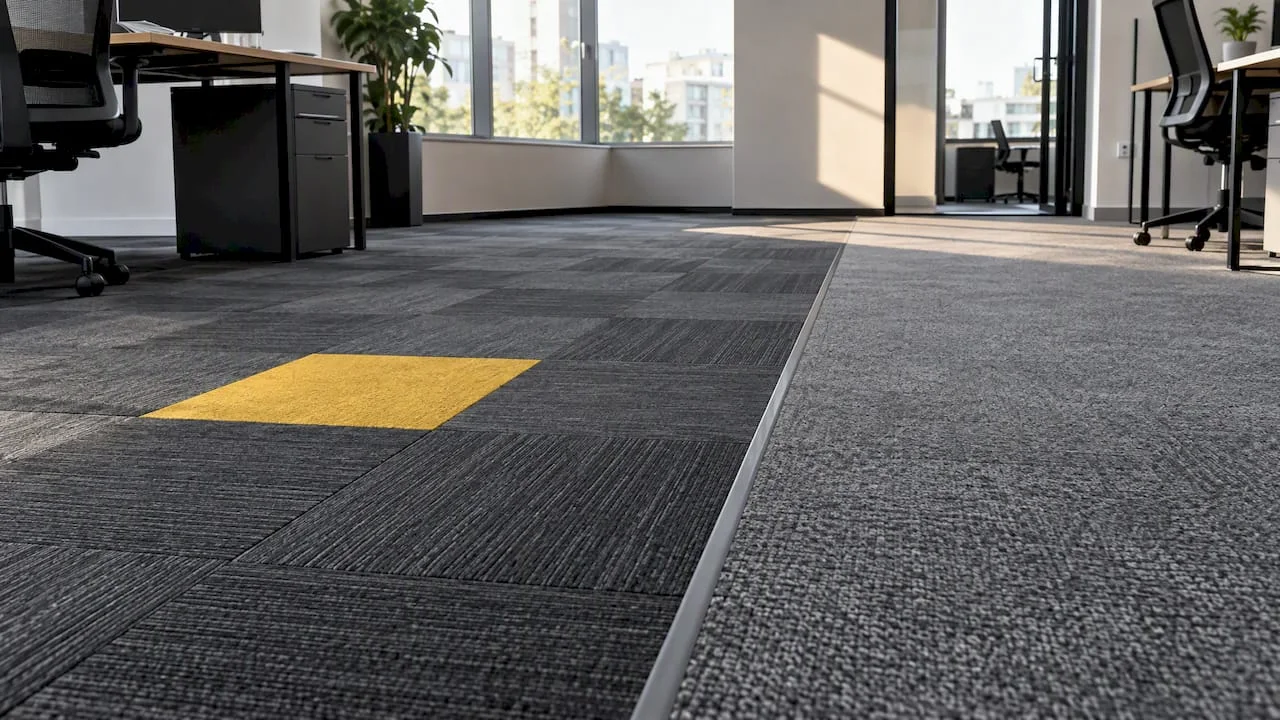
For spaces with variable traffic, technical areas or need for local replacement, choose carpet in tiles. For large, continuous surfaces, where the unitary appearance prevails, the roller is the right choice. The decision is based on three factors: the flexibility of assembly and repairs, the cost of long-term maintenance and the way the space must look every day. We break down each criterion below.
In summary:
- The mounting losses reach 3–4% for tiles and about 10% for the roller; ask for the cutting plan before confirming the quantity.
- Punctually fixed tiles are suitable for technical floors, but the installation without integral gluing requires special anti-slip elements for stability.
- The theoretical duration of the tiles is 10–15 years, but commercial projects often replace them after 7–10 years for aesthetic reasons.
- In showrooms and stores, combine the roller in the exhibition areas with the color tiles and near the technical access, according to the traffic of each area.
SelfDezign
Set up a team-friendly office
SelfDezign provides interior concept, technical design and implementation coordination, adapted to the context and objectives of the project.
Technical differences: format, materials and construction
Carpet tiles usually come in a standard format of 50×50 cm, with thicknesses between 5 and 10 mm and a weight of 3.5-5 kg per square meter, as shown carpet tile reference datasheet. The roll, on the other hand, is delivered in large, continuous widths, designed to cover large areas without visible joints.
The structure of the two products differs significantly. The wear layer (piles), the backing and the eventual sponge layer (padding) directly influence the traffic behavior, the sound insulation and the way the product absorbs the impact of the steps. On tiles, the backing is thought to provide individual dimensional stability so that a single piece dismantled does not affect the rest of the surface.
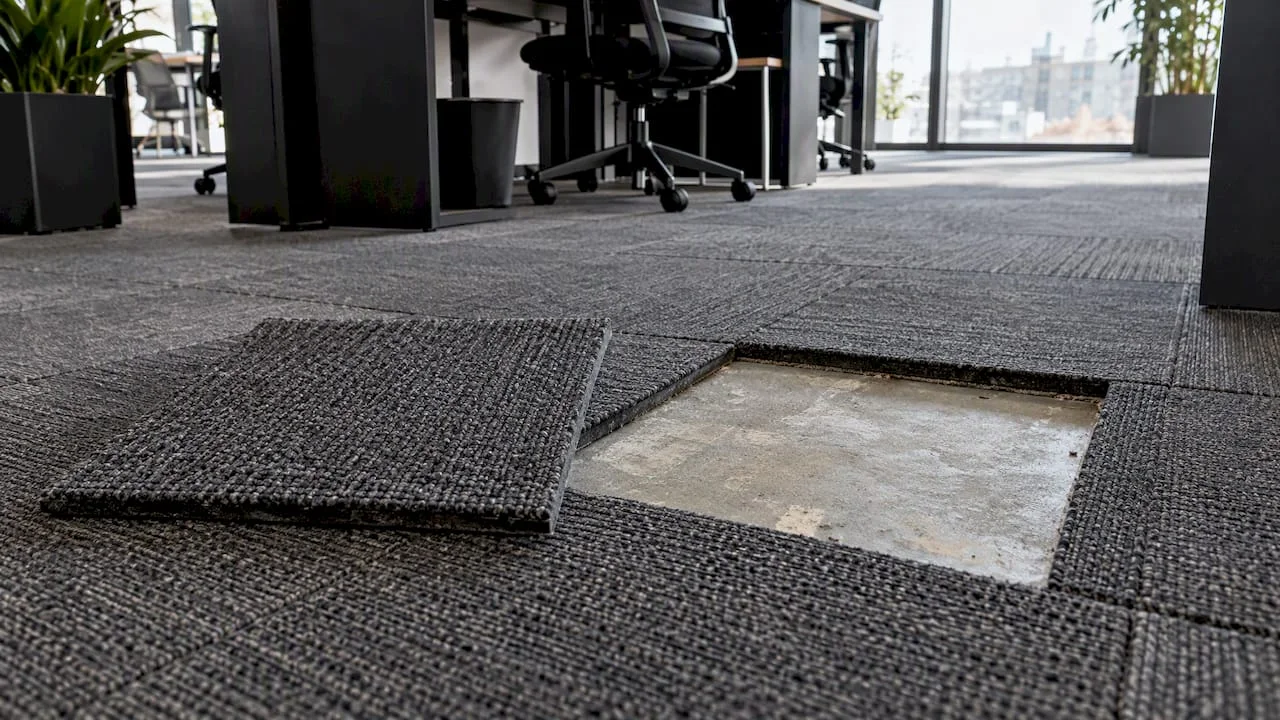
An important technical concept is the “self-laying” mounting, i.e. tiles without glue on the entire surface, fixed only punctually with low adhesion adhesives, a solution also available for modular containers such as those listed on Noleggio Tiny Space - Container. The installation recommendations for this type of tiles specify the use of specific anti-slip fastenings when it does not fully stick, according to installation notes for self-laying tiles. This method works well on technical floors (double floro), where regular access to installations is a requirement, not a fad.
The differences in construction are basically translated as follows:
- The slabs provide individual dimensional stability and allow the removal of a single piece without disturbing the rest of the surface.
- The roller provides visual and structural continuity, but a local damage affects a larger portion of the carpet.
- Self-laying reduces the need for full-surface glue, which helps to easily access technical floors.
Installation and costs: practical calculations before ordering
The mounting method directly influences the budget and the execution time. The roller is usually installed by integral gluing on the screed, which means thorough surface preparation and a drying time of the adhesive. The tiles allow either spot bonding or completely non-adhesive systems, which reduces the time to commission the space.
Cutting losses differ considerably between the two formats. The Modulyss data sheet shows an assembly waste rate of 3-4% for tiles, compared to approximately 10% for the roller, according to modulyss technical documentation for tile carpet. The difference comes from the way the small parts adapt to corners and irregularities, while the roller requires extensive cuts to follow the exact perimeter of the room.
The practical steps for a correct estimate, before requesting a quotation, are:
- Measure the actual area and add a margin for losses, higher for the roller than for the tiles.
- Check the type of existing floor (screed, technical floor) to decide the method of fastening.
- Determine whether the space needs regular access to installations, in which case self-laying tiles are more practical.
- Ask for a cutting plan (stereotomy) before ordering, not after.
Professional advice: ask the supplier for the cutting plan before confirming the quantity, not vice versa, to avoid additional emergency orders.
A cutting plan made by a specialist before ordering optimizes the material consumption and ensures the coherence of the wire direction, according to the recommendations of good practice in technical standards regarding the installation of floors. The cost of labor varies depending on the method, but tile installation tends to be faster on segmented surfaces, because teams can work in parallel on different areas without waiting for the adhesive to dry all over the surface.
Sustainability and maintenance: what you want in the long run
The right choice depends on the traffic class of the space. An office hallway with constant flow of people requires a product resistant to repeated compression, while a residential area or a less circulated cabinet tolerates lighter variants.
Some practical criteria for the decision:
- Spaces with heavy traffic (receptions, main aisles) benefit from tiles, because the damaged parts are replaced locally, without changing the entire carpet.
- Residential spaces or small offices with moderate traffic can use the roller without the risk of premature wear on certain areas.
- Regular professional cleaning extends the life of both variants, regardless of the format.
- For areas prone to stains (serving areas, office kitchens), the tiles allow quick change of the affected part.
The theoretical service life of carpet tiles is 10-15 years, but in practice many commercial projects replace them after 7-10 years for aesthetic reasons, according to the technical data on carpet tiles. This figure shows that physical durability is not always the deciding factor: the image of the space and the updating of the design concept play an equally important role in the replacement decision.
Aesthetics and Design Options: How Space Perception Influences Choices
The roller creates a continuous surface without dividing lines, which works well when the space needs to look unitary and calm, without points of visual attention. Tiles, in contrast, allow combinations of colors and textures that can delineate functional areas without walls or other physical barriers.
Practical principles of working with tiles:
- Use a dominant color for traffic areas and a different shade for work or relaxation areas.
- Alternate thread direction between rows of tiles for a controlled depth effect.
- Keep the color palette aligned with the visual identity of the brand, not with a passing trend.
- In HORECA premises and medical clinics, combine aesthetics with functional requirements such as stain resistance and easy sanitation.
For HORECA spaces, zoning with colored tiles can visually guide the flow of customers without additional signaling elements. In medical clinics, a calm and uniform palette, obtained either by roller or tiles of the same shade, supports the perception of order and hygiene, essential for patient comfort.
Practical recommendations by scenarios: office, store, residential, HORECA
The final decision depends on the specific context of the space, not on a universal rule:
- Open-space office: tiles are the right choice, because they allow local replacement of worn parts in the passage areas and easy access to the technical floor where there are cables and installations.
- Hallways and high-traffic areas: the tiles win again, thanks to the possibility to change only the affected portions, without interrupting the activity in the rest of the building.
- Showroom or store: a combination of the two can work, roller for exhibition areas where visual continuity matters, tiles for access corridors and storage areas.
- Housing: the roll remains frequently preferred, for the thermal and sound comfort that a continuous surface offers, especially in bedrooms and living room.
Each scenario requires additional verification of the available budget and long-term maintenance plan, because the right decision today reduces intervention costs in a few years.
SelfDesign perspectives: integrating choice into the design project
In our projects, the choice between tiles and roll is not made in isolation, but according to three criteria: the actual function of the space, long-term maintenance requirements and how the material supports the customer's brand image. An office with high staff fluctuations needs a solution other than a medical clinic where visual calm prevails.
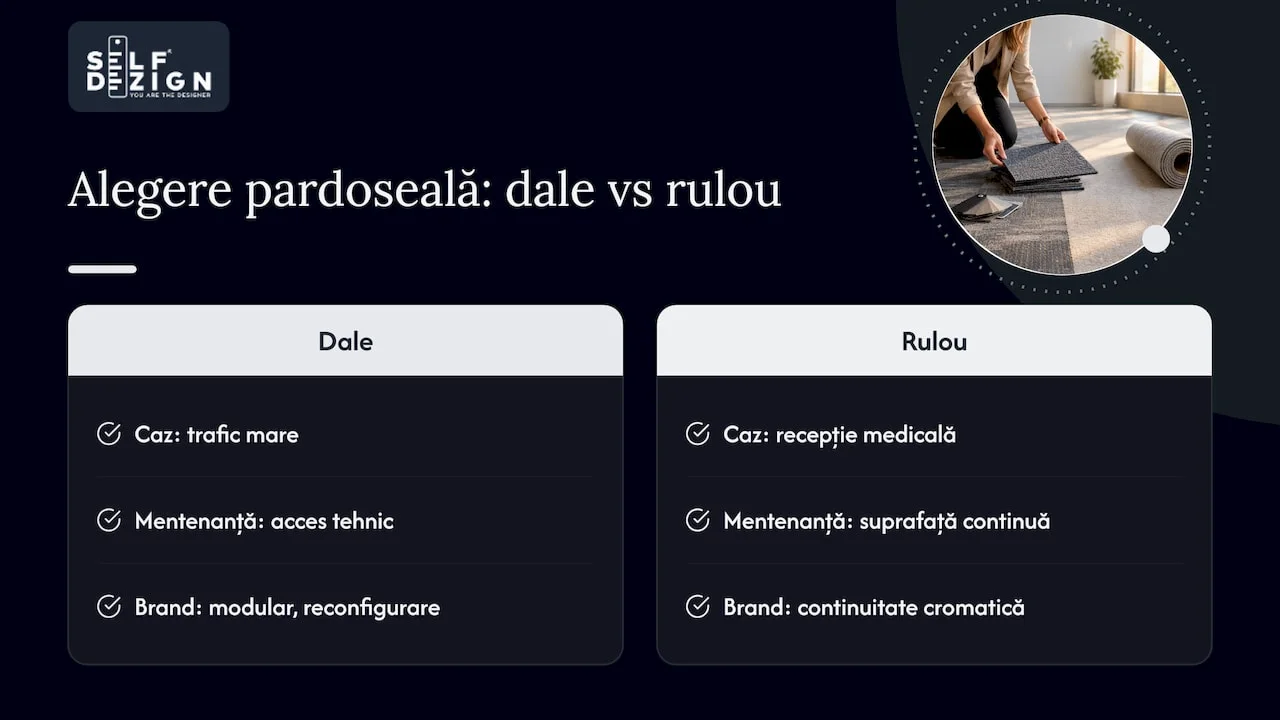
We evaluate each project based on how the space will be used on a daily basis, not what's trending. For a commercial space with frequent access areas to the technical floor, we recommend self-laying tiles for maintenance flexibility. For a medical reception where the atmosphere must transmit silence from the first contact, a continuous surface, well chosen chromatically, can count more than modularity.
For details on how we structure such decisions in commercial projects, we have also written a guide to choosing materials for commercial premises, useful for those who want to understand the process beyond the floor.
Toni
SelfDesign services for floor selection and implementation
Beyond the choice of material, the success of a project depends on how the technical decision combines with the rest of the space concept. By consultancy with written conclusions, we offer a clear assessment of flooring options, a material recommendation tailored to traffic and budget, and a cutting plan that reduces installation losses. For remotely coordinated HORECA projects, the package SelfDezign Remote - Remote HORECA CONSULTANCY provides the same clarity without displacement. If you are preparing a commercial or office project and want to avoid additional orders or regretted choices, you can see the entire offer on our service pageement