Tempered glass vs polycarbonate: what we choose for each type of project
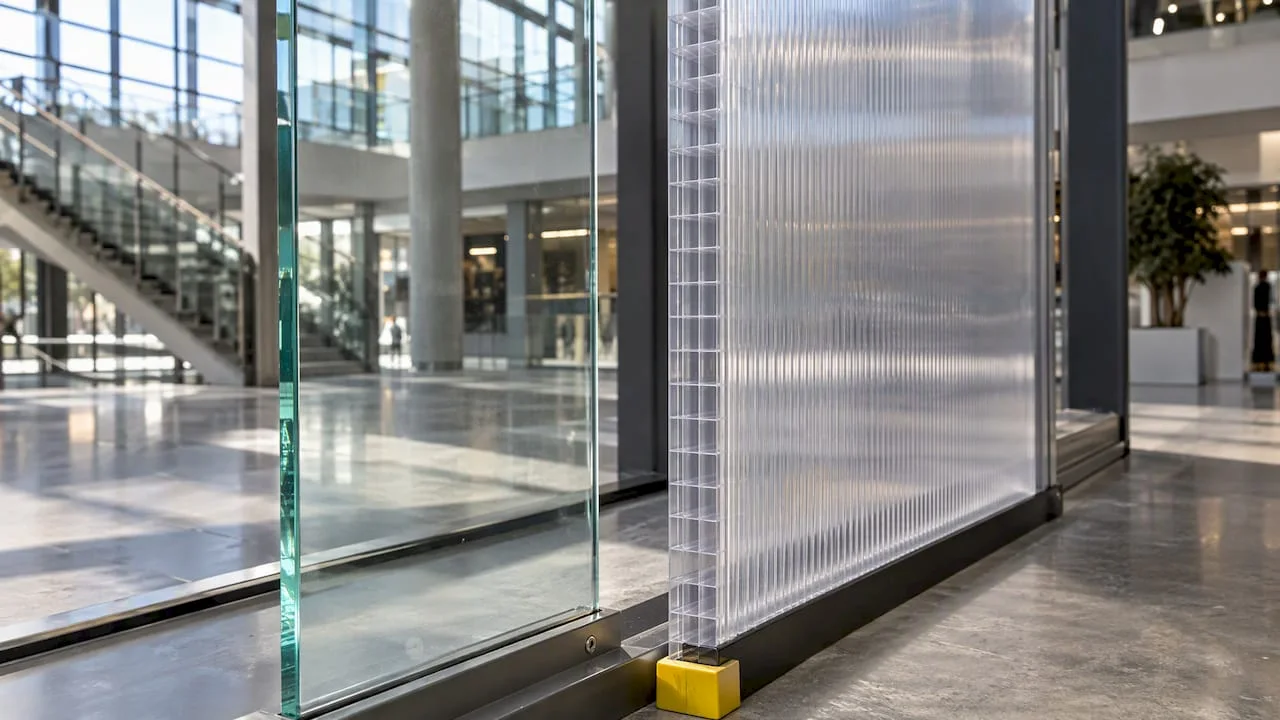
For spaces with strict fire safety requirements, escape routes and facades with public exposure we recommend tempered glass, because it remains non-combustible and retains an optical clarity that no polymer equals. For awnings, greenhouses, pergolas or curved structures where weight and flexibility matter more than the premium image, polycarbonate remains the practical choice. The difference can be clearly seen from the first project: one is the material that imposes elegance, the other is the material that solves a technical problem.
In summary:
- For projects with strict fire requirements, ask for the Declaration of Performance, CE marking and EN standard according to the risk envisaged in the application.
- For outdoor polycarbonate, check that the UV coating is facing outwards and provide expansion joints; solvents may damage the surface.
- For handrails where keeping fragments after shattering matters, choose laminated glass with PVB foil; polycarbonate is especially suitable for industrial or temporary solutions.
- Tempered glass cannot be cut or drilled after heat treatment, so fix the dimensions and attachment points before manufacturing.
SelfDezign
Interior projects tailored to your space
SelfDezign designs interior spaces starting from the context and objectives of the project, not from standard solutions.
Comparative analysis by practical dimensions: resistance, fire, appearance, weight, cost
The differences between the two materials are not reduced to "which is more resistant". Each property has different weight depending on the type of project, and a good designer balances them, not automatically ranks them.
On impact, the behavior is radically different. The tempered glass breaks into small and relatively non-hazardous fragments, but a sufficiently strong blow can still pierce it. Polycarbonate absorbs the impact by deformation, which makes it almost impossible to break under normal conditions of use, which is why it often occurs in vandal protection and industrial parapets.
At fire, the distinction is fundamental to design. Glass without organic materials, including basic tempered glass, falls into class A1, i.e. non-combustible, according to classification established by EC Decision 96/603/EC. Polycarbonate, being an organic polymer, behaves differently to fire: it can be treated to delay combustion, but it emits smoke and melts under high temperature, which changes the calculation for spaces with strict evacuation rules.
On the appearance side, tempered glass provides optical clarity without visible distortion, essential for representative showcases and facades. Polycarbonate, especially in multiwall variants, introduces a slight light diffusion, useful where diffuse light is sought, not perfect transparency.
Weight completely changes the structural logic of a project:
- The tempered glass is considerably heavier, which requires robust fastening systems and properly sized supporting structures.
- Polycarbonate weighs much less on the same surface, reducing the load on the load-bearing structure and simplifying height mounting.
- Multiwall polycarbonate panels also add a thermal advantage: indoor air ducts provide better insulation than an equivalent solid sheet.
- Glass, on the other hand, requires additional treatments (low-e, double glazing) for comparable thermal performance.
Maintenance differs over time more than most beneficiaries anticipate. Glass resists UV radiation well without changing its color or transparency, while untreated polycarbonate can yellow or lose clarity after prolonged exposure, which is why UV protection treatments become mandatory for long-term results.
Initial cost usually favors polycarbonate, but life-cycle calculation depends on the context: a well-mounted and protected tempered glass has a long service life without visible degradation, while a sun-exposed polycarbonate may require partial replacement sooner than would be expected. INVESTOR:
What certificates and norms to ask for: DoP, CE and relevant EN standards
A well-documented project is not based on commercial promises, but on documents proving the actual performance of the material. The European Construction Products Regulation requires that products covered by harmonized standards be accompanied by a Declaration of Performance and bear a CE marking, and this also applies to most glass products marketed in the European Union.
For security glass, the common standards we require in the specifications include:
- EN 12150, for thermally tempered glass and its controlled breaking behaviour.
- EN 356, for resistance to manual attack and burglary.
- EN 1063, for the classification of resistance to bullets, relevant in projects with high safety requirements.
- EN 13541, for explosion pressure resistance.
These standards are published and updated by CEN/TC 129, the European technical committee dedicated to construction glass, and are the reference that any serious supplier can document.
Fact verified: glass without organic components is classified A1, non-combustible, which makes it the default option for escape routes and public spaces with strict fire reaction requirements.
A lesser-known technical detail: in recent editions of the standards, the mechanical strength of the processed glass is declared as a bending strength value, expressed in megapascals, and the manufacturers must either specify it in the Declaration of Performance or explicitly declare that the performance has not been determined. When receiving the material, we check exactly this correspondence between what is written in the DoP and what appears on the label of the product delivered to the site, because the discrepancies only come to light when it is too late to change the supplier.
Practical scenarios: facades, railings, canopies, showcases and protections
The right decision always depends on the function of the space, not on an isolated aesthetic preference.
- Facades and areas with heavy public traffic: tempered glass remains the basic choice due to its A1 fire rating and the optical clarity required for the image of a representative building.
- Handrails and parapets: for fall safety, PVB-foil laminated glass provides structural strength and fragment preservation in case of breakage, while a polycarbonate panel may be sufficient for industrial or temporary railings, where cost and low weight matter more than the finish.
- Canopies, greenhouses and pergolas: here multiwall polycarbonate wins clearly, because it transmits light well, weighs little and can be curved on lightweight structures, without additional stresses on the foundation.
- Showcases: tempered glass remains the standard, for the image quality of the exhibited products and for the premium perception it conveys to the customers.
- Vandal protection and areas of repeated impact risk: polycarbonate, due to its resistance to deformation, performs better than plain glass in the face of repeated blows.
There are also hybrid solutions, which we often use in projects with mixed requirements: PVB laminated glass where we want both breakage safety and visual clarity, and multiwall polycarbonate where thermal insulation and light weight matter more than perfect transparency. The final decision always consists of four factors: the available budget, the capacity of the supporting structure, the code requirements for safety and, last but not least, the visual identity that the space must convey.
Assembly and maintenance: details that decide long-term performance
The wrong material chosen during assembly becomes a problem even if the technical specification was correct.
Tempered glass has an essential limitation: it cannot be cut, drilled or ground after the thermal securing process, because any subsequent intervention compromises its integrity and can lead to spontaneous breakage. All dimensions and clamping holes must be established prior to the securing process, which requires accurate technical documentation as early as the design phase.
Polycarbonate is mounted with other rules, related to its thermal behavior:
- Expansion joints are always left, because the panels expand and contract significantly with temperature.
- Fastenings are made with screws and washers that allow easy movement, not rigid fastening.
- The sun-exposed surface receives a UV protection coating, usually co-extruded by manufacturing.
- Cleaning is done with non-aggressive solutions, because strong solvents can attack the surface of the polymer.
Professional advice: always check if the UV protection layer of the polycarbonate is facing outwards when mounting, because the reversal of the faces cancels the protective effect and accelerates the yellowing.
For both materials, preventive maintenance planning short-circuits costly problems: an annual inspection of joints and seals to polycarbonate, respectively periodic inspection of fastening systems to tempered glass, prevent most incidents that otherwise end up in emergency repairs.
Sound insulation performance
Sound insulation does not follow the same logic as mechanical resistance. Glass, being a denser material, attenuates sound better at equivalent thicknesses, and laminate or double configurations significantly increase acoustic performance, which explains why they often occur in facades on busy arteries or in street-facing office spaces.
Polycarbonate, being lighter and less dense, transmits sound vibrations more easily, and its acoustic performance usually remains inferior to glass at comparable thicknesses. The multiwall structure partially helps, because the air in the channels introduces an additional barrier, but it does not reach the level of a laminated or double-glazed package.
In design, this means that the choice is not made just by impact or fire: in a space where inner stillness matters, street or installation noise can tip the decision towards glass, even if polycarbonate would have been structurally sufficient.
Resistance to UV and weathering
Long exposure to the sun and climatic variations clearly separates the two materials over time, even if they look identical during assembly.
Glass does not react to ultraviolet radiation: it does not change color, does not become brittle and does not lose transparency, no matter how many years it is exposed directly to the sun. This stability is one of the reasons why it remains preferred in facades that need to look as good over a decade.
Untreated polycarbonate is vulnerable to UV: without a co-extruded protective layer, the surface may yellow, and optical clarity visibly decreases within a few years of continuous exposure. Quality panels marketed for outdoor usually come with this treatment from the factory, but its performance depends on the correct mounting orientation and the quality of the manufacturer.
In weather, both materials resist well to rain, moderate hail and temperature variations, but polycarbonate has the advantage of flexibility: it absorbs thermal and mechanical shocks by slight deformation, while the glass, being rigid, transfers the tension directly to the fastening system, which is why ROS seals and gaskets become more important in exposed glass projects.
Sustainability and recyclability
From a full life-cycle perspective, glass has a simple advantage: it is recycled endlessly without loss of properties, and the recycling infrastructure for flat glass is already mature in most European markets. Its physical durability, without visible degradation by decades, also reduces the frequency of replacements, which means less material consumed over the life of a building.
Polycarbonate is a technically recyclable material, but the process is more limited in practice: its recycling depends on the purity of the waste stream and the existence of specialized facilities, less widespread than those for glass. In compensation, the light weight decreases energy consumption during transport and assembly, a factor that counts in the calculation of the environmental footprint on the project as a whole.
For a beneficiary concerned about the long-term impact, the choice is not reduced to "which material is greener", but to how each integrates in the specific context: a facade designed to last fifty years favors glass, while a temporary or seasonal structure can benefit more from the ease of annipulation and installation of polycarbonate.
Customization options and additional treatments
Both materials allow treatments that extend their functionality beyond the raw form, and these options often change the final decision.
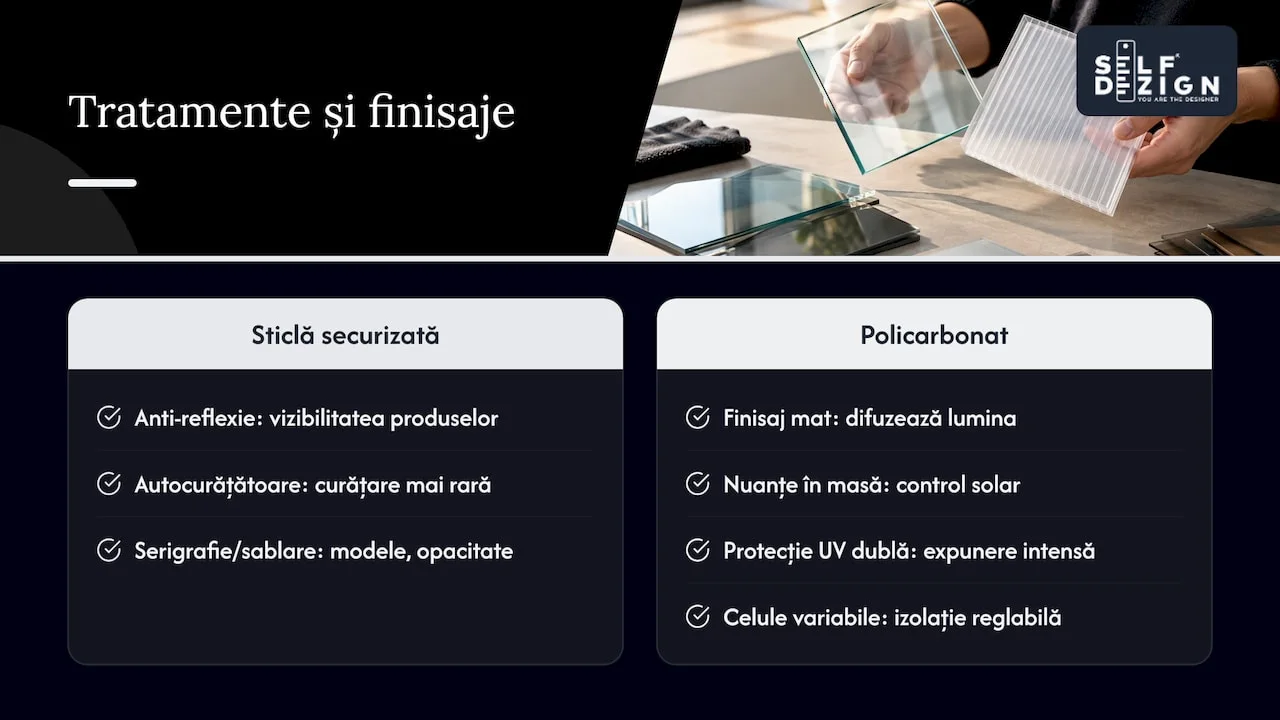
Tempered glass can receive anti-reflective treatments, useful in showcases and exhibition spaces where reflections disturb the visibility of products, as well as self-cleaning coatings, which break down organic dirt under the action of light and reduce the frequency of cleaning on high facades. Screen printing and sandblasting allow custom designs or varying degrees of opacity, useful for partial privacy without giving up natural light.
Polycarbonate offers its own set of variants: matte finishes for controlled light diffusion, mass integrated color shades for solar control and variants with double UV protection for intense exposure climates. The multiwall structure also comes in variable cell configurations, which allows the thermal insulation to be adjusted according to the specific needs of the project.
Choosing the right treatment depends on the exact function of the surface: a showcase benefits more from anti-reflection than from self-cleaning, and an exterior awning benefits the other way around. We discuss these details from the concept phase, because a treatment chosen after installation almost always means additional costs.
SelfDezign opinion: integrating the decision into the interior and architectural design project
In real projects, the decision between tempered glass and polycarbonate is never made in isolation from the rest of the concept. We weigh it alongside safety, function and visual identity, because the material chosen on a facade or a showcase speaks about space as much as any other design element.
We recommend technical advice whenever the project involves code requirements for fire safety, structures with unusual loads or assembly details that do not appear in the standard supplier catalogs. A material decision without prior technical verification becomes, in practice, a hidden risk until the acceptance of the work.
For the beneficiary, we justify each choice starting from the result that the space must support: a clinic needs visual clarity and confidence, a Horeca space needs heat and resistance to heavy traffic, and an office needs balance between natural light and sound insulation. The material becomes correct only when it answers these questions, not vice versa.
Toni
How we help you choose and implement the right materials
For commercial, residential or Horeca interior design projects, we offer design consultancy which covers exactly this type of technical decision, from the choice of materials to the technical design and coordination of the implementation on site. We start from the real context of the project, not from standard solutions, because each space has different safety, budget and image requirements.
At the first step, you receive a clear brief of the identified needs, a synthesis of the technical options suitable for the project and a collaboration proposal adapted to the type of space, whether we are talking about an office, a medical clinic or a Horeca concept. For customers who only need a punctual technical validation, we also offer consultancy with written conclusions, a documented report that you can use directly in discussions with the contractor or supplier.
If your project is at the material selection stage or you need a technical perspective before signing an execution contract, we invite you to see our interior design services and establish the first step together.