Strategies for Efficient Interior Functionality

A poorly organized space is not just inconvenient. It costs time, energy, and, in the context of a business, real money. Efficient interior functionality strategies don't mean placing furniture anywhere it fits or following a visual trend, but building an environment that supports the activity that takes place in it. Whether we're talking about an office, a commercial space, or a medical clinic, a well-thought-out interior can completely transform how people work, feel, and make decisions. This guide presents the concrete steps you can take to do just that.
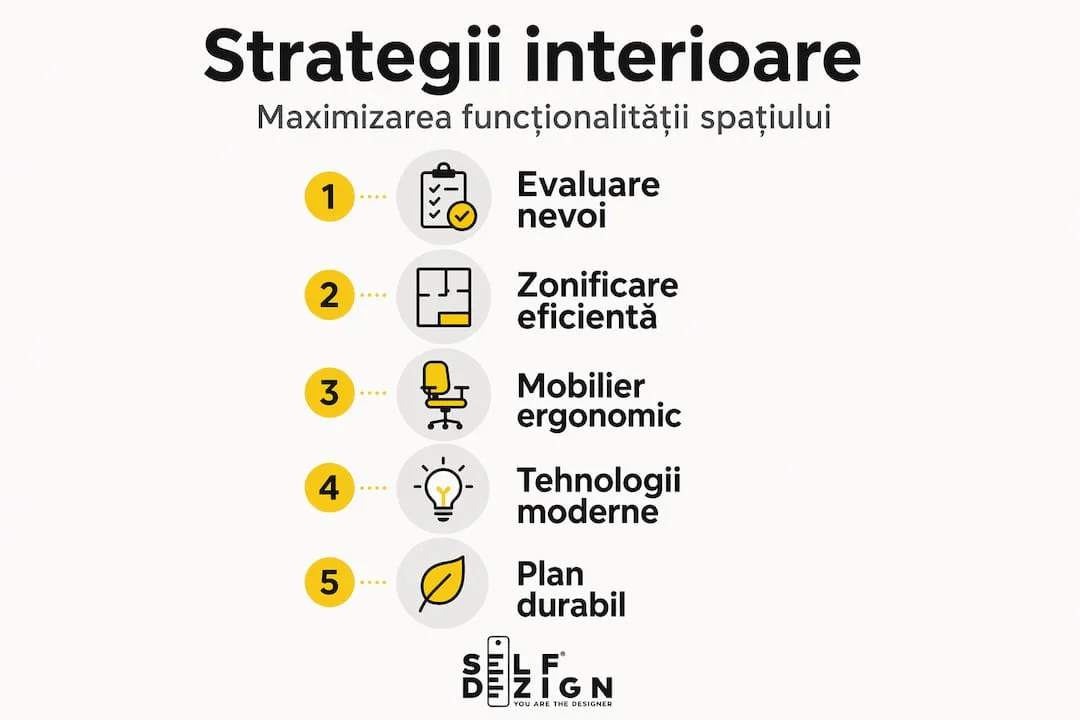
Strategies for Interior Functionality: Needs Assessment
Before any furniture or layout decisions, you need to understand how your space works now and what doesn't. This is not an optional step. It's the foundation on which all other choices are built.
Mapping Activity ZonesBefore purchasing furniture, prevent visual and physical blockages that inevitably occur when furniture is chosen for aesthetics, not functionality. Think of each area in the space as a character with a well-defined role: the concentrated work area, the collaboration area, the client reception area, the storage area. If these roles overlap or contradict each other, the space becomes chaotic, no matter how good it looks.
Concretely, here's what you should analyze before any intervention:
- Circulation Flow:Avoid blocking main routes with heavy furniture. People should move naturally, without having to go around obstacles at every step.
- Congested vs. Underutilized Areas:Almost any space has corners that "accumulate" things without any clear function and central areas that are overused. Identify them.
- Specific Activity Requirements:A design office needs abundant natural light and large work surfaces. A clinic needs clear pathways and quiet waiting areas. There's no universal formula.
- Team or Client Usage Style:How many people use the space simultaneously? Are there peak moments? Do they work in isolation or collaboratively? The answers to these questions dictate the configuration of areas.
Efficient Zoning Reduces Time Spent Searching for Objects and Optimizes Resource Use. It's a Simple Effect, but the Cumulative Daily Impact is Significant.
Organization and Furnishing for Maximum Functionality
Once you know what your space needs, it's time for concrete furniture and organization choices. This is where most mistakes are made, not due to a lack of taste, but a lack of prioritization.
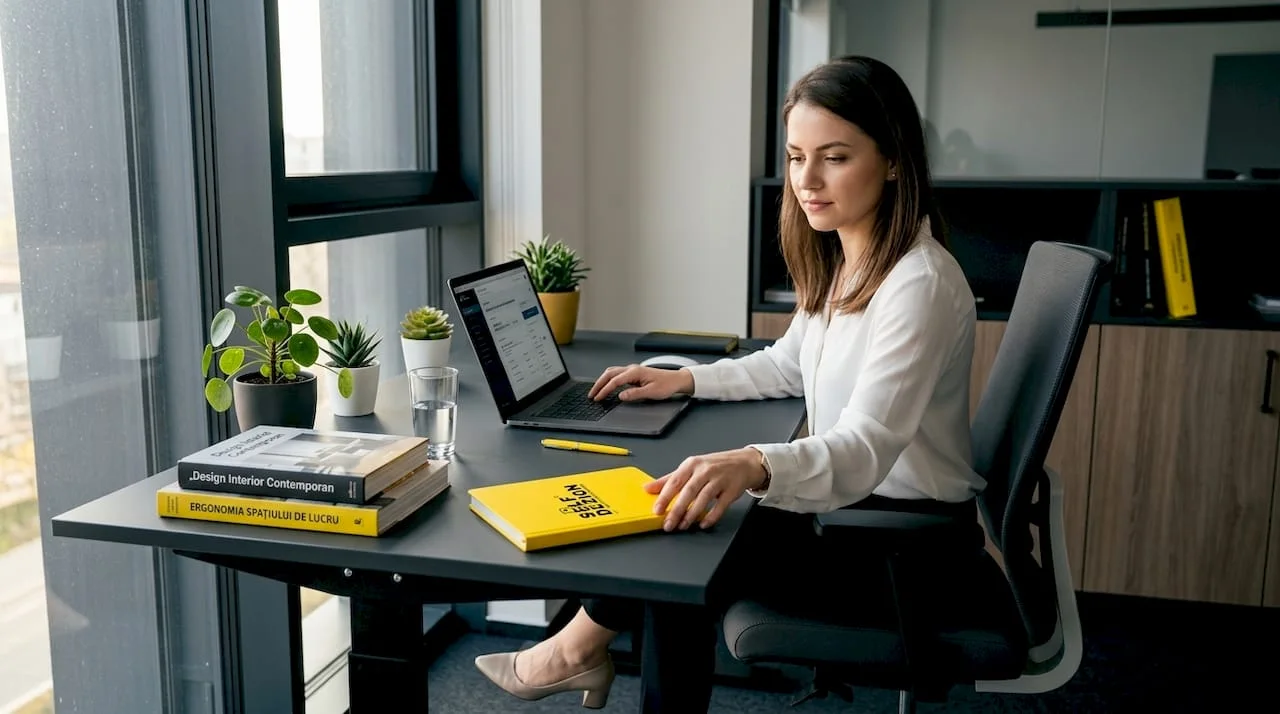
Ergonomic and Multifunctional Furnitureis not a luxury.An Adjustable Deskallows for alternating work positions and increases employee energy throughout the day. Ergonomic chairs, adjustable surfaces, and modular furniture are investments that pay off in productivity and reduced discomfort.
The intelligently applied minimalist principle is perhaps the most powerful tool in the arsenal of interior organization strategies."Less is More"means that every object in the space must have a precise purpose. It's not about visual austerity, but functional clarity. A well-thought-out minimalist space doesn't look empty. It looks clean, calm, and controlled.
A few practical techniques that work:
- Integrated Storage Systems:Wall cabinets, hidden drawers under work surfaces, and shelves that use the room's height instead of floor space.A Well-Organized Officeallows for quick access to information and eliminates operational blockages.
- Reducing Visual Clutter:Exposed cables, piles of documents on desks, and objects without a fixed place create cognitive fatigue. Integrated cable management solutions and dedicated temporary storage areas make an immediate difference.
- Layered Lighting:Lighting is not just one ceiling light. A concentrated work area needs direct and powerful light. A client reception area works better with warm and diffused light. Proper lighting in each area is not an aesthetic detail, but a direct functional element.
Professional Advice: Before buying any furniture or storage system, spend a whole day observing how people move in the space. Note where congestion forms, where things are left "temporarily", and where no one ever goes. The data you collect will be more valuable than any furniture catalog.
You can find applied inspiration ininterior design examples for officesthat combine comfort with efficiency without sacrificing one for the other.
Technologies and Modern Elements for Space Efficiency
Optimizing interior functionality in 2026 cannot ignore the technological component. Not because it's trendy, but because digital and modular solutions address concrete problems that traditional furniture cannot.
- Programmable Lighting Systems:Motion sensors and automatically adjustable lighting reduce energy consumption and adapt the ambiance according to the time of day or activity.
- Mobile Walls and Flexible Partitions:Allow for the rapid reconfiguration of space according to current needs. A 200-square-meter space can function as an open space in the morning and as three separate rooms in the afternoon.
- Document Digitization:Scanning documents reduces the wear and tear on originals and facilitates quick access and sharing of information, freeing up considerable physical space. File shelves can become collaborative or relaxation areas.
- Adaptable Modular Furniture:Systems that can be reconfigured without major construction interventions, responding to changing needs as the team grows or the work model changes.
The table below summarizes the main categories of modern solutions and their direct impact:
|
Modern Solution |
Primary Benefit |
Applicability |
|---|---|---|
|
Programmable Lighting |
Energy consumption reduction and ambiance adaptation |
Offices, clinics, commercial spaces |
|
Mobile Walls |
Maximum flexibility in zoning |
Offices, event spaces |
|
Modular Furniture |
Reconfiguration without renovation |
Any type of space |
|
Document Digitization |
Physical space liberation and quick access |
Offices, medical clinics |
|
Integrated Outlets and Hubs |
Exposed cable elimination |
Offices, coworking spaces |
Integrating digital components into workspace management frees up surface area for collaborative and relaxation zones, directly boosting team productivity.
On the sustainability side, eco-friendly materials are no longer a niche choice. Certified wood, low-VOC paint, and recycled textiles contribute to a healthier indoor environment, directly impacting user comfort and concentration. You can see this principle applied inthe approach to adaptable officeswhich reduce long-term costs.
Planning and Implementing a Sustainable Plan
Strategy is useless without execution. And execution without monitoring is a change that will deteriorate over time. Improving interior efficiency is not a project with an endpoint, but a process that requires continuous attention.
Here's a practical implementation sequence:
- Document the current state.Photos, measurements, a circulation map. Without a clear starting point, you can't evaluate progress.
- Define priorities based on impact.Not all problems are equal. First, solve what most affects daily productivity or comfort.
- Involve space users.Employees or clients who use the space daily know things that a layout plan can't see. Consult them before, not after.
- Implement in stages.Major changes at once generate resistance and disrupt activity. A staged plan is easier to absorb and correct.
- Evaluate periodically. Simplifying spaceis a continuous process, not a singular action. A quarterly or semi-annual evaluation of functionality can identify new problems or opportunities before they become costly.
Common mistakes in this stage include delegating all decision-making to one person without consulting the team, purchasing furniture before finalizing the zoning plan, and underestimating the time needed for users to adapt to the new space.
Professional Advice: Establish a "space owner" in the organization. Someone who monitors functionality, collects feedback, and has the authority to propose adjustments. Without such clearly attributed responsibility, rearranged spaces return to old habits within months.
Organized Spacesincrease a business's strategic capacity by eliminating reactive responses and provide the team with an environment in which they can work proactively. Periodic evaluation and adaptation of systems ensure the long-term success of any interior organization strategy.
Our Perspective: Functionality Before Aesthetics
We've worked on interior design projects in very different contexts: tech offices, medical clinics, HORECA spaces, commercial showrooms. And the most frequent pattern we've observed is not a lack of taste or budget, but the inversion of priorities.
Clients come with visual references and ask to recreate that aesthetic. But aesthetics without functionality is a theatrical backdrop. It looks good in a photo and functions poorly in real life. We've seen offices that looked impeccable in renderings and where people couldn't find a place to put a glass of water.
What we've learned over time is that well-thought-out functionality almost inevitably produces its own aesthetic. A space where every element has a place and a purpose looks balanced and clean without needing a decorator. Aesthetics is a byproduct of correct organization, not the other way around.
The role of specialized consulting is not to impose a style, but to ask the right questions at the right time: who uses the space, when, how, with what purposes, and with what limitations. Without these answers, any design decision is an educated guess. With them, it becomes a strategy. You can read more about howcustomized design supports a business's brand identityand productivity.
— Toni
How Can SelfDezign Optimize Your Space
If you've made it this far, your space probably has concrete problems you recognize in what you've read. At SelfDezign, we work with business owners who want more than just a beautiful layout. They want a space that works for them.
Regardless of whether we're talking about an office, a commercial space, or a clinic, our approach always starts with understanding the project's real context, not standard solutions. You can explore ouroffice interior design servicesor go through ourcommercial space consulting guideto understand what the step-by-step process looks like. The first step can be a preliminary discussion, without obligations, where we clarify your space's priorities and objectives.