
What is sustainability in landscaping: a complete guide to 2026

Sustainability in amenities is defined as the process of creating spaces that balance present comfort with responsibility for future resources, according to UN and FAO standards. The concept is based onthree fundamental pillars: environment, social equity and economic stability. A sustainable space isn't just one that looks good or uses natural materials. It is a space designed to minimize the impact on the planet, to streamline resources and to ensure the long-term health of those who live or use it. The “triple bottom line” principle translates this vision into concrete design decisions, from the choice of materials to how space handles energy and waste.
What is sustainability in landscaping and why it matters in 2026
Sustainability in design is not an aesthetic trend. It is a working method that asks different questions than conventional design: where the material comes from, how long it lasts, what happens to it at the end of its useful life and what impact it has on the people who live or work in that space.
The European regulations of 2026 accelerate the adoption of this balance, and companies and owners who ignore these criteria risk falling behind, both from a competitive point of view and in terms of the long-term value of the space. Sustainability does not compromise any of the three directions: environmental, social and economic. It integrates all three at once.
The difference from an ordinary project occurs in the concept phase. A sustainable designer does not choose materials by catalogue, but by their full life cycle: extraction, production, transport, use and disposal. This thinking fundamentally changes what "a good choice" means in a landscaping project.
Professional advice: If you want to evaluate the sustainability of a project, ask one question: “What happens to this material in 20 years?“ The answer immediately shows you whether the design has been designed for the long term or just for presentation.
How to choose sustainable materials in interior and exterior design
Materials are the most impactful decision in a sustainable project.2026 iF Design AWARD STANDARDSgive 20% of the score to sustainability, with a clear preference for low carbon materials. This confirms that the professional design market has integrated sustainability as an evaluation factor, not as an additional option.
Renewable and natural materials
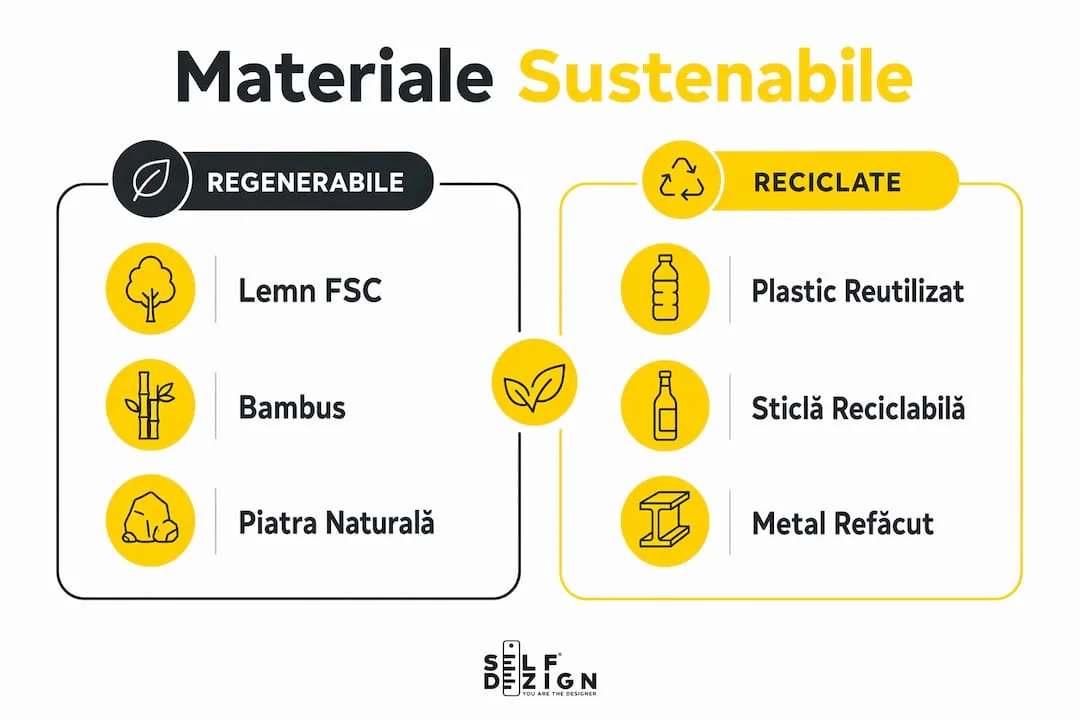
The most used materials in the current sustainable design are:
- FSC or PEFC certified wood: comes from responsibly managed forests and has a significantly lower carbon footprint than synthetic materials.
- Bambus: grows rapidly, requires no pesticides and has comparable mechanical strength to hard wood.
- Local natural stone: sustainable, no chemical production emissions, provided that it comes from close quarries to limit transport.
- Organic textiles: organic cotton, hemp and wool are alternatives to synthetic petroleum-derived fibers, with low impact on soil and water.
Each of these materials comes with an essential condition: traceability.Consumers in 2026 demand material traceabilityand producer ethics, which profoundly influences product selection. A natural material without origin certification does not guarantee that it has been produced responsibly.
Circular economy applied in landscaping
Circular economy means that a space does not generate waste at the end, but returns materials to the circuit. Basically, this translates into three concrete choices:
- Restored parts: refurbished old furniture with solid structure and new finishes, reduces the consumption of raw material and adds character to the space.
- Recycled components: materials recovered from demolition or industrial production, reintegrated into new design contexts.
- Repairable products: furniture and finishing elements designed to be repairable, not thrown away at the first fault.
The local origin of the materials significantly reduces the transport footprint. A supplier 50 km away from one per 2,000 km produces incomparably lower emissions with equal product quality. You can explore more aboutinnovative materials for 2026to understand what options are now available in the local market.
Professional advice: When evaluating a material supplier, ask for the product traceability document. If the supplier cannot provide it, the material does not meet the criteria of a serious sustainable project.
How to reduce energy and water consumption through sustainable design
Energy efficiency does not start with photovoltaic panels. It starts with the orientation of the space towards the sun, the thickness of the walls and the way the air naturally circulates through the building. These are the passive design decisions that determine how much energy a space will consume over its lifetime.
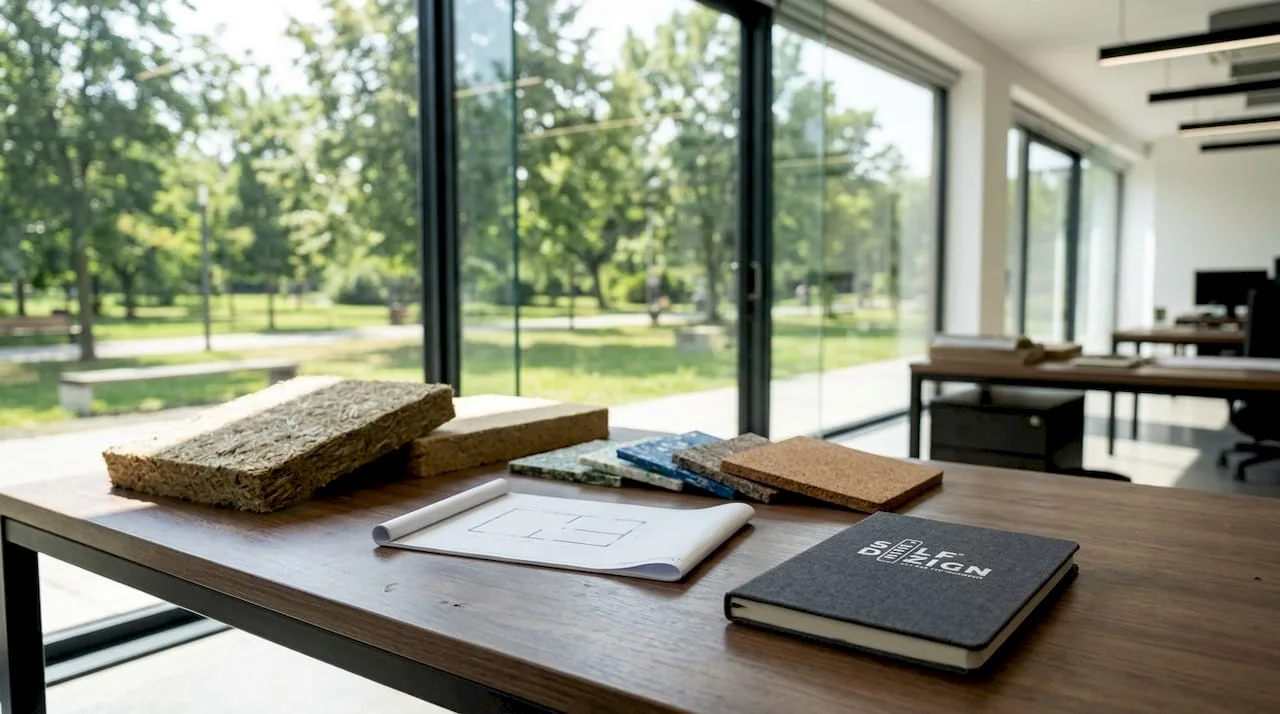
Implementation of sustainable designreduces energy and water consumption by orienting buildings, natural ventilation and rainwater collection. These measures are not technical luxuries reserved for large projects. There are principles applicable in any arrangement, from an apartment to a commercial space.
Four practical energy efficiency strategies
- Orientation and natural light: a camera correctly oriented towards the cardinal points can reduce the need for artificial lighting by up to half of the operating hours. Large windows to the south capture the heat in winter; awnings or exterior blinds block it in summer.
- Natural ventilation: the placement of openings on opposite facades creates air currents that cool the space without air conditioning. This is one of the oldest architectural techniques, now rediscovered as sustainable practice.
- Rainwater collection: systems integrated into the exterior design collect rainwater for irrigation or toilets, reducing drinking water consumption. The installation cost is recovered in a few years through lower invoices.
- Energy efficient appliances: LED lighting fixtures, appliances with energy class A or higher and automation systems that stop consumption when the space is empty complete the efficiency strategy.
The impact of these decisions exceeds the monthly bill.Reduction of concrete paved surfacesand replacement with permeable structures shortens the construction CO2 offset time. Moving from 20 m² of concrete to 8 m² can reduce the emission compensation time from 20 to 10–15 years. This means that exterior fit-out decisions have a direct and measurable effect on the carbon footprint of the project. You can also deepen these strategies inthe guide to business premisesmade by SelfDezign.
The benefits are not just environmental. Spaces with abundant natural light and fresh air improve concentration, reduce fatigue and increase the satisfaction of those who use them daily. This is the direct link between sustainability and users' health, an argument that any customer understands immediately.
Why modularity and sustainability define a truly sustainable design
The biggest enemy of sustainability in design is not the lack of natural materials. It is the culture of rapid consumption that normalizes the replacement of furniture every few years, regardless of its actual condition. Sustainable design combats this logic with modularity and durability.
Modularity in design allows individual components to be repaired or replaced, avoiding throwing away all furniture. This means that a sofa with a modular structure can be reupholstered when the fabric wears out without being completely replaced. A cabinet with interchangeable components can be reconfigured when the needs of the space change.
Combating scheduled obsolescenceis essential in sustainable design through modularity and durability. Scheduled obsolescence is the practice by which products are designed to break down or appear obsolete after a short interval, forcing replacement. A sustainable designer refuses this logic and chooses suppliers that offer spare parts and extended warranties.
The long-term benefits of this approach are concrete:
- Low costs: a space designed to last 20 years without major renovation costs less than one that requires redevelopment every 5 years.
- Stable identity: spaces with durable materials and timeless design do not “age” visually as fast as those based on seasonal trends.
- Minimum waste: each repaired or reused component is a component that does not reach the landfill.
An often ignored element in sustainability discussions is the waste sorting infrastructure integrated in the development.Recycling integrated into the designreduces resource consumption and pollution, turning sorting into a reflex gesture through invisible systems integrated into furniture. A kitchen cabinet with dedicated compartments for recycling fractions is not a minor detail. It is the infrastructure that makes a sustainable lifestyle possible in practice, not just in theory.
Professional advice: When choosing new furniture, check if the manufacturer offers spare parts and if the structure allows repairs. A product without spare parts available is, by definition, a product designed to be discarded.
Interdisciplinary collaboration and certifications validating a sustainable project
A sustainable project cannot be carried out by a single specialist. Sustainability in design involves technical decisions that go beyond the competence of a single field: the choice of materials requires knowledge of chemistry and ecology, energy efficiency involves thermal engineering, and water management requires knowledge of hydraulics.
Interdisciplinary collaboration between designers, engineers and environmental specialists is crucial to the success of sustainable projects. This collaboration must start from the concept phase, not after the main decisions have already been made. An installation engineer involved from the start can influence the orientation of the space, the location of windows and the choice of technical systems, with a direct impact on the final energy consumption.
Current certifications and standards provide an objective reference framework for assessing the sustainability of a project. Here's an overview of the most relevant in 2026:
Standard / CertificationScope of applicationWhat they rateiF Design AWARD 2026Product & Interior Design20% of the score for Sustainability, Materials and Circular EconomyFSC / PEFCTimberResponsible management of the forests of originBREEAMBuildings and amenitiesEnergy, water, materials, health, managementLEEDCommercial and residential buildingsEnergy efficiency, indoor air quality, materialsEuropean EcolabelProducts and servicesFull Life Cycle Environmental ImpactThese certifications are not simple marketing labels. They are independent audit processes that verify whether a project or product meets measurable criteria. A BREEAM or LEED-certified project provides the customer with the guarantee that sustainability has not been declared but demonstrated.
Material traceability is another validation element. The priority of local products reduces transport emissions and supports the economy of the community, along with complying with standardized certifications. A fully documented material of origin, production and transport is a material that you can confidently include in a sustainable project. Reducing the carbon footprint in landscaping projects is also addressed inpractical guides to sustainable construction, detailing concrete decarbonization methods also applicable in Romania. The role of the architect and designer in coordinating these processes is detailed in the SelfDezign article onefficiency in interior projectsThe
Sustainability in design: what I learned after years of real projects
When I started working on projects with explicit sustainability requirements, the first thing that surprised me was how often customers mistook sustainability for aesthetic sacrifice. They believed that a sustainable space must look "natural" in the literal sense: raw wood, earthy colors, rough texture. The reality is completely different.
Sustainability redefines aesthetics, not limits it. Some of the finest spaces I've seen in recent years used recycled or local materials, not in spite of sustainability, but precisely because of it. Material constraints force creativity and lead to solutions that an unrestricted project would never have found.
The second thing I noticed is that real sustainability costs less in the long run, but more in the beginning. Customers who understand this difference make better decisions. Those who do not understand it choose the cheap option now and pay three times more in 10 years. This is the economic argument that any design advisor must put on the table from the first meeting.
The most important thing I learned is that sustainability is not a layer applied over a completed project. It is a thinking logic that must be present from the first sketch. A sustainable space is not achieved by adding plants or solvent-free paints at the end. It is achieved by making the right decisions in the right order, with the right people around the project table.
Toni
SelfDezign and sustainable design projects
SelfDezign works with clients in Bucharest and Europe on residential, commercial, hospitality, office and medical clinics projects, integrating the principles of sustainability at every stage: concept, technical design and coordination of implementation. The team does not apply standard formulas. Each project starts from the real context of the customer and the objectives that the space must support in the long run. If you want to understand what aresidential interior designthought with responsibility towards the environment and the user, or if you have a commercial space that requires aspecialized design consultancy, SelfDezign provides clarity before any decision.