
Warranty on interior fit-out works: your rights and the steps to follow

The warranty for interior fit-out works in Romania covers the remedy of defects attributable to the contractor within the agreed contractual period, usually between 1 and 5 years. For hidden defects, those that could not be observed at acceptance, the law provides an extended window of 10 years, regulated by the Code of Spatial Planning, Urbanism and Construction (Law no. 169/2026), which repealed most of Law no. 10/1995, and by the Civil Code. The first practical step, regardless of the type of defect, is simple: do not repair anything before requesting a technical assessment and notifying the contractor in writing.
In summary:The warranty for interior works covers defects attributable to the contractor for a period of 1 to 5 years, and for hidden defects, the law provides a window of 10 years from acceptance.Apparent defects can be observed at handover and are accepted if they have not been noted in the minutes, while hidden defects are manifested later and cannot be easily detected at acceptance.If a defect is discovered, do not repair it before the technical assessment and the written notice to the contractor, and keep all relevant evidence.The limitation period of 3 years starts from the date of discovery of the defect, being different from the contractual warranty period or from the 10 years for hidden defects.A construction contract must clearly set out the duration of the warranty, the notification procedure, financial protection mechanisms and the mandatory documents for handover.
SelfDezign
Plan your fit-out more clearly
SelfDezign designs and coordinates customized interior spaces, starting from the actual context and objectives of the project.
What the warranty on interior fit-out works covers: apparent defects vs. hidden defects
The difference between the two categories basically decides the rest of your file. An apparent defect is the defect that you could see by a normal check at handover, without tools or specialized expertise. If you signed the acceptance protocol without noting that defect, the law considers that you have accepted it and the right to claim it subsequently is lost.
A hidden defect is another story. It is the defect that could not be detected at acceptance, because it manifests itself only over time or because its source is invisible to the naked eye.
In interior fit-outs, the distinction translates concretely into situations such as these:
- Apparent defects: a visible crack in the cladding at handover, a different shade of paint from the contract, an unfinished drywall corner.
- Hidden defects: an infiltration that occurs after three months from a sanitary joint incorrectly mounted under the floor, a deformation of the parquet caused by a screed not properly dried, a structural crack masked by the finish.
- Usual exclusions: defects arising from subsequent interventions of another craftsman, from improper use (excessive humidity, loads above the designed limit) or from lack of maintenance (non-sealing of joints, for example).
The warranty does not work as a universal insurance. It protects against errors in workmanship or material, not against normal wear and tear or negligence on the part of the client. A well-structured interior design contract addresses exactly these gray areas from the beginning, so that they do not become a cause of conflict at the first defect.
Legal deadlines and limitation periods: how warranty periods run
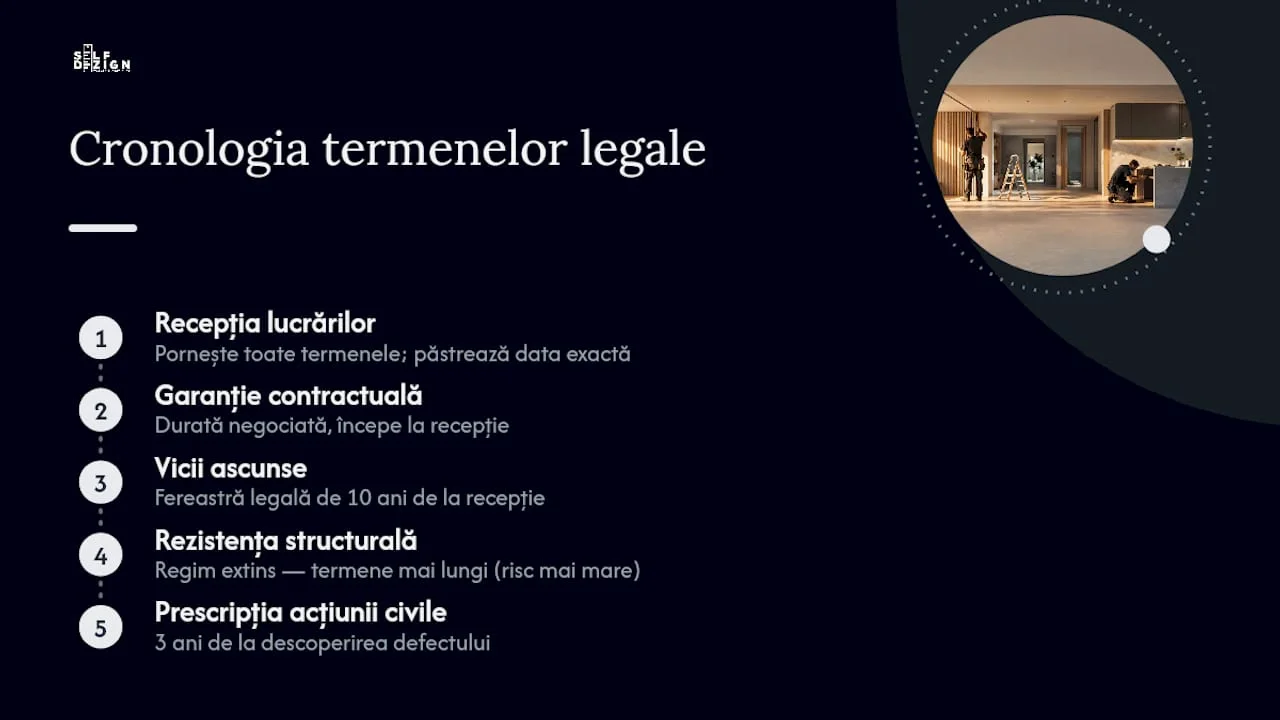
The contractual warranty period is negotiated directly with the contractor, for a duration agreed by both parties, and begins to run from the acceptance upon completion of the works. This is the first trap: many beneficiaries believe that the warranty expires with this negotiated term, regardless of the type of defect.
Not so. For hidden defects, the law grants a separate 10-year window, independent of the duration of the contractual warranty. The load-bearing structure of the construction benefits from an even more extensive regime, given the risk it involves.
Professional advice: keep the exact date of acceptance upon completion of the works. It is the reference point for all the deadlines that follow, and without it you cannot prove that you fit into the legal window.
A different term overlaps the 10-year period: the limitation period for the civil action, which is 3 years from the date the defect is discovered, not from acceptance. An example helps to understand the mechanism: you discover a structural leak in year 9 after acceptance. You are still within the 10-year window for hidden defects. From the moment of discovery, you have 3 years to start legal proceedings, otherwise the right of action is time-barred. The two legal clocks run separately, and confusing them is the reason why many clients miss deadlines without realizing it.
Practical steps after discovering a defect in an interior fit-out
The order in which you act matters as much as the action itself. A rush to repair yourself or call another craftsman without a prior technical assessment can compromise your entire file.
- Do not repair before the technical assessment. Once the defect is repaired, the evidence of it also disappears. Without technical proof of the cause, your claim remains an unsupported statement.
- Request an out-of-court technical assessment from a certified expert. The report should include the exact diagnosis, the probable cause of the defect and a cost estimate for the remedy.
- Officially notify the contractor in writing, by letter with acknowledgement of receipt or by email with acknowledgement of reading. The notification must describe the defect, state the conclusions of the expertise and indicate a reasonable time for remediation.
- Keep all evidence: dated photos, invoices, correspondence with the contractor, the acceptance report.
- Wait for the contractor's response for an amicable remedy. If the contractor refuses or delays, follow the path of formal negotiation or, as a last resort, court action, supported by the evidence gathered.
This sequence of steps appears almost identical in legal guides specialized in hidden defects, because it works in any type of file, not just in interior fit-outs.
What the construction contract must contain to protect the warranty
An unclear contract can make a coherent warranty negotiation difficult. A few clauses make the difference between a solid file and a shaky one:
- Exact warranty duration, the time from which it starts to run (acceptance upon completion of the works) and the step-by-step procedure for notification and remediation.
- Financial safeguards: a percentage retention from the final payment, a performance bond or, for larger projects, a decennial insurance policy. The conditions and coverage of these tools should be checked punctually, not assumed.
- Documents required at handover: the signed acceptance protocol, the technical book of the work and the quality certificates for the materials used.
These clauses are not bureaucratic details. They are exactly what will save you a negotiation from scratch when a defect occurs two years after handover. A renovation planning guide that doesn't address these points from the start leaves room for interpretation exactly where you can't afford it.
Who can be liable for defects and how liability is established
The liability for a defect does not automatically fall on the contractor. The Code of Spatial Planning, Urbanism and Construction concerns several participants in the construction process, and the identification of the party at fault depends on the real source of the defect:
- The contractor is liable for workmanship defects: wrong installation, incorrectly applied materials, failure to follow the technology.
- The designer may be liable when the defect comes from a design error, for example a technical solution unsuitable for the conditions of the space.
- Material suppliers are liable when the defect comes from a product with manufacturing defects, not from the way it was installed.
In practice, the technical assessment not only documents the defect, but also directs the notification to the right party. A notice sent to the contractor for a defect caused by a faulty material risks delaying the actual resolution of the problem.
Acceptance of works: what effect it has on the warranty
The Regulation on the acceptance of construction works, originally approved by Government Decision no. 273/1994 and fully replaced by Government Decision no. 343/2017, structures the acceptance process in two distinct stages, and the difference between them matters to any client:
- Acceptance upon completion of the works marks the moment from which the contractual warranty starts. The committee checks the work as a whole, and the report signed here becomes the time benchmark for all subsequent deadlines.
- Final acceptance is convened only after the warranty period set in the contract expires, in order to confirm that no defects have occurred throughout this period.
- The acceptance committee may suspend acceptance if it finds unresolved defects during the warranty period, a useful tool to force the remedy before the file is finally closed.
The technical book of the work and the intermediate minutes remain the decisive evidence in any subsequent claim. Without them, demonstrating a correct timeline becomes much more cumbersome.
When legal action is worth it: cost, evidence and legal options
The decision to go to court is not made on impulse. The cost of remediation compared to the total value of the project is the first filter: courts may reject claims if the remediation involves a cost disproportionate to the claimed defect.
The decisive evidence is limited, but it must be solid: the certified expert report, the written correspondence with the contractor, the acceptance reports and the invoices proving the payments made.

The law offers several options, applied differently depending on the severity of the situation: remedy at the expense of the contractor, a proportional price reduction, termination of the contract for serious defects or compensation for the damage suffered. The right choice depends on the ratio between the severity of the defect and the value of the project, which is why the analysis of the costs involved must be done before hiring a lawyer.
SelfDezign perspective: how we reduce the risk of warranty problems
On projects coordinated by SelfDezign, documenting the execution is not a formality at the end, but a protection tool built from the first day on site. Milestone photos, approved technical details and intermediate reports form a complete handover file, exactly the material that makes the difference when the cause of a defect has to be determined. A team that supervises the execution step by step drastically reduces the area of uncertainty in which warranty disputes arise.
How SelfDezign helps you avoid warranty disputes
Problematic warranty files do not arise from bad work, they arise from incomplete documentation. SelfDezign addresses exactly this vulnerability: detailed technical design, coordination of execution on site and a complete handover file with minutes, technical details and stage photos, which gives you exactly what you need if a defect occurs in two or five years. For a residential project, this documentation turns the warranty discussion from a conflict to a formality resolved quickly.
If you're working on a residential interior design project or an office space and you want the handover to come with complete technical evidence, not just a hastily signed report, you can talk to the SelfDezign team about the design and supervision stages from the concept stage.
Sources
For direct verification, the full texts of the Regulation on the acceptance of construction works and of the Code of Spatial Planning, Urbanism and Construction, published on the legislative portal of the Romanian Ministry of Justice, remain the starting points.
This article is general information, not a substitute for advice from a qualified lawyer. Consult a qualified legal professional about your own circumstances before acting on anything here.