Guide to Lighting Concepts: Strategy and Technique

Lighting is the backbone of any well-designed interior space. A guide to lighting concepts is not a list of beautiful fixtures or seasonal trends. It means a coherent strategy that combines technique, functionality, and atmosphere into a single system designed from scratch. Without this strategy, even the best-chosen materials and furniture can appear flat or uncomfortable. Lighting determines how you perceive a room's dimensions, how you feel in it, and how much time you want to spend there.
What is Layering Light and How to Apply It in Interior Design
Layering lighting on three levels—general, task, and accent—is the basic principle of any successful lighting project. Without this structure, the space risks looking uniform and lacking depth, regardless of the quality of the fixtures chosen. Think of the three levels as the layers of a painting: each adds dimension and meaning.
The Three Levels Explained
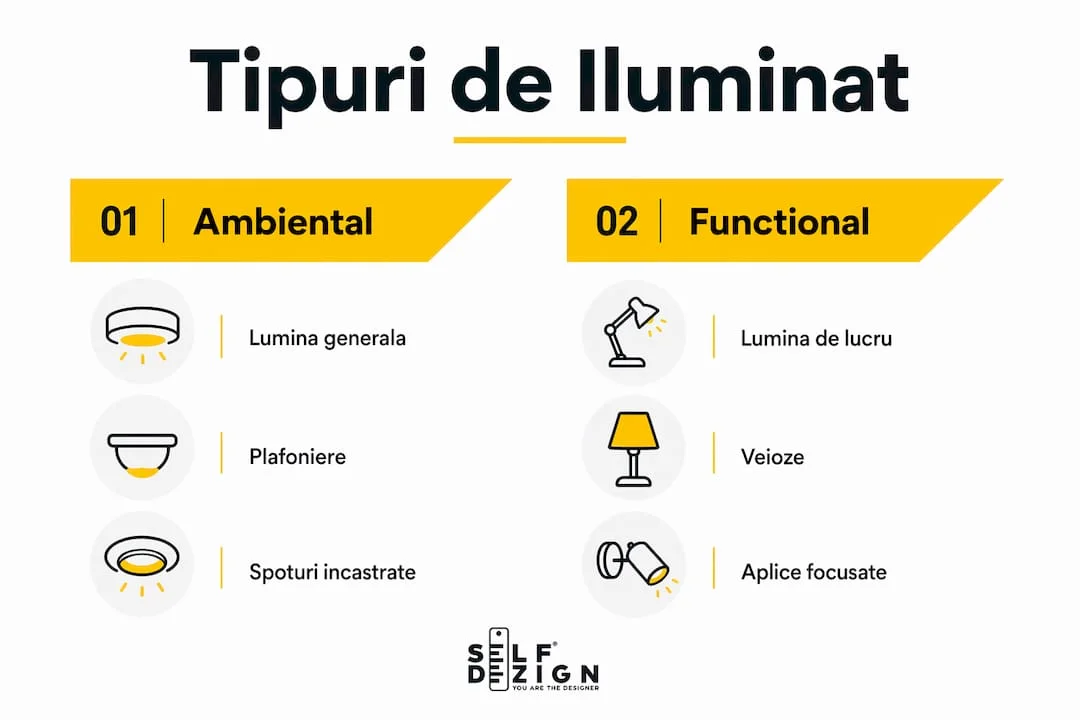
General lighting provides the background light of the room. Typical sources are ceiling lights, recessed spotlights, or suspended fixtures with a wide diffuser. Its role is to eliminate harsh shadows and provide comfortable visibility throughout the space.
Task lighting (or work lighting) focuses on specific areas where activity requires more light: the kitchen counter, the desk, the bathroom mirror. Without this level, general lighting becomes insufficient and tiring for the eyes.
Accent lighting creates visual hierarchy and atmosphere. Directional spotlights, LED strips, wall sconces, or table lamps highlight a painting, a wall texture, or a relaxation area. This is the level that transforms a functional space into a memorable one.
Advantages of Combining Multiple Sources
Intelligent combination of the three levels avoids a flat atmosphere and enhances both functionality and aesthetics of a space. Practically, it means you can adapt the same room for multiple scenarios: bright light for cleaning, warm and diffused light for a relaxing evening, accent on the reading area when you need focus.
A few concrete application examples:
- Living room: ceiling with recessed spotlights (general) + floor lamp next to the sofa (accent) + table lamp on the nightstand or console (task/accent)
- Kitchen: ceiling light or spotlights (general) + LED strip under wall cabinets (task) + pendant above the island (accent and task)
- Bedroom: dimmable spotlights (general) + wall sconces or table lamps on nightstands (task) + LED strip behind the headboard (accent)
- Bathroom: recessed spotlight (general) + side lighting relative to the mirror, not above (task) + accent light in the bathtub area if present
Professional tip: Install dimmers or a smart system such as Philips Hue, IKEA Tradfri, or Lutron Caseta on each circuit separately. Separate control of the three levels gives you total flexibility and reduces energy consumption during low-activity hours.
How Color Temperature Influences the Atmosphere of Each Room
Color temperature is measured in Kelvin (K) and defines the tone of light: warm, neutral, or cool. Choosing the wrong temperature can make a room look like a medical office or, conversely, too dark for daily activities. This decision is as important as choosing the wall color.
Warm light, between 2700 and 3000K, is recommended for rest rooms and living rooms, where visual comfort and a relaxing atmosphere are priorities. This means a bedroom lit with 4000K sources will always seem too alert, too clinical, no matter how well it is decorated. Color temperature is not a minor technical detail. It is an atmosphere decision.
Here are practical recommendations by room:
- Living room: 2700 to 3000K for the relaxation area; you can add 3000K sources in the reading area
- Kitchen: 3000 to 3500K for the counter and work areas; neutral light helps correctly perceive food colors
- Bedroom: 2700K for general lighting and table lamps; avoid sources above 3000K near the bed
- Bathroom: 3000 to 4000K near the mirror, where you need clarity for makeup or shaving
- Hallway and circulation areas: 3000K is a balanced choice, warm enough to welcome, clear enough for orientation
A less discussed aspect is that warm light can be powerful and efficient even in the kitchen, while maintaining a welcoming atmosphere. The myth that the kitchen necessarily needs cool or neutral light comes from confusing color temperature with light intensity. You can have a 2700K source with high luminous flux, and the result will be a warm, well-lit, and pleasant kitchen.
The role of colors and color temperature in space perception is closely linked to the chosen finishes: white walls reflect light differently than gray or beige ones, meaning the same source can produce completely different effects depending on the context.
What Types of Lighting Fixtures Exist and How to Choose Them Correctly
Lighting fixtures fall into three functional categories: ambient, task, and decorative. Choosing a fixture solely by appearance is one of the most common mistakes in renovation projects. Technical parameters such as IP rating, LED driver, and compatibility with switches are as important as design.
|
Fixture Type |
Main Role |
Examples |
Key Technical Parameters |
|---|---|---|---|
|
Ambient |
General background lighting |
Ceiling lights, recessed spotlights, LED panels |
Luminous flux (lm), beam angle |
|
Task |
Work lighting, specific area |
Directional spotlights, LED strips, desk lamps |
Color temperature, CRI minimum 80 |
|
Decorative |
Visual accent, atmosphere |
Pendants, table lamps, decorative sconces, RGB LED strips |
Dimmer compatibility, IP if in bathroom |
|
Outdoor |
Protection and visibility |
Garden spotlights, facade sconces, floodlights |
Minimum IP44 or IP65 |
The IP protection rating is a technical criterion many ignore until a bathroom fixture fails after a few months. A fixture with IP20 is not suitable near the sink or in the shower area. For bathrooms, zone 1 (above the bathtub or shower) requires minimum IP65, and zone 2 (outside the direct perimeter) requires minimum IP44.
Classic switches can cause problems with modern LEDs, generating flickering or noise. The solution is either replacing them with LED-compatible switches or switching to smart systems that completely eliminate this issue.
Professional tip: Always check whether the integrated LED driver in the fixture is replaceable or soldered. A non-replaceable driver means that upon failure, the entire fixture must be replaced, not just the worn component. This decision directly affects the long-term cost of the installation.
How to Plan Lighting for Main Rooms and Outdoor Spaces
Lighting planning is a technical process that must be integrated into the electrical installation design phase, not added at the end. Late-planned lighting generates aesthetic compromises and additional execution costs. If you know from the start that you want an LED strip in the ceiling or a directional spotlight above the dining table, the electrical circuits must be provided before plastering.
Recommended Illuminance Levels by Room
According to current standards, work areas require 500 to 750 lx, and rest rooms operate optimally at 150 to 250 lx. This means a home office and a bedroom cannot be lit with the same type of circuit or the same density of spotlights. Planning based on lux values is the only method that guarantees real visual comfort, not visual estimation.
|
Space |
Recommended Level (lx) |
Color Temperature |
Observations |
|---|---|---|---|
|
Home Office |
500 to 750 lx |
3500 to 4000K |
Avoid shadows on the work surface |
|
Kitchen (counter) |
400 to 600 lx |
3000 to 3500K |
LED strip under wall cabinets |
|
Living Room (relaxation) |
150 to 250 lx |
2700 to 3000K |
Dimmer recommended |
|
Bedroom |
150 to 200 lx |
2700K |
Separate table lamps on nightstands |
|
Bathroom (mirror) |
300 to 500 lx |
3000 to 4000K |
Side lighting, not from above |
|
Hallway |
200 to 300 lx |
3000K |
Optional motion sensor |
Outdoor Lighting: What You Need to Know
For outdoor spaces, the minimum recommended IP rating is IP44 for semi-protected areas, such as a covered terrace, and IP65 for areas directly exposed to rain or moisture. Choosing the IP rating is crucial for the longevity of the fixtures and the safety of the installation. A fixture with an inadequate IP is not just inefficient. It can become an electrical risk.
Smart technologies add an extra level of control and efficiency. Systems such as Philips Hue Outdoor, LEDVANCE Smart, or Lutron Aurora allow programming outdoor lighting scenarios, automatic intensity reduction after midnight, and integration with motion sensors.
Lighting Plan Checklist
- Have you identified the three lighting levels for each room?
- Have you checked the required lux values based on the activities in the space?
- Have you chosen the appropriate color temperature for each room's purpose?
- Have you checked the IP rating of fixtures in the bathroom and outdoors?
- Have you confirmed the compatibility of LED fixtures with switches or planned smart systems?
- Are the electrical circuits planned before installation execution?
- Have you provided dimmers or separate circuits for each lighting level?
By following these steps, you can reduce energy consumption by up to 60% compared to old systems, an advantage that directly translates into lower bills and superior visual comfort. Also consult strategies for interior functionality if you want to integrate lighting into a broader space optimization plan.
Why Lighting Must Be Thought of from the First Drawing, Not the Last Nail
We have worked on interior design projects long enough to see the same pattern repeated: lighting is left for last, treated as a shopping list, not as a design decision. The result is almost always the same: beautiful fixtures mounted in wrong places, insufficient circuits, flat atmosphere despite a substantial budget.
What we have observed in projects where lighting was planned integrally, alongside finishes, furniture, and installations, is that the space works differently. It not only looks better. It feels better. The client no longer ends up saying something is wrong without knowing exactly what. They know exactly what they want, because they saw the lighting scenarios before execution.
Another thing we have learned: the budget for lighting is not a separate expense. It is an investment in the quality of the entire project. A well-chosen fixture, with a replaceable driver, compatible with the smart system and with the correct IP, costs more initially and much less in the long run. Conversely, a cheap fixture mounted incorrectly costs twice: once at purchase and once at replacement or remediation.
If you are in the renovation or design phase, the best time to discuss lighting is now, not after the walls are ready. You can explore more ideas about choosing the perfect light to understand how strategy translates into concrete decisions.
How SelfDezign Can Help You with Lighting in Your Project
At SelfDezign, lighting is not a separate chapter added at the end. It is integrated into the design concept from the early stages of the project, alongside finishes, furniture, and technical installations. Whether you are working on a high-performance workspace or a customized residential home, the SelfDezign team analyzes the real context of the project and proposes lighting solutions that support the functionality, atmosphere, and identity of the space. No standard formulas, no seasonal trends. Solutions designed for you, for the way you use the space, and for the result you want to achieve.