
The role of colors in indoor spaces: how they influence the atmosphere

Colors in a space do much more than just make it “look good.” They can determine whether your employees are focused or distracted, whether customers stay longer or leave quickly, whether a residential space invites relaxation or creates tension. It's not just about walls, but a complex relationship between shades, light, materials and function. This guide shows you exactly how colors work in real indoor spaces and how you can use them consciously to get the results you want.
The main findings
|
Punct |
Detalii |
|---|---|
|
Colors change perception |
Choosing the right shade can make a space look bigger, friendlier, or more professional. |
|
Don't ignore the light |
Chromatic effects fundamentally depend on the type and intensity of lighting in the space. |
|
Testing is essential |
Apply samples in the real context to avoid surprises and uninspired decisions. |
|
Contrast to be dosed |
Well-managed harmony and contrast define the identity and key areas of the space. |
|
User experience matters |
Colors support emotional state and productivity if they are adapted to the function of each space. |
Why colors matter in indoor spaces
When you first enter a space, your brain processes color before any other detail. Before you notice the furniture, before you read a sign or feel the air temperature, the color palette has already influenced your emotional state. This is not a metaphor, but a documented mechanism that affects both customer behavior, employee productivity and tenant comfort.
Colors influence the perception of space, including perceived dimensions, brightness, and general atmosphere. A light wall makes a small room look bigger. A dark-colored treated ceiling visually lowers the height, creating privacy. These optical effects are not design tricks, but real visual architecture tools.
The role of colors does not stop at aesthetics:
- Warm colors(red, orange, yellow) energizes, stimulates the appetite and creates the sensation of movement. That's why you frequently find them in fast food restaurants or physical activity spaces.
- Cold Colors(blue, green, purple) soothes, reduces stress and promotes concentration. They are commonly used in medical clinics, consulting offices, or meditation spaces.
- Neutral shades(white, gray, beige) provides a balanced background that leaves room for other elements to speak.
“It's not just about beauty, it's about efficiency, communication and identity. A strategically designed color scheme is just as important as the functional layout of the space.”
The choice of color should be correlated with the function of the space and the type ofchoosing the perfect lightavailable. A restaurant that wants to create an intimate and warm atmosphere will make completely different choices than a car showroom that wants to communicate precision and modernity.
How shades and light influence users' perception and status
You can choose the best thought-out color palette, but if you ignore the light, the result will be unpredictable. The same color tone can look completely different in the morning than in the evening, under natural light versus warm or cold artificial light. This is one of the most common mistakes in interior projects.
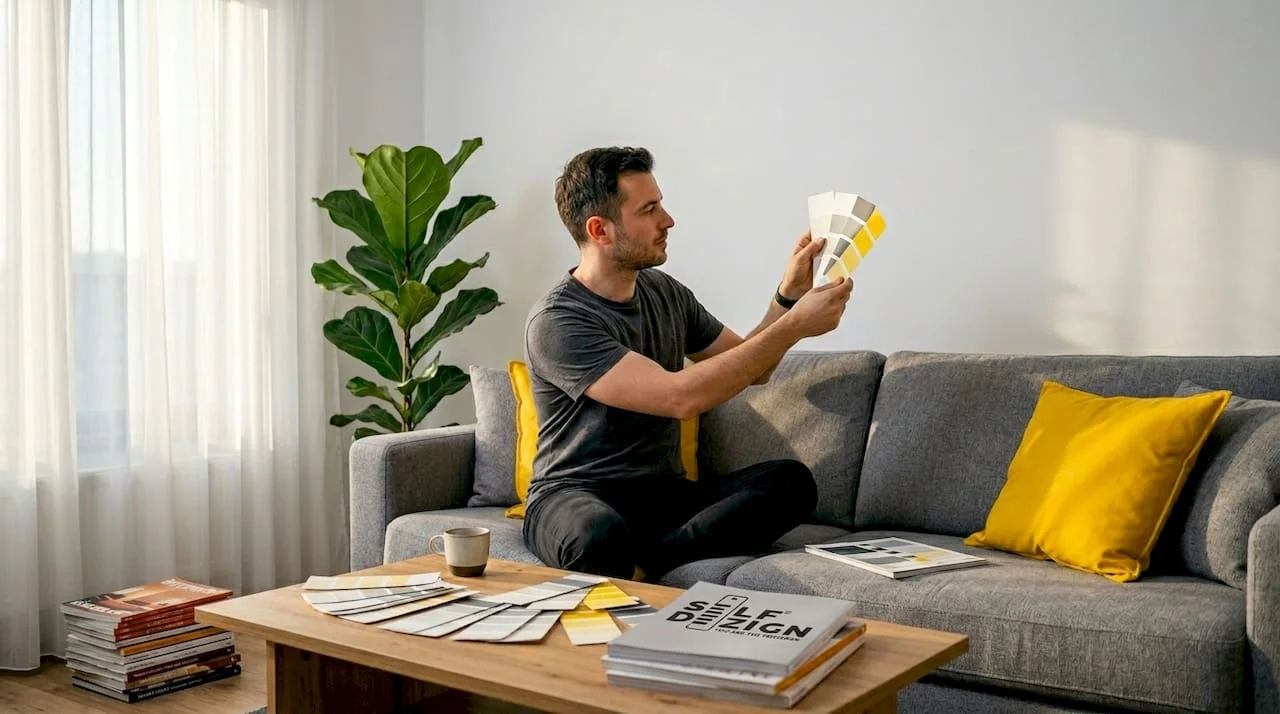
Recent research confirms thatcolor schemes directly influenceproductivity and emotional state in workspaces. Controlled studies show that blue and yellow walls produce a higher positive affect, while green has been associated with slightly decreased productivity, and red with a negative affect in certain contexts.
|
Wall color |
Observed emotional effect |
Recommended background |
|---|---|---|
|
Blue rare |
Calm, concentration, positive effect |
Offices, clinics, educational spaces |
|
Warm yellow |
Energy, optimism, stimulation |
Reception areas, cafes |
|
Red |
Emergency, excessive stimulation |
Avoided in prolonged workspaces |
|
Verde |
Balance, nature, slight decrease in productivity |
Wellness Spaces, Residential |
|
White/neutral |
Clarity, spaciousness |
Showrooms, galleries, clinics |
In addition to the shades of the walls,light color temperatureradically changes spatial perceptions. A warm light (2700K) turns a white desk into a cozy and relaxing space. The same cold light (5000K) applied in a bedroom will create an atmosphere of hospital, not rest.
Light-color impact assessment steps:
- Identifies sources of natural light (orientation of windows, their size).
- Write down the hours with maximum and minimum light in the space.
- Apply the color samples to the walls and observe them at least three different times of the day.
- It also tests with activated artificial light, not just natural light.
- Compare what colors look like in combination with existing materials (floor, ceiling, furniture).
The difference between thecolors and productivity in the officeit's not just about the hue, it's also about the intensity. A saturated, intense blue can become tiring as easily as an aggressive red. The secret lies in the dose and context of use. You can consult andexamples of effective officesto see how the applied principles work.
Professional advice:Brightness (tonal value) matters as much as hue. A dark green and a light green can produce completely different effects even if the chromatic family is the same.
Correct methodology: choosing and testing the color palette
Many space owners start from a color they like and build around it. Sometimes it works. Often it doesn't. A correct methodology starts from function and identity, not from personal aesthetic preference.
Ignoring the difference between natural and artificial lightconstantly leads to wrong choices, which become obvious only after the completion of the works. A perfect color on the sample or in the showroom may seem completely inappropriate on the main wall of your space, especially in the evening when natural light disappears.
The recommended process looks like this:
- Defines the functionality of the space.What do you want to happen there? Focus, relax, socialize, sell?
- Identifies the brand identity or personality of the space.A doctor's office communicates something different from a fine dining restaurant.
- Selects the palette based on the purpose.Work with the right color family for the function and emotion you want.
- Test on real surfaces.Not on small cards, but on surfaces of at least 50x50 cm on the actual walls.
- Observe at different times.Morning, noon, evening with artificial light.
- Validate with other items.Floors, furniture, and textiles alter the final effect of wall color.
Professional advice:Avoid using heavily saturated colors on all surfaces at once. One or two accent surfaces work better than a space completely wrapped in intense colors that quickly gets tired. Work with proportions: 60% dominant color, 30% secondary color, 10% accent.
These principles apply whether you're working on the right light for your room or you're in thecreate interior concept. Color and light should be planned together, not separately.
Contrast, harmony and identity of the space
Once you have the color palette, another critical decision follows: how much contrast do you use and where? Contrast and harmony are not opposites, but complementary tools that serve different purposes.
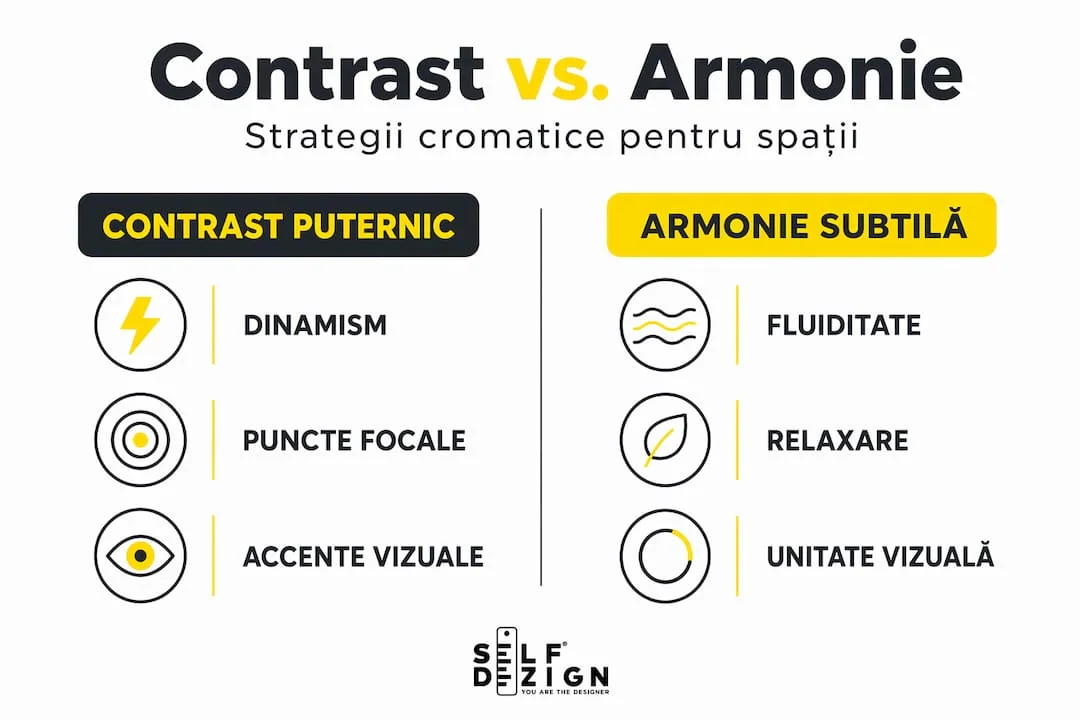
Contrast and harmony can be usedstrategically to create focal points and direct visitors' attention. An accent wall in a contrasting color draws the eye and signals the importance of an element, whether it is a product shelf, a brand logo, or an architectural element.
|
Abordare |
Avantaje |
Dezavantaje |
Suitable For |
|---|---|---|---|
|
High contrast |
Memorable, dynamic, clear accent |
May get tired, may seem aggressive |
Commercial premises, exhibition areas |
|
Chromatic harmony |
Comfortable, stylish, coherent |
It may seem flat, without personality |
Residential, Wellness Spaces, Clinics |
|
Moderate contrast |
Balance, visual interest without tension |
Requires accurate dosage |
Offices, hotels, restaurants |
Brand identity often dictates choice. A commercial space that sells premium products will use subtle contrasts and a sophisticated palette. An entertainment space for young people will use bold contrasts and vibrant colors. Both are correct in their context.
Classical chromatic harmonies, such as those based on analogous colors (neighboring on the chromatic circle) or triads (three equidistant colors), provide a solid starting point. You can explore in more detailarticles about interior design conceptto understand how colors integrate into a broader concept.
A less discussed aspect is the effect of reflected light. Glossy surfaces multiply color and light, creating the feeling of space. Matte surfaces absorb light and create depth.Role of prisms in designillustrates how much light can play with the color perception of a space.
Contrast-created focal points guide the gaze and create a visual narrative. Without focal points, the eye wanders without direction. Too many focal points create visual chaos. Dosage is everything.
Practical settings: examples and recommendations for different spaces
Principles make sense in theory. But what does it look like in practice? Each type of space has its specific needs and responds differently to the same chromatic choices.
- Office:White or light grey with accents of discreet blue or green.Light color temperaturerecommended is 3500 to 4000K, i.e. neutral light that supports concentration without tiring the eyes.
- Residential living room:Warm tones, beige, terracotta or sage green, with 2700 to 3000K light for a cozy and welcoming atmosphere.
- Kitchen:Clean colors, possibly white or light gray with colorful accents, and 3000 to 3500K light that makes food colors look appetizing.
- Commercial SpaceBolder contrasts work well. Brand colors should be strategically present, not overwhelming.
- Medical clinic:Neutral, pale tones with accents of warm blue or green. The light should be strong enough for functionality, but without creating a cold and sterile effect.
Recent research in educational and learning environments shows that certain colors produce significant neurophysiological and psychological differences. Blue with specific chromatic parameters has produced the greatest psychological comfort in virtual learning spaces, confirming that the choice of color in classrooms or vocational training spaces should not be left to chance.
Integrating lighting into room-by-room color planning is a step that many are skipping. The result: colors that look perfect in the catalog and disappoint in real space.
Un exemplu concret.A restaurant with cool gray walls and cool white light lighting will look more like a cafeteria than a gastronomic experience space. The same grey palette, treated with warm light at 2700K and complemented with natural wood and textile accents, becomes sophisticated and inviting.
What no one tells you about the role of colors in interior spaces
There is a persistent myth in interior design: if you choose the right colors for the walls, everything will be fine. It's a dangerous simplification. We have seen projects with impeccable color palettes on paper that have completely failed in execution, and vice versa.
Field reality shows that the effects of colors vary significantly with light, color parameters, and context of use. The same blue that works perfectly in a bright office with large windows facing north can create a depressing atmosphere in a space with limited daylight.
The second thing that not enough specialist articles mention is that every element in the space alters the perception of color. Furniture, textiles, floors, and even plants influence how the brain processes the color palette of walls. You cannot evaluate a wall color in isolation.
We worked on projects for the same retail brand in different locations. Same brand colors, same materials. The results were visually different, solely due to differences in natural lighting and the geometry of the space. The solution was not changing colors, but adjusting artificial lighting to compensate. This is not understood from standard color guides.
The third aspect ignored is the cultural context of the users. Colors are not universal in their emotional sensitivity. Context, previous experience, and even the age of users influence perception. Acustom business designconsider all these variables, not just a general theory of color.
The conclusion we draw from years of working on various projects is simple: color is a system, not an isolated choice. Works or not works in relation to light, materials, function and users. Any other approach produces random results.
Transform your space with professional help in interior design
Colors are one of the most powerful design tools, but also one of the easiest to mismanage without applied experience. At SelfDezign, we approach the color palette as an integral part of the design concept, not as a separate decision taken in the end. If you want to create a space that communicates your identity and really works for users, explore ourprofessional office design, understand how you canincrease the value of your spacethrough a custom design or check out our guide tocommercial spaces consultancy. We do more than pick colors, we build experiences.