
The Importance of Ergonomics in Offices: A Practical Guide 2026

Ergonomics in offices reduces medical risks and hidden productivity losses. It must be designed, measured, and managed from the concept phase, not improvised after the furniture has been delivered. Three authoritative references structure any serious decision in this field:
- Directive 2009/104/EC obliges employers to take ergonomic principles into account when selecting work equipment.
- ISO 9241 defines the technical requirements for human-system interaction and underpins any correctly dimensioned workstation project.
- SelfDezign integrates these requirements into the design concept from the first sketch, not as a checklist at the end.
The first concrete step: an ergonomic audit of the existing space, followed by concept consultancy with SelfDezign.
Why ergonomics matters for employees and for business
An employee working in moderate physical discomfort, with the monitor at the wrong height and a chair without lumbar support, loses real productivity day after day, silently. Multiplied by the number of people on the team and the working days in a year, the sum becomes considerable, without including absenteeism caused by musculoskeletal disorders.
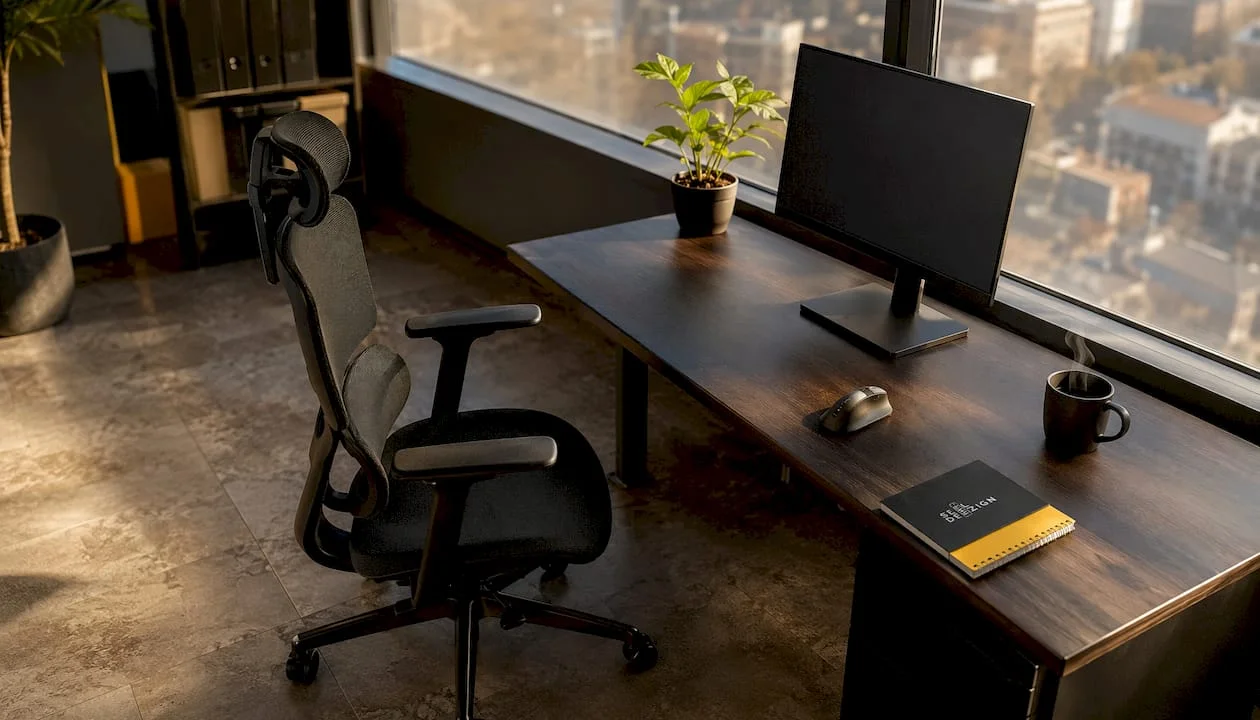
The link to business indicators is direct. Ergonomic investments reduce absenteeism and improve work quality when implemented as programs, not as mere furniture purchases. Talent retention is another argument: candidates observe the office at the interview, and new employees form opinions about the company based on the physical working conditions as well.
For a CFO, the ergonomics argument must be tied to metrics over 2–3 years: reduced sick leave days, higher net productivity, and lower operational costs. A quality ergonomic chair has a lifespan of 8–10 years. Compared to the cost of an employee over the same period, the initial investment is negligible relative to the long-term impact.
Legal compliance adds another dimension. EU minimum standards on occupational health and safety are not optional, and non-compliance exposes the employer to legal and reputational risks.
What European legislation and applicable technical standards in Central Europe require
Employers' obligations are clear and leave no room for interpretation:
- Directive 2009/104/EC requires taking ergonomic principles into account when selecting any work equipment, including office furniture and IT equipment.
- ISO 9241 (ergonomics of human-system interaction) sets technical requirements for workstations: dimensions, angles, distances, lighting, and visual space organization.
- EN 1335 defines European standards for office chairs: mandatory minimum adjustments, structural strength, and safety requirements. An EN 1335 certified chair guarantees that it can be adjusted for users of different heights, with knees at 90° and feet flat on the floor.
In Central Europe, practical responsibilities are distributed as follows: the employer is responsible for equipment compliance and employee training; the interior design designer is responsible for correctly integrating dimensions and flows into the concept; the execution coordinator verifies at handover that the delivered furniture meets the technical specifications in the project. Technical documentation for the OHS audit must include product data sheets, certificates of conformity, and handover reports.
Modern office design starts precisely from these technical requirements, not from aesthetic preferences.
What to measure and adjust at each workstation
The ergonomics of an office is not seen; it is measured. A few basic rules structure any evaluation:
Essential distances and angles:
- Eye-to-monitor distance: 50–70 cm, with the screen at eye level or slightly below.
- Elbow angle: approximately 90° when hands are on the keyboard.
- Feet flat on the floor or on a footrest, with knees at 90°.
- Desk height: 73–76 cm for most adults, or adjustable for mixed teams.
Lighting that respects circadian rhythms reduces visual fatigue and supports concentration throughout the day. Acoustics is equally important in hybrid offices: concentration zones require sound absorption, while collaboration spaces can tolerate a higher level of ambient noise.Benefits of height-adjustable desks are documented for both health and productivity, especially in teams that alternate working from home with being at the office.
Professional tip: Delivering an ergonomic chair without an individual adjustment session is a half-investment. A chair used incorrectly, with the user too low or without using the backrest, does not achieve its purpose. Include a training component in any project, even in the form of a visual guide displayed at the workstation.
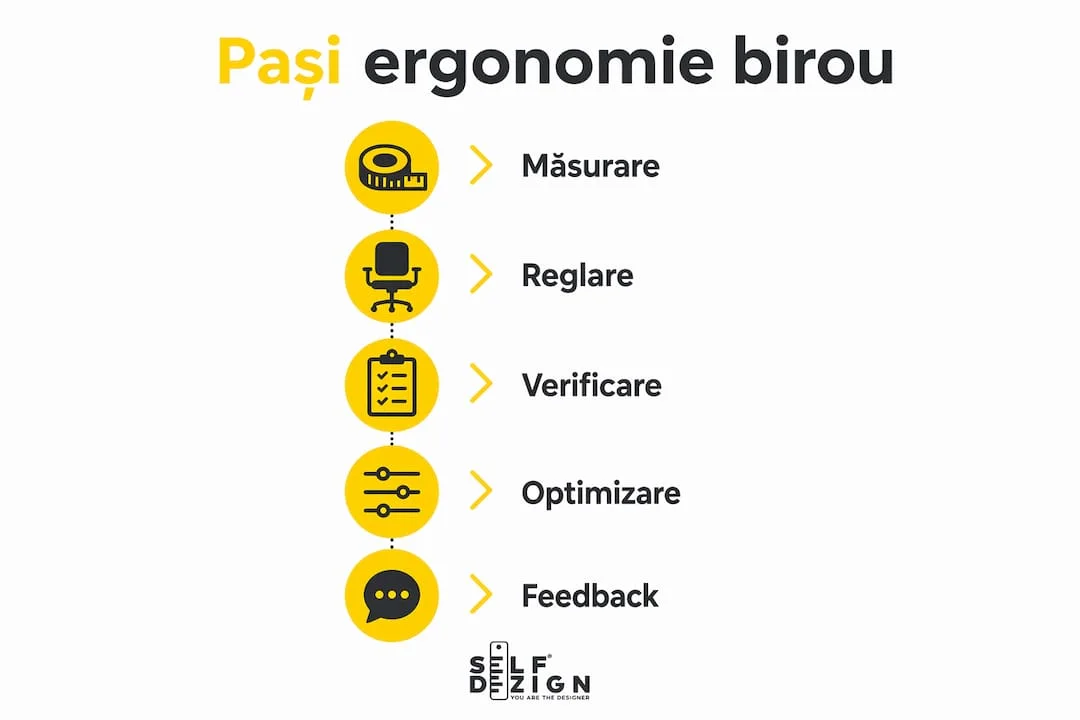
How to integrate ergonomics into a design project, step by step
The process has six distinct phases, each with roles and estimated durations:
- Ergonomic audit (1–2 weeks): evaluation of existing stock, employee questionnaires, flow observations, and identification of critical points. Responsible: designer or OHS consultant.
- Integrated concept (2–3 weeks): zoning, furniture selection, lighting and acoustic proposals integrated into the visual identity of the space. Responsible: interior design designer.
- Technical project (2–4 weeks): detailed plans, product specifications with EN/ISO certifications, documentation for procurement. Responsible: designer, verified by OHS.
- Procurement and delivery (4–8 weeks): supplier selection, verification of certificates of conformity, quantitative and qualitative reception.
- Installation and handover (1–2 weeks): assembly, initial adjustments, handover report with verification of technical specifications.
- User training (1 day): practical session on individual adjustment and internal communication about daily best practices.
|
Element |
Indicative range (Central Europe) |
Factors influencing price |
|---|---|---|
|
Professional ergonomic chair (EN 1335) |
prices vary depending on certification, adjustments, and brand |
|
|
Height-adjustable desk |
costs depend on electric vs. manual mechanism and dimensions |
|
|
Ergonomic audit (per project) |
price is influenced by area, number of workstations, and complexity |
|
|
User training (per session) |
costs depend on number of participants and included materials |
|
KPIs to monitor in the first 12–36 months: medical absenteeism rate, employee satisfaction score (semiannual questionnaire), number of furniture adjustment requests, and maintenance costs.
How SelfDezign integrated ergonomics into an office project
A representative project from SelfDezign's portfolio started from a common problem: an office space with 40 workstations, non-uniform furniture, and constant complaints about fatigue and back pain. The objective was not a 'new fit-out' but a space that supports daily performance and reduces physical friction.
The adopted solutions included replacing chairs with EN 1335 certified models, introducing height-adjustable desks for roles with extended hours, zoning the space to separate concentration areas from collaboration ones, and a lighting system with variable color temperature. The post-installation training session covered individual adjustment of each workstation.
Team feedback after 90 days showed a visible reduction in interruptions caused by physical discomfort and an improvement in workflow in concentration areas. The project was editorially and technically coordinated by Toni, within theoffice projects portfolio of SelfDezign.
What to do concretely in 30, 90, and 180 days for ergonomics
First 30 days
- Conduct a quick audit: go through each workstation and note missing adjustments, incorrect monitor positions, and chairs without lumbar support.
- Make immediate minimal adjustments: adjust chair heights, reposition monitors at eye level, add footrests where needed.
- Communicate internally: a simple message about the importance of correct posture and visual instructions at each workstation.
First 90 days
- Launch the procurement process for adjustable furniture, based on the specifications from the ergonomic audit.
- Implement zoning for hybrid scenarios: concentration zones with sound absorption, collaboration zones with flexible furniture.
- Organize a training session for all users, focusing on individual adjustment and active breaks.
First 180 days
- Evaluate the KPIs set at launch: absenteeism, satisfaction, adjustment requests.
- Review furniture supplier contracts and include warranty and service clauses for ergonomic equipment.
- Build a 2–3 year investment plan for gradually replacing non-compliant furniture and extending ergonomic solutions to all roles.
Ergonomics as the identity of the space, not as standard equipment
There is a common confusion in the market: ergonomics is treated as an 'upgrade' you add after solving the 'serious' problems. This logic reverses causality. Ergonomic furniture is not an extra, but the basic infrastructure that allows people to deliver what is expected of them.
At SelfDezign, ergonomics enters the concept from day one, not as a list of technical requirements to check off, but as part of the space's identity. An office that supports daily performance conveys something about the organization: that it understands people's real needs, not just their professional goals. This is the difference between a 'furnished' space and a designed space.
The resimercial trend from 2025–2026 confirms this direction: offices become wellbeing centers, where residential comfort and commercial functionality coexist. Adjustable furniture, circadian lighting, and adapted acoustics are no longer luxury options, but talent retention arguments. Good candidates compare offers and observe the physical space as carefully as they read the salary package.
Properly designed ergonomics becomes, over time, a brand asset. The space speaks about the organization's values before any employee opens their mouth. This is the real stake of a well-thought-out interior design project, and the commercial space concept must reflect it.
SelfDezign designs ergonomic offices from concept to handover
An ergonomic office project does not mean buying better chairs. It means designing a space where every decision, from zoning to lighting, supports the team's daily performance. SelfDezign delivers exactly that: ergonomic audit, integrated concept, technical project with EN/ISO specifications, execution coordination, and user training, all under a single contract.
We work with clients in Bucharest and Central Europe, for offices from 10 to several hundred workstations. The process begins with an initial assessment of the space and objectives, followed by a clear proposal with an implementation timeline.
If you want to understand what a complete office interior design project entails, the SelfDezign services page is the first place to start. Or contact us directly for an initial assessment of your space.
Useful sources and recommended readings
|
Source |
What it offers |
Practical relevance |
|---|---|---|
|
Directive 2009/104/EC (EUR-Lex) |
Official legislative text on minimum OHS requirements for work equipment |
Mandatory for employers and designers |
|
Summary of minimum OHS standards (EUR-Lex) |
Accessible presentation of employers' obligations regarding ergonomics |
Useful for HR and facility managers |
|
EU strategic framework and evolution of OHS legislation |
Legislative context and future directions |
|
|
Office ergonomics and daily performance (BusinessPsychology) |
Analysis of the impact of posture and physical environment on concentration |
Arguments for managers and HR |
|
Ergonomic investments increase returns (SmartLiving) |
Practical examples and ROI arguments from the European market |
Useful for budget justification |
|
Office design trends 2025 (Forbes.ro) |
Analysis of the resimercial direction and hybrid offices |
Strategic positioning and retention arguments |
|
Electric desk adjustment guide (ELEVATIX) |
Practical adjustment instructions for electric height-adjustable desks |
Useful for user training |
|
Office interior design: SelfDezign examples |
Portfolio of office projects with integrated ergonomic solutions |
Reference for decision-makers |