The Importance of Innovation in Interior Design: 2026 Guide

Interior design innovation is the process by which spaces are strategically, not just aesthetically, designed to generate real value for businesses and users. The importance of innovation in design is not limited to choosing a visual style or following trends in magazines. It means the early integration of design decisions with business objectives, with available technologies and with the concrete needs of those who will live or work in that space. For business owners and designers working in the 2026 market, this distinction makes the difference between a project that performs and one that looks good on paper.
Why the Importance of Innovation in Landscaping Starts at Phase Zero
Integrated interior design from the concept phaseincrease business performanceprojects directly and measurably. Projects that include innovative design from the start sell faster and at higher prices than those where the design is later added as a cosmetic layer. This difference does not occur by chance. It is the result of decisions made at the right time, when changes are still possible without major additional costs.
When the design enters the project only after the structure and installations are completed, compromises occur. A wall that cannot be moved, a pipe that limits the location of furniture, a window that blocks a natural flow of circulation. Planning zero-phase installations and furniture eliminates these situations and reduces the cost of time and money during execution.
Here's what happens concretely when innovation is integrated from the start:
- Technical routesare optimized around the functionality of the space, not the other way around
- Furniture and finishesare designed together with the structure, not adapted later
- User experienceis validated prior to execution, not corrected after
- Brand valueis amplified by the coherence between identity and physical space
INFORMATION: If you are a business owner working with a developer or builder, request the inclusion of a designer in the team before finalizing the technical plans. Each week of delay in this decision means fewer options and higher costs.
Innovative design integrated into premium projects increases brand value and market positioning. This is not an aesthetic observation. It is a fundamental business decision, with a direct impact on customer perception and on the price the market is willing to pay.
Sustainability and biophilic design: innovation with technical conditions
86% of Romaniansare familiar with the concept of sustainable construction, compared to the European average of 69%. This figure shows that the demand for sustainable solutions in Romania significantly exceeds the continent average, which means that business owners who ignore this direction lose a real competitive advantage.
Biophilic design, i.e. the integration of natural elements into interior spaces, is one of the most discussed interior design trends in recent years. Plant walls, plants in work areas, natural materials, maximized natural light. The benefits are real: studies show improvements in well-being, concentration, and employee satisfaction. But these benefits are not automatic.
|
Biophilic element |
Potential benefit |
Technical condition required |
|---|---|---|
|
Indoor vegetal wall |
Better air quality |
Adequate irrigation and ventilation system |
|
Plants in workspaces |
Reduce stress |
Calibrated artificial lighting for plants |
|
Natural materials (wood, stone) |
Thermal and acoustic comfort |
Protective and maintenance treatments |
|
Maximized daylight |
Increased productivity. |
Sunscreen to avoid overheating |
Green Infrastructure Performanceinteriors depends on the technical integration and the specific conditions of the space. The presence of plants without the correct technical parameters does not bring the promised benefits and may generate undue maintenance costs.
Specifically, the biophilic benefits must be supported by technical parameters such as lighting and ventilation in order to be real. This means that innovation in design cannot be separated from engineering. A designer who proposes a plant wall without collaborating with a climatic installation specialist delivers an incomplete solution. You can read more about the real conditions of this approach in the SelfDezign article aboutapplied biophilic designThe
Green innovation in design is therefore an interdisciplinary project. Designers, horticulturists and technical specialists must work together from the beginning, not sequentially. That's the difference between a space that looks sustainable and one that works sustainably.
How artificial intelligence is changing the interior design process
Artificial intelligence acceleratesthe interior design process, shifting the focus from concept generation to execution and technological integration. Renders that required working days are now generated in hours. Customers can view multiple variants before making a decision, and designers can test solutions without investing time in each iteration.
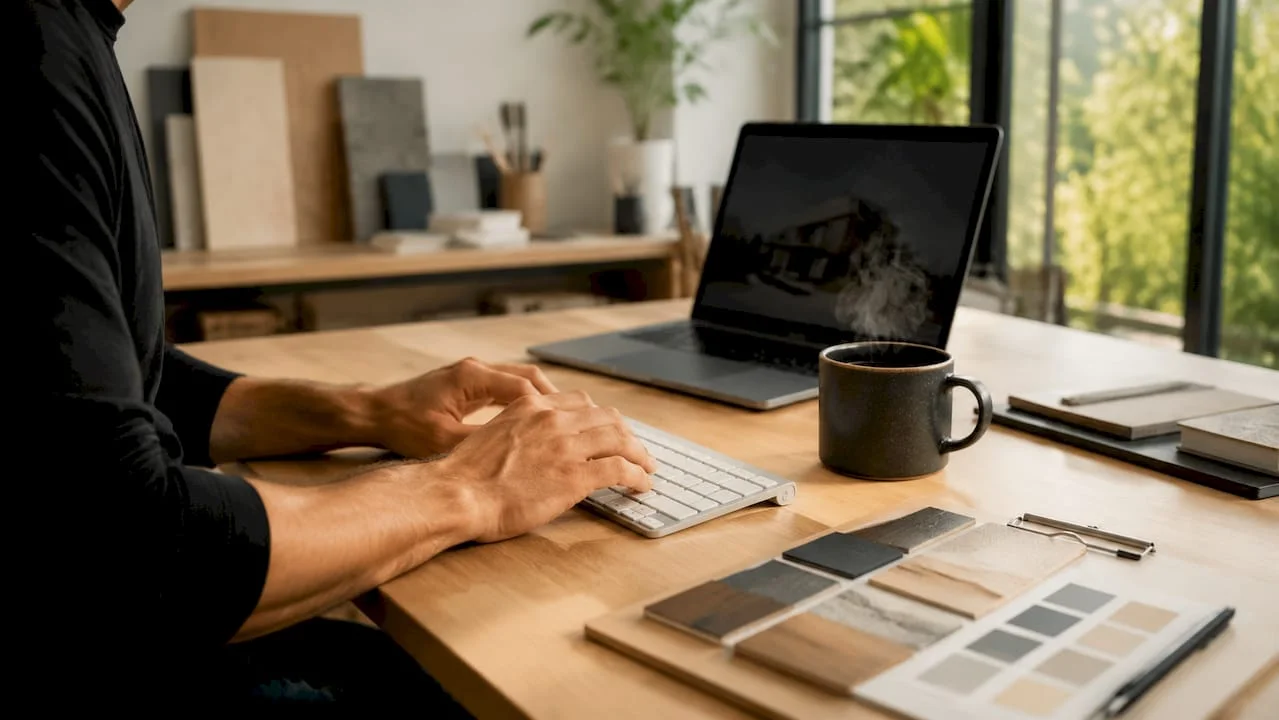
This changes the role of the designer. In line with 2026 trends, new digital tools transform the designer from a concept creator into a facilitator of integrated and validated execution. Competence no longer consists only in imagining a beautiful space, but in coordinating its correct implementation, with all the technical details aligned.
Several concrete directions in which new technologies in landscaping change current practice:
- Real-time AI renderings: customers see variants of finishes, colours and furniture before purchase, reducing the risk of wrong decisions
- Building Information Modeling (BIM): allows coordination between architect, designer and installer on the same digital model, eliminating technical conflicts
- 3D scanning of existing spaces: accurate surveys in hours, not days, with data directly usable in design software
- Lighting simulations: testing natural and artificial light scenarios before execution
INFORMATION: Before adopting an AI tool into the design process, check that its output can be validated functionally, not just visually. A beautiful render that does not take into account the actual dimensions or technical routes creates problems in execution.
AI reduces the risk of slow decisions by quickly generating design and execution options. This capability fosters early integration and functional validation, exactly the type of approach that differentiates successful projects. You can see how these principles apply incoordinating a projectof interior design, from concept to implementation.
Why Prototyping and Monitoring Reduce Fit-out Risks
Innovative solutions in decoration and landscaping do not have to be fully implemented from the first iteration. Continuous testing and adjustment are principles taken from engineering and product design, and their application in interior design significantly reduces investment risks.
A relevant example comes from a different context but with a directly applicable logic:monitored floating islandsvideo for biodiversity protection on Bistret Lake demonstrates that continuous monitoring allows validation and adjustment of innovative solutions in real time. The same principle applies in amenities: a newly configured workspace can be monitored by usage feedback before it is fully completed.
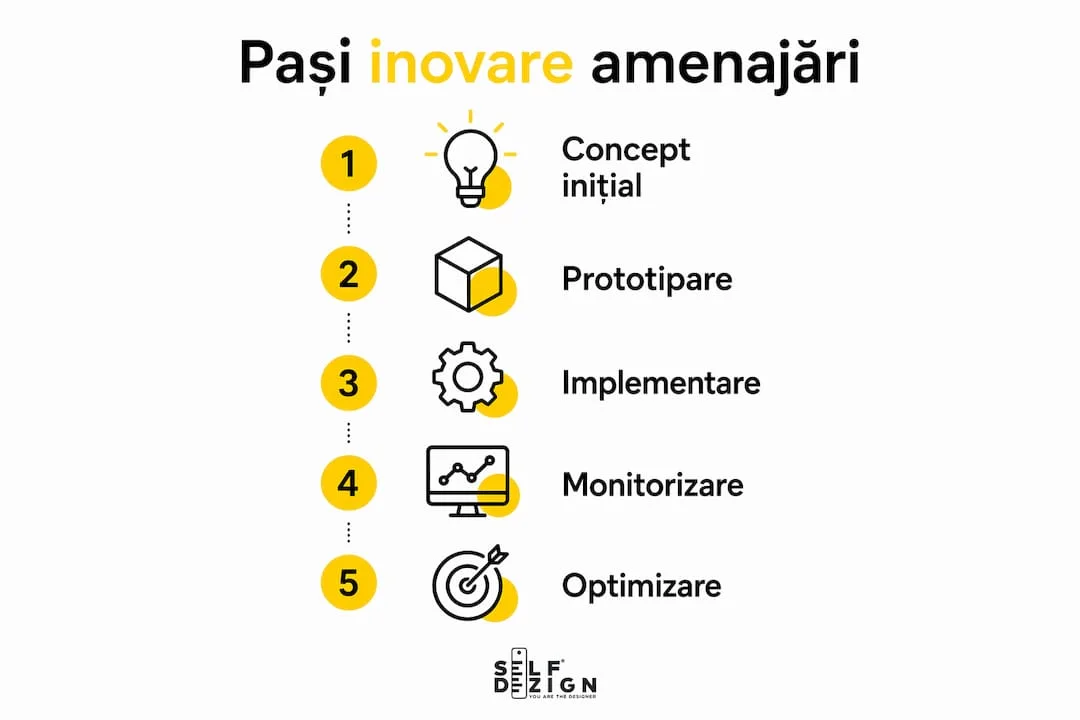
Here's what an iterative validation process applied in interior design looks like:
- Definition of functional objectivesbefore any aesthetic decision. What the space should do, not what it should look like.
- Prototyping of critical areaswith temporary or modular solutions, testable before final execution.
- Collecting Usage Feedbackfrom employees, customers, or patients, depending on the type of space.
- Adjusting solutionsbased on real data, not subjective aesthetic preferences.
- Final implementationwith the certainty that the solution works in the real context of the space.
This process is particularly useful in complex projects such as medical clinics, offices with varied flows or Horeca spaces with strict operational requirements.Risk managementin interior design projects it thus becomes a competence as important as creativity. Business owners who understand this logic make better decisions and avoid the costs of subsequent reconfigurations.
What I Learned from Years of Real Stake Projects
The most common point where fit-out projects lose value is not execution. It is the time when design comes into question too late, after structural decisions are already made. We have seen this repeatedly in office projects, commercial spaces and clinics: a space that could have worked great ends up being a permanent compromise, because no one has put the designer at the table in the planning phase.
Innovation in design does not mean choosing the latest materials or following trends at international fairs. It means asking the right questions before concrete is poured. What experience should the user have in this space? What behavior should the configuration support? How will use change in two or three years?
Early collaboration between all stakeholders, from owner to architect, designer, installer and sometimes end user, is the only way innovation becomes functional, not decorative. New technologies, from AI to BIM, help enormously, but they amplify the right approach, not replace the wrong one.
The risks avoided through a design strategy thought out from the start are concrete: expensive reconfigurations, underutilized spaces, poor user experiences and, finally, a brand value lower than the actual potential of the project. Innovation is not an aesthetic bonus. It is the backbone of a performing project. "— Toni Bunăiașu
How SelfDezign supports innovation in your projects
SelfDezign works with business owners and designers who want more than just a nice space. The team integrates the interior concept, the technical design and the coordination of the implementation into a single coherent process, designed to support the real objectives of the project. If you have an office space that needs to reflect the company culture and support productivity, or a Horeca space that needs to function flawlessly under operational pressure, the SelfDezign approach starts from the context, not from standard formulas. You can exploreoffice solutionsor you can check outconsulting guidefor commercial spaces as a starting point for a personalized discussion.