Acoustic panels vs foam: which treats noise correctly
Acoustic panels offer, in most scenarios, superior performance, durability and safety compared to acoustic foam. Foam remains a cheap and fast solution, especially effective at high frequencies, but limited in the bass range and problematic in terms of fire resistance. For a temporary space or a strict budget, foam can be enough. For a permanent project such as an office, restaurant or clinic, panels remain the long-lasting choice.
In summary:
- Acoustic panels have an absorption coefficient (NRC) of up to 0.95, while foam only absorbs between 0.25 and 0.50, thus requiring larger surfaces for the same effect.
- In commercial premises, mineral core panels better comply with fire safety requirements compared to standard polyurethane foams, which have lower classifications.
- The lifetime of mineral or PET core panels frequently exceeds 15 years, while the acoustic foam degrades in 3 to 5 years due to UV and dust exposure.
- For real sound insulation, the acoustic treatment must be supplemented with structural measures, such as insulation of doors, windows and walls; these materials do not ensure the blocking of external noise.
- The actual lifetime cost reveals the advantages of the panels, although initially the foam seems cheaper, the replacement costs over time make the longer-lasting variant more cost-effective.
SelfDezign
Integrates acoustics into the interior design
SelfDezign designs commercial spaces, hospitality, offices, clinics and housing, from interior concept to coordination of implementation.
Acoustic panels vs foam: the differences that matter
The first confusion to avoid: soundproofing and sound absorption are not the same thing. Isolation blocks out noise passing from one room to another, while absorption reduces echo and reverberation inside the room. Most projects go wrong exactly here, buying foam thinking it will isolate them from the neighbors, when in fact the material only works on echo, not on sound transmission.
The difference in performance is clearly seen in the figures. Professional panels with mineral wool or PET core frequently achieve an absorption coefficient (NRC) of 0.80 to 0.95, while consumer foams tested typically produce values of only 0.25 to 0.50. The difference is not cosmetic: it means you need significantly more foam-covered surface for the same perceived effect.
- Acoustic performance: panels dominate throughout the frequency band, the foam loses ground below 250 Hz.
- Aesthetics and integration: panels come in textiles, custom prints or minimalist finishes; the foam remains visually “technical”, difficult to integrate into a coherent design concept.
- Risk and compliance: mineral core panels usually have fire classifications superior to standard polyurethane foam.
- Lifetime cost: foam costs little to purchase, but is often replaced; panels cost more initially, but last for many more years.
Professional advice: if your main problem is noise coming from neighbors or from the street, neither the panels nor the foam solve this on their own. You need structural insulation (doors, windows, wall insulation); acoustic treatment with panels or foam solves the echo inside.
What the NRC shows and why the foam loses at low frequencies
NRC (Noise Reduction Coefficient) is the average absorption of a material at four standard frequencies (250, 500, 1,000 and 2,000 Hz), rounded to a number between 0 and 1. An NRC of 0.90 means that the material absorbs approximately 90% of the sound energy that reaches it, at the frequencies tested. Major limitation: the tests are done under controlled laboratory conditions, and the actual performance varies depending on the mounting, the distance from the wall and the geometry of the room.
|
Material |
Typical NRC |
Behaviour at low frequencies |
|---|---|---|
|
Standard polyurethane foam |
0.25 to 0.50 |
Weak below 250 Hz |
|
Melamine foam (Basotect type) |
variable, depending on thickness |
Moderate but still limited on bass |
|
Fabric-wrapped panels (mineral core) |
0.80 to 0.95 |
Good, especially at thicknesses over 50 mm |
|
Mineral wool (thick panels, 50-75 mm) |
0.80 to 0.95 |
Very good, including on bass |
Foam loses ground at 125 and 250 Hz for a simple physical reason: long low-frequency waves need a thick, dense material to be absorbed efficiently, and standard foam is usually too light and too fine for that. Mineral wool and thick fabric-wrapped panels solve the problem much better, precisely because their density retains low energy more efficiently.
- Practical rule of coverage: treat 20 to 40% of the wall surface, not everything.
- Prioritize the primary reflection points (between the sound source and the listening position) and the corners of the room where the bass accumulates.
What you need to know about fire safety
Here many commercial projects get stuck, because standard polyurethane foam frequently has lower reaction to fire classifications than those required for public spaces. In Europe, the reference standard is the Euroclass system (A1, A2, B, C, D, E, F, non-combustible to easily flammable); in markets using American references, ASTM E84 often appears, which ranks materials by degree of flame spread and smoke. Many inexpensive polyurethane foams don't achieve the classes required for a restaurant, doctor's office, or office with many visitors.
Basically, this means that before buying any acoustic material for a space open to the public, you need to ask the supplier:
- Technical data sheet of the product, with the exact thickness and density.
- Fire rating (Euroclass or ASTM E84, depending on the market).
- Declaration of compliance confirming that the delivered batch complies with the class promoted in the marketing materials.
For public or semi-public spaces, the safer options remain mineral core or stone wool panels, respectively PET panels with a suitable rating for the risk class of the space. For a private bedroom or home studio, the requirements are much more permissive, but it is still worth checking if the space has another function (office occasionally received by customers, for example).
How long panels and foam last
The expected lifetime clearly separates the two categories. Standard acoustic foam degrades in 3 to 5 years: UV rays make it friable, dust settles in the pores of the material and frequent handling crushes it at the corners. Mineral core or PET panels, protected by a textile cover, typically last 15 years or more without significant loss of performance.
- The degraded foam not only looks bad, but absorbs even less than when installed.
- The panels allow the textile face to be renewed without replacing the functional core.
- For areas with heavy traffic or moisture (professional kitchens, clinic hallways), panels with washable or moisture-resistant cover reduce the risk of visible degradation and odors much more.
How much does it really cost: lifetime calculation, not just on purchase
The price per square meter tells only part of the story. As a guide, the standard acoustic foam costs less at the initial purchase than fabric-wrapped or mineral core panels, but the correct calculation is the annualized one, not the one at the moment.
- Calculate the cost per year of use, not just the list price. A foam replaced every 4 years costs, for 16 years, four successive purchases; a panel with a duration of 15 years plus reserve costs, in the same interval, a single purchase and possibly a textile re-dressing.
- Count the actual area required. Because of the lower NRC, foam often requires significantly more surface area for comparable result, which partially cancels the unit price advantage.
- Request specific offers from local producers before you decide, by checking the NRC and fire class labels on each product compared, not just on the marketing sheet.
The difference becomes visible especially in commercial projects, where the treated area is large and changing the degraded material also means temporarily stopping the activity.
When choosing foam and when panels: recommendations by scenarios
The right choice depends on three variables: how long you need the solution, what budget you have, and what safety requirements the space requires. A temporary home studio or short-term rental room tolerates foam, especially if the problem is mid-high frequency echo in the voice or instruments. A permanent office, restaurant or medical clinic needs a material that lasts for years and complies with safety rules, so panels become practically mandatory.
The first step, regardless of the scenario, is the diagnosis: determine whether the real problem is the noise entering or exiting the room (need isolation) or the echo inside (need absorption), because many rooms need both solutions combined, not just one.
Checklist before you contract the supplier:
- What is the exact NRC for the thickness you buy, not the thickest variant in the catalogue?
- What Euroclass or ASTM E84 class does the product have, and does it meet the requirements of your space?
- What guarantee does the manufacturer offer for degradation over time?
- What aesthetic options (color, texture, print) are available without significant additional cost?
Professional advice: in SelfDezign projects I have seen customers choose foam for a restaurant thinking they are saving money, only to replace it entirely after two years because of the absorbed smells and the degraded appearance visible from the entrance. The real cost of the “cheap solution” was higher than if they had chosen panels from the beginning.
How to integrate acoustic solutions into a real project
In SelfDezign projects, the choice of acoustic material is not a separate design decision, but part of the technical specification of the space. We audit the acoustic needs, recommend the material according to the function of the space and coordinate the execution so that the acoustic panel becomes a design element, not a visible addition. The customer receives the data sheets and the assembly diagram for each proposed solution, at technical detail verifiable.
Editorial perspective: why NRC figures don't tell the whole story
The most often ignored aspect of this comparison is not the gross performance, but the context. An NRC figure of 0.90 means little if the panel is mounted incorrectly, at an inappropriate distance from the noise source, or if it only covers 10% of the wall in a room that needed 30%. Technical guides often treat NRC as a final verdict, when in fact it's just an ingredient in a space solution.
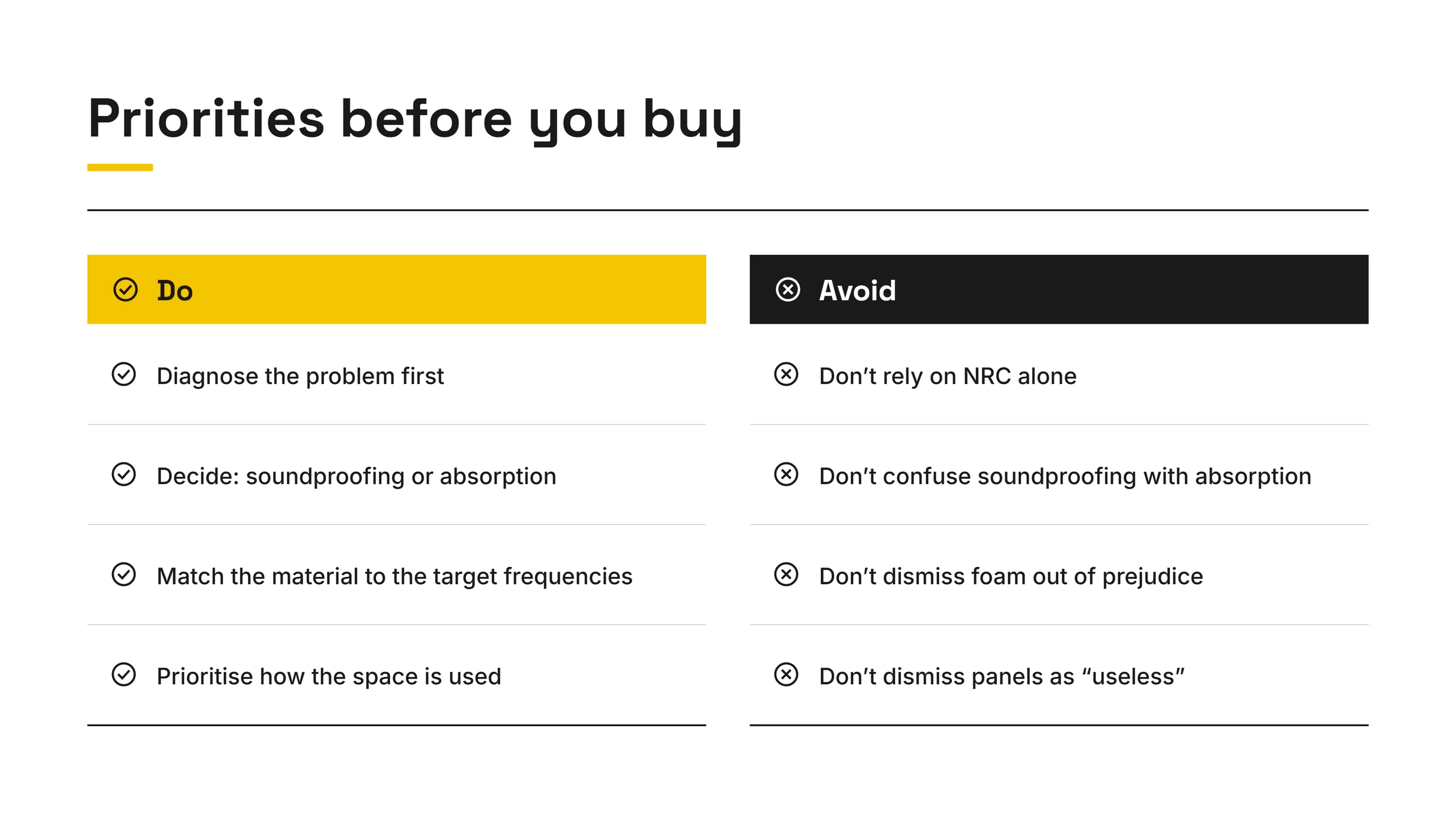
I think the biggest mistake people make is not choosing the material, but ignoring the initial diagnosis: they mistake an isolation problem for an absorption problem and buy the wrong product for the wrong symptom. Foam is not a "cheap and stupid" material, as it is often presented, but a suitable tool for a limited category of problems, at medium-high frequencies, in temporary spaces. The panels are not “expensive and useless for amateurs”, but the solution that resists when the space has a permanent function and a real audience.
The real priority, before any purchase, is to understand what you want to solve in your room. The rest, from NRC to fire class, are implementation details, not the starting point.
Toni
What SelfDezign offers for a well-integrated acoustic treatment
An alternative approach to choosing acoustic material on your own is to benefit from a technical specification thought out from the start together with the design concept. We recommend consulting especially for commercial projects, hospitality spaces and medical clinics, where safety and aesthetic requirements intersect and a material mistake costs time and money.
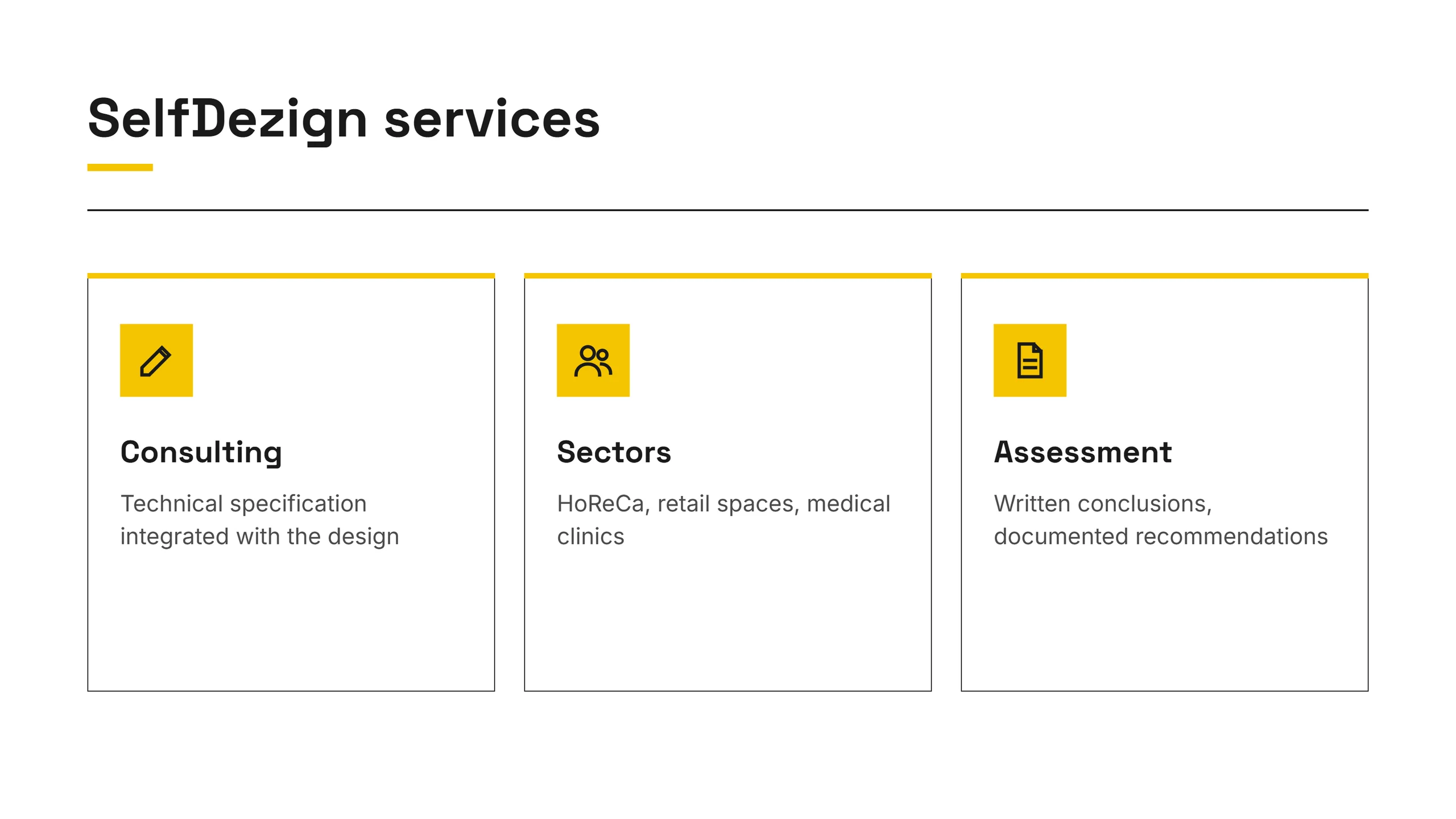
The services of commercial interior design and design consultancy include the specification of acoustic materials suitable for the function of the space, coordinated with the rest of the project. If you want a punctual technical assessment, you can request a consultancy with written conclusions, with documented recommendations for the right material for your room.