HPL vs Laminate Countertop: Real Differences and What to Choose in 2026
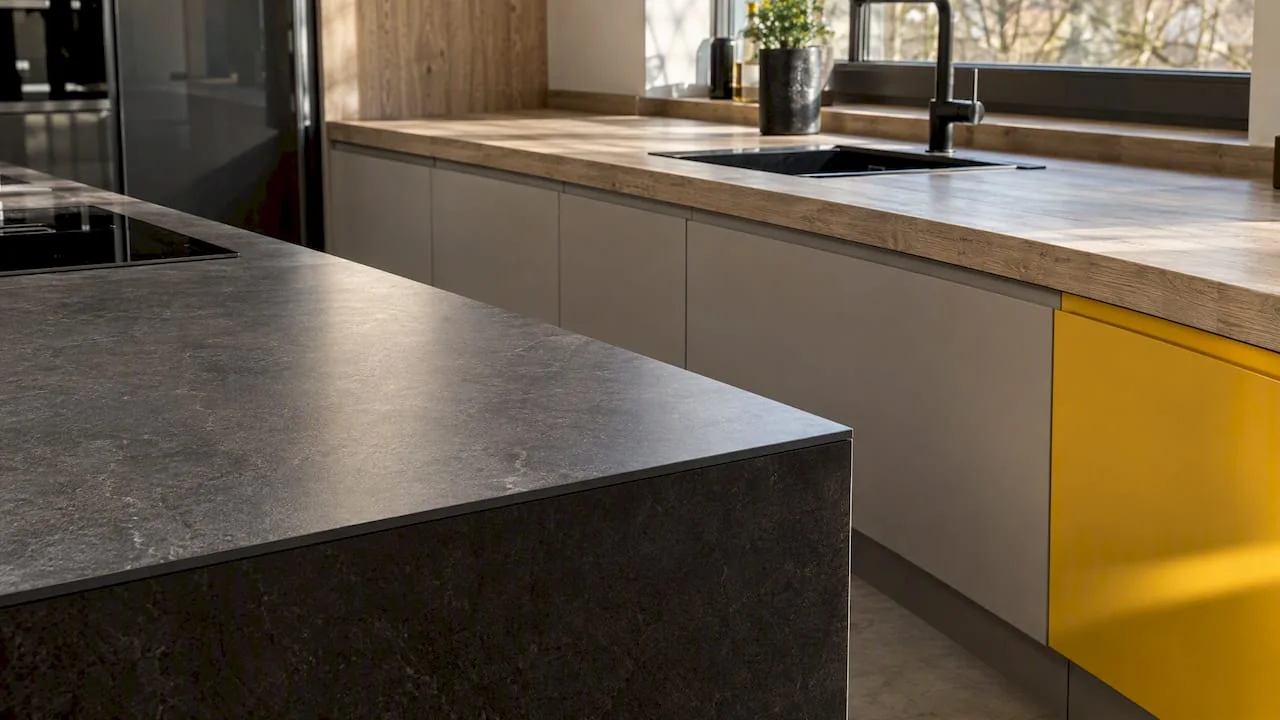
If you are wondering whether to choose an HPL countertop or a laminate countertop, here is the short answer. A classic laminate countertop is a particleboard panel covered with a thin sheet of HPL. A compact HPL countertop is a dense, solid board of about 12 mm, made entirely of layers laminated under high pressure. The first is the rational choice for a home kitchen on a controlled budget. The second is worth the money where water, heavy wear and hygiene are part of the daily life of the space: cafes, clinics, office kitchenettes, high-traffic bathrooms. Below we show you why, with figures, with prices from stores in Romania and with the criteria we use to decide in our projects.
SelfDezign
Choose the right countertop for your space
SelfDezign designs commercial spaces, HoReCa, offices and homes, adapting the interior concept to the context and goals of the project.
In short
- “Laminate” and “HPL” are not opposites. Most laminate countertops already have an HPL surface. The real difference is in the core: particleboard (wood agglomerate) versus a compact, water-resistant core.
- Laminate countertop on particleboard is usually 28–38 mm thick, is cheaper and holds up well in home use. Its weak points are the edge banding and the cutouts, where water can get in.
- Compact HPL countertop is around 12 mm thick, has no edge banding, does not swell with water and allows cutouts for undermount sinks. It costs noticeably more: in the offers we checked at stores in Romania, a 4.1 m compact countertop cost between about 2,650 and 3,300 lei.
- For HoReCa and medical spaces, compact is usually the right investment. For a home, a countertop made of moisture-resistant particleboard (P3) with HPL is often enough.
- Installation matters more than the material: a poorly joined compact or a particleboard with an unsealed cutout fails just as fast.
Where the confusion between HPL and laminate comes from
In stores, the word “laminate” names several different products, and that is where half the questions we get come from. Technically, HPL (High Pressure Laminate) is a surface material: a decorative paper impregnated with melamine resin, laid over layers of kraft paper impregnated with thermosetting resins, pressed together at high temperature and pressure.
This material ends up in a countertop in two ways:
- As a thin sheet, glued onto a substrate. This is what an ordinary “laminate” countertop looks like: an HPL sheet of about 0.6–0.8 mm glued onto particleboard. An example from manufacturer data sheets is the Duropal PerForm P3 countertop, made of P3-type particleboard for wet areas, covered with HPL on the decorative face, with a moisture-resistant balancing layer on the back.
- As a solid, self-supporting board. This is compact HPL: dozens of layers pressed until they become a dense board, with no other substrate. The European standard EN 438-4 classifies compact laminates with thicknesses of 2 mm and above.
A comparison that helps in our conversations with clients: the HPL sheet is the “skin” of the countertop, and the core is the “skeleton.” Two countertops can have the same skin and completely different behavior, because the skeleton of one is wood agglomerate and the skeleton of the other is compact all the way to the center.
How the two types of countertop behave, criterion by criterion
The table below compares the three variants you meet most often in offers in Romania. We separated standard particleboard from moisture-resistant particleboard, because the two behave differently with water.
|
Criterion |
Laminate countertop on standard particleboard |
Laminate countertop on moisture-resistant particleboard (P3) |
Compact HPL countertop |
|---|---|---|---|
|
Typical thickness |
28–38 mm |
28–38 mm |
about 12 mm (10 mm also exists) |
|
Core |
Particleboard (wood agglomerate) |
Particleboard treated for moisture |
compact, laminated under high pressure |
|
Water resistance |
good on the surface, poor at the edge banding and cutouts |
better, but still vulnerable at the joints |
very good, the core does not swell |
|
Edge banding |
required |
required |
not needed |
|
Undermount sink |
not recommended |
possible only with careful sealing |
yes, with milled edges |
|
Edge impact resistance |
good |
good |
very good |
|
Weight |
moderate |
moderate |
high density, but the board is thin |
|
Fabrication |
easy, in any workshop |
easy |
specific tools and experience |
|
Relative cost |
lowest |
medium |
highest of the three |
|
Where it fits |
homes, offices with light use |
home kitchens, kitchenettes |
HoReCa, clinics, bathrooms, public spaces |
Water: where a laminate countertop actually fails
The HPL surface of a laminate countertop is practically waterproof. The problem appears where the surface ends: at the edges, at the edge banding, at the cutout for the sink or hob, at the joint between two boards. If water reaches the particleboard, the agglomerate swells, and the swelling does not go back down. That is where the “raised” countertops next to the sink come from, the ones you see in many kitchens after 4–5 years.
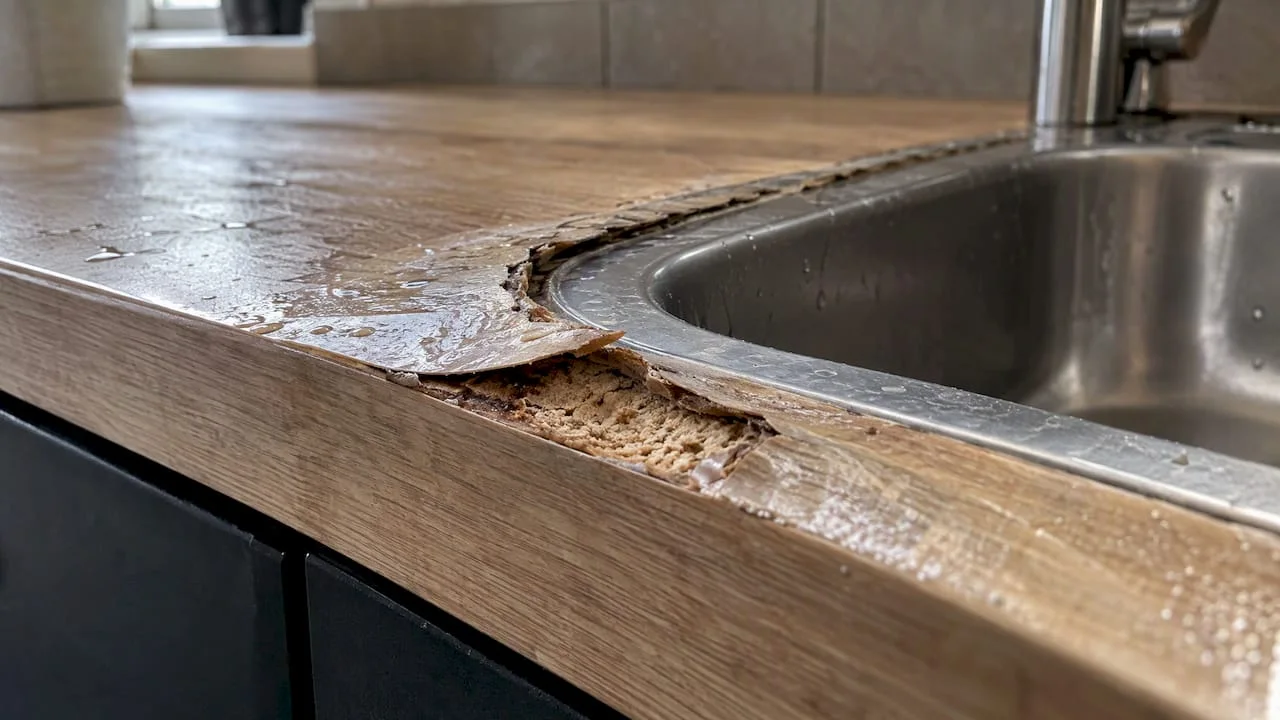
Material manufacturers say the same thing, in their own terms: in its guide to the material, REHAU notes that HPL tolerates moisture and wear better than melamine particleboard. The compact countertop does not have this weak point, because there is no sensitive core under the surface.
Wear and hygiene
On the surface, both types use the same family of material, so in ordinary use they resist scratches and stains comparably. The difference appears with impacts on the edge, where an edge banding can chip or come off, and a milled compact does not. It also appears in hygiene: a continuous surface, with no joints between edge banding and board, is cleaned and disinfected more reliably. For a clinic or a professional kitchen, this is not an aesthetic detail but an operating requirement.
Heat
On neither of the two do you put a pot straight from the fire. Use trivets. The compact handles brief contact with hot objects better, but it is not stone.
How much a compact HPL countertop costs compared to a laminate one
Prices vary a lot by decor, manufacturer and format, so we give you concrete reference points, not an invented average. At the time of writing (October 2026), in stores in Romania:
- an Egger F311 ST87 Ceramic anthracite compact countertop, black core, 4100 x 650 x 12 mm, costs 2,658.06 lei apiece at Mathaus;
- a Kronospan Slim Line K551 Calacatta Olympus countertop, 4100 x 650 x 12 mm, is listed at 3,270.00 lei at Galex;
- compact boards with a premium technical surface go up a lot: a Fenix 0750 Verde Comodoro countertop, 4200 x 1300 x 10 mm, with a colored core, is listed at 9,900.00 lei.
Laminate countertops on particleboard from the same decor ranges usually cost a fraction of these sums, which is why they remain the dominant choice in apartment kitchens. But look at the total cost, not only the price of the board. With compact, cutting, milling the cutouts and the joints are done with special tools and usually cost more than with particleboard. With laminate, add the edge banding, the sealing profiles and, sometimes, replacement after a few years if the sink area fails.
A simple calculation we do with HoReCa clients: a cheap countertop that has to be replaced in a venue open 7 days a week means not only new material, but also one or two days of lost business. Over 8–10 years, the price difference is often recovered.
Black core, gray core or “full color”: the compact variants
After you have chosen compact, the next decision shows on the edge. Classic compact has a dark core. Some retailers explain the difference between compact HPL with a brown core and full color HPC, whose core has the color of the surface. Major manufacturers classify boards by core: EGGER compact laminates conform to EN 438-4, EN 438-8 or EN 438-9, depending on core color and decor, and Pfleiderer has a Duropal Compact countertop with a uniform gray core, conforming to EN 438-9.
How to choose:
- Black core: graphic contrast, suited to dark decors or to a minimalist visual language, with a fine line on the edge.
- Gray core: more discreet on concrete, light stone or gray decors.
- Colored core (full color): the edge “disappears,” and the countertop reads as a unified block, in the color of the surface. It is the most expensive variant, but also the closest to the impression of solid material.
For architects and designers, this is where the real difference in visual vocabulary lies compared with a 38 mm laminate countertop. A 12 mm profile allows countertops that seem to float, slim islands, reception desks with a fine line and office kitchenettes that do not look like a catalog kitchen.
When to choose a laminate countertop and when to choose compact HPL
There is no “better” material in the abstract. There is a material suited to the demands the space places on it. Here are the most common scenarios from our projects.
Apartment kitchen, ordinary family use
A laminate countertop on moisture-resistant particleboard does a very good job, with the sink mounted on top of the countertop (not under it) and with correctly sealed cutouts. If the budget allows only one upgrade, put it into the quality of the installation rather than into a more expensive decor.
Kitchen open to the living room, with a focus on design
Here compact justifies its price through aesthetics: slim profile, undermount sink, clean edges. If the kitchen is the “face” of the home, the difference shows every day.
Cafe, bar, restaurant
Compact, almost without exception, on work areas, at the bar and at washing stations. Wear, water and aggressive cleaning destroy particleboard much faster than in a home.
Clinic, dental office, laboratory
Compact. The continuous surface, with no joints between edge banding and board, supports hygiene protocols and reduces the areas where dirt and moisture can build up.
Office kitchenette
It depends on traffic. For an office of 10 people, laminate on P3 particleboard is reasonable. For a floor with 80 people using the same sink, compact is the prudent choice.
If the same dilemma appears for fronts and furniture carcasses, we explained the logic in the article about the scenarios in which you choose HPL or MDF.
Installation: the detail that determines service life
Most countertops fail not because of the material, but because of the execution. Here is what we check on site:
- Sealing the cutouts on a laminate countertop. The particleboard edge in the cutout for the sink and hob must be protected with a suitable sealant before the sink is installed. It is an operation of a few minutes, often skipped.
- Joints on compact. Being monolithic, compact does not need edge banding, but the joints between boards are made with dedicated systems. In practice, joining kits with polyurethane adhesive are used, for watertightness.
- Supports. Compact is self-supporting, but over long spans it needs support at the intervals set by the manufacturer. The retailer itself recommends that you check the technical data sheet for the maximum distances between supports and the fixing method.
- The workshop. Compact is cut and milled with hard tools and requires experience. Before you order, ask the workshop how many compact countertops it has fabricated and ask to see a cutout it has made.
The SelfDezign perspective
When a client asks us “HPL or laminate?”, we almost never start with the material. We start with the space: who uses it, how many times a day, what gets spilled on it, who cleans it and with what, how long it has to look impeccable without intervention. The answer for a family kitchen differs from the one for the bar of a cafe with 300 customers a day or for a doctor's office that disinfects surfaces between patients.
We often see two mistakes. The first is a compact chosen only because it “looks premium,” in a home where a well-installed laminate would have been perfectly sufficient, and the budget difference would have mattered more for lighting or acoustics. The second, more costly, is a particleboard chosen to save money in a commercial space and replaced after two or three years, including the closure days.
The countertop is not an isolated object. Its thickness influences the proportions of the furniture, the color of the core dialogues with the floor and the fronts, and the choice of sink depends on it. That is why we treat it as a concept decision, not as a line in a list of materials. For an overview, our guide to choosing materials for commercial spaces places the countertop in the context of the whole project.
When it is worth deciding together with a designer
If you are choosing the countertop for your own kitchen and you already have a trusted workshop, the table above tells you almost everything you need. If, however, you are fitting out a cafe, a clinic or an office, the countertop is one of dozens of decisions that must work together, and a mistake is paid for in operating time, not only in materials.
For a one-off decision, we offer consulting with written conclusions, at 500 lei per session: you leave with clear material recommendations and execution details that you can hand directly to the workshop. For complete projects, commercial interior design costs 25–55 euros per square meter and residential 20–40 euros per square meter, with concept, technical design and coordination of execution. You can find the details on the page of SelfDezign services. If you are preparing a venue in Romania from abroad, SelfDezign Remote, remote HoReCa consulting, starts at 450 euros per session.
Sources
- Kanelli: HPL Laminate technical data sheet
- Pfleiderer: Duropal Worktop PerForm P3, technical data
- Pfleiderer: Duropal Compact Worktop, gray core, technical data
- EN 438-4: compact laminates with a thickness of 2 mm and above
- REHAU: complete guide to HPL material
- Mathaus: compact and HPL boards
- Galex: compact HPL kitchen countertops
- Galex: Fenix compact HPL countertops
- Salice: compact HPL countertops
- EGGER: compact laminates