Movable wall vs fixed wall: how to choose the right space partitioning
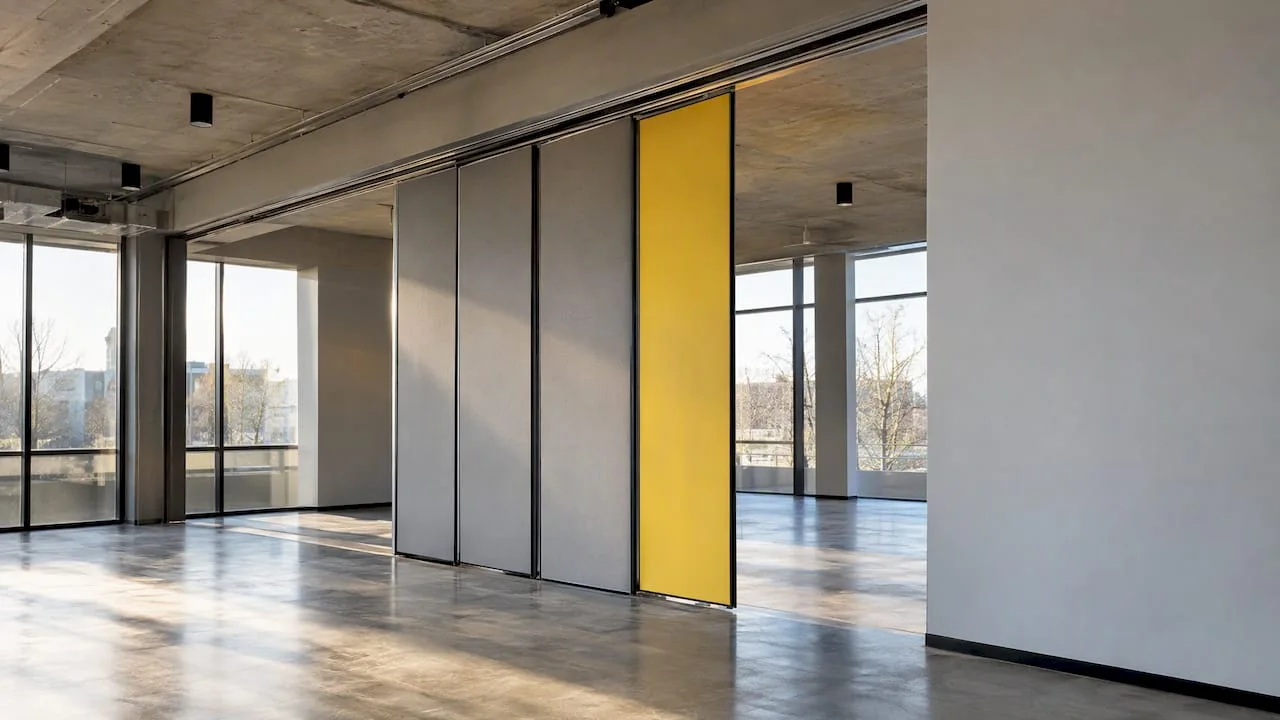
A movable wall is the right choice when your space must work in several configurations: a restaurant that also hosts private events, or an office with meeting rooms that join together for presentations. A fixed wall is the right choice when the separation must be permanent, reliable and discreet: a medical office, a bedroom, a management office. Between these two clear situations, however, lie many intermediate cases, and there the decision is not made from a catalog. It is made from how the space is actually used, day to day. Below you will find the real options, compared on the criteria that matter, and the questions worth asking before you sign an offer.
SelfDezign
Choose the right partitioning
SelfDezign designs interior spaces starting from how they are used, from concept and technical design to implementation coordination.
In short
- Fixed wall (drywall on a metal frame or masonry) offers predictable acoustics, almost zero maintenance and full integration with building services, but any reconfiguration means construction work.
- Movable wall (sliding, folding or demountable) turns the space into a flexible asset, but it requires a ceiling and a structure that are prepared for it, plus periodic adjustments to keep its performance.
- Acoustics is not only about the wall: the floor junction, the ceiling and the gaps above decide whether the value on the data sheet shows up in your space.
- In Romania, seismic and fire safety are handled through design details, not by choosing a "good" product.
- Compare the total cost, over the whole period of use, not just the purchase price.
The real question is not "movable or fixed"
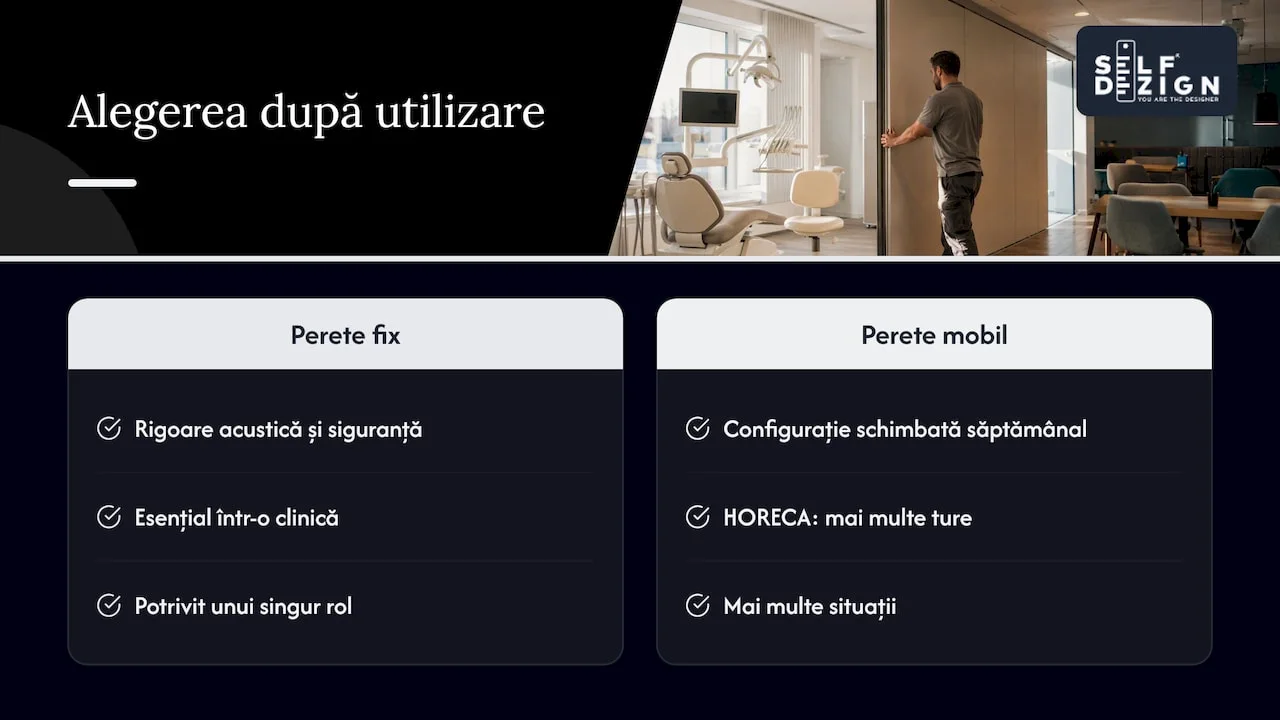
When a client asks us which wall to choose, our first question is not about materials, but about rhythm: how many times a year will the configuration of the space change? If the answer is "probably never," a movable wall is an investment in flexibility you will not use. If the answer is "a few times a week," a fixed wall blocks the very business model you are building.
The choice is, in fact, a diagnosis of the operational flow. The fixed wall offers acoustic rigor and safety, which is essential in a clinic. The movable wall turns static square meters into square meters that work in several shifts, which in a HORECA space can make the difference between an empty room on Tuesday and a room rented for a corporate event.
An analogy that helps us: the fixed wall is like a tailored coat, perfect for a single role. The movable wall is like a modular wardrobe, which serves you in several situations, provided it is well maintained and used correctly. Neither is superior in absolute terms. One is right for you.
The real options to choose from
On the Romanian market, "movable wall" and "fixed wall" actually cover at least four families of solutions, each with its own logic.
Fixed drywall wall on a metal frame
This is the standard solution for non-structural interior partitioning. It goes up quickly, is finished like any other wall, can hide electrical, plumbing or data installations, and can be configured for high acoustic and fire-resistance requirements through the choice of boards, number of layers and mineral wool. Manufacturers publish detailed systems, for example the wall on a double UW/CW 100 metal frame with multi-layer boarding, each with documented performance. Correct installation requires compliance with product standards and design codes, including SR EN 520, SR EN 13963, P100-1 and GP 053-2000.
Fixed masonry wall
AAC block or brick remain the "heavy" option: large mass, a feeling of solidity, good support for suspended objects. In return, they add weight on the slab, need execution and drying time, and in a rented commercial space they are often hard to justify, because they must be demolished at the end of the lease.
Acoustic movable wall, sliding or folding
These are panels suspended on a track fixed in the slab, which are pulled out of the "parking" position to close a large opening. They are used to temporarily divide or resize rooms, from conference rooms to event halls. Some systems have panels with a thickness of only 80, 90 or 110 mm and take up very little space when parked. Acoustic performance varies a lot from one model to another, so the data sheet for the exact model matters more than the generic name.
Removable or demountable walls, usually glass
These are modular systems, common in offices: aluminum profiles with single or double glass, opaque panels, integrated doors. They are not moved daily, but they can be dismantled and reconfigured when the team grows or reorganizes, without demolition. If you consider this option, it is worth understanding the differences between glazing materials too; we explained these differences in the article on tempered glass vs polycarbonate.
Direct comparison
|
Criterion |
Fixed drywall wall |
Fixed masonry wall |
Acoustic movable wall |
Removable glass wall |
|---|---|---|---|---|
|
Flexibility |
None, reconfiguring requires construction work |
None, requires demolition |
Maximum, reconfigured in minutes |
Medium, dismantled and reassembled |
|
Acoustics |
High and predictable if the details are correct |
High thanks to mass |
Good to high, sensitive to sealing and adjustments |
Medium, better with double glazing |
|
Services integration |
Complete |
Complete |
Very limited |
Limited |
|
Structural requirements |
Low |
Heavy load on the slab |
Track in the slab, possibly a support structure |
Low |
|
Maintenance |
Practically zero after finishing |
Practically zero |
Periodic adjustments and service |
Low, door adjustment |
|
Execution time |
Short |
Long |
Medium, includes made-to-order production |
Medium |
|
Natural light |
Blocks |
Blocks |
Blocks, except glazed versions |
Preserves |
|
Suitable for |
Clinics, homes, closed offices |
Homes, owned spaces for the long term |
HORECA, conference rooms, hotels |
Offices, rented spaces |
The table shows one simple thing: there is no overall winner. There is a winner for each type of use.
Acoustics: where the decision is won or lost
Most buyers compare walls by the sound insulation value on the data sheet. It is a starting point, not a guarantee. The laboratory value is obtained under ideal conditions, and in your space real performance depends on three critical points.
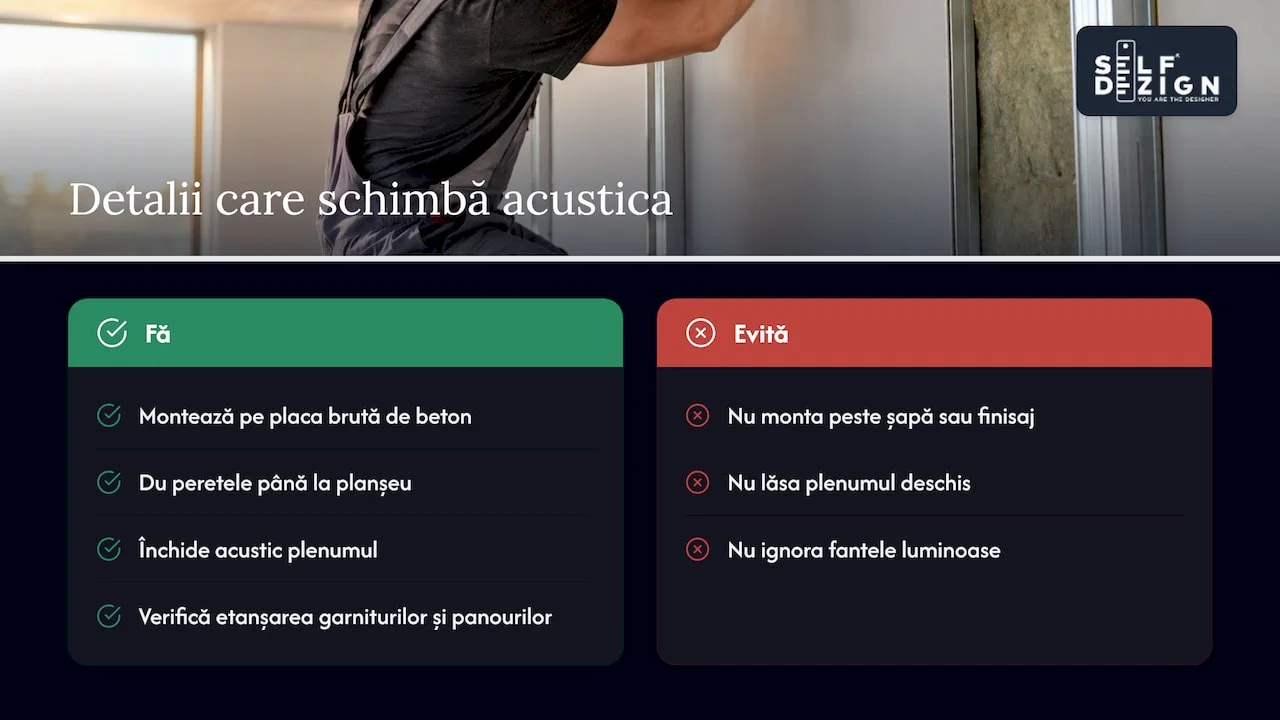
1. The floor junction. With a fixed drywall wall, there is a detail that owners usually find out too late: the wall must be installed on the raw concrete slab, not on the screed or over the floor finish. Rigips design details show that a wrong installation over the screed creates a connection that transmits vibrations and cancels a large part of the wall's acoustic performance. In other words, you can pay for an excellent wall and get a mediocre one.
2. The gap above. If the wall stops at the suspended ceiling and a continuous plenum remains above it, sound simply passes over it. The wall must be carried up to the slab or the plenum must be closed acoustically. Here the choice of ceiling becomes part of the decision; we detailed the trade-offs in the guide on cassette ceiling vs drywall.
3. Sealing in the movable wall. An acoustic movable wall works only if the top and bottom seals press correctly and the panels close tightly against each other. Over time the track may deform slightly, the seals wear out, and a small sliver of light means an acoustic leak that is obvious to anyone sitting in the next room.
Insulation between rooms is only part of the problem. Reverberation inside each room is treated separately, with absorbent materials. If you want the full picture, our guide on types of interior acoustic solutions explains what each one solves.
Safety: earthquake and fire
Romania is a seismic-risk country, and this changes how even lightweight walls are designed. According to the same Rigips technical documentation, drywall partitions are non-structural components that, under the P100-1 Code, need elastic joints horizontally and vertically, to absorb the displacements between levels without cracking. A rigidly installed fixed wall can crack in the first moderate earthquake, even if the building structure remains intact.
For movable walls, the seismic question shifts to the floor track and the support structure: who checks whether the slab can carry the weight of the panels, and how is the track anchored? It is a discussion among the structural designer, the supplier and the designer, not an installation detail.
For fire, the rule is simple: if a wall separates a compartment for which the fire safety design requires a certain resistance, the chosen wall must have that certified classification, in the exact configuration in which it is installed. Both drywall systems and some movable wall models can be fire-rated, but not every commercial variant is. Ask for the certificate for the exact model and check it with the specialist designer before ordering.
A practical tip for large projects: professional specifications require the contractor to build a sample wall section with the approved materials and technology before work starts. It is the cheapest way to check the details before they are multiplied across hundreds of square meters.
What to choose, by type of space
HORECA and events
Here the movable wall has the strongest case. A hall that can become two or three private rooms lets you sell the space in several formats: a family brunch at lunch, a corporate event in the evening. The condition is that the rest of the space is designed for these configurations: separate entrances or at least service flows that do not cross a private event, zoned lighting and air conditioning, acoustics treated in each compartment. For how these decisions connect, see our guide to workflow for HORECA fit-out.
Offices
Offices usually combine all the options: fixed walls for areas that need confidentiality, removable glass walls for meeting rooms, a movable wall between two rooms that join for trainings. If the space is rented, demountable systems have a serious economic argument, because they can be relocated. And if the starting problem is noise in the open space, partitioning is not always the first answer; sometimes the acoustic diagnosis shows something else, as we explain in the article on acoustics of open-plan offices.
Medical clinics
In clinics, the fixed wall is almost always the answer. The confidentiality of the conversation between doctor and patient, surface hygiene, integration of services and long-term stability weigh more than flexibility. For radiology rooms there are even dedicated systems, with drywall boards for X-ray protection, which are designed together with the radiation protection specialist. If you want to understand what to solve first, we wrote about sound insulation for a medical office.
The reasonable exception: a clinic's waiting room or training room, where a movable or removable wall can create flexibility without touching the consultation areas.
Homes
In residential settings, the movable wall appears mostly as a large sliding door or as a divider between the living room and a home office. It is a good solution for small apartments, where a room must be an office by day and a guest room in the evening. For bedrooms and bathrooms, the fixed wall remains the choice that gives you quiet and privacy without compromises.
Total cost, not just the purchase price
Many partitioning failures in commercial spaces do not come from choosing the wrong wall, but from underestimating what comes after installation. When comparing offers, ask for each option:
- Purchase and installation cost, including related work: the track and any reinforcements for the movable wall, the finishes and services for the fixed one.
- Space preparation cost: the ceiling, closing the plenum, any changes to air conditioning and zoned lighting.
- Annual maintenance: a movable wall needs periodic adjustment of panels, seals and mechanisms; a fixed wall is practically maintenance-free after finishing.
- Reconfiguration cost: if in three years you need a different layout, how much does it cost to demolish and rebuild a fixed wall compared with moving a removable system?
- Occupancy cost: a movable wall used twice a year is a large investment for rare flexibility; one used weekly can pay for itself through extra revenue.
The choice of finishing materials also affects long-term cost, especially in high-traffic spaces. We gathered the criteria in a guide to choosing materials for commercial spaces.
Our perspective
In our projects, the discussion about walls rarely comes first. It comes after we understand how the business works: who comes in, where they wait, what must be heard and what must not, on which days the space is full and on which it is half empty. Only then does the wall become a tool, not a product.
We have often seen two symmetric mistakes. The first: an expensive movable wall, installed "just in case," that sits parked for years and takes up space. The second: a room partitioned permanently, in a hurry or to save money, which later blocks the very events that would have brought revenue. In both cases, the decision was made from a catalog or a trend, not from the reality of the space.
That is why we prefer to treat partitioning in an integrated way, together with the ceiling, acoustics, lighting and flows. A good wall in a poorly thought-out space remains a partial solution. A right wall in a coherent concept becomes almost invisible: it does its job and lets the space support the experience you imagined.
If you are at the stage where you must decide and want a second opinion before requesting execution quotes, a consultation with written conclusions costs 500 lei per session and leaves you with a clear document of recommendations for your space. For complete projects, commercial interior design starts from concept and technical design and goes through to construction coordination, with rates between 25 and 55 EUR per m². If you live abroad and are preparing a venue in Romania, remote HORECA consulting starts from 450 EUR per session.
Sources
Rigips: Design and installation details for drywall systems, walls Rigips: Wall system data sheet 3.64.00E Saint-Gobain: Walls and ceilings with X’Ray Protection drywall boards Arhitectura.info: Specifications for drywall partitioning Pereti-mobili.ro: Use of movable walls Peretemobil.ro: Movable walls and partitioning systems