Explaining Horeca Styles: A Guide for Owners and Designers
Design styles in the Horeca sector are the visual and functional systems that define the identity of a hospitality space, from the materials on the walls to the way a waiter moves through the tables. Explanation of horeca styles is not reduced to a list of beautiful adjectives. Each style is a complete visual vocabulary, with its own rules of materials, color, furniture and lighting, which communicates a clear message to customers before they order the first course. The wrong choice of style is not just an aesthetic issue. It is a business issue: a space that does not reflect the target audience will not retain the customers you want, no matter how good the food is.
What are the main design styles in Horeca and their essential features
Interior design for Horeca operates with several dominant styles, each with a distinct set of visual and functional features. Understanding the differences between them is the first step before any fit-out decision.
Modern style
Modern style in Horeca is defined by clean lines, smooth surfaces and a neutral color palette, dominated by white, gray and black. The furniture is geometric, without ornaments, and the preferred materials are glass, stainless steel and apparent concrete. The transmitted atmosphere is one of precision and efficiency, suitable for fast service restaurants or productivity-oriented urban cafes.
Contemporary style
Contemporary designis not synonymous with the modern one, although the two are often confused.Contemporary design reflects current trendsand can incorporate rustic or vintage elements, as opposed to modern, which remains oriented towards innovation and abstraction. A contemporary restaurant in 2026 can combine an industrial ceiling with velvet upholstered chairs and living plants, creating a warm and current atmosphere at the same time.
Rustic style
The rustic style is built on raw wood, natural stone, thick textiles and an earthy color palette. Apparent ceiling beams, solid wood tables and Edison filament lights are defining elements. This style communicates authenticity and comfort, working great for traditional restaurants, guesthouses or wineries.
Industrial style
The industrial style borrows the aesthetics of reconverted factories and warehouses: exposed concrete, untreated metal, exposed brick and visible pipes. The color palette is cold, with accents of rust or matte black. Urban bars, craft breweries and specialty coffee shops frequently adopt this style because it conveys authenticity and non-conformity.
Vintage Style
The vintage style recreates the atmosphere of past eras, usually the 50's and 70's, through furniture with rounded shapes, saturated colors (emerald green, mustard yellow, brick red) and decorative details specific to the period. It's not the same as rustic. Vintage means urban, not rural nostalgia.
Professional advice: Before choosing a style, write down the experience you want your venue to offer. A single paragraph about how you want your customer to feel when they walk through your door is worth more than hours of browsing on Pinterest.
Materials play a decisive role in the consistency of each style.Treated solid wood (beech or oak), reinforced metal, washable upholstery and warm metal accentsare preferred in high traffic spaces, regardless of the style chosen. Resistance should not be sacrificed in favor of aesthetics.
Choosing the right hospitality style for your venue
Choosing a design style is not an isolated aesthetic decision. It is a strategic decision that must take into account the type of venue, the target audience and the way the space works on a daily basis.
Here's a four-step process that works in practice:
- Define the type of experience offered.A fine dining restaurant requires a different visual vocabulary than a neighborhood cafe or cocktail bar.Clear vision that reflects the target audienceis the required starting point. Copying trends without a concept of its own produces spaces that do not attract the desired customers.
- Analyzes the target audience.A local for young professionals in the city center requires a different visual language than a family restaurant in the residential area. The age, lifestyle and expectations of the ideal customer must be found in every design choice.
- Evaluate the functionality of the space. Circulation planningmust avoid bottlenecks that affect customer experience and staff efficiency. A style with bulky furniture (rustic, for example) requires more space between tables than a minimalist one.
- Match style to serving style.Serving styles (plated, buffet, cocktail, mixed) directly influence the organization of the space. A sideboard requires wide circulation areas and exhibition areas, which excludes certain rustic or vintage style furniture configurations.
INFORMATION: Avoid choosing a style from a single item you love, like a chandelier or chair type. Style is only coherent when all elements speak the same visual language.
The most common mistake in horeca design is overloading the space. Over 50% of unsuccessful decorations have this problem: too many decorative elements that cancel each other out and create visual confusion. The practical rule is simple: every element in the space must have a functional role or contribute to the desired atmosphere. If he doesn't do either, he doesn't belong there.
Zoning is an underestimated tool in choosing style. A well-thought-out horeca space has distinct areas: entrance, waiting, dining, bar, toilets. Each area can be treated with different accents of the same style, creating variety without losing consistency.Warm lighting and delimitation of areascontributes significantly to the atmosphere and the natural orientation of customers in the space.
What Horeca design trends define 2026?
Trends in 2026 do not replace classic styles. It reinterprets them with new materials, updated colors, and an increased sensitivity to sustainability.
|
Trend |
Descriere |
Compatible Styles |
|---|---|---|
|
Organic shapes and curves |
Furniture with rounded corners, no hard angles |
Contemporary, modern |
|
Natural palette |
Green sage, terracotta, beige, ochre |
Rustic, contemporary |
|
Warm metallic accents |
Matte gold, copper, bronze |
Vintage, Industrial, Contemporary |
|
SUSTAINABLE MATERIALS<g id="1">1</g> |
FSC-certified wood, recycled textiles, water-based finishes |
all-styles |
|
Modular furniture |
Flexible, event adaptable configurations |
Modern, contemporary |
|
Integrated architectural lighting |
Light as a design element, not just functional |
Industrial, modern |
Curved shapes, colors such as sage green, terracotta and beige, combined with gold, copper and bronze accents create relaxing and attractive spaces that meet customers' current need for visual comfort. This trend is a direct reaction to years of cool minimalist design.
Sustainability has moved from the "optionally desirable" category to the "practical requirement" category. Modular furniture, FSC-certified wood, water-based finishes, and recycled textiles increase the perceived value of the brand without compromising sustainability. A customer in 2026 notices and appreciates these choices, even if they do not articulate them explicitly.
Hybridizing styles is another solid trend. A restaurant can combine the industrial structure of the space (high ceiling, apparent concrete) with warm contemporary furniture and living plants, creating an atmosphere that does not rigidly fit into one style, but is perfectly coherent. This approach, however, requires a steady hand: without a clear concept, hybridization becomes uncontrolled eclecticism. You can read more about the differences between modern and contemporary style and how it applies in practice.
The impact of these trends on the customer experience is direct. A space with organic shapes and warm lights reduces anxiety and prolongs the time spent at the table, which translates into higher consumption. A stiff and cold space, no matter how "fashionable" it is, visually tires and speeds up the departure.
Comparison of Horeca styles: durability, maintenance and costs
Choosing a design style has long-term financial consequences, not just at the time of fitting out. The table below summarizes the main differences between major styles from an operational perspective.
|
Stil |
Material durability |
Ease of maintenance |
Estimated Initial Cost |
Brand image |
|---|---|---|---|---|
|
Modern |
High (glass, metal, concrete) |
Average (visible surfaces) |
Medium to high |
Premium, Urban |
|
Contemporan |
High (mixed materials) |
Hello (current materials) |
Medium to high |
Current, versatile |
|
Rustic |
Average (raw wood, stone) |
Difficult (porous surfaces) |
Mediu |
Authentic, traditional |
|
Industrial |
High (Metal, Concrete) |
Good (hard surfaces) |
Mediu |
Urban, nonconformist |
|
Vintage |
Low to medium (old parts) |
Difficult (delicate materials) |
Variabil |
Nostalgic, distinctive |
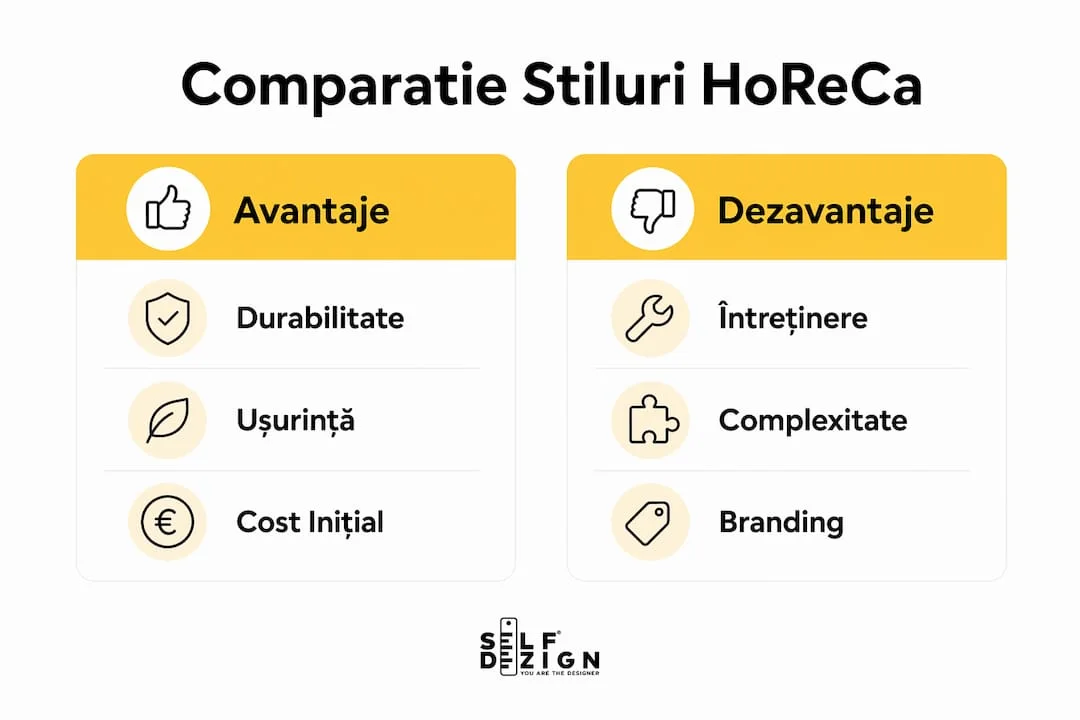
Rustic and vintage style pose the biggest maintenance challenges. Raw wood absorbs grease and odors, and original vintage pieces quickly deteriorate in heavy traffic. The practical solution is to use the aesthetics of these styles with modern materials: water-repellent treated wood, washable upholstery, vintage-looking but wear-resistant surfaces.
Industrial and modern style have the best ratio between maintenance cost and durability. Apparent concrete and metal are easy to clean and withstand daily wear and tear. The initial cost may be higher, but the maintenance costs are significantly lower in the long run.
Branding of the interior spaceis directly influenced by the consistency of the chosen style. A space that looks the same after three years of operation communicates stability and professionalism, two attributes that retain customers more effectively than any marketing campaign.
What I learned from the Horeca projects where the style was chosen wrong
I have seen enough horeca projects where the owner chose a style because "it looked good on Instagram" and ended up redoing the arrangement after 18 months. Not because the style was wrong in itself, but because it wasn't his. It did not reflect the customer it wanted to attract, it did not support the way the place worked, and it did not withstand real traffic.
The mistake is not aesthetic. It's strategy. The style of a hospitality space is the backbone of the experience you offer. If you're not clear about what experience you want to create, no style will save you.
What really works is to start with the right question: “Who is my ideal customer and how does he want to feel in my space? “ The answer to this question dictates style, not the other way around. A fine dining restaurant for business people needs a visual vocabulary that communicates discretion, quality and control. A cocktail bar for creative young people needs energy, surprise and personality. Same materials, same colors, but with completely different intentions.
Another thing I've noticed constantly: landlords underestimate the impactlighting in creating atmosphere. You can have the best furniture and the most beautiful finishes, but if the light is wrong, the style doesn't work. Lighting is not a final detail. It's part of the style structure.
Working with a designer who understands the business context, not just aesthetics, makes the difference between a space that looks good in photos and one that works profitably for years. The chosen style must be sustainable not only environmentally friendly, but also operational.
— expertise provided by Irina Stoica
How SelfDezign helps you choose and implement the right style for your venue
SelfDezign works with restaurant, café and hotel owners in Romania and Europe who want more than just a beautiful setting. The process starts with understanding the business context, the target audience and how the space must function on a day-to-day basis. Only then do we talk about styles, materials and finishes. If you want to understand what a well-structured consulting process for a commercial space looks like,commercial design consulting guideis a useful starting point. For complete horeca projects, from concept to implementation, thehoreca interior designoutlines the approach and types of projects we manage.