Guide to Home Decoration: From Ideas to Outcome

Decorating your place seems simple until you actually get started. You want a space that looks good, is comfortable, represents you, but somewhere between a full shopping cart and a non-tied room, you get stuck. This guide to decorating your home doesn't give you trend lists without context. It gives you a clear framework: how to analyze what you have, how to prioritize what you do, and how to make decisions that make sense in the long run, not just for a photo.
Planning as the foundation of any successful décor
Before you buy anything, you need to understand what you have. It sounds trivial, but most of the mistakes in decorating come from jumping directly to the selection without having first evaluated the space, the natural light, the traffic flow and the relationships between objects.
Start with an honest review of your room. What's already working? What furniture is worth keeping? What creates visual clutter? Answers to these questions will save you money and time more than any moodboard.
What you need to clarify before proceeding to execution:
- Chromatic palette. Trends for 2026 indicates the preference for warm tones and neutral shades with colorful accents: Cloud Dancer, dusty rose, sage green, dusty terracotta. Choose a palette of up to three tones and stick to it throughout your home for visual consistency.
- Budgeting and prioritizing. Not all rooms need simultaneous intervention. Determine which spaces you spend the most time and focus your investments there. The bedroom and living room usually have the greatest impact on daily comfort.
- Personal style. There is no right style. There's a style that makes you feel at home. Explore interior design types before you make buying decisions, so you don't end up with a mix of aesthetics that don't talk to each other.
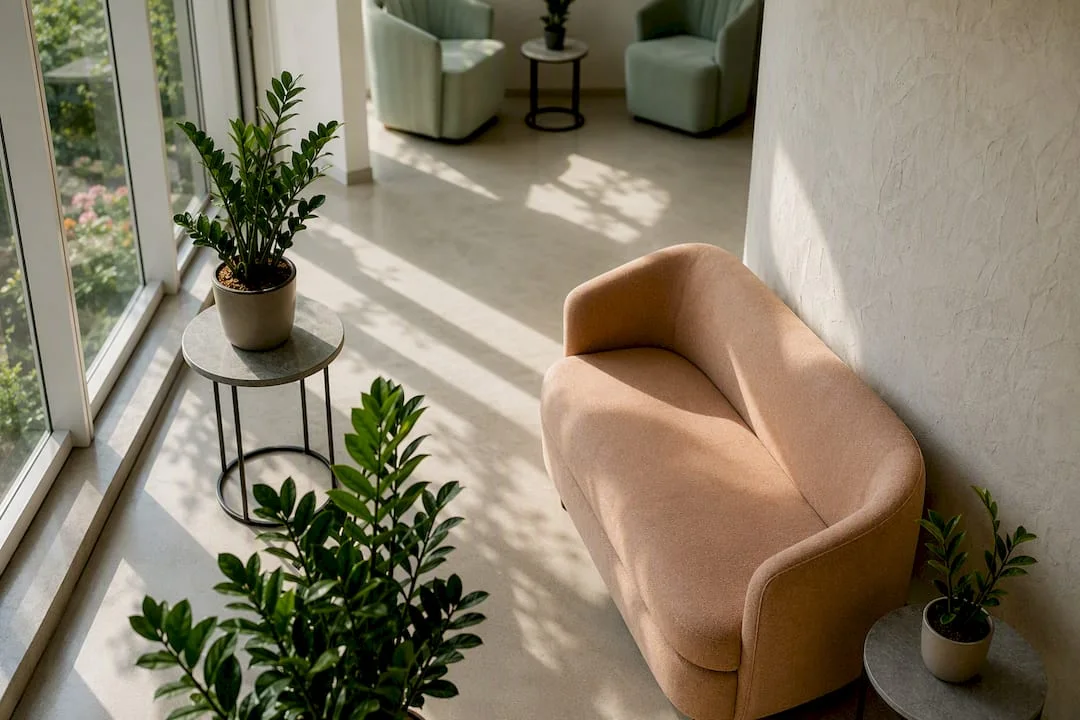
- Biophilia as a principle, not a trend. Biophilic design it doesn't mean putting a plant on a shelf. It means thinking about space in relation to natural light, organic materials, and living elements. It positively influences sleep, concentration, and stress reduction.
Effective interior planning does not end with a plan on paper. It ends when you understand why every decision takes place, not just what it looks like.
Choosing and arranging key elements
Once you have clarity of direction, execution follows. And this is where the mistakes of proportion, lighting and textural selection most frequently occur.
Furniture: proportions and spacing
Too much furniture suffocates the room. Furniture too small makes it look incomplete. Before choosing a piece, measure and mark its contour on the floor with duct tape. You'll immediately see if the dimensions work in context.
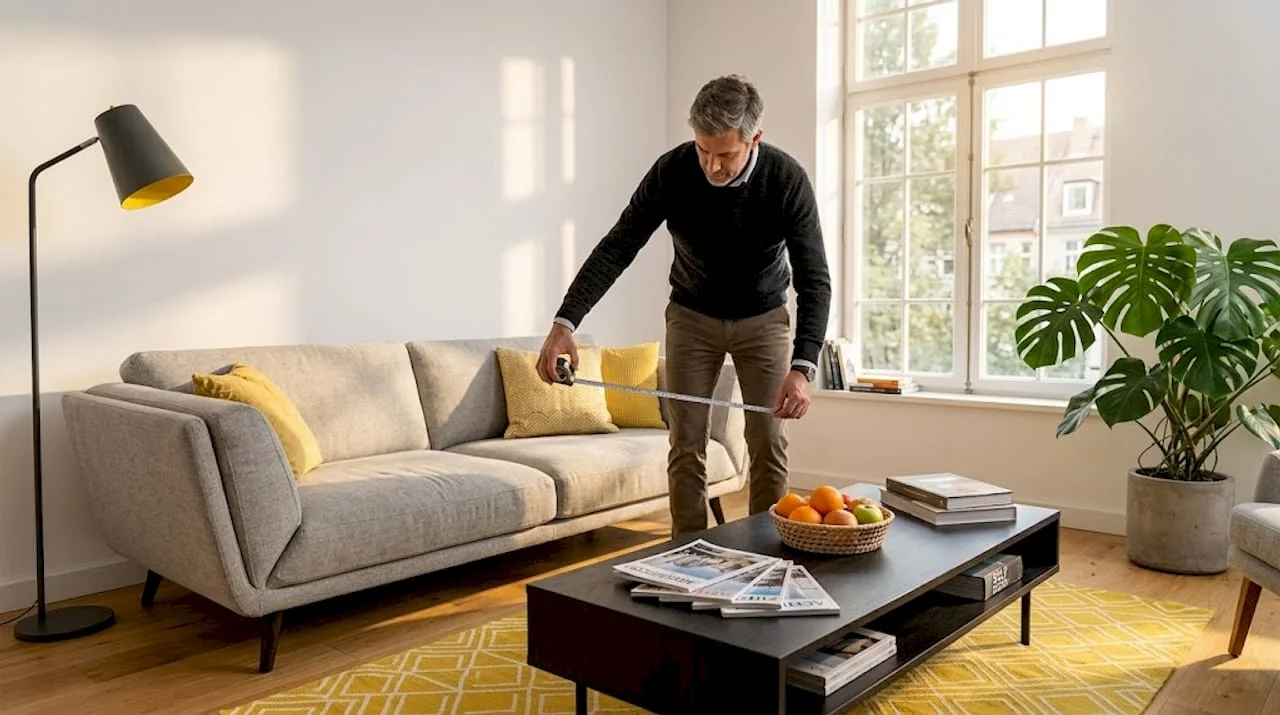
For living room rugs, recommended minimum size is 200x290 cm, enough to anchor all the pieces of furniture and create a clear visual center. Too small a carpet leaves the furniture floating unrelated.
The distance between the sofa and the coffee table should be a minimum of 45 cm for real daily comfort. Respecting ergonomic distances is not a design detail. It's what makes the difference between a living room that looks good and one where you feel good.
Layered lighting: the most underestimated element
Wrong lighting can destroy a beautiful space. A single central light bulb does not create atmosphere, it creates an office.
Here's how to think three-layer lighting:
- Environmental General light of the room. Ideally made with dimmable spotlights or diffuse ceiling lights, not with a strong central lens. The standard of comfort is 300-400 lumens/sqm for a pleasant visual sensation.
- FUNCTIONAL Light for specific activities: reading, cooking, working. Floor lamps near the armchair, spotlights above the kitchen counter, directed office light.
- Accent. Light that highlights: a painting, an object shelf, a large plant. Lighting layering is the technique by which a space goes from "arranged" to "thought." Choose bulbs below 3000K for a warm light that creates real comfort.
Professional advice: Replace a single central light bulb with two floor lamps and apply it to the wall, and you will completely change the atmosphere of the room without moving any furniture.
Textiles and décor: materials matter
Natural materials like flax, cotton, wool and velvet add texture and visual depth without aesthetic noise. A sage green velvet pillow on a beige sofa simplifies the palette and adds character at the same time.
Plants are the most accessible biophilic element. A large indoor plant costs between 50 and 150 Ron, oxygenates the air and turns an empty corner into a point of interest. If you want to understand in more detail how you integrate biophilic elements in the home, it's worth the time invested before any purchase.
Refreshing your décor without a big budget
This is the chapter that many ignore, but which has the best effort/impact ratio. You don't need new furniture to change the way a room feels.
Some principles that work immediately:
- Eliminate clutter before you add anything. Reducing the number of exposed objects automatically creates the feeling of space and clarity. Choose a maximum of 5 decorative items per visible surface.
- Change textiles. New pillowcase, a runner on the table, an armchair cover. There are interventions of maximum 100 Ron per part with immediate visual impact.
- Invest in affordable lighting. A floor lamp from a furniture store or second-hand can completely change the atmosphere of the evening.
- Add art to your walls. A wall decorated with art or personal photos customizes the space and makes it memorable. You don't need expensive paintings. A good print in a simple frame does the job.
- Add a plant. Always. Without exception.
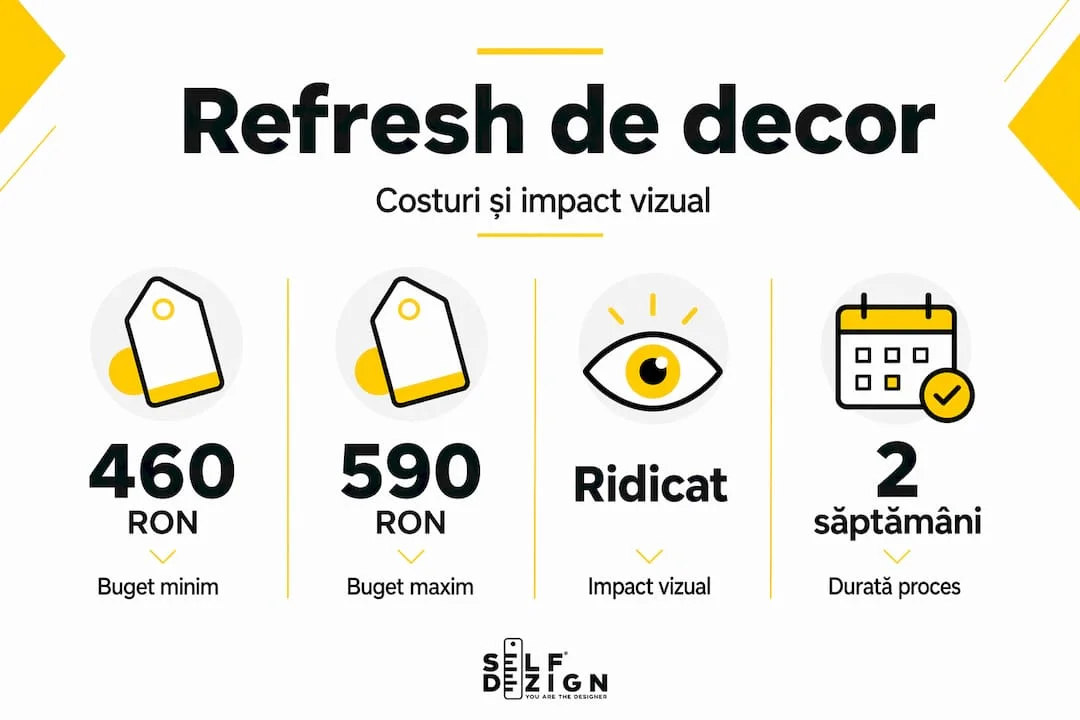
Concrete budget tip: A full refresh of your décor without new furniture can cost anywhere from $100 to $150 if you prioritize textiles, lighting, and accent decor. This is not a symbolic amount. It's a real budget that, intelligently distributed, visibly transforms a space.
|
Category |
Estimated Budget |
Visual impact |
|---|---|---|
|
New textiles (pillows, small carpet) |
150-200 Ron |
High |
|
Floor lamp or apply |
120-180 Ron |
High |
|
Large plant + pot |
80-150 Ron |
Medium-high |
|
Wall art (print + frame) |
60-100 Ron |
Medium |
Common mistakes and how to avoid them
The most common décor problems don't come from bad taste. They come from a few automatic reflexes that sabotage the space.
Professional advice: Before rearranging furniture, take a photo of the room in the door. You will immediately see what does not work at the level of visual composition, things that the eye ignores when you are in the middle of space.
- Furniture glued to the walls. It's the most common reflex and the most harmful. The spacing of the furniture from the walls creates visual depth and the feeling of a greater space. Even 15-20 cm from the wall make a difference.
- Overloading the space. More doesn't mean richer. It means more agitated. Every extra object competes for attention and tires the eye.
- Absence of a focal point. Every room needs a central element that organizes everything else around it. A large painting, a piece of furniture with character, an impressive plant. Without it, the eye does not know where to rest.
- Ignoring the mix of textures. Design in 2026 favors authenticity and mixed textures: wood, clay, linen, matte metal. Combining materials with different finishes adds depth without complicating the color palette.
- Copying a style without adapting it. Trends are a starting point, not a prescription. Adapt them to your space, your light and your real life. A space that looks good in photos but does not work in everyday life is not a successful space.
My perspective after years of real projects
I have worked on dozens of homes and noticed the same pattern: people fear making a mistake more than they are motivated by the result. They order little, hesitate a lot, and end up living for years in a space that does not represent them at all.
What I have learned, concretely, from working on residential projects: the spaces that work best are not the aesthetically perfect ones. They are the ones designed around the real life of the people who live in them. I have seen apartments with expensive furniture that felt cold, and modest apartments that had genuine warmth from the very first second. The difference was not the budget. It was the coherence between the choices and the way the person lived there.
The move from perfect, showroom-style spaces to authentic interiors is the most important shift in home design right now. It is not an aesthetic trend. It is a reordering of priorities: from how a space looks to how it feels.
I believe the biophilic element, whether it is a plant, a natural material or the light that comes through the window in the morning, is what turns a room from an arranged space into a lived-in one. And that does not cost much. It costs attention.
How SelfDezign can help with your home fit-out
If you have gone through this guide and feel that you know what you want but are not sure how to get there, that is exactly where SelfDezign comes in. The team does not arrive with a standard formula applied to every space. It comes with the right questions: what happens in this space, who lives in it, what it needs to support every day.
The residential interior design services cover the entire process: from concept and color palette to coordinating the implementation. You do not need to know where to start. You only need clarity about what you want to feel in your own space.
If you want to understand the concrete steps before a first conversation, the article on custom residential fit-outs gives you a useful framework. And if the functionality of the space is your priority, the strategies for functional interiors are a solid starting point.