
Medical Clinical Design Process: 2026 Guide

The medical clinical design process is a structured set of technical, normative and functional steps that transform a raw space into a certified, safe and operationally efficient clinic. It's not just about aesthetics or the choice of finishes. We are talking about a precise sequence of decisions that determine whether the space will receive the DSP approval, whether the MEP installations will support the medical equipment and whether the internal flows will operate without friction. Clinic owners and architects who understand this logic from the start save time, money, and avoid costly bureaucratic bottlenecks. This guide details each step, criterion and tool relevant for 2026.
What are the main steps of the medical clinical design process?
Designing a medical clinic follows a logical order that you can't reverse without consequences. Each stage prepares the ground for the next, and a wrong decision in the initial phase can block the final authorization.
1. Space Assessment and Preliminary Study
The first concrete action istechnical field visitbefore signing the lease or purchase agreement. The destination entered in the land book, the actual dimensions of the space and the structure of the building may determine the rejection of the DSP file before the project starts. An “office” space requires a change of destination, which adds months to the calendar. Check these before, not after you sign.
2. Collaboration between Architect, Technical Engineer and Owner
Early collaborationbetween the architect and the Technical Officer (ART) is essential to avoid additional costs and to comply with the rules. The owner of the clinic must be present in this phase, not only as a document signer, but as a source of information about the actual clinical flows: how many patients per day, what specialties, what equipment. Without this clarity, the architect projects into the void.
3. Preparation of technical documentation
The documentation includes the space survey, the technical report, the functional drawings and the installation plans. Each document has a precise role in the DSP file and the ISU file. The technical report describes the materials used, the functional circuits and the technical solutions chosen. Functional drawings show the separation of clean and dirty areas, a criterion verified directly on inspection.
4. Obtaining opinions in parallel
Applying for ISU approval in parallel with the DSP file saves up to 4 weeks of waiting. The two processes are not excluded and should not be treated sequentially. The DSP health authorization is issued within 15–30 working days after the inspection, if the file is complete. Any missing documents restart the term.
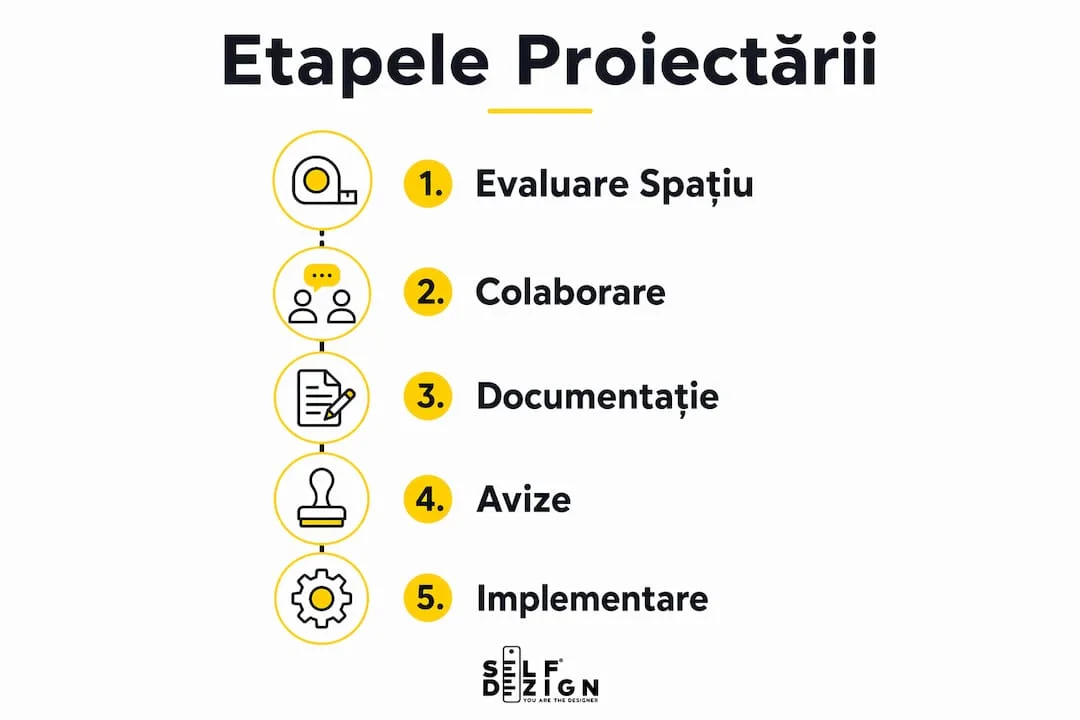
5. Implementation of design and coordination of installations
The last stage is the actual execution, where coordination between the interior design team, installers and suppliers of medical equipment becomes critical. Aclinical fitting guidewell-structured reduces the risk of costly changes during execution.
Professional advice: Prepare the complete list of medical equipment before the installation plans are completed. Each appliance has specific power supply, ventilation and operating space requirements that must be integrated into the project, not added later.
What criteria and regulations must be followed in the design of clinics?
Design criteria for medical clinics are not recommendations. They are mandatory conditions verified by the DSP upon inspection, and their non-compliance means the rejection of the sanitary authorization.
Mandatory functional circuits
The design of the clinic must comply with strict functional circuits, mandatory for DSP approval. Clear separation between sterile and non-sterile area, unidirectional flow of patients and medical staff are checked directly upon inspection. A patient must not cross the sterilization area to reach the waiting room. Healthcare professionals must not transport contaminated materials through clean areas.
Suitable materials and finishes
Washable materials and surfaces that are easy to disinfect are mandatory, their evaluation being part of the DSP inspection. Floors, walls and ceilings in clinical areas must withstand detergents and disinfectants without visible degradation. The rounded corners at the joint of the floor and the wall are not an aesthetic detail. They are a hygienic requirement that removes areas where bacteria accumulate.
Equipping sterilizers and sterilization room
The sterilization room has its own rules regarding the minimum dimensions, ventilation and separation of the clean and dirty circuit. The sterilizer must be placed so that the sterile instruments are not contaminated on the way to the treatment room. This spatial logic must be solved in the architectural plan, not improvised in execution.
Things to rememberAny change to the premises after obtaining the sanitary authorization, without notifying the DSP, may lead to the suspension of the clinic's activity. The regulations of 2026 provide for periodic inspections, not just at the opening.
Here are the main regulatory requirements grouped by category:
- Functional circuits:unidirectional patient/staff flow, clean/dirty area separation, controlled access to the sterilization area
- Internal Featureswashable surfaces on walls and floors, rounded corners, resistance to chemical disinfectants
- Ventilationmechanical ventilation system in treatment and sterilization rooms, controlled differential pressures
- Lighting:adequate medical lighting in the consultation and treatment rooms, according to the specific rules of the specialty
- materialsseparate bathroom for staff and patients, washbasin in each treatment room
- ISU:emergency exits marked, smoke detectors, evacuation plan displayed
Viewclinical design regulationsupdated for 2026 before completing the technical documentation.
How does MEP technology integrate into a high-performance clinic?
Mechanical, electrical and sanitary (MEP) installations are not an added layer on top of the architecture. They are the backbone of clinical functionality, and decisions about them must be made in parallel with architectural plans, not after.
Why MEP can't be left at the end
The technical infrastructure must support operational continuityand compatibility with medical equipment. A radiology machine or steam sterilizer has power supply, cooling and ventilation requirements that cannot be improvised. If installations are designed without knowing exactly which equipment will be used, the result is either costly oversizing or insufficient infrastructure blocking operation.
Electromagnetic compatibility and air pressures
Sensitive medical equipment, such as imaging machines or anesthesia monitors, requires electromagnetic compatibility (EMC). Data and power wiring must be physically separated. Ventilation systems must maintain differential pressures between areas: positive pressure in clean rooms, negative pressure in containment areas. Strict sterilization circuits and air pressure regulation are fundamental to preventing cross-contamination and must be integrated already in the design.
Example Affidea Bistrița
Affidea Bistrita radiotherapy project, carried out on an area of approximately 2. 600 sqm, demonstrates that the design of MEP installations is not a technical formality, but conditions safety and clinical performance. In such a project, installations of radiation protection, controlled ventilation and redundant power supply are an integral part of the design concept, not elements added subsequently.
Professional advice: Requires the MEP Engineer to attend at least two project meetings in the concept phase. Decisions made in the first 10% of the project duration influence 80% of installation costs.
Comparison table: early vs. late MEP integration
|
Criteriu |
Integrated MEP from concept phase |
MEP added by architecture |
|---|---|---|
|
Execution costs |
Controlled, no surprises |
Frequently exceeded by 20–40% |
|
Equipment compatibility |
Verified and guaranteed |
Risk of incompatibility |
|
DSP/ISU Compliance |
Project Documented |
Requires modification and re-approval |
|
Times of Performance |
Predictibil |
Frequent tardiness |
|
INDOOR AIR QUALITY |
Designed according to norms |
Often below standard |
What digital tools support clinic planning and administration?
Digital planning is not just programming software. It means an IT infrastructure designed from the design phase so that cabling, servers and terminals are integrated into the architecture plans.
Cloud solutions in new clinics
95% of new clinics in 2026 use integrated cloud solutionsfor appointment management and billing. This figure shows that digital infrastructure is no longer optional. It must be planned from the project phase: where are the data sockets, where is the local server (if any), how are the patients' data protected according to GDPR.
Costs for clinical management software vary between 100 and 1,000 Ron per month, depending on the functionalities. This variation reflects the difference between a basic solution for an individual practice and an integrated platform for a multi-specialty clinic.
What needs to be planned digitally from the design phase
- Data network:wi-Fi access points, RJ-45 sockets in each consultation room and at the reception
- Display systems:information screens in the waiting room, integrated into the electricity plan
- E-Invoice Integration:compatibility with ANAF systems for electronic invoicing, mandatory in 2026
- Electronic Patient File:servers or secure cloud access with automatic backup
- Digital Signage signalling designand orientation in medical spaces reduces patient anxiety and streamlines internal traffic
Modern clinical planningis evolving towards personalized care that requires flexible spaces and integrated diagnostic technologies. A space designed without taking into account the digital flow of clinical data quickly becomes an operational obstacle.
Professional advice: Consult your medical software provider before completing electrical plans. Some imaging or monitoring systems require dedicated networks, separate from the administrative network.
What I learned from the clinical projects I was involved in
The most common point of failure we have seen in clinic projects is not lack of budget. It is the lack of a single interlocutor to coordinate the architect, MEP engineer, equipment supplier and clinic owner at the same time.
Each specialist works correctly in their field. The architect delivers compliant plans. The engineer designs functional installations. The equipment supplier complies with the technical specifications. But if these three worlds do not communicate simultaneously, the result is a space where the equipment does not fit on the door, the three-phase socket is missing from the treatment room, or the ventilation does not reach the flow necessary for sterilization.
I saw projects blocked at DSP because the architecture plan did not reflect the real functional circuits. I have seen clinics physically completed but inoperable for months because the ISU endorsement had not been requested in parallel with the DSP documentation. These situations are not exceptions. They are the direct consequence of a sequential planning, when the process must be simultaneous.
Technical details in the design of clinicsare not bureaucracy. I am the tool through which a space becomes functional, safe and authorized. Patient-centered design, which we are talking about more and more, is not just warm colors and comfortable furniture. It means that a patient arrives at the consultation room without crossing risk areas, that he does not wait 40 minutes because the appointment system does not communicate with the reception and that the space tells him, from the entrance, that it is a professional and safe place.
My practical recommendation: start with the technical visit, continue with a joint architect-MEP-owner meeting and do not sign any execution contract without having the DSP file in progress. Order matters more than speed.
Toni
How SelfDezign can support you in your medical clinic project
SelfDezign works with clinic owners and architects who understand that a well-designed medical space is not a cost, but a competitive advantage. The team coordinates the interior concept, technical documentation and implementation, ensuring consistency between DSP requirements, MEP installations and patient experience. If you have a space in view or a project already started,interior design services for clinicscovers the entire process, from preliminary study to coordination of execution. For projects combining medical areas with administrative or reception spaces,interior design solutions for workspacesprovides an integrated framework that supports long-term functionality.