Clinic Design Guide: Steps, Standards, and Design in 2026

Designing a medical clinic is defined as the process of planning, executing, and authorizing a space that simultaneously complies with DSP standards, ISU requirements, and the principles of functional design focused on patient safety. It is not just about aesthetics or choosing furniture. Every design decision, from flooring to circulation flow, directly impacts legal compliance, infection prevention, and the patient's experience from the moment they walk through the door. This clinic design guide brings together the essential steps, technical criteria, and the most costly mistakes, updated for 2026.
What are the essential steps in the clinic design guide?
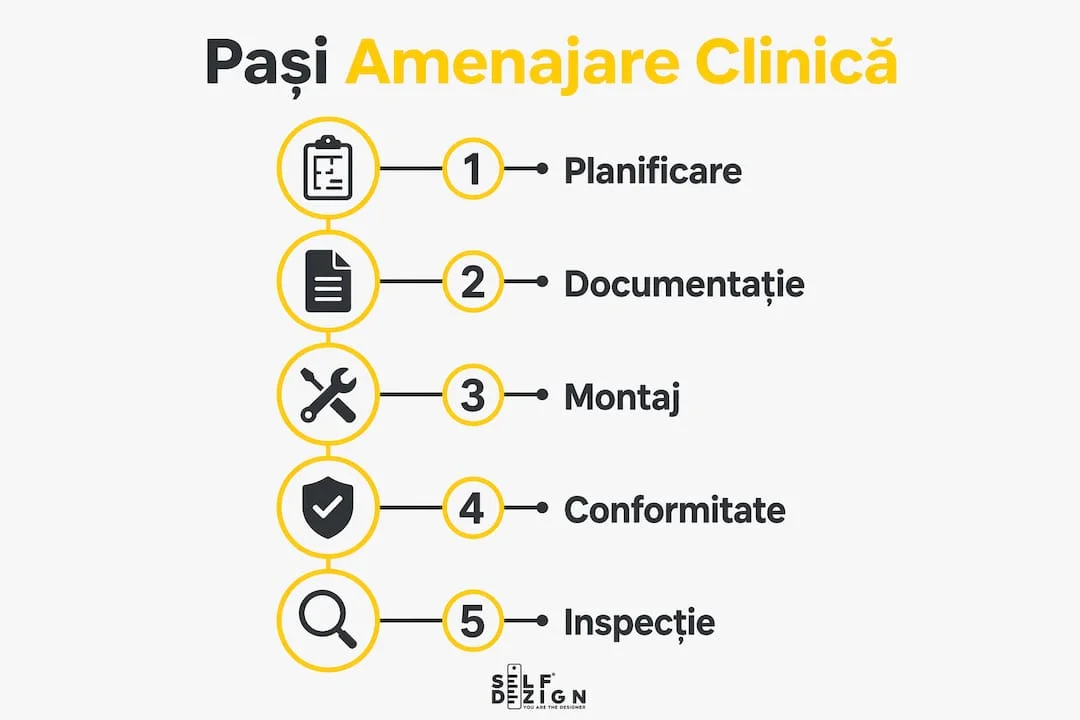
Designing a medical office follows a precise timeline, and deviating from it generates delays and additional costs.The realistic process takes 3–4 months from signing the lease agreement to receiving the first patients. This duration surprises many owners who initially estimate 6–8 weeks.
Optimal Timeline of a Clinic Project
Here is the recommended stage-by-stage structure, based on the complete 2026 guide:
- Weeks 4–5: Lease Agreement. You sign the contract and immediately verify the space's intended use in the cadastral documents. Without this verification, you risk later discovering that the space cannot be authorized for medical use.
- Weeks 5–6: ISU Application and Start of Renovation. You submit the application for the ISU approval simultaneously with starting the renovation works. The two processes run in parallel, not sequentially. This overlap saves 3–4 weeks from the total calendar.
- Weeks 6–10: Renovation and Furnishing. You execute the finishing works, install medical furniture and equipment. Equipment purchases are made within this window, not after the works are completed.
- Weeks 8–10: DSP File. You prepare and submit the file to the Public Health Directorate. Required documents include space plans, contracts with medical staff, and proof of equipment.
- Weeks 10–12: Inspection and Authorization. The DSP conducts the on-site inspection. Planning includes a 2–4 week buffer for potential non-conformities and corrections. Without this buffer, any minor issue can delay the opening by a full month.
- Weeks 12–14: First Patient. The authorization is issued and the office can legally operate.
Legal Documentation of the Space
Before anything else, the updated land register extract is the document that confirms the real owner, legal destination, and absence of legal encumbrances. Authorities require proof of legal right of use, and the destination recorded in the land register must permit medical use. If the space is registered as a residence or warehouse, the process of changing the destination adds months to the timeline.
Our advice: Request the land register extract before signing any lease agreement or paying any deposit. It is the document that shows you whether the project is legally feasible.
2026 legislation also brings an additional obligation: newly established offices declare staff and their contracts to the DSP within 30 days, with notifications within 5 days for any subsequent changes. Activity suspension can be extended beyond 12 months with DSP notification in case of prolonged renovation works. This rule changes how you plan hiring relative to the authorization timeline.
How to Design a Functional Layout That Prevents Infections?
The design of a medical space is not a matter of taste. It is a matter of applied epidemiology. Minimizing the number of objects in the office directly reduces contaminated surfaces and simplifies hygiene protocols, according to recommendations by Prof. Dr. Codruța Nemet. Every additional object is an extra surface that must be disinfected after each patient.
Principles of Efficient Clinic Design
- Unidirectional flows. The patient's circuit must be designed as a system with controlled entry and exit, without intersecting the patient's path with technical areas or staff paths. The waiting room, office, and sterilization area form a clear circuit, not a labyrinth.
- Separation of clean and contaminated zones. This separation is not optional but mandated by DSP standards. Doors, partitions, and sink placement must naturally support this separation, without staff having to improvise protocols.
- Reduced and easily sanitized surfaces. Furniture with sharp corners, open shelves, and decorative textiles are incompatible with a medical space. Smooth, continuous, and ornament-free surfaces reduce sanitization time and the risk of cross-contamination.
- Medical staff ergonomics. The height of the work surface, distance to equipment, and organization of instruments directly affect the physician's physical fatigue over a day with 20–30 patients. A design that ignores ergonomics generates errors and exhaustion.
- Lighting and acoustics. Correct medical lighting is not the same as office lighting. Color temperature and light intensity in the consultation area differ from the waiting room. Acoustics protect patient confidentiality and reduce stress in the waiting room.
Our advice: Draw on paper the path of a patient from entry to exit, including hand sanitization moments. If the path intersects with technical areas or staff entry, you have a flow problem that must be resolved before execution.
Also consult SelfDezign resources on technical detailing in clinic design to understand how zone separation translates into concrete constructive solutions.

What Materials and Finishes Are Recommended for Flooring and Walls?
Flooring is the finishing element with the greatest impact on DSP compliance and long-term maintenance costs. Choosing the wrong material or installation method can lead to non-compliance during inspection, even if the rest of the design is impeccable.
PVC Flooring: The Standard for Medical Spaces
PVC flooring is the recommended material for medical office floors according to 2026 DSP standards. Its continuous, non-porous, and disinfectant-resistant surface makes it superior to tiles or parquet in a medical context. Tiles have grout lines that accumulate bacteria, and parquet does not withstand chlorine-based disinfectants.
The critical element, however, is not the material itself but the installation method. PVC flooring is installed with a hygienic cove base raised on the wall, eliminating right angles between floor and wall. These corners are areas impossible to clean completely and represent one of the most common causes of non-compliance during DSP inspections.
Comparison of Medical Flooring Finish Types
|
Criterion |
PVC Flooring with Cove Base |
Tiles with Grout |
Laminate Parquet |
|---|---|---|---|
|
DSP Compliance |
Compliant |
Partially compliant |
Non-compliant |
|
Sanitization |
Easy, continuous surface |
Difficult, grout lines |
Incompatible with disinfectants |
|
Durability to Disinfectants |
High |
Medium |
Low |
|
Installation Cost (indicative) |
32–42 RON/sqm (cove base) |
25–35 RON/sqm |
20–30 RON/sqm |
|
Heat Welding of Joints |
Required and possible |
Not applicable |
Not applicable |
Essential Technical Details for Installation
Heat welding of joints is mandatory for medical PVC flooring. Non-welded joints create micro-cracks where bacteria and biological fluids accumulate. This operation requires a certified installer for medical materials, not a regular parquet installer.
The height of the hygienic cove base on the wall varies depending on the type of office. For general medicine offices, the cove base rises to 180–200 cm. For treatment rooms or dental offices, the height can reach ceiling level. This differentiation is specified in DSP standards and must be respected according to the exact purpose of each room.
Supplier selection matters as much as material selection. Request conformity certificates for the chosen material and verify that the installer has documented experience in medical spaces. Incorrect installation of a correct material produces the same result as a wrong material: non-compliance during inspection.
What Common Mistakes Occur in Clinic Design and How to Avoid Them?
Mistakes in designing a medical space are not just aesthetic. They generate remediation costs, authorization delays, and in extreme cases, the impossibility of opening the office in the chosen space. Here are the most frequent ones and how to prevent them.
- Ignoring the legal status of the space. Authorization problems most often stem from unclear situations in property documents, not from the physical design. A space with a mortgage, litigation, or incompatible destination blocks authorization no matter how well it is designed.
- Incorrect sizing of spaces. DSP standards prescribe minimum areas for each type of office. A general medicine office requires a different minimum area than a dental office or a physiotherapy office. Ignoring these requirements during the planning phase leads to redoing partitions after inspection.
- Neglecting hygiene details at corners and flooring. An incorrectly executed hygienic cove base is one of the most common causes of non-compliance during DSP inspections. Right angles between floor and wall, non-welded joints, and flooring with grout lines are details that seem minor but are systematically checked by inspectors.
- Underestimating authorization times. Owners who do not include a buffer for inspection and corrections end up delaying the opening by 4–6 weeks compared to the initial plan. The 2026 guide explicitly recommends a compliance checklist completed internally before requesting the DSP inspection.
- Treating design as a separate stage from compliance. The most costly scenario is when an owner designs the space according to aesthetic preferences and later discovers that the chosen finishes are not compliant or that functional flows do not meet standards. Functional design and DSP compliance must be treated as a single process, not as two consecutive stages.
- Choosing a designer without experience in medical spaces. A residential or general commercial designer does not know the specific requirements of DSP, ISU, or sanitary regulations for medical spaces. This choice apparently saves money at the beginning and costs significantly more in remediation.
Also consult the regulations for clinic design 2026 for a complete picture of updated legislative requirements.
What We Learned After Years of Clinic Projects: Medical Design Does Not Forgive Improvisation
We have worked on design projects for clinics of various specialties, from family medicine to dentistry and physiotherapy. The recurring conclusion is the same: owners who treat clinic design as a regular renovation pay twice. Once for execution and once for remediation.
The most common scenario is this: an owner signs the lease, hires a general construction team, chooses finishes based on visual preference, and discovers during the DSP inspection that the flooring is non-compliant, the hygienic cove base is missing, or the functional flows do not respect zone separation. Remedying these issues after work completion costs 3 times more than if they had been included in the initial project.
What still surprises me is that these mistakes do not come from a lack of resources, but from a lack of information at the right time. Owners do not know what to ask for, do not know what to check, and do not know that a designer with experience in medical spaces is not a luxury but a condition for a project that works from the first inspection.
At SelfDezign, we approach each clinic project starting from understanding the real context: the type of specialty, patient volume, number of doctors, relationship with DSP standards, and the owner's long-term objectives. Functional design is not a standard formula. It is a solution built on the specifics of each space and each medical practice. Technical details, such as sanitary norms in interior design, are not bureaucracy. They are the infrastructure on which an office that works well for years is built.
A well-designed medical space reduces friction for the patient, reduces fatigue for the doctor, and reduces the risk of non-compliance for the owner. These are three concrete, measurable results that justify the investment in a serious design project.
— Toni
Transform Your Medical Space with SelfDezign
SelfDezign designs functional medical clinics that comply with 2026 DSP standards, support infection prevention, and create a clear experience for patients and staff. The team combines technical design with implementation coordination, so you do not have to manage the relationship with builders, material suppliers, and approval authorities alone. Whether you are starting from scratch or redesigning an existing space, specialized consultancy reduces the risk of costly errors and shortens the timeline to authorization. Discover clinic design services and contact the SelfDezign team for a personalized evaluation of your project.