Regulations for Clinic Design: Complete Guide 2026

Regulations for medical clinic design represent the set of mandatory norms that define how a medical space must be compartmentalized, finished, and equipped to operate legally and safely. The central reference document in Romania isMinistry of Health Order no. 1,670/2025, published in the Official Gazette no. 1,101 bis and effective as of November 28, 2025. Explaining clinic design regulations is not a topic reserved exclusively for lawyers or architects. If you are a clinic owner or a designer specialized in medical spaces, these norms directly influence every design decision, from finishes to functional flows.
What are the technical and sanitary requirements imposed by current regulations?
The methodological norms approved by Ministry of Health Order no. 1,670/2025 establish a clear framework for clinic layout, structured into several categories of requirements. Each category directly influences interior design decisions, from the floor plan to material selection.
The main requirements cover the following areas:
- Compartmentalization and functional flows. The space must clearly separate clean areas from contaminated ones, ensure a logical flow for patients, staff, and sterile materials, without intersections that create cross-contamination risk.
- Ventilation and air quality. Mechanical ventilation systems are mandatory in treatment and procedure rooms, with specific parameters for pressure and air changes per hour, depending on the type of medical activity.
- Lighting. Lighting levels are regulated differently for the waiting room, consultation offices, and procedure spaces, where visual precision is critical.
- Interior finishes. Surfaces must be smooth, easy to sanitize, and resistant to chemical disinfectants. Floors, walls, and ceilings in clinical areas cannot be finished with porous or hard-to-clean materials.
- Accessibility. The norms impose minimum dimensions for corridors, doors, and sanitary facilities adapted for persons with disabilities, in accordance with national accessibility legislation.
- Sanitary facilities and washbasins. Each consultation office must have access to a sink with running water, and the number of patient sanitary facilities is calculated based on the clinic's capacity.
Professional tip: Before ordering any finishing material, check the product's technical sheet for resistance to chlorine and alcohol-based disinfectants. Many owners discover too late that the chosen flooring or paint does not withstand daily sanitization protocols.
The 2025 methodological norms provide a clear framework, but the challenge remains precise adaptation to each type of medical service offered. A dental clinic has different requirements than a dermatology or medical recovery clinic, and the designer must know these nuances before proposing any solution.
Clinic, practice, or hospital: what differences exist in design requirements?
Confusion between these three types of medical units frequently generates costly design errors.The clinic operates on an outpatient basis, without hospitalization, but with greater complexity than a simple practice, both in services and space requirements.

|
Criterion/Type |
Medical practice |
Medical clinic |
Hospital |
|---|---|---|---|
|
Operating regime |
Outpatient, one doctor |
Outpatient, multiple doctors |
Inpatient and outpatient |
|
Authorization |
Simple MS authorization |
MS authorization with extended norms |
Complex authorization, ANMCS |
|
Minimum area |
Small, regulated per specialty |
Larger, with mandatory common areas |
Extensive, with wards and beds |
|
Ventilation requirements |
Natural or simple mechanical |
Mechanical mandatory in procedures |
Complex systems, differential pressures |
|
Functional flows |
Simplified |
Separated into clean/contaminated zones |
Very complex, with sterile circuits |
|
Mandatory equipment |
Specific to the specialty |
Multiple, including centralized sterilization |
ICU, operating room, internal pharmacy |
Ponderas Hospital, for example, operates withapproximately 400 beds and specialties including ICU and surgery. This complexity imposes completely separate circuits, differential pressure systems, and centralized sterilization zones, requirements that do not apply to an outpatient clinic. Understanding this difference helps you correctly calibrate the budget and scope of the design project.
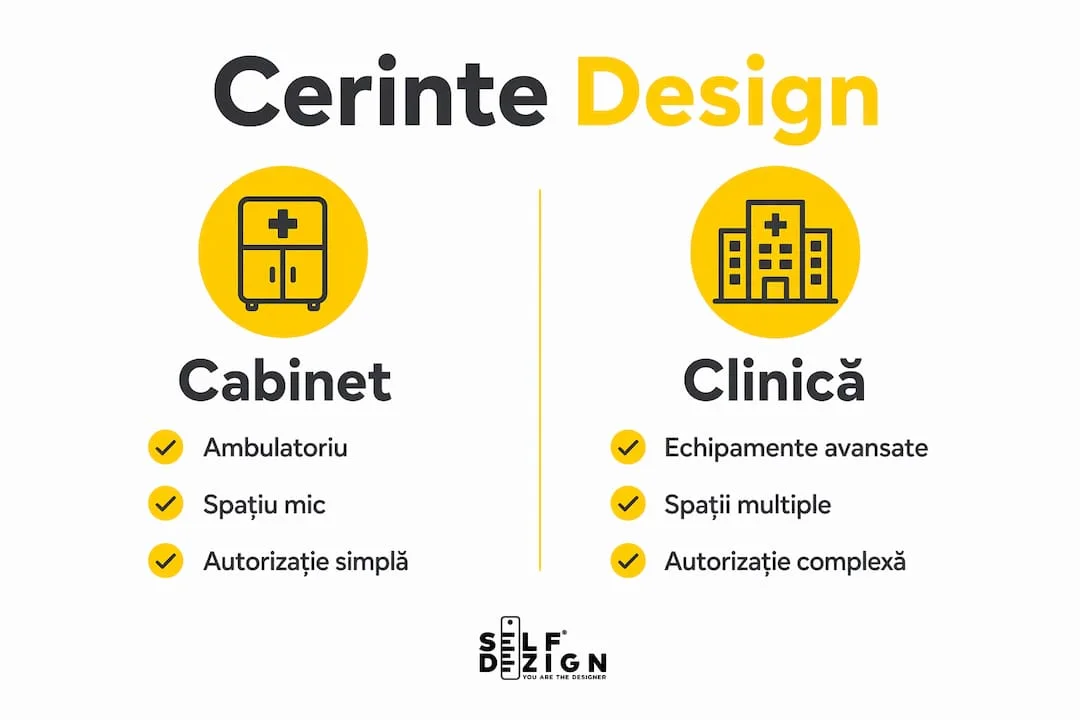
The clinic, in terms of requirements, sits between the practice and the hospital. This intermediate position makes it more difficult to design correctly, precisely because the norms are more complex than for a practice, but not as standardized as for a hospital with surgical procedures.
How are regulations applied in the practical interior design process?
Compliance with norms is not a box-ticking exercise at the end, but a backbone of the entire design process. If regulations are integrated from the first sketch, compliance costs drop dramatically compared to when they are addressed after plans are already finalized.
Here is what a correctly structured process looks like:
- Analysis of the type of medical services offered. Before any design decision, it must be clarified exactly which specialties and procedures will take place in the clinic. Each specialty brings specific requirements for space, equipment, and flows.
- Consultation of Ministry of Health Order no. 1,670/2025 and its annexes. The methodological norms contain minimum areas, mandatory equipment, and detailed technical requirements per type of office. These are the starting point, not an optional reference.
- Collaboration with an architect or designer specialized in medical spaces. Professional clinic design consultancy prevents costly errors and ensures compliance with all legal and technical norms. A designer without experience in medical spaces may deliver an aesthetic but non-authorizable project.
- Obtaining preliminary sanitary approvals. The county or Bucharest municipality Public Health Directorate issues approvals in stages. Prior consultation, before finalizing the technical project, can save months of revisions.
- Integration of technical requirements into the execution project. Ventilation installations, water and sewage systems, electrical circuits for medical equipment, and sterilization systems must be coordinated with the interior design, not added later.
- Complete documentation for authorization. The sanitary authorization file includes compartmentalization plans, technical reports, material sheets, and declarations of conformity. Each document must be coherent with the others.
Professional tip: Request an informal meeting with representatives of the Public Health Directorate before submitting the official file. This practice, although not mandatory, significantly reduces the risk of rejection and clarifies the specific expectations of local inspectors.
Emerald Medical Network invested3.1 million euros in opening a clinic in Timișoara, equipped with state-of-the-art MRI and CT. A project of this scale requires precise coordination between the technical requirements of medical equipment and design norms, a concrete example of how compliance and functionality are inseparable.
What are the most common challenges in complying with regulations?
Owners and designers working on a clinic project for the first time face several recurring obstacles. Knowing them in advance significantly reduces the risk of errors.
- Confusion between applicable norms. There are overlaps between Ministry of Health Order no. 1,670/2025, construction norms, fire safety regulations, and accessibility legislation. Each set of norms comes from a different authority and must be respected simultaneously.
- Unexpected legislative updates. The repeal of Ministry of Health Order no. 153/2003 and its replacement with the 2025 norms caught many owners in the middle of a project. Monitoring the Official Gazette and the Romanian College of Physicians' communications is mandatory throughout the project.
- Tension between aesthetics and compliance. Clinic design must combine aesthetics with hygiene and operational requirements, without compromises in either direction. Many owners pressure designers to choose visually appealing materials or configurations that, however, do not pass sanitary inspection.
- Incomplete documentation when submitting the file. An authorization file rejected due to a missing technical report or inconsistent plans can delay the clinic's opening by months.
- Underestimation of requirements for auxiliary spaces. Sterile material storage, decontamination rooms, and medical waste spaces are often treated as an afterthought, although norms regulate them as strictly as the offices themselves.
Law no. 319/2006 onoccupational safety and health adds another layer of requirements for spaces where medical staff work, including obligations regarding medical surveillance and ergonomic conditions of the workplace. These requirements directly influence how nurse workstations and staff rest areas are designed.
What resources are useful in the compliant design of a clinic?
Access to the correct sources of information makes the difference between a project authorized on first submission and one stuck in repeated revisions.
|
Resource |
Type |
Main utility |
|---|---|---|
|
Ministry of Health Order no. 1,670/2025 |
Official document |
Complete methodological norms for establishment and operation |
|
Official Gazette of Romania |
Official publication |
Tracking legislative updates |
|
County Public Health Directorate |
Approval authority |
Preliminary consultation and issuance of sanitary approvals |
|
Romanian College of Physicians |
Professional body |
Guidelines and clarifications on authorization |
|
Designer specialized in medical spaces |
Private consultant |
Integration of norms into the design project |
A few practical resources to constantly monitor:
- Bucharest College of Physicians (CMB) publishes on its website the ministerial orders and application guides, including the full text of Ministry of Health Order no. 1,670/2025.
- Ministry of Health periodically issues clarifications and methodologies for applying the norms, available on the official portal.
- Technical detailing in design is an often neglected but essential aspect for the final compliance of the project.
Access toefficient interior functionality does not come from isolated aesthetic choices, but from planning that integrates technical norms from the first sketch.
Why regulations are actually a competitive advantage
I have worked on clinic projects where the owner saw the norms as a bureaucratic obstacle to overcome as quickly as possible. And I have seen what happens when this perspective guides the project: spaces authorized with difficulty, costly revisions, and, worse, clinics operating at the edge of compliance that do not inspire real trust in patients.
Our perspective, after several years of medical projects, is that regulations are actually a very well-thought-out design brief. They tell you exactly what needs to function, what needs to be safe, and what needs to be sanitizable. If you start from these requirements as a foundation, not as a constraint, you arrive at a space that is simultaneously compliant, functional, and aesthetic. Easy access, transparent costs, and clinic functionality are closely linked to compliance with design regulations, and patients feel this coherence even if they cannot articulate it.
The most frequent advice we offer to owners building or renovating: do not hire a designer and then a regulations consultant. Hire a designer who understands regulations from the start. The cost difference is negligible compared to the cost of a refused authorization or a space that must be redone after inauguration.
How can SelfDezign help you with your clinic design?
SelfDezign works with clinic owners and designers who understand that a well-designed medical space is not only beautiful but authorizable, functional, and built to support the medical act. The SelfDezign team integrates the requirements of Ministry of Health Order no. 1,670/2025 directly into the design process, from concept to implementation coordination. If you are at the beginning of a new clinic or preparing a renovation, you can exploremedical clinic design services or consult thecommercial design consultancy guide to understand what a correctly structured process looks like. Each SelfDezign clinic project starts from the clinic's real context, not from standard formulas.