
The role of medical furniture in the design of private clinics

Furniture in a clinic is not a chosen accessory after everything is in place. The role of medical furniture in design is, in fact, one of the most neglected factors in planning a private medical space, although it directly influences patient comfort, staff productivity and compliance with sanitary norms. If you have a clinic or are in the process of fitting out, this guide shows you what you really need to know about the choice, standards and integration of medical furniture, not just the surface of the subject.
Key <x id="1"/>Takeaways
|
Punct |
Detalii |
|---|---|
|
Furniture “more than decoration |
Medical furniture is the central component that supports functionality and comfort in medical spaces. |
|
2026 Core Standards |
Furniture must comply with strict rules for hygiene, durability and ergonomics. |
|
Ergonomics and optimal flow |
Ergonomic furniture improves the patient experience and reduces the effort of the medical staff. |
|
Essential furniture in admission |
Adjustable beds and auxiliary furniture help the patient recover and streamline operations. |
|
Professional advice |
A multidisciplinary team can help to optimally integrate medical furniture into the clinic design. |
The importance of medical furniture in the design of clinical spaces
Think of medical furniture as the backbone of your clinic. You can invest in the best equipment, you can paint the walls in soothing shades, but if the chairs in the waiting room are uncomfortable or the examination bed is rigid and difficult to adjust, the patient experience deteriorates quickly.Medical furniture is not decoration, but a determining factor for functionality and comfort, both for the patient and the medical team.
The importance of medical furniture becomes even clearer when you look at its impact from multiple angles:
- Quality of caredepends directly on how the staff can move, access the tools and position the patient correctly.
- Operational efficiencyis influenced by how well the workflow is thought out in relation to the existing furniture.
- Health rulesrequire specific materials, easy-to-disinfect surfaces, and design that minimizes bacterial accumulation.
- Psychological comfortof the patient often starts from how he/she physically feels in the space: the chair on which he/she sits, the indirect light, the accessibility of the space.
When the furniture is chosen correctly, hetransforms the clinic experiencefrom a simple practice to a truly professional nursing home. When wrongly chosen, it becomes a daily obstacle for everyone involved.
Clinic Interior Designit's not about making the space look good in photos. It means creating an environment where every piece of furniture serves a clear purpose, is easy to clean, and resists intensive use specific to the medical environment.

Essential requirements and standards for modern medical furniture
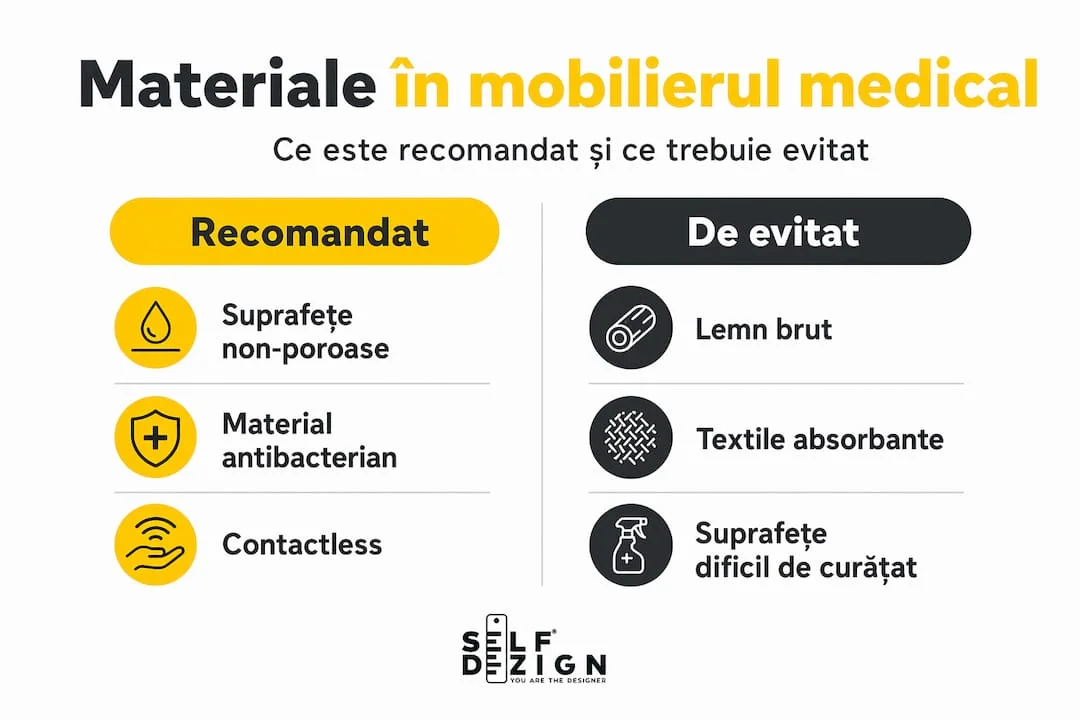
If you thought any durable furniture could fit into a doctor's office, the reality of 2026 standards will change your perspective.Essential medical furnituremust withstand over 500 disinfections without visible or structural degradation, and the surfaces must be antibacterial and easy to clean.
Materials accepted in the medical environment
- Stainless steel 304 and 316: corrosion-resistant, easy to sterilize, ideal for work surfaces and instruments.
- Antibacterial artificial stone: used for cabinet countertops, provides non-porous surfaces that do not retain microorganisms.
- Plastic laminate for medical use: applied on furniture, it must withstand 75% alcohol, iodophore and chlorine solutions, without cracking or discoloration.
Non-porous surfaces andcontactless designare recommended by the FGI 2026 guidelines precisely to reduce the risk of cross-contamination, a solidified lesson in clinical practice after the pandemic.
Recommended minimum dimensions according to FGI 2026
|
Clinical area |
Min Area |
KEY OBSERVATIONS |
|---|---|---|
|
Individual patient room |
23 m² |
Includes bed maneuver area |
|
Twin lounge |
33 m² |
Minimum distance 90 cm between beds |
|
Consultation Cabinet |
14 m² |
Bilateral access to the examination table |
|
waiting room |
1.5 m² per patient |
Accessible chairs for people with disabilities |
Medical furniture solutionscomplying with these dimensions are not an option, but a condition for the legal authorization and operation of the clinic.
A few criteria to keep in mind:
- Avoid handles and hidden corners where dirt accumulates.
- Prefers wall-mounted systems over multi-foot parts to facilitate floor cleaning.
- Verify that the manufacturer offers certificates of conformity to EN 1116 or European equivalents.
Professional advice:Choose furniture with easily removable components. When you can quickly disassemble a drawer or panel, complete disinfection becomes a 5-minute process, not a 30-minute process.
For a complete picture of how it integratessanitary rules in interior designand what implications they have on your project, it is useful to understand that these requirements do not contradict aesthetics, but define it.
Ergonomic furniture for critical areas: waiting room and medical office
The waiting room is the patient's first physical contact with your clinic. It is not an exaggeration to say that the impression here influences his perception of the quality of the medical act that follows.Minimum 1 to 1.5 m² per patientand ergonomic chairs with seat height between 45 and 50 cm, with handles for easy access, are basic requirements, not optional.
Ergonomic waiting room furniture
|
Seat type |
Primary Advantage |
Recommended background |
|---|---|---|
|
Seat with side handles |
Easy access for seniors |
Geriatric clinics, family medicine |
|
Anti-infectious upholstered seat |
Prolonged comfort, easy to disinfect |
Specialties with long waiting times |
|
Pluggable modular seat |
Flexibility in arranging |
Variable traffic spaces |
|
Bariatric chair |
Increased capacity (up to 250 kg) |
General-profile clinics or obesity |
Ergonomics don't stop at chairs. The reception table must allow direct visual contact with the patient standing and in the chair, without the staff having to bend awkwardly at each interaction.
The medical office: where ergonomics becomes clinical
In a dental or surgical office, the correct position of the patient is not a preference, it is a necessity.Ergonomic dental chairsoptimizes workflow and reduces physician fatigue in long procedures, which directly translates into fewer errors and better concentration.
Some principles that make the difference in the medical office:
- Modular furnitureallows quick reconfiguration of space for different procedures.
- Worktopmust be at the correct height for the doctor operating standing or in the chair, otherwise postural fatigue occurs within a few hours.
- Equipment Bracketsintegrated into the furniture eliminates exposed cables and reduces the risk of accidents or contamination.
Professional advice:In small rooms or high-volume patient practices, opt for adaptable medical furniture with lockable wheels. You can rearrange your space in minutes to manage epidemic flows or add a temporary workstation without renovation.
Thinkingholistic cabinet design, ergonomic furniture becomes part of a coherent assembly, not an insulated piece chosen by price or availability.
Essential furniture in inpatient medical facilities: comfort and functionality
Inpatient units put maximum pressure on furniture. The parts are used non-stop, in 24-hour shifts, by patients with reduced mobility and by staff who need to intervene quickly. The most common mistake that private clinic owners make is to treat these pieces as hotel furniture. They're not the same thing.
Here are the indispensable pieces of furniture and what concrete role they play:
- Electric or manually adjustable bedallows adjustment of the patient's position without physical effort on the part of the staff, reduces the risk of bedsores and facilitates procedures such as collection or administration of infusions.
- Bedside table with wheels and antibacterial surfacegives the patient access to personal belongings without stretching dangerously, and staff can move it quickly for cleaning or interventions.
- Adjustable Bedside Serving Tableallows patients to eat comfortably or use a laptop in bed without constantly asking for help. Small detail, big psychological impact.
- Multifunctional stretcherwith adjustable side rails and quick disinfection surface is essential for safe transfers and emergency procedures in the saloon.
- Personal effects cabinetwith padlock and ventilation ensures both patient safety and the correct sanitary conditions for storing clothes and personal items.
Each of these parts contributes to a coherent operational flow. When chosen together, withinterior design services for clinicswho think of the space as a whole, the difference becomes visible immediately, both in the satisfaction of the patients and in the performance of the staff.
Our perspective on integrating medical furniture into clinics
There is a recurring confusion in medical fit-out projects that we often encounter: clinic owners allocate large budgets for equipment and finishes, but treat furniture as a minimizable cost line. The result? Cabinets with state-of-the-art equipment and chairs that tire doctors after two hours of consultations.
Medical furniture conditions posture, the risk of incidents and the quality of the medical act directly. It's not a marketing statement, it's a clinically documented reality. A doctor who works on a table at the wrong height develops musculoskeletal problems within a few years. A patient sitting on too high a chair in the waiting room feels a diffuse discomfort that they unconsciously associate with the clinic itself.
Our opinion, based on concrete projects:the best medical furniture is not the most expensive, but the one chosen in the context.A psychiatric clinic has completely different needs than an outpatient surgery office. The medical furniture trends of 2026 clearly show that customization and adaptability beat rigid standardization.
A piece of advice we rarely give that makes a difference:involve doctors and nurses in the furniture selection process, not just the clinic manager. They know exactly where they run into obstacles on a daily basis. Add a psychologist to the discussion if you also treat patients with anxiety or prolonged recovery. Their perspective on how space affects your mental state will completely change your priority list.
Balancing strict functionality with a humanized atmosphere is the real challenge of setting up modern medical spaces. Clinics that do that don't look like hospitals and they don't look like hotels. They look like places where people feel safe. And furniture is one of the main vectors of this perception.
If you want to delve deeper into what it really meansclinical design consultancyat a strategic level, there are a few approaches that differ significantly from what typical fit-out offer.
How SelfDezign makes it easier to integrate medical furniture into your clinic
At SelfDesign, we approach every clinic project from what's really going on in the space, not a standard template. We know that setting up hospitals and private practices raises specific questions about flow, norms, ergonomics and visual identity, all at the same time.
We offer clinical design consultancy covering both the selection of adaptable medical furniture and its integration into the overall concept of the space. We don't sell products, we think spaces. That means we choose furniture based on the actual flow of your clinic, the type of patients, and the requirements of your medical team.
If you want to understand how the step-by-step process works,indoor project coordination workflowgives you a clear picture of the stages, from the first discussion to implementation. And if you have several types of spaces in your portfolio, including offices or administrative areas, our team is also experienced ininterior design for office spaceswith specific functionality requirements.