Corian vs Quartz: Which Countertop to Choose for a Home or Commercial Space
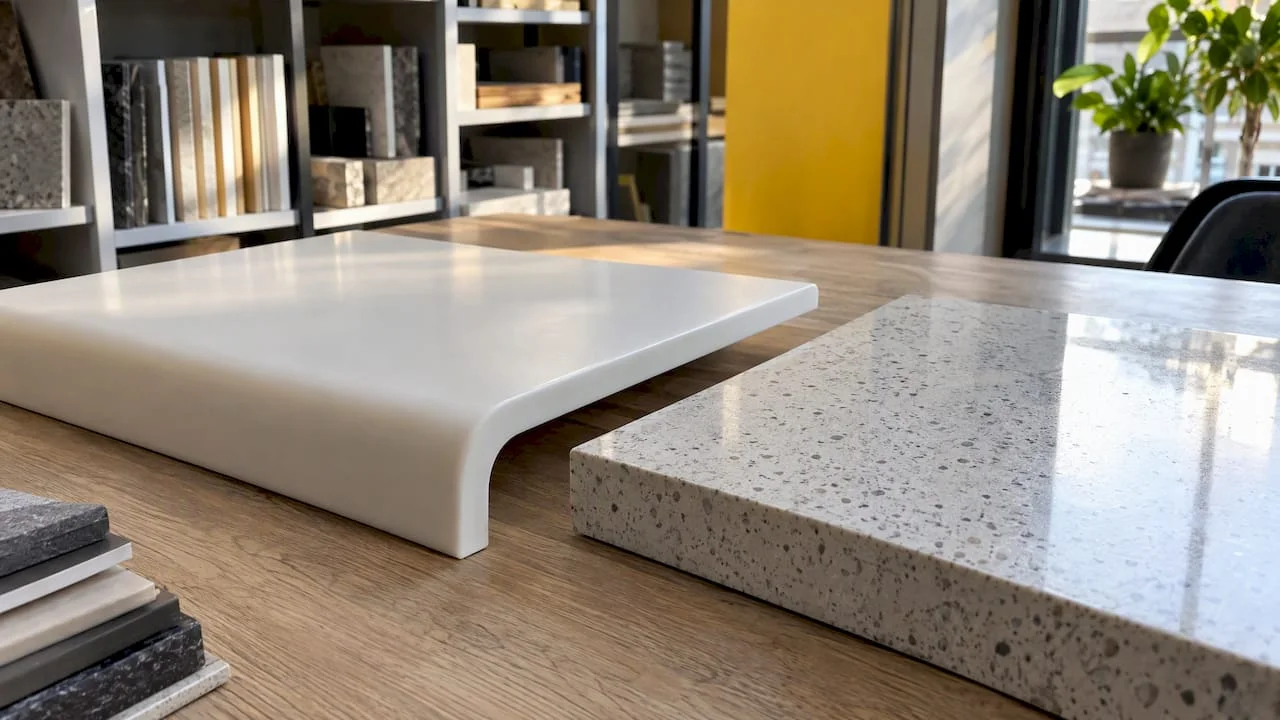
Choose engineered quartz for a heavily used countertop: it handles scratches, heat and carelessness better. Choose Corian when a continuous surface matters: invisible seams, a sink made from the same material, curved shapes and repairs on site. The decision depends on how you use the space, not on which material is “better” in the abstract.
SelfDezign
Choose the countertop that fits the space
SelfDezign designs spaces starting from the context and goals of each project.
In short
- Hardness: engineered quartz rates 7 on the Mohs scale, Corian around 2–3. Against scratches and knocks, quartz clearly wins.
- Heat: Corian can show marks from about 100°C. Quartz tolerates more, but a trivet is still recommended for both.
- Shape and continuity: Corian can be thermoformed and bonded without visible seams, including with an integrated sink. Quartz is worked like a stone slab, and its joints show.
- Repairs: scratches on Corian can be sanded out. Chips in quartz are filled with a special compound and polished, and the result depends heavily on the fabricator.
- Decision: choose by how the space will be used, not by the sample. In a commercial space, an unsuitable countertop is paid for in repairs or replacement, not only in the price difference.
What are Corian and engineered quartz, exactly?
Both are composites, but their proportions differ a lot: about a third resin in Corian, between 6 and 10% in quartz.
Corian is a solid surface brand launched by DuPont in 1967. According to the Corian Solid Surface product bulletin, it consists of roughly one third acrylic resin and two thirds natural minerals. The resin lets the material be heated, curved and bonded, which is why Corian can become a countertop, a sink, a wall cladding or a reception desk front that reads as one visual “piece”.
Engineered quartz (also called artificial stone or engineered stone) contains between 90 and 94% crystalline quartz, bound with 6–10% resin and pigments. It behaves like stone: hard, heavy, stable, but rigid. It is cut, ground and installed as slabs, not shaped.
Watch out for a naming confusion: the Corian Quartz brand also sells an engineered quartz, not a solid surface. When you receive a quote for “Corian”, check which material you are actually getting, because everything else in this article changes with the answer.
Corian and quartz compared, criterion by criterion
|
Criterion |
Corian (solid surface) |
Engineered quartz |
|---|---|---|
|
Composition |
~1/3 acrylic resin, ~2/3 minerals |
~90–94% natural quartz + resins |
|
Hardness (Mohs) |
~2–3 |
~7 |
|
Scratches |
Scratches relatively easily, especially in dark colors |
Very resistant |
|
Heat |
Marks possible from ~100°C |
Copes better, trivet recommended |
|
Porosity |
Non-porous |
Practically non-porous |
|
Seams |
Practically invisible |
Visible, even if fine |
|
Curves, thermoforming |
Yes |
No |
|
Integrated sink |
Yes, in the same material |
Usually a separately mounted sink |
|
Look |
Uniform, matte or satin, solid colors |
Imitates stone: veining, depth |
|
Repairs |
Sanding on site, discreet repairs |
Filling with a special compound, then polishing |
|
Daily care |
Simple, no sealing |
Minimal, no sealing |
The table shows the general tendency. Real differences also depend on thickness, color, finish and, above all, the quality of the workshop that fabricates the material.
Look, color and seams
This is where each material’s character shows most. Corian has a uniform, matte look with a wide range of solid colors, while engineered quartz tends to imitate marble or granite, with veining and a visual depth that solid surface reproduces less easily.
From a design point of view, this means:
- Corian works when you want a surface that “disappears” into the architecture: a continuous white countertop that climbs the wall as cladding, a curved reception desk, a basin that looks carved out of the top. Joints are bonded and sanded until they can no longer be seen, and the manufacturer’s bulletin stresses exactly this capacity for invisible seams and thermoformed shapes.
- Quartz works when you want the countertop to be an element of materiality: an island with Calacatta-type veining, a stone-look bar, a bathroom with a hotel feel. On a long island, quartz may need two slabs, so the seam must be planned where it is least visible.
A countertop does not stand alone in a room. Strongly veined quartz calls for quieter textiles and finishes around it, while a matte white Corian more easily carries rich textures, with prints or generous pleats. For a decision framework, our guide to choosing finishes starts from the same idea: finishes are not chosen in isolation, but together.
Resistance to scratches, knocks, heat and stains
This is the point where the difference becomes practical.
Scratches and knocks. With a Mohs hardness of 7 against 2–3 for Corian, engineered quartz better resists scratches from knives, ceramic pots dragged across the top, keys and belt buckles. Over time, Corian will show micro-scratches, especially in dark and glossy colors. In light colors and a matte finish, these marks are much less visible.
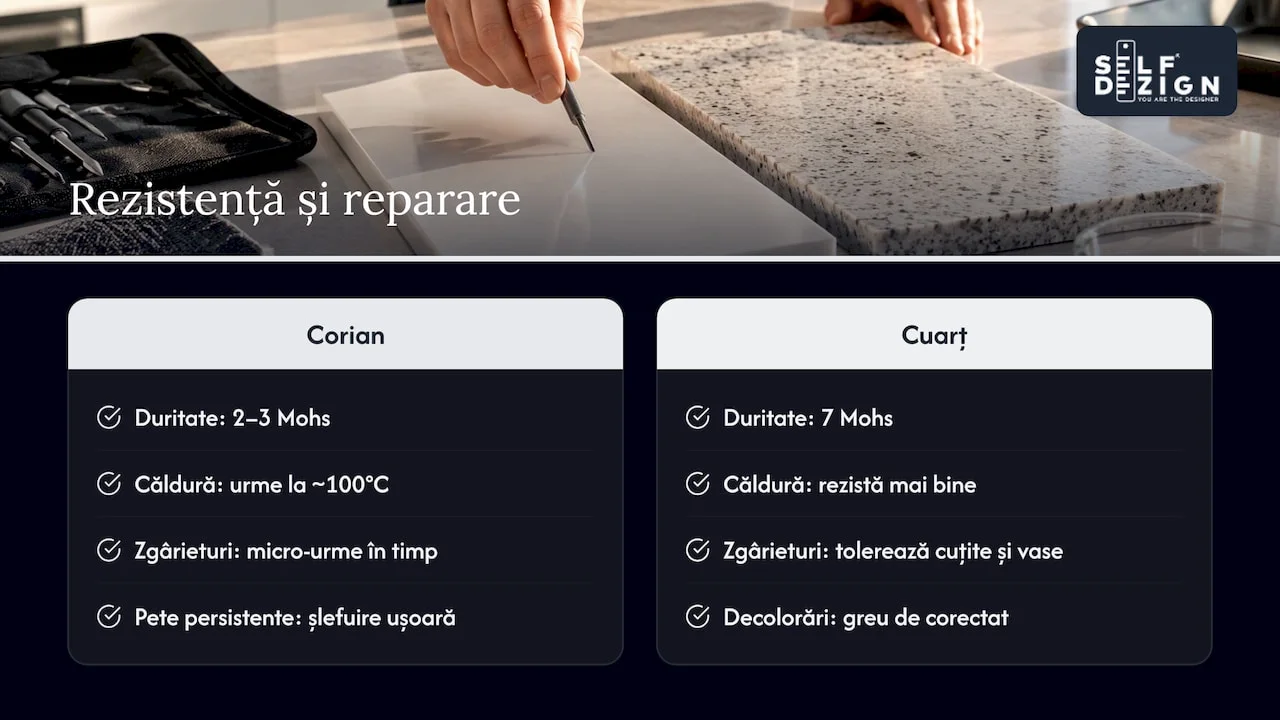
Heat. Corian can show marks at about 100°C, the temperature of boiling water. Quartz copes better, but it does not tolerate pots taken straight off the heat either: HomeGuide points to a risk for the resin from about 150°C, when it can discolor. For both materials, a trivet is the rule, not an option.
Stains. Corian is non-porous and quartz is practically non-porous, so wine, coffee or oil do not penetrate the material if wiped up in time. On Corian, a persistent stain can be removed by light sanding; on quartz, stains are rare, but discoloration from heat or harsh chemicals is hard to correct.
A simple rule: if the countertop will be an intensive work surface, used by people who do not take care of it (a bar, a café, an office kitchenette), quartz is more forgiving. If the countertop is part of an architectural composition and used with care, Corian offers more freedom.
Hygiene and care: kitchens, hospitality and medical spaces
For a clinic, a laboratory or a professional kitchen, hygiene depends not only on the material but on how many seams there are. Every silicone joint and every square corner between countertop and wall is a place where dirt collects.
Here Corian has a structural advantage. The manufacturer states that its smooth surface with no visible seams does not promote the growth of mold and bacteria, provided it is cleaned properly. A cabinet countertop with an integrated sink and a curved joint to the wall is effectively a single surface to disinfect.
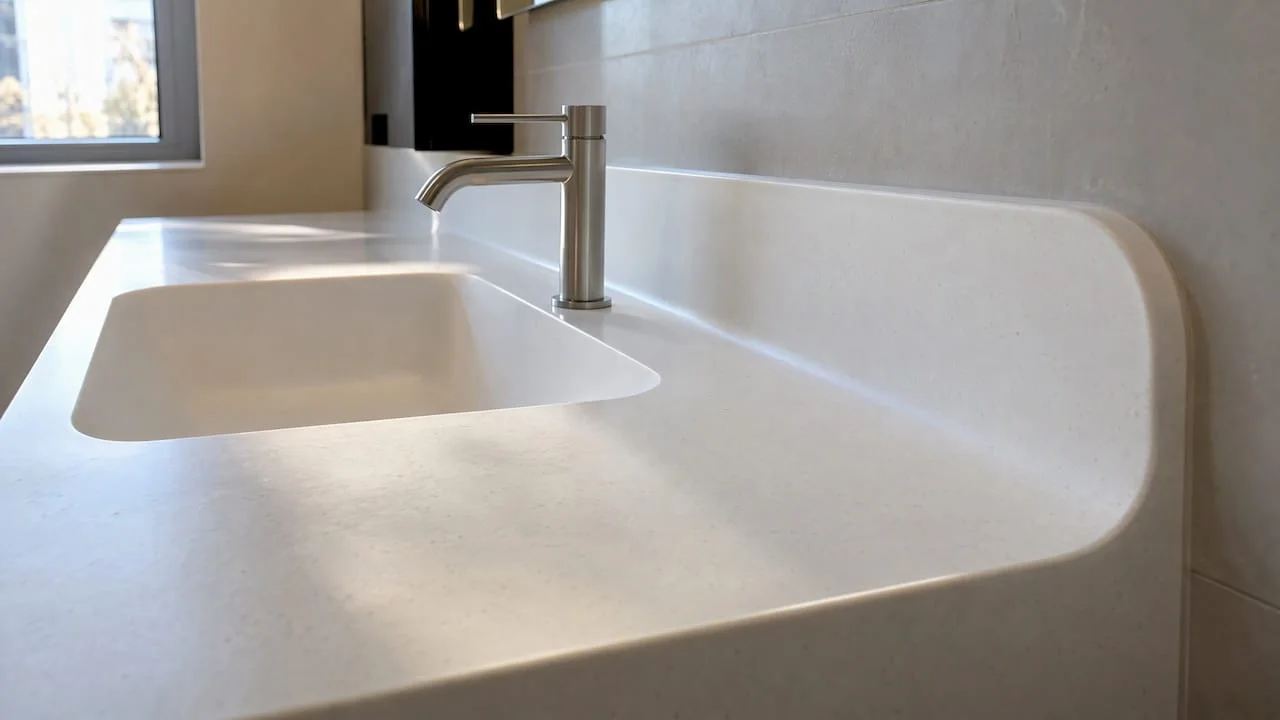
Engineered quartz is also practically non-porous and needs no sealing, so daily care comes down to water, a neutral detergent and a cloth. Its limit in medical spaces is not porosity but the fact that it cannot form curved corners and continuous sinks.
One detail that matters in commercial spaces: cleaning products. The manufacturer’s bulletin lists strong acids, acetone, chlorinated solvents and paint strippers as risks for Corian, and for hospitals and laboratories, where it meets strong disinfectants, it recommends solid colors and avoiding prolonged contact. Exposure outside the specifications can exclude warranty cover; check the duration and terms for Romania with the distributor. Before choosing the material for a clinic, ask the cleaning team for the list of products they use and check it against the manufacturer’s technical sheet. For a practice or clinic, see also interior design for medical clinics.
Repairs and installation
Repairs. On Corian, the owner can remove minor scratches and stains with fine sandpaper and a scouring pad, while cracks and deep impact damage call for an authorized fabricator. Chips can also be repaired with a kit, according to Bob Vila. Quartz repair needs a special filler compound, applied with a syringe and then polished, so it is harder to do yourself. The result on a chipped quartz edge depends on the workshop and on the slab pattern.
Installation. Installation differences matter as much as the material:
- Final measurement is taken after the cabinets are installed, not from drawings. With quartz, an error of a few millimeters cannot be corrected on site.
- Seam planning: with quartz, you decide in the design where the slabs join, ideally away from the sink and hob. With Corian, the joint is bonded and sanded on site.
- Cutouts for the sink, hob and tap are usually made in the workshop for quartz; with Corian, the sink can be integrated in the same material.
- Support: quartz is heavy, so on cantilevered sections or on islands with a wide span, the cabinets must be sized for its weight.
- Fabrication: ask the workshop how it cuts quartz. Wet cutting and dust control are today’s responsible practice, and a serious workshop answers without hesitation.
What goes into the price of a Corian or quartz countertop?
Prices in Romania vary a lot from one workshop to another, so a figure without context can mislead you. What matters is comparing quotes on the same items. The final price of a countertop, whatever the material, depends on:
- brand and collection: for both materials, veined or special-color models cost more than the basic ones;
- thickness: with quartz, the difference between 12, 20 and 30 mm is significant, while with Corian apparently thick edges can be built up from thin sheets;
- edge and profile: straight, chamfered, rounded or block-style edge;
- cutouts: sink, hob, tap, pop-up outlet, each with its own cost;
- integrated elements: a molded Corian sink or a wall cladding in the same material adds cost but removes other work;
- transport, measuring and installation: sometimes included, sometimes invoiced separately.
When you compare two quotes, ask for them itemized, per linear or square meter, with cutouts and edges listed separately. Also consider lifetime cost: a cheap countertop that must be replaced after a few years in a restaurant ends up costing more than one suited to the use. If you are also weighing more affordable options, our comparison of HPL vs laminate countertops covers the budget segment.
Warranties and conditions of use
For Corian, DuPont offers limited residential and commercial warranties; the manufacturer’s documentation lists 10-year limited warranties for North America. Conditions for Europe and Romania should be checked with the local distributor. The manufacturer trains and certifies fabricators and installers, so ask whether your workshop holds this certification.
For engineered quartz, each manufacturer sets its own conditions, and the differences between brands can be large, especially between residential and commercial use. Ask explicitly:
- whether the warranty also covers commercial use (hospitality, offices, clinics);
- which cleaning products are allowed;
- whether the warranty requires installation by a specific workshop;
- what happens with sun fading, for countertops next to shop windows or large windows.
Other options worth considering
Corian and quartz are not the only choices. When comparing countertops, it is worth putting these on the table too:
- Other solid surface brands, such as HI-MACS or Staron, with behavior close to Corian: invisible seams, thermoforming, repairability.
- Other engineered quartz brands, such as Silestone or Caesarstone, with differences in collections, thicknesses and warranty conditions.
- Sintered ceramic and technical porcelain (large-format slabs), very resistant to heat and scratches, but sensitive to edge chipping, and a chip shows immediately.
- Natural granite, durable, but varying from slab to slab and, as a rule, needing periodic sealing.
- Compact HPL, often chosen for offices and for areas with water and heavy wear.
For an overview of materials for interior spaces, see also our comparison of materials for interiors.
When to choose Corian and when to choose quartz
Choose Corian if:
- you are preparing a medical practice, a dental office or a laboratory, where the absence of seams and curved corners matters;
- you want a reception desk, a bar or a basin with curved shapes, in one visual piece;
- you need the countertop and the wall cladding in the same material, with no transitions;
- you prefer a material you can refinish after a few years.
Choose quartz if:
- the countertop will be an intensive work surface: a family kitchen with daily cooking, a bar, a café, an office kitchenette;
- you want a stone look, with veining and depth;
- you want minimal maintenance and high tolerance for carelessness;
- scratches bother you more than on-site repair helps you.
Sometimes the right answer is a combination: quartz on the intensive work zone and Corian where continuity matters, for example the basins in a restaurant or the reception desk of a clinic.
How to decide, in practice
The question “Corian or quartz?” is better asked after answering a few others: who uses the countertop, how many times a day, which products clean it, and what the space should convey. These answers choose the material better than a showroom sample.
In a clinic, the countertop is part of the patient’s experience: a continuous surface with no seams signals order and care before the doctor says anything. In a restaurant, the same countertop must survive a rushed evening service, and there the hardness of quartz is a form of peace of mind for the owner. In a home, what matters is how you cook and how much you want the countertop to be background or protagonist.
A fashionable material placed in the wrong context becomes a maintenance problem and a hidden cost. Build the decision on the real scenario of use and write it down, so that years later you know why you chose what you chose.
When you need a second opinion
If you are at the quoting stage and want clarity before signing with a workshop, a consultation with written conclusions costs 500 lei for a 2-hour session: we review the space, the use and the quotes you received, and leave you the recommendations in writing. For complete projects, the design fee starts at €25/sqm for commercial interior design and goes up to €55/sqm, and for residential it ranges between €20 and €40/sqm, with concept, technical design and site coordination, detailed on the SelfDezign services page. If you are preparing a venue in Romania from another country, remote hospitality consulting starts at €450 per session. Tell us what space you have.