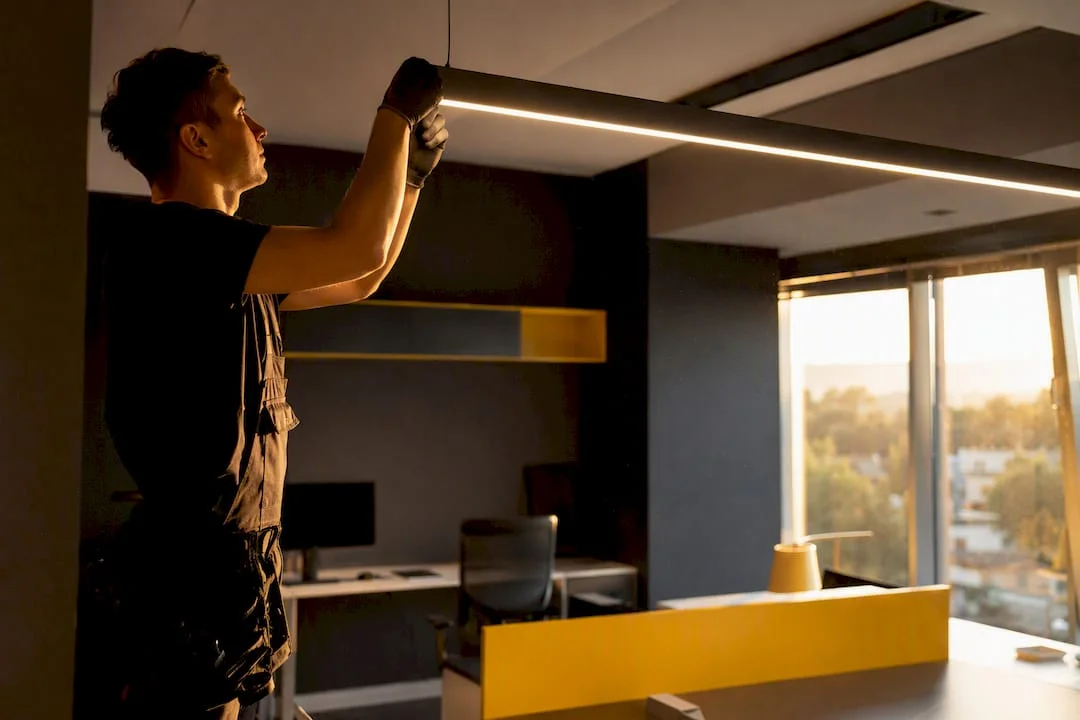
Track vs downlight lighting: how to choose the right one
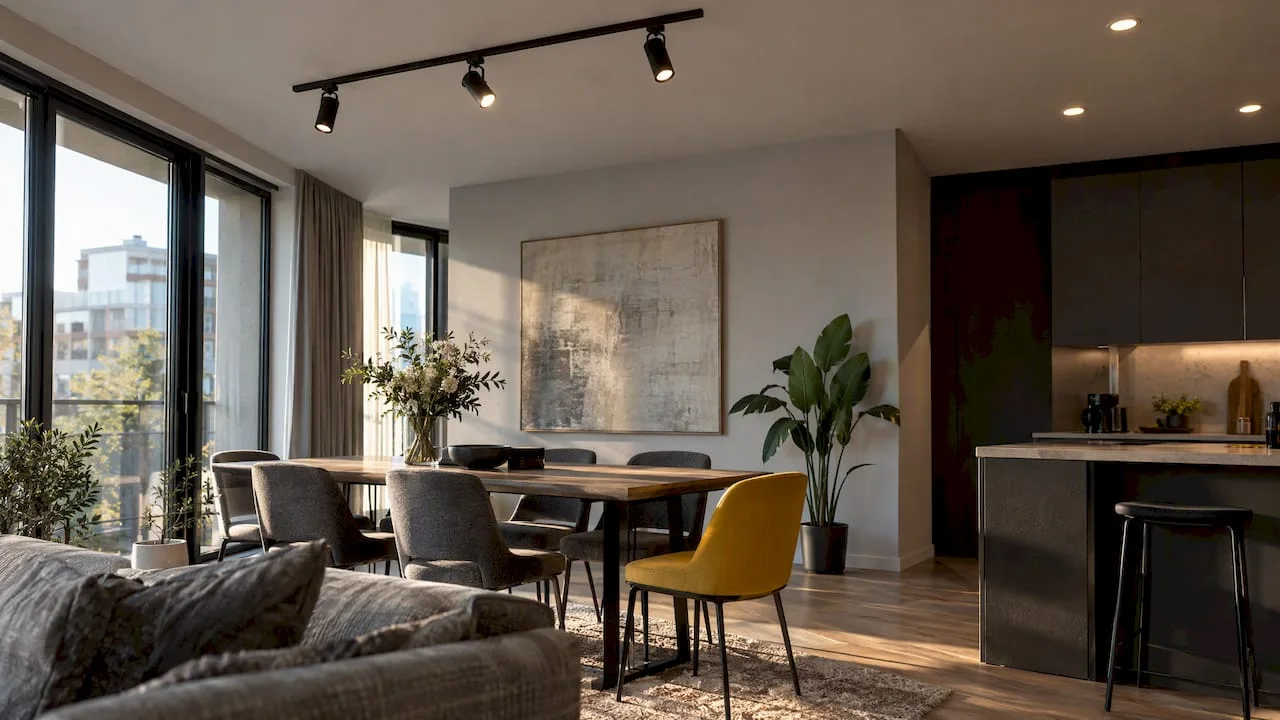
For visual accents, wall art or frequent rearrangements, we choose track lighting. For discreet general lighting with clean lines and an uncluttered ceiling, the downlight remains the right solution. High ceilings or exhibition spaces sometimes change the calculation, and the technical differences and scenarios below explain exactly why.
In summary:The track is recommended for spaces with frequent rearrangements or changes of use, as it allows quick and easy adjustments to the position of the fixtures.Downlighting is ideal for general lighting of rooms with a constant function, but requires more extensive work to change position or reconfigure.In spaces with high ceilings, track suspended systems offer flexibility, while downlights are more suitable for low ceilings because they add no visual volume and are simple to install.The choice of system largely depends on the need for reconfiguration, ceiling height and installation and maintenance costs.Total costs vary depending on the complexity of the system, and retrofit adaptation is possible for both solutions, with risks related to electrical compatibility and additional work.
SelfDezign
Integrate lighting into your project
SelfDezign designs custom interiors, from concept and technical design to implementation coordination.
Track anatomy versus downlight anatomy
The difference between the two systems starts from the construction, not the appearance. The track system is based on a ceiling-mounted or suspended rail, through which electricity flows, and on modular lighting fixtures, called spotlights, which are attached anywhere along the length of the rail. Each fixture rotates and tilts independently, and its position changes without interventions in the ceiling, just by sliding and reconnecting to the rail.
The downlight works the other way around. The luminaire is recessed in a ceiling cutout, almost completely hidden behind a thin frame, and the mounting box remains fixed from the moment of installation. The light falls vertically, evenly, without the possibility of reorientation, except in adjustable (gimbal) trims, which allow a limited inclination.
From a practical point of view, these construction differences determine everything from cost to maintenance:
- The track allows quick reconfiguration of light direction, useful for showcases, galleries or walls with rotating art.
- The downlight provides an even distribution, suitable for general lighting of an entire room.
- The rail supports the addition or removal of fixtures without ceiling work, only through connectors.
- The downlight cutout is permanent, and changing position means a new hole in the ceiling.
- Track fixtures remain visible, so they contribute to the overall appearance of the room, not just the function.
The choice between the two is not just aesthetic, it's about how often we anticipate changing the use of the space. A living room that frequently houses artwork or furniture rearrangements benefits from the track's flexibility. A room with a stable function, such as a bedroom or corridor, does not need constant reorientation of light.
Essential technical parameters and how they compare between the two solutions
Technical specifications matter more than the type of fixture chosen, because they directly determine the visual comfort of the space. The first parameter to check is the luminous flux, measured in lumens, not the power consumed in watts, which only shows how much the bulb consumes, not how much it lights up.
For a living room, an indicative value of 1,500 to 3,000 lumens covers the general lighting of the room, while a kitchen or office usually requires more, for activities that require visual accuracy. The color rendering index, denoted CRI or Ra, shows how faithfully the light source reproduces the actual colors of objects. For residential spaces, a CRI of minimum 80 is acceptable, but for commercial areas, especially retail and horeca, we recommend a CRI of 90 or above, so that products and materials retain their true shade.
Modern LED sources offer superior luminous efficiency compared to older technologies such as metal halide, which means lower consumption for the same level of brightness.
The color temperature, expressed in kelvin, directly influences the atmosphere of a room. A 2700 to 3000K light creates a warm atmosphere, suitable for the living room or bedroom, and choosing the right temperature for each room depends on the function of the space and the times it is used. For work or retail areas, a temperature of 3500 to 4000K provides visual clarity and energy, useful for precision tasks.
Other factors to check:
- Compatibility with dimmers or control systems requires suitable drivers, otherwise flickering or adjustment limitations occur.
- A quality driver directly influences the lifespan of the fixture and the stability of the light over time.
- The beam aperture angle determines whether the light is focused for accent or diffused for general lighting.
Practical scenarios: how to choose by room, activity and aesthetics
The right decision depends on the activity taking place in each space, not on a general preference for a fixture type. Some indicative landmarks by room type:
- In the living room, the track works well above art areas or bookshelves, and the downlight covers the ambient lighting of the rest of the room.
- In the kitchen, the downlight provides uniform light for the countertop and cooking area, and additional track accents can illuminate the island or wall with open shelves.
- In the bathroom, downlighting remains the practical choice, because it requires watertight fixtures and a constant distribution without any targeting requirements.
- In the hallway, the track helps to visually guide you to paintings or decorative niches, where the visual path counts.
- In retail, the track allows quick reconfiguration of showcases according to collections or season, an advantage that the downlight does not offer.
- In restaurants, the combination of downlight for passage areas and track or suspended for tables creates layers of light that support the atmosphere.
- In offices, the downlight covers general work areas and the track can highlight reception areas or walls with visual identity.
- In exhibition spaces, track flexibility is almost mandatory, because exhibits change periodically.
Professional advice: If you are not sure how you will use the space in two or three years, choose the track: changing the direction of the light costs much less than rebuilding the ceiling.
The quick rule we apply in our projects takes into account three variables: ceiling height, need for accent and frequency of rearrangements. Low ceilings favor the downlight because they do not add visual volume, while high ceilings allow suspended rails that themselves become a design element. A complete guide to indoor lighting types details other possible combinations for each type of space.
What it costs, what installation involves, and what retrofit options exist
The initial cost differs less than the complexity of the work behind it. A track system, with a rail and a few modular fixtures, usually starts at an affordable price for a simple mounting on a short rail, but increases in proportion to the number of spotlights and the complexity of the control system. Downlighting often looks cheaper per fixture, but the total cost depends on the number of cutouts needed for even coverage of the room.
Installing the downlight involves cuts in the ceiling, access to the rear structure and, in many cases, checking the beams or existing installations before cutting out. For false ceilings, the installation is relatively simple, but for concrete ceilings or structures without technical space, the work becomes much larger and more expensive.
The track requires routing a power cable to the rail mounting point, but once installed, track rail is in many cases more flexible for later modifications, because adding or moving fixtures no longer requires ceiling work.
For owners who want to upgrade a space without major renovations, there are retrofit options for both systems:
- LED retrofit modules can replace old light sources in existing fixtures, if the driver and the socket are compatible.
- Retrofit downlights are mounted in already existing cutouts, without enlarging the hole in the ceiling.
- The main risk of retrofit is electrical compatibility, especially when the old driver does not bear the load of the new LED fixtures.
- The advantage of retrofit is the low cost compared to a complete renovation of the lighting system.
For commercial projects, where each day of work means interrupted activity, the difference in complexity between the two systems often weighs more than the price of the fixtures themselves.
Energy efficiency, maintenance and long-term operational costs
Both systems operate almost exclusively on LED technology today, and the differences in consumption between them are more related to the number and power of the fixtures than to the type of mounting. Modern LEDs reach operating times of 25,000 to 50,000 hours, a lifespan usually declared by manufacturers, which means years of use without replacing the light source.
Access for maintenance differs visibly. With track, a defective fixture is removed from the rail in a few seconds and replaced without tools, and the system remains functional for the rest of the fixtures during the intervention. In downlighting, replacing the integrated LED module may require removing the entire housing from the ceiling, and in some older models, the entire fixture needs to be changed, not just the light source.
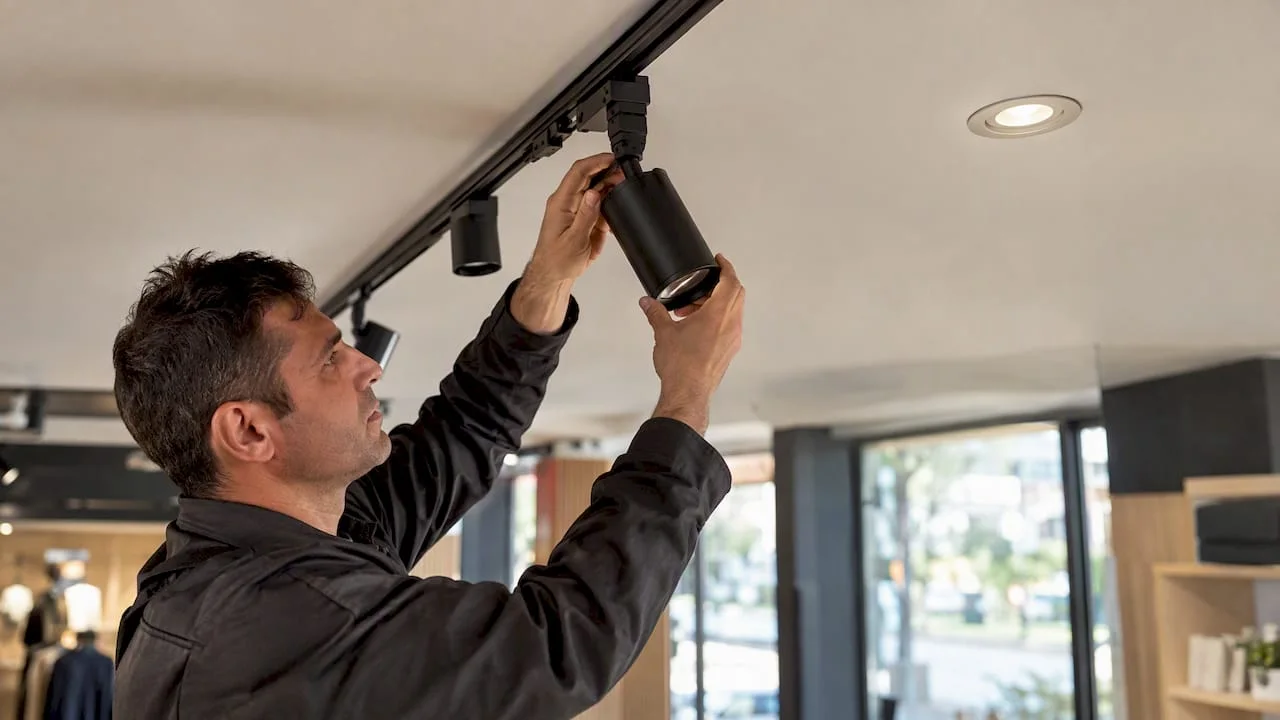
Over a five-year horizon, the difference in operational cost does not come from the almost identical energy bill at equal power, but from the time and cost of maintenance interventions. A commercial space with dozens of downlights distributed on the false ceiling entails higher service costs if the drivers are not easily accessible, while a track system allows quick checks and replacements without additional working hours.
Essential points to keep in mind:
- The long life of the LEDs reduces the frequency of interventions, regardless of the type of mounting chosen.
- The track provides faster access for replacement without tools or ceiling removal.
- The downlight requires checking the type of module, integrated or interchangeable, before installation to avoid high subsequent maintenance costs.
Aesthetics and integration: how the choice influences atmosphere and visual direction
Each system produces a different visual effect, and the right choice takes into account how we want the space to “breathe” light. Downlighting creates an ubiquitous light with no visible sources, suitable for spaces that need to look calm and tidy. The track, through the visibility of the fixtures and the possibility of targeting, introduces drama and punctual accents, useful to guide the gaze to a specific element.
Many successful projects combine the two solutions for light layering, a common practice in design: the downlight covers the general background of the room, and the track adds accents to walls, art objects or exhibition areas.
Some visual coherence principles we follow in choosing the solution:
- The finish of the luminaires must align with the palette of materials in the rest of the space, not just the color of the ceiling.
- The colour temperature must remain constant between the two systems to avoid unwanted contrasts between warm and cold light.
- The number of visible track sources must be dosed, because too many fixtures can visually fragment the ceiling.
A practical guide to choosing the right light also details other criteria for combining light sources for each interior style.
How we apply selection criteria in our projects
In each project, the decision between track and downlight starts from the actual function of the space, not from an isolated aesthetic preference. We first analyze the activities taking place in each area, then determine the required luminous flux, the right color temperature and the degree of flexibility required by the customer in the medium term.
The checklist we go through in the technical design phase includes:
- The exact function of the space and the frequency of changes of layout or use.
- The luminous flux required for each zone, calculated according to the area and activity.
- The level of maintenance accepted by the customer and the access available to the ceiling.
- Aesthetic consistency with the material palette and the rest of the lighting concept.
For horeca spaces, where the atmosphere directly influences the customer experience, and for offices, where productivity depends on the quality of light, these criteria become even stricter. A technical material on office lighting design explains the parameters we follow in this type of project, and for horeca spaces, the technical recommendations in the restaurant lighting guide complement the same principles applied on a different scale.
When the technical scenario involves mixed areas, retail with exposure corners, clinics with waiting areas and consulting rooms or offices with distinct reception spaces, hybrid solutions become almost mandatory, and an anticipated technical discussion avoids costly changes after installation.
What most lighting guides underestimate
Most comparisons between track and downlight treat the choice as a purely technical decision, reduced to lumens and watts. In reality, the right decision is more about anticipating the change than the initial brightness calculation. A space that seems stable today, a living room, an office, a showcase, changes over time: the furniture moves, the exhibits rotate, the function evolves.
The recommendation we support, based on our projects, is to choose according to the capacity of the space to transform, not just its current configuration. Downlight perfectly solves a fixed need, but penalizes any subsequent change with ceiling work. The track sometimes costs a little more to install, but that cost buys freedom in the long run, an advantage that data sheets never quantify.
The real priority for the reader is not “what lights better”, but “how often this space will change in the coming years”. The answer to this question, not the CRI or luminous flux, should decide first.
SelfDezign services relevant to your lighting project
The choice between track and downlight quickly clarifies in a technical discussion, because each space has its own ceiling, budget and function constraints, which a photo or an online catalog cannot fully evaluate. In our commercial and residential interior design, we integrate the lighting solution into the overall concept of the space, not as a separate element chosen at the end.
For those who need a punctual recommendation, without a complete project, we offer a consultancy with written conclusions, which includes space assessment, technical recommendations for the right type of fixtures and aesthetic proposals to integrate with the rest of the interior. For horeca projects coordinated from abroad, SelfDezign Remote offers the same evaluation structure, adapted to a remote collaboration.
If the technical scenario of your project involves multiple areas with different lighting requirements, an anticipated technical discussion prevents unnecessary costs later.