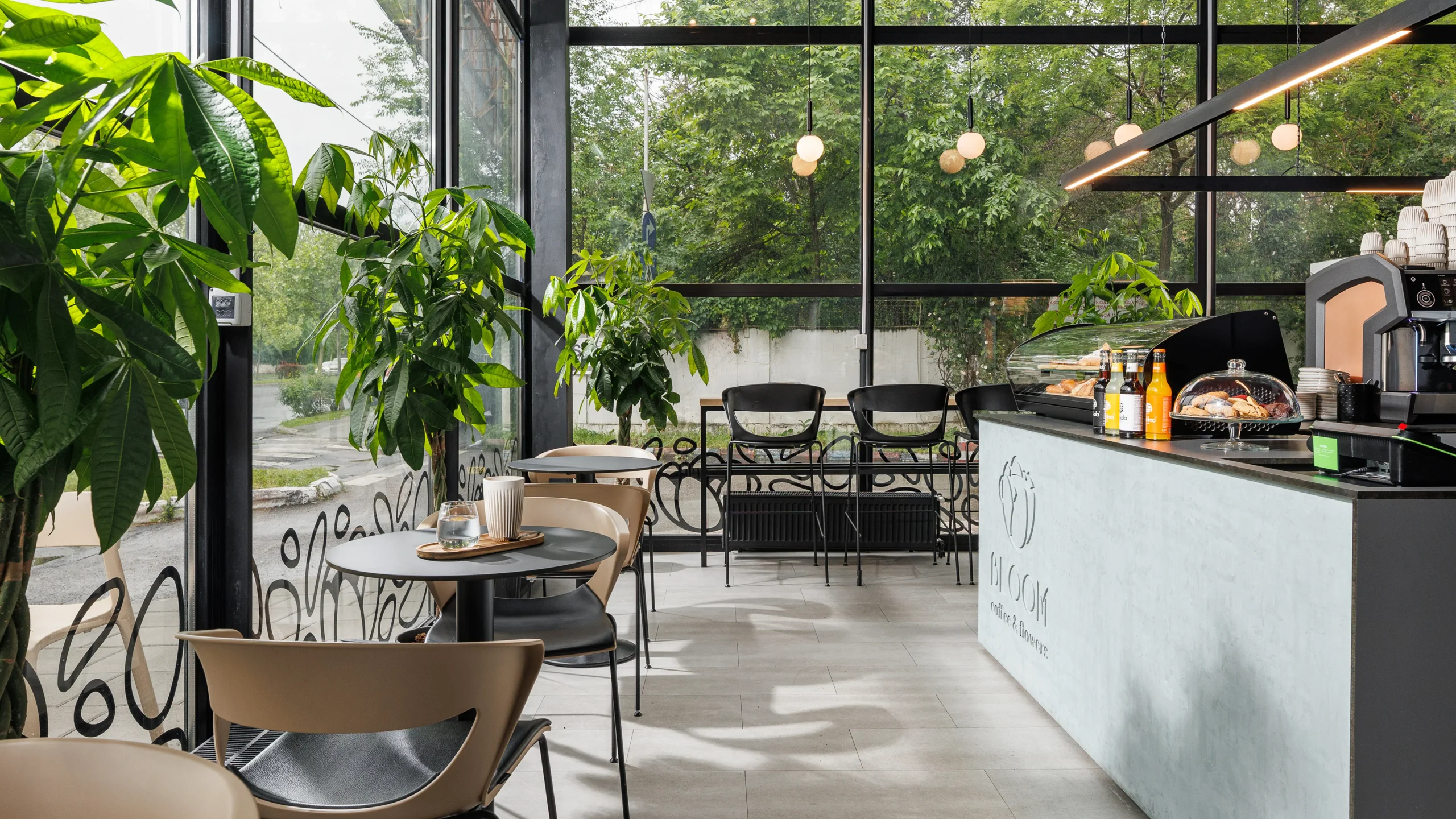
The role of the interior design team: key to profit and image

Many restaurant, hotel, and commercial space owners treat interior design as a final step, something to be resolved after all important decisions are made. This is one of the most costly misconceptions in the industry.Interior design directly contributes to profitby optimizing staff flow, increasing customer satisfaction, and creating an atmosphere that differentiates the brand in the market. In reality, a well-chosen interior design team does not decorate a space but transforms it into a business tool. This guide explains exactly how this happens and how you can leverage this expertise for your business.
Key Ideas
|
Topic |
Details |
|---|---|
|
Interior design, strategic investment |
The interior design team brings direct value to profit, efficiency, and brand image. |
|
Economy and operational efficiency |
Smart design decisions reduce major costs and maximize space profitability. |
|
Branding and loyalty |
Personalized design forges memorable experiences and loyal customers. |
|
Interdisciplinary collaboration |
A complete team minimizes risks and increases project success chances. |
Why the interior design team is the pillar of success
There is a fundamental difference between making a space look good and making it work well. Most entrepreneurs in HoReCa and retail intuitively understand the first part but ignore the second. It is precisely this mistake that costs money, time, and customers.
Interior design optimizes staff flow, increases customer satisfaction, and contributes to profit through memorable atmosphere and operational efficiency. Practically, every decision made by the design team, from the positioning of a service area to the choice of finishes, has a direct effect on how your business operates day by day.

Think of a restaurant with a poorly placed kitchen relative to the serving area. Waiters cover extra distances for each order, service times increase, customers become impatient, and reviews suffer. No good menu or marketing campaign can compensate for this structural inefficiency. An experienced interior design team spots these issues before they arise and solves them in the design phase.
Here is what an interior design team concretely does for your business:
- Optimizes operational flowsso that staff works efficiently and without collisions
- Creates an atmosphere that retains customerslonger, increasing the average spend
- Reflects brand identitythrough coherent choices of materials, colors, and shapes
- Reduces wastethrough smart space solutions that eliminate dead or unnecessary zones
- Contributes to scalabilitythrough concepts that can be replicated or adapted for expansion
International chains like Marriott have shown that a strategic redesign, carried out by multidisciplinary teams, can bring significant profit increases. Not because the space looks better, but because it works better. Understanding this principle is the starting point for any investor or manager who wants real results.
"Interior design is not a decorative element added at the end. It is the experiential infrastructure of your business, as important as the accounting system or the sales team."
The role of the architect in interior projectsis often underestimated precisely because many entrepreneurs do not understand that commercial design has a technical component as important as the aesthetic one. Andcollaboration with the interior designerbecomes effective only when the client understands that it is a strategic partner, not a supplier of decorative ideas.
Structure and specializations within the interior design team
Once you understand why the interior design team is vital, the natural question arises: who is it made up of and how do these roles collaborate?
An interior design team for commercial and HoReCa projects is not a single person with a laptop full of mood boards. It is an organism made up of specialists with complementary skills, each responsible for an essential component of the project.
|
Role |
Main Responsibility |
When They Get Involved |
|---|---|---|
|
Interior Designer |
Visual concept, material selection, atmosphere |
From brief to completion |
|
Architect |
Technical design, regulatory compliance |
Design and approval phase |
|
Project Manager |
Team coordination, deadlines, budget |
Throughout implementation |
|
Installation Engineer |
Electrical, plumbing, HVAC systems |
Technical phase of the project |
|
Branding Specialist |
Visual identity, brand coherence |
Initial brief and concept validation |
Design is not just aesthetics but strategic investment, and precisely for this reason, the team structure must reflect this complexity. When each specialist works in their own silo without real communication, classic problems arise: a beautiful concept that cannot be technically implemented, or an engineering solution that destroys the atmosphere envisioned by the designer.
Here is how interdisciplinary collaboration works in practice:
- The designer proposes a concept, and the architect checks structural feasibility
- The project manager translates design decisions into real deadlines and costs
- The installation engineer integrates technical solutions without compromising aesthetics
- The branding specialist validates that every choice correctly communicates the company's values
Professional tip:When evaluating an interior design team, ask how team members communicate internally and who your single point of contact is. Multidisciplinary teams with a clear coordinator dramatically reduce execution risks and increase overall project efficiency. If each specialist sends you separate emails, it is a sign that the team is not truly integrated.
A guide to collaborating with a designer shows you what questions to ask before signing a contract and how to structure the initial brief so that the team starts with the right information. Choosing the right team is not a budget decision; it is a strategy decision.
Measurable impact: operational efficiency and profits
Theory is good, but numbers are more convincing. Let's talk concretely about what a well-coordinated interior design team brings in terms of savings and profit increases.
Industry datashows that removing the minibar from a hotel room saves approximately550 RON per room per year, and switching to modular furniture generates savings of approximately400 RON per room per year. For a hotel with 40 rooms, these design decisions translate intoover 58,000 RON saved annually. Not through quality cuts, but through strategically thought-out solutions by the design team.
Marriott recorded a 9% profit increase after implementing a strategic redesign focused on operational efficiency and guest experience. It is not about cosmetic renovation, but about rethinking how the space supports hotel operations.
How these principles translate into concrete benefits:
- Reduced cleaning timesby choosing easy-to-maintain finishes
- Optimized number of employeesthrough a more efficient workflow
- Increased average length of stayof customers through comfortable and well-defined zones
- Reduced maintenance coststhrough correctly selected quality materials
Key statistic:A small hotel with 40 rooms can save over 58,000 RON per year exclusively through smart design decisions, without reducing staff or service quality.
There is also a less discussed dimension: investment in interior design has one of the best recovery rates among all business investment categories.The advantages of interior design consultancyinclude not only direct savings but also an increase in the perceived value of your services, allowing you to adjust prices upward without losing customers.
The benefits of personalized interior design for businessesgo beyond savings: a well-thought-out space reduces employee stress, lowers staff turnover rates, and creates an environment where productivity naturally increases. All these are real financial benefits, even if they do not immediately appear on a budget line.
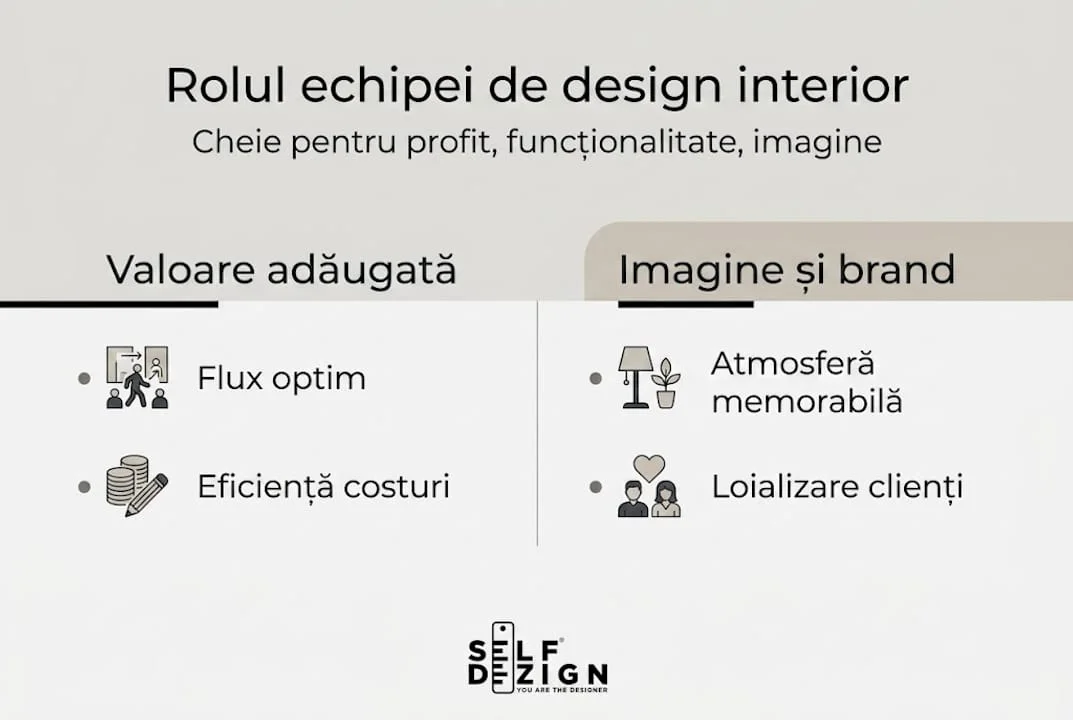
Interior design as a vector of brand and customer loyalty
So far we have talked about efficiency and savings. But there is another dimension of interior design that is equally important for owners of HoReCa and commercial spaces: the ability to transform a space into a loyalty tool.
Good design increases customer loyalty and generates additional sales. Architects like Zaha Hadid and Patricia Urquiola have shown that spaces with strong personality become destinations in themselves, not just places where people consume a product. Customers return because they like how they feel in that space, not just for what they eat or buy.
The process by which an interior design team builds this emotional connection follows three essential steps:
- In-depth brand brief:The team identifies your brand's values, target audience, and differentiators. A family restaurant does not speak the same visual language as a cocktail bar for professionals, even if both use wood and exposed brick.
- Creating a coherent concept:Every element in the space, from floor materials to the type of lighting, serves the same message. Coherence is what makes a space memorable, not the price of finishes.
- Validation with real customers:Experienced design teams test the concept through real feedback before implementation, adjusting solutions so they resonate with the target audience.
"A memorable space is not the most expensive or the most photographed. It is the one that makes the customer feel they have found exactly what they were looking for, without knowing why."
Interior space brandingis more than logos on walls and company colors on furniture. It is about creating a coherent experience that communicates your brand values at every customer touchpoint. From the entrance to the restrooms, every design decision says something about who you are as a business.
Memorable spaces generate recurrence. A customer who had a pleasant visual and sensory experience will return and bring others. This recurrence is much more valuable than any marketing campaign because it comes from genuine desire.Interior design consultancyhelps you build this value systematically, not through intuition or passing trends.
What no one says about the role of the interior design team
We have seen the benefits and structure. Now let's talk about what is avoided in industry conversations.
The most expensive mistakes in HoReCa and commercial projects occur when design becomes an afterthought. That is, when you call the design team after you have signed the lease, approved the floor plan, and already bought some furniture. At that point, the design team can no longer optimize the space; they can only embellish it.
Investing in a competent design team involved from day one has a higher ROI than most rebrandings or marketing campaigns that companies in the industry undertake. Every design decision has an operational and a strategic component. Choosing furniture suppliers on your own because "it's cheaper" without consulting the team is the design equivalent of building a building without an architect: it works until it doesn't.
Professional tip:Involve the interior design team as early as the space negotiation phase, not after signing the contract.The coordination workflow of an interior projectshows that decisions made in the first 10% of a project's duration influence 90% of costs and final results.
How to leverage the expertise of an interior design team for your business
If after reading this guide you feel that your business would benefit from a more strategic approach to interior design, the next step is to talk to a team that understands both aesthetics and business objectives.
SelfDezign works with owners of HoReCa spaces, investors, and managers of commercial spaces in Romania and Europe, offering customized solutions from concept to implementation. Whether you needinterior design for officesor a complete strategy for a commercial space, our approach always starts from your real objectives, not from trends or standard formulas. You can explore theconsultancy guide for commercial spacesto understand what the process entails, or you can learn directly about the benefits of personalized design for your type of business. The first discussion costs nothing and can clarify more than months of individual research.