Holistic design: Efficient spaces and inspired people

When you hear "holistic design," you probably imagine hanging plants, scented candles, and a zen aesthetic. The reality is far more strategic and valuable than that.The wellness economy exceeds $6.8 trillionglobally by 2026, and a significant part of this growth comes precisely from how companies and real estate investors arrange spaces to support health, productivity, and efficiency. If you manage a commercial space, an office, or an investment property, holistic design is not an aesthetic luxury, but a business decision with measurable impact.
Main Ideas
|
Subject |
Details |
|---|---|
|
Holistic design explained |
It approaches the space as a system where everything is interconnected – people, function, environment. |
|
Demonstrated benefits |
Increases productivity, reduces pollution, saves energy, and supports health. |
|
Application guide |
Follow the recommended steps to successfully integrate holistic principles into any project. |
|
Differences from other styles |
Holistic design does not exclude trends but integrates them into a coherent, user-centered vision. |
What is holistic design and where does it come from
First of all, let's clarify the term. "Holistic" comes from the Greekholos, which means "whole." And this is not a simple academic etymology, but the key to understanding the entire philosophy behind this approach.
Holistic design represents an integrated approachthat considers the entire system, the interconnections between components, and the total impact on users, space, and the surrounding environment. It does not analyze elements in isolation, but views them as a functional ecosystem.
Think of a human body. You cannot treat just a painful knee without considering how the gait, posture, and musculature of the entire body contribute to that pain. Similarly, a holistic space is not designed merely with a selection of nice colors or isolated ergonomic furniture. It is built starting from a clear understanding of who uses that space, how they use it, what emotions and behaviors it must support, and what impact it has on the environment.
The basic principles of holistic design include:
- User integrationas the central point of any design decision
- Indoor environmental quality(air, light, acoustics, thermal)
- Sustainability of materialsand their long-term impact
- Spatial flowand how people move and interact with the space
- Visual and functional coherencebetween all elements of an interior
- Emotional and psychological impactof every design choice
This approach did not appear out of nowhere. It was gradually built from the intersection of architecture, environmental psychology, neuroscience, and sustainability principles. Today, the world's best-performing offices, highest-rated hotels, and most efficient medical clinics are designed precisely through this lens.

The concrete advantages of holistic design for businesses and spaces
Now that you know what it is, let's talk about what it does. Concretely.
Industry data shows that biophilic design increases employee productivity by15%, that spaces with adequate natural light generate an increase of8 to 13%in productivity, that materials with low volatile organic compound (VOC) emissions reduce indoor pollutants by20 to 40%, and that LED lighting can reduce energy consumption by50 to 75%compared to traditional solutions.
|
Holistic principle |
Measurable impact |
Applicable in |
|---|---|---|
|
Biophilic design (plants, light, water) |
+15% productivity |
Offices, commercial spaces |
|
Optimized natural light |
+8 to 13% efficiency |
Offices, clinics, retail |
|
Low-VOC materials |
VOC reduction 20 to 40% |
Any type of space |
|
Smart LED lighting |
50 to 75% energy savings |
All categories |
|
Managed acoustics |
Stress and distraction reduction |
Open-plan offices, HoReCa |
These figures are not abstract. If you have an office with 20 employees and productivity increases by 15%, it means your team is effectively working at the capacity of nearly 23 people. The economic calculation is obvious.
Understandingthe benefits of sustainability in interior designgoes beyond savings on energy bills. A healthy space reduces absenteeism, lowers employee turnover, and increases satisfaction among visiting clients. For real estate investors, holistically designed properties have higher resale and rental value, precisely because the market recognizes them as superior quality spaces.
A few benefits that space owners most frequently report:
- Reduction of maintenance costs through durable and efficient materials
- Improvement of user well-being and reduction in the number of sick leave days
- Increase in customer satisfaction in commercial and HoReCa spaces
- Significant energy savings through integrated lighting and ventilation solutions
Exploringbiophilic design and its real benefitsis an excellent starting point if you want to understand how nature integrated into interior architecture produces proven physiological and psychological effects.
Professional advice:Do not treat holistic design as a separate budget category. Integrate health, energy efficiency, and productivity goals from the concept phase, before any decisions on finishes or furniture. Subsequent correction costs three times as much.
Comparison between holistic design, biophilic design, and traditional style
Many space owners confuse holistic design with biophilic design or treat it as a synonym for natural aesthetics. The difference matters, especially when making investment decisions.
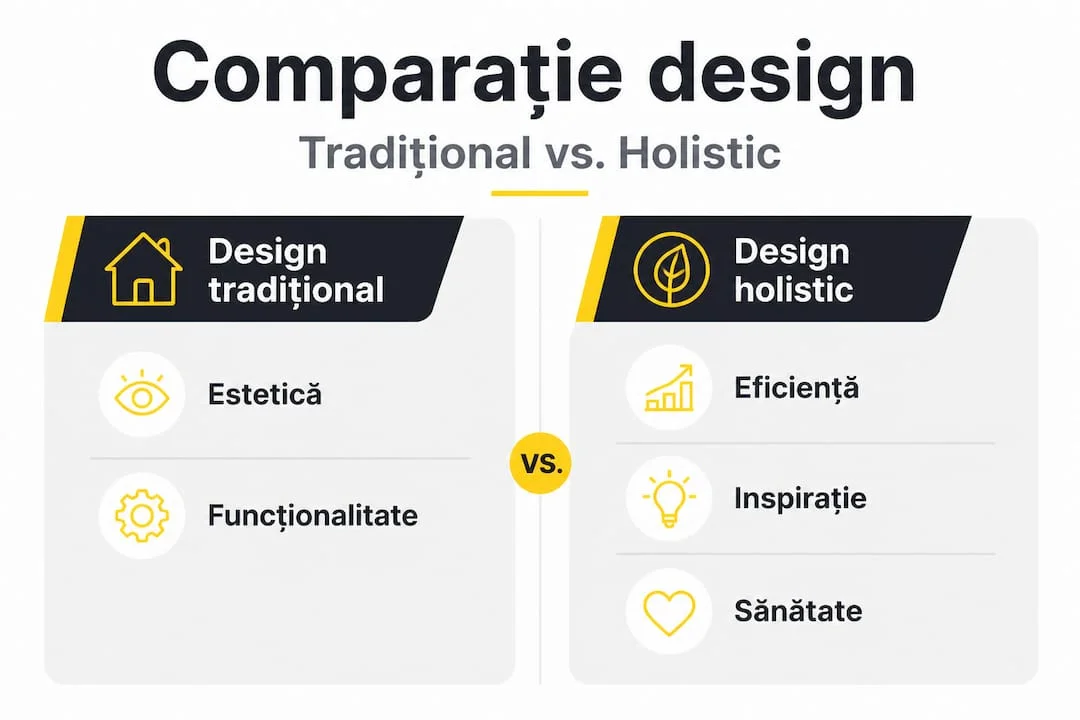
The contrasts are clear: traditional design emphasizes aesthetics and functionality, biophilic design brings nature indoors to reduce stress and improve connectivity with the environment, while holistic design integrates all of these and adds the dimensions of energy, spatial flow, health, and systemic coherence. Holistic minimalism, for example, is not austere, but intentional. And it does not reject the conventional, but integrates it according to purpose.
|
Criterion |
Traditional design |
Biophilic design |
Holistic design |
|---|---|---|---|
|
Main focus |
Aesthetics and function |
Nature and human connection |
Integrated system and total impact |
|
Materials |
Anything, according to trends |
Natural, organic |
Sustainable, healthy, durable |
|
Energy and flow |
Rarely considered |
Partially considered |
Central to design |
|
User health |
Secondary |
Important |
Top priority |
|
Adaptability |
Average |
Hello |
Elevated |
|
Suitable for |
Classic residential spaces |
Offices, spa, premium retail |
Any type of space with clear objectives |
It is important to understand that the difference between biophilic and holistic design is not about hierarchy, but about scope. Biophilic is a valuable component of holistic design, not its competitor. A space can be biophilic without being holistic, but a truly holistic space will inevitably integrate biophilic principles as well.
Followingmodern interior design trends for 2025 and 2026, you notice that the boundary between these approaches is becoming increasingly fluid. Clients no longer ask for "something beautiful," but for spaces that truly work for the people who use them.
How to apply holistic design: Steps and recommendations for your spaces
You already know what it is and what it does. Now let's see how to apply it concretely, whether you are working on an office, a commercial space, or a residential property.
A correctly integrated approach always starts from a deep analysis of the context, not from an aesthetic selection. Here are the essential steps:
- Analyze the real needs of the users.Before anything else, understand who will use the space, how, at what times, and for what purposes. A law office has completely different needs than a creative studio, even if both can benefit from holistic design.
- Define functional and health objectives.Do you want to increase concentration? Reduce stress for waiting clients? Optimize energy consumption? These objectives must be clear before making any design decision.
- Evaluate the existing indoor environmental quality.Check the levels of natural light, air quality, acoustics, and temperature. These are measurable parameters that will guide your decisions.
- Select materials and finishes with low impact.Choose materials with ecological certification, low VOC emissions, and proven durability. Consultingthe steps for personalized residential designcan provide you with a useful methodological framework.
- Design the flow of light and energy.Understand how natural light enters the space throughout the day and optimize artificial lighting to complement, not replace it.Choosing the right lightingis one of the most powerful levers for transforming an interior, with a direct impact on well-being and energy efficiency.
- Monitor and adjust after implementation.Holistic design does not end at the inauguration. User feedback, energy consumption measurements, and analysis of behavior in the space are all tools for continuous calibration.
Common mistakes we often see:
- Choosing holistic elements based exclusively on trends, without an analysis of the real context
- Ignoring acoustics, which is often the most underestimated factor of discomfort in office spaces
- Treating sustainability as a checklist, not as an integrated philosophy
- Neglecting the post-implementation monitoring phase
Professional advice:Don't start a holistic project with the question "what do I like?", but with the question "what does this space need to do for the people who use it?" The answer to the second question inevitably contains the answer to the first.
Why holistic design is (still) underestimated and how to truly benefit from it
Here's a perspective you probably haven't heard: the fact that more and more people talk about holistic design doesn't mean more and more people are truly benefiting from its potential.
The problem isn't a lack of information. It's the mindset with which the project is approached. Many entrepreneurs and investors allocate a budget for "holistic design" and settle for a selection of plants, a few natural materials, and an earthy color palette. They check off a list of ingredients without following the recipe. The result looks good in photos, but doesn't produce the changes in productivity, energy, and health that the authentic approach promises.
Holistic design becomes a real strategic investment only when it starts from a deep understanding of business objectives. A restaurant that wants to increase table turnover needs a completely different design than one that wants to extend the customer experience. Both can be holistic, but in radically different ways. The same principle applies to a start-up office versus a medical practice.
Those who truly benefit from holistic design treat the space as a business tool, not as an aesthetic frame.The benefits of personalized interior design for businessesgo far beyond the visual image. They include reducing operational costs, increasing employee and customer retention, and a real competitive advantage over spaces designed according to standard formulas.
What differentiates those who get results from those who don't? The answer is simple: involving a designer or a team that understands the specific context of your business, not one that applies a generic aesthetic solution renamed "holistic." Words cost little. Methodology costs a bit more, but it produces results.
Transform your space with personalized holistic interior design
If you've made it this far, holistic design probably no longer seems like a vague concept related to aroma and plants. It means productivity, health, energy efficiency, and a real competitive advantage for your business. The SelfDezign team works exactly with this perspective, fromprofessional office designto commercial projects, HoReCa, and residential spaces in Bucharest and Europe. We don't apply standard formulas and don't follow trends for the sake of trends. We understand your specific context, the real objectives of the project, and build a concept that works for you in the long term. If you want to know concretelywhat the practical steps for a business look like, you'll find a useful guide there to clarify your priorities before the first step.