
The role of the interior design concept in personalizing business spaces

Many entrepreneurs and project managers end up confusing interior aesthetics with design strategy. They choose colors, materials, and furniture based on personal preferences or what is trendy, and later wonder why the space does not function, does not sell, or does not communicate anything clearly. The truth is thatthe interior conceptrepresents the initial phase that transforms the client's needs into a structured strategy, not a collection of beautiful ideas. In this article, you will understand what an interior concept truly is, what steps are involved in building it, and what real impact it has on a business space or a medical clinic.
Main Ideas
|
Subject |
Details |
|---|---|
|
The foundation of any successful project |
The interior concept establishes the strategic and functional direction of the layout. |
|
Authentic personalization |
It allows each business or clinic to reflect its own identity and achieve maximum performance. |
|
Impact on efficiency and safety |
Correct application of the concept reduces operational and medical risks, as statistically proven. |
|
Adaptation to trends |
Integrating minimalism and modern technology ensures a current and competitive space. |
What is the interior design concept and why it matters
The interior concept is not a moodboard with inspirational images, nor a list of preferred materials. It is the backbone of the entire project, the strategic document that justifies every design decision before you buy a single object or paint a single wall.
Think of the difference between a recipe and a list of ingredients. You can have all the ingredients in the world, but without a recipe, without proportions and without order, the result will be unpredictable. The same principle applies in design. Without a structured concept, you spend budget on elements that do not dialogue with each other and that serve no clear objective.
A well-defined concept includes several essential elements:
- Project brief: understanding business objectives, target audience, and technical or legal constraints
- Visual moodboard: a tool for aligning expectations, not just a collage of pretty pictures
- Color palette and materials: chosen with logic, not personal taste
- Spatial planning: circulation flows, functional zoning, ergonomics
- Conceptual sketches: the first graphic representations of proposed solutions
The value of interior designdoes not lie in the beauty of the surface, but in how well the space solves the real problems of those who use it daily. Andthe benefits of interior design for businessesbecome visible precisely when there is a solid concept at the foundation of the project.
An interior concept transforms the client's needs into a structured strategy through briefing, moodboards, and spatial planning.Without this stage, the project risks becoming a collection of momentary solutions, not a coherent vision.
Once you understand why this concept matters, let's see what stages it consists of and what the essential steps are.
The fundamental steps in creating an interior concept
The process of creating the concept is not linear in the rigid sense of the word. It is iterative, meaning you go back, adjust, and validate at each stage. That is precisely what makes it effective.
- The initial briefing: The first structured meeting where business objectives, audience, indicative budget, and technical constraints are clarified. It is not an informal conversation, but a tool for systematic information gathering.
- Research and context analysis: Studying competitors, analyzing user flows, understanding the legal and technical requirements specific to the type of space (office, clinic, commercial space).
- Visual concept development: Creating the mood board, color palette, and initial zoning sketches.Key methodologies include iterative briefing, mood boards, color palettes, ergonomic planning, legal standards, and Evidence-Based Design (EBD).
- Spatial planning: Defining functional zones, circulation flows, and relationships between spaces. Ergonomics is not optional, but a design criterion.
- Concept validation and adjustment: Presenting solutions to the client, collecting feedback, and adjusting based on real priorities, not momentary aesthetic preferences.
- Transition to technical design: Only after concept validation does one move on to technical plans, material specifications, and implementation coordination.
|
Stage |
Description |
Tools |
|---|---|---|
|
Briefing |
Collecting objectives and constraints |
Structured questionnaire, meeting |
|
Research |
Context, competition, regulations analysis |
Documentation, site visit |
|
Visual concept |
Aesthetic and functional direction |
Mood board, sketch, color palette |
|
Spatial planning |
Zoning, flows, ergonomics |
2D plan, 3D simulation |
|
Validation |
Alignment with the client |
Presentation, iterative feedback |
|
Technical design |
Execution plans |
CAD, technical specifications |
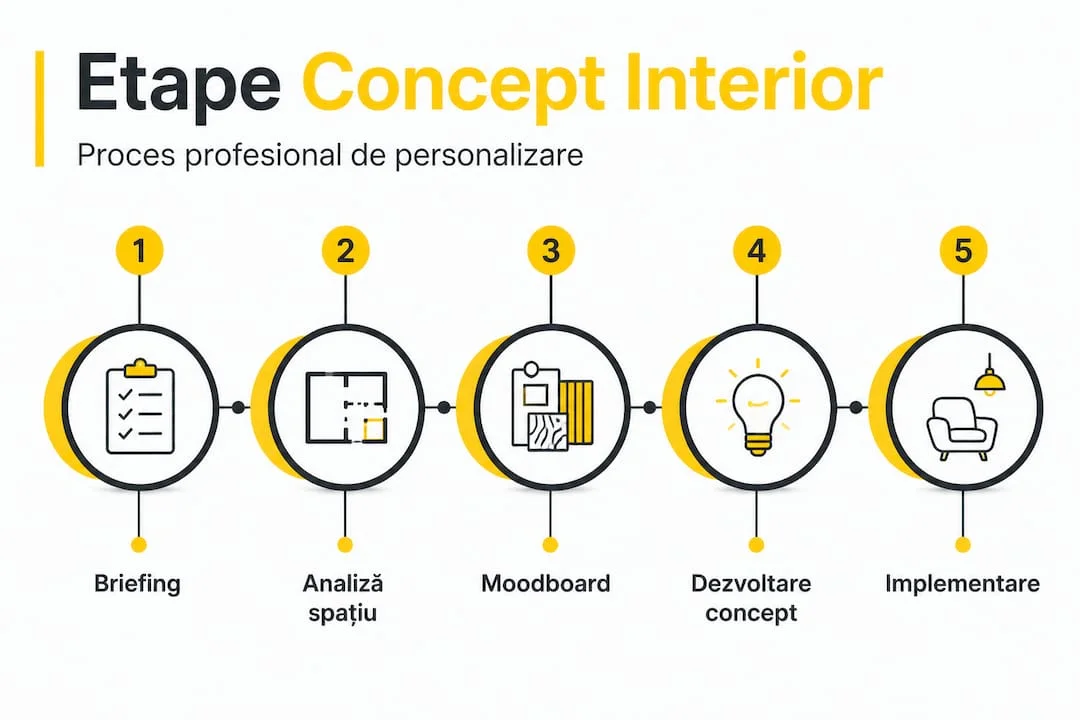
Key steps of commercial designfollows a similar logic, whether we are talking about a restaurant, a showroom, or a medical office. The structure adapts, but the process remains solid.
Professional advice:Do not treat the briefing as a formality. A poorly completed briefing at the start will generate at least two additional rounds of revisions later, with time and budget costs. Investing a few hours in clarifying objectives at the beginning saves entire weeks throughout the project. Discoverthe practical steps for custom interior designto understand how this process works in practice.
Knowing the structure of concept development, it is essential to analyze the value it brings to the personalization and differentiation of the space.
The impact of the interior concept on the personalization and differentiation of spaces
A commercial space and a medical clinic have radically different needs, but both benefit enormously from a well-defined concept. The difference lies in how the concept is calibrated to the specifics of the activity.
|
Criterion |
Commercial spaces and offices |
Medical clinics |
|---|---|---|
|
Main objective |
Conversion, productivity, brand identity |
Safety, operational efficiency, patient comfort |
|
Personalization |
Visual branding, customer experience, commercial flow |
Clinical ergonomics, EBD, universal accessibility |
|
Materials |
Aesthetics + durability |
Hygiene + durability + regulatory compliance |
|
Lighting |
Ambient, accent, functional |
Light quality, WELL v2 standards |
|
Technology |
Smart office, AV, presentation |
Telemedicine, patient flow management |
For commercial spaces, a coherent concept means that a client walks in and immediately feels that your brand is different. They don't just see a store or an office. They feel an identity.Branding and interior personalizationworks when the concept guides every decision from the type of flooring to the temperature of the light.
For clinics, the stakes are even higher.Evidence-Based Design (EBD) optimizes the spaceFor clinics, the WELL v2 standard regulates light and air quality according to the activities carried out. It is not about aesthetics. It is about medical performance and patient safety.
A few concrete benefits of a well-applied customized concept:
- Reduced orientation timefor patients or clients through intuitive wayfinding systems integrated into the concept
- Increased staff satisfactionthrough ergonomic workspaces, well-defined break areas, and lighting appropriate to the activity
- Brand consistencyacross all surfaces, from the entrance to the back-office area
- Compliance with regulationswithout aesthetic compromises, by integrating legal requirements into the concept from the briefing phase
Biophilic design reduces stressand increases space efficiency, a finding validated in clinic and hospital projects across Europe. Plants, natural light, and materials with natural texture are not decorations; they are functional tools.
Professional advice:If you are working on the design or renovation of a medical clinic, explicitly request that EBD be part of the designer's methodology. It is not a luxury option; it is the professional standard that differentiates a functional practice from one that is truly efficient and safe.Space transformation through conceptbegins precisely with this alignment between medical objectives and design decisions.
Next, we will focus on current trends and practical tips for maximizing the interior concept.
Trends and best practices for 2026 in developing the interior concept
The world of interior design for business is changing rapidly. If a few years ago minimalism was an aesthetic choice, today it has become a functional necessity. Visually cluttered spaces tire users and reduce productivity.
The main directions shaping interior concepts for 2026:
- Functional minimalism: Less, but better chosen. Every element in the space has a functional and aesthetic justification. You do not decorate for the sake of decoration.
- Integrated sustainability: Not as a PR element, but as a design decision. Certified materials, energy efficiency, modular and reusable furniture.
- Discreet technology: Building Management Systems (BMS), telemedicine systems integrated into the wall, smart office solutions that do not dominate the aesthetics of the space but invisibly support it.
- Spatial flexibility: Spaces that can be quickly reconfigured for different uses, a lesson the pandemic definitively imposed across all sectors.
- Biophilic design as a standard: Maximized natural light, organic materials, and green areas are no longer exceptions; they are basic expectations.
Trends from 2025-2026confirm this convergence:functional minimalism, sustainability, and discreet technologydominate design directions in European professional spaces.
And the data from the medical field speaks clearly:Correct design through EBDcan reduce infections by up to 45%, and proper furniture spacing decreases airborne infection risk by 60%. These are not abstract figures, but arguments for treating the interior concept as an investment in your clinic's operational safety.
Key statistic: A 45% reduction in infections through correct design equates, in the case of a medium-sized clinic, to hundreds of hours of saved staff time and a reputation protected from avoidable risks.
Followcurrent interior design trendsto always stay up to date with what the market is changing.
Professional tip:When updating the concept of an existing space, don't throw away everything that exists just to be "modern." Flexibility means identifying which elements can be adapted, not replaced. A good concept plans from the start zones and solutions that can evolve, saving significantly in future renovation or redesign phases.
After detailing the trends, a practical and different perspective follows on mistakes and the real value of the concept in interior projects.
What no one tells you: how you sabotage yourself without a well-defined interior concept
There is a common assumption among entrepreneurs and project managers: that a good designer will instinctively know what to do. That inspiration and aesthetic taste are enough. That you can jump straight into execution and solve problems along the way. This is perhaps the most costly illusion in the entire process.
I have seen office projects completely redesigned three months after opening, because no one had checked the actual user flows before positioning the glass walls. I have seen clinics with oversized waiting areas and circulation corridors so narrow that complying with accessibility standards required costly demolitions. I have seen commercial spaces with spectacular visual branding, but such poor acoustics that staff could not hold normal conversations with clients.
All these situations share the same common denominator: a superficial or non-existent interior concept. Special requirements, from anti-ligature constraints for psychiatry spaces to anti-COVID ventilation and the aesthetics-hygiene balance, cannot be solved on the spot, during execution. They must be anticipated in the concept.
When clarity and alignment are missing from the start, compromises appear. The contractor improvises, the supplier offers what they have in stock, the project manager approves quickly to meet the deadline. Each individual compromise seems minor. Their sum means a space that does not function as it should and will require costly interventions in the short term.
Documentation and planning always beat momentary inspiration. Not because inspiration doesn't matter, but because without a clear structure, inspiration has nowhere to land.The role of the commercial design consultantis precisely to create that structure before any visual decision is made.
A robust concept does not eliminate creativity. It disciplines it and makes it useful. The difference between a successful project and a costly one usually lies in a few weeks of work on the concept, not in the quality of materials or the talent of the contractor.
Professional guidance for the interior concept: next steps
If you have made it this far, it means you already understand that an interior concept is not a shopping trip for inspiration, but a strategic process that directly influences the success of your space. At SelfDezign we work with entrepreneurs and project managers from Romania and Europe to build exactly this type of solid foundation, whether your project is anoffice space, a medical clinic, or a commercial space. You can explore thecommercial interior design consultancy guideto understand how the collaboration works, or you can go through the practical steps for business projects to clarify what best fits your situation. A preliminary discussion can clarify priorities and show you exactly where to start.