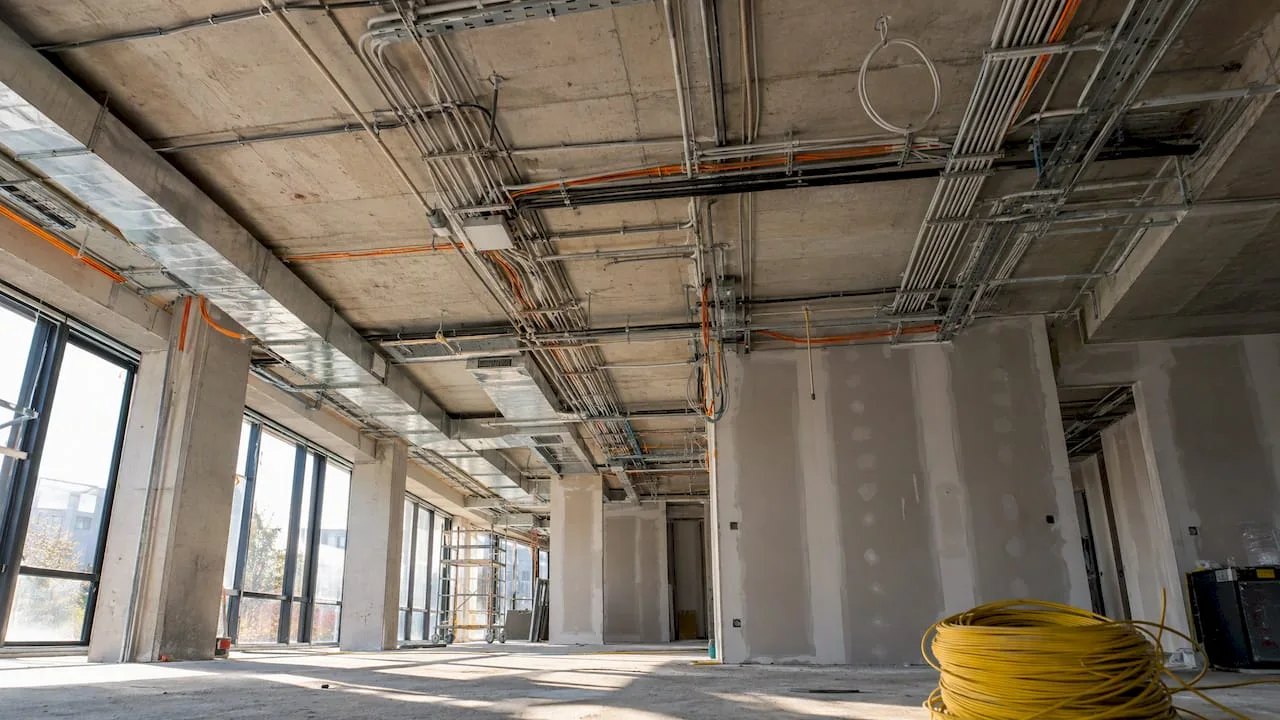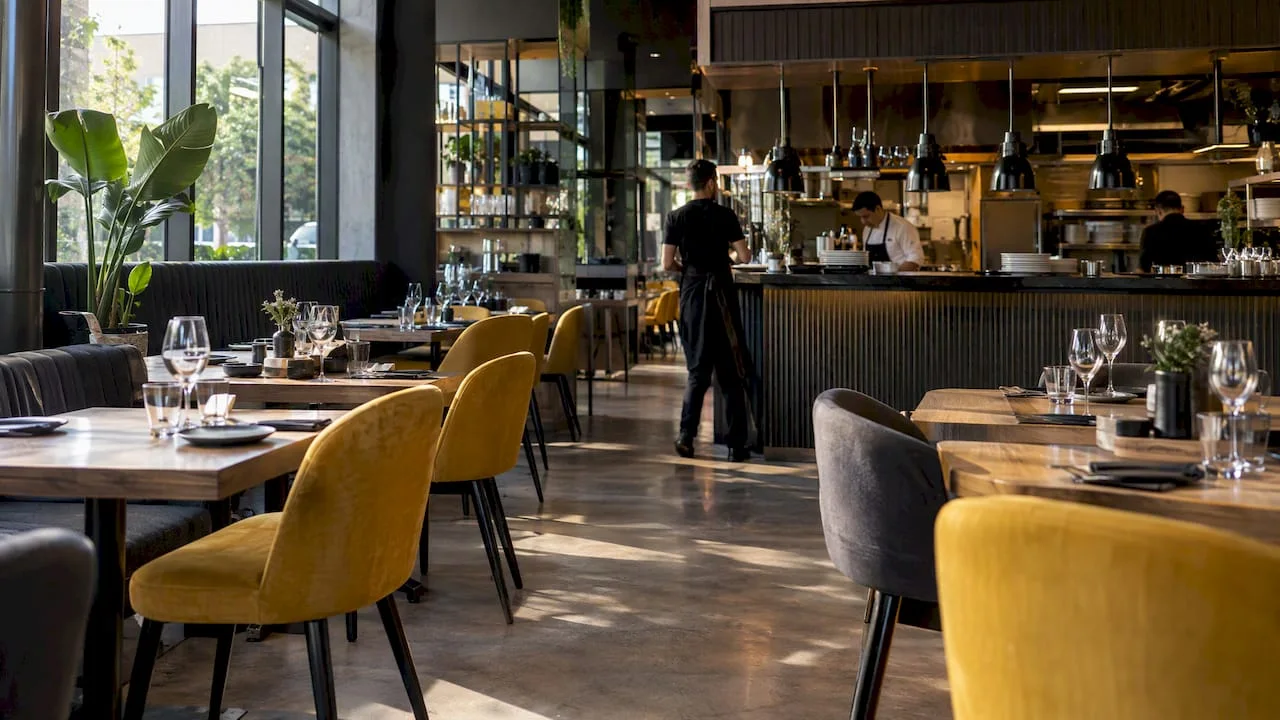
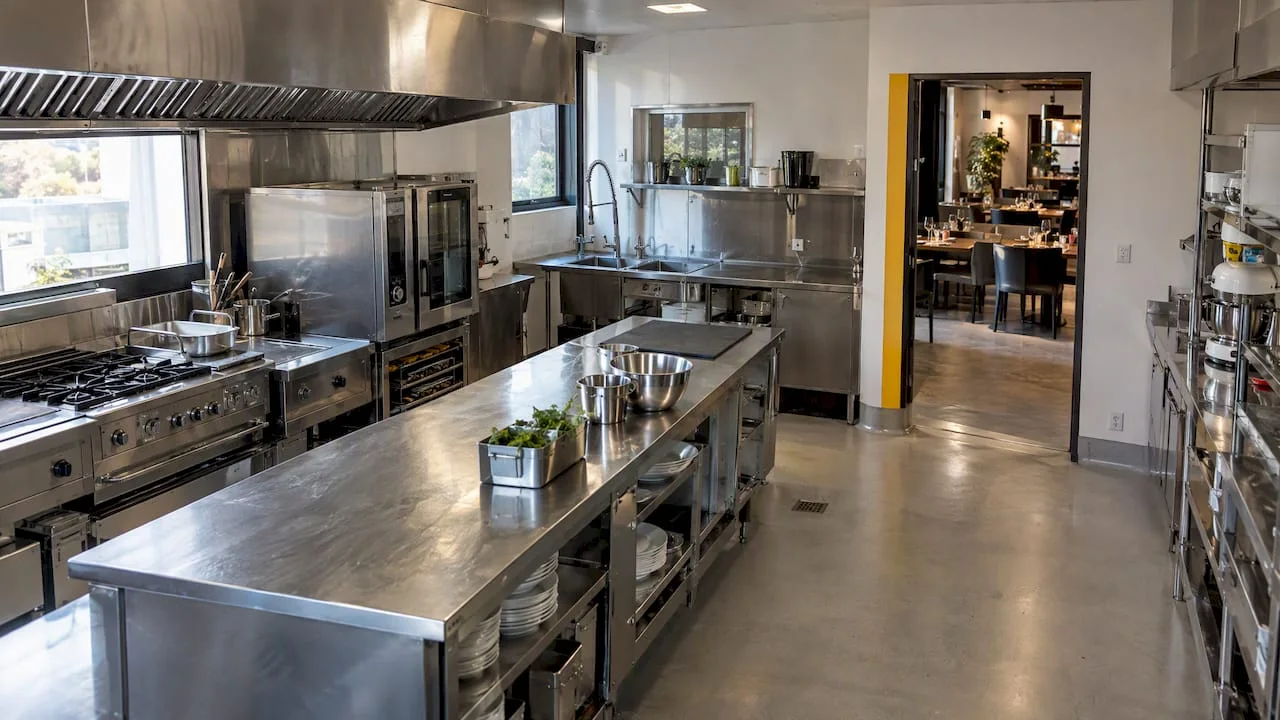
A durable finish in a restaurant, bar or hotel is not the one that looks sturdy in the showroom, but the one that withstands the specific combination in your space: water, grease, detergents, thermal shocks, dragged chairs, heels, trolleys and harsh daily cleaning. The right choice is made zone by zone, not for the whole venue, and starts from the material's technical datasheet, not from the sample. Below you will find what the law requires for food areas, which finishes work in the kitchen, at the bar, in the dining room and in the restrooms, which classifications to look for in the documentation, and where most money is lost.
SelfDezign
Suitable finishes for each zone
SelfDezign designs and coordinates HoReCa spaces, adapting the concept and the solutions to the context and objectives of the project.
In short
- Durability is defined zone by zone. The kitchen, the bar, the dining room and the restrooms face different stresses, so they need different finishes, even if you keep the same visual language.
- In food areas, the law decides before taste does. Floors and walls must be impervious, non-absorbent, washable and non-toxic, in line with Regulation (EC) No 852/2004.
- Read the classifications, not just the commercial description. The slip resistance class (R10-R13, per DIN 51130), the use class (33 for heavy commercial traffic, per EN ISO 10874), the UPEC classification and the reaction to fire (class per EN 13501-1) say more than "durable" on a label.
- Installation accounts for half of the durability. Good tiling laid with the wrong adhesive cracks or comes loose.
- Maintenance can ruin an excellent finish. The wrong detergent attacks resin, even if the floor was the best performer in the offer.
What "durable" really means in a HoReCa space
The word "durable" appears on almost every product for restaurants, from ceramic tiles to laminates and upholstery. The problem is that, on its own, it means nothing. A material can be very scratch-resistant and still swell at the first prolonged contact with water. Another can withstand water perfectly and stain irreversibly from oil or red wine.
That is why, before comparing products, it is worth translating "durable" into concrete stresses. In a HoReCa space, these are usually seven:
- Mechanical stress: heavy traffic, dragged chairs, trolleys, dropped dishes and heavy objects.
- Moisture and water: daily jet washing, spills, condensation, permanently wet zones.
- Chemical agents: grease, food acids (vinegar, citrus, wine), professional detergents and disinfectants.
- Temperature variations: hot water, steam, ovens, but also cold rooms.
- Slipping: wet or greasy floors, where the risk of accident is real for staff and customers.
- Fire: the reaction-to-fire class is set by the project's fire safety scenario.
- Hygiene: the surface must be easy to clean and must not retain dirt in pores, joints or corners.
A good concept for a HoReCa space ignores none of them, but does not treat them the same everywhere either. The dining room of a bistro does not need the floor of an industrial kitchen. The kitchen, on the other hand, allows no aesthetic compromises. If you want an overview of the types of spaces and their needs, the complete guide to HoReCa spaces is a good starting point.
What the law requires for food areas
For kitchens, laboratories, preparation and storage areas, you do not choose by preference. Regulation (EC) No 852/2004 on the hygiene of foodstuffs requires that, in rooms where food is prepared, treated or processed, floors and walls be made of impervious, non-absorbent, washable and non-toxic materials, easy to clean and, where necessary, to disinfect.
The consolidated text of the regulation also contains a requirement often forgotten at design stage: ceilings and overhead fittings must be constructed and finished so as to prevent the accumulation of dirt and to reduce condensation and the growth of mould. In other words, durability does not stop at the floor. A cheap tiled ceiling above a cooking area can become, within a few months, the main problem at an inspection.
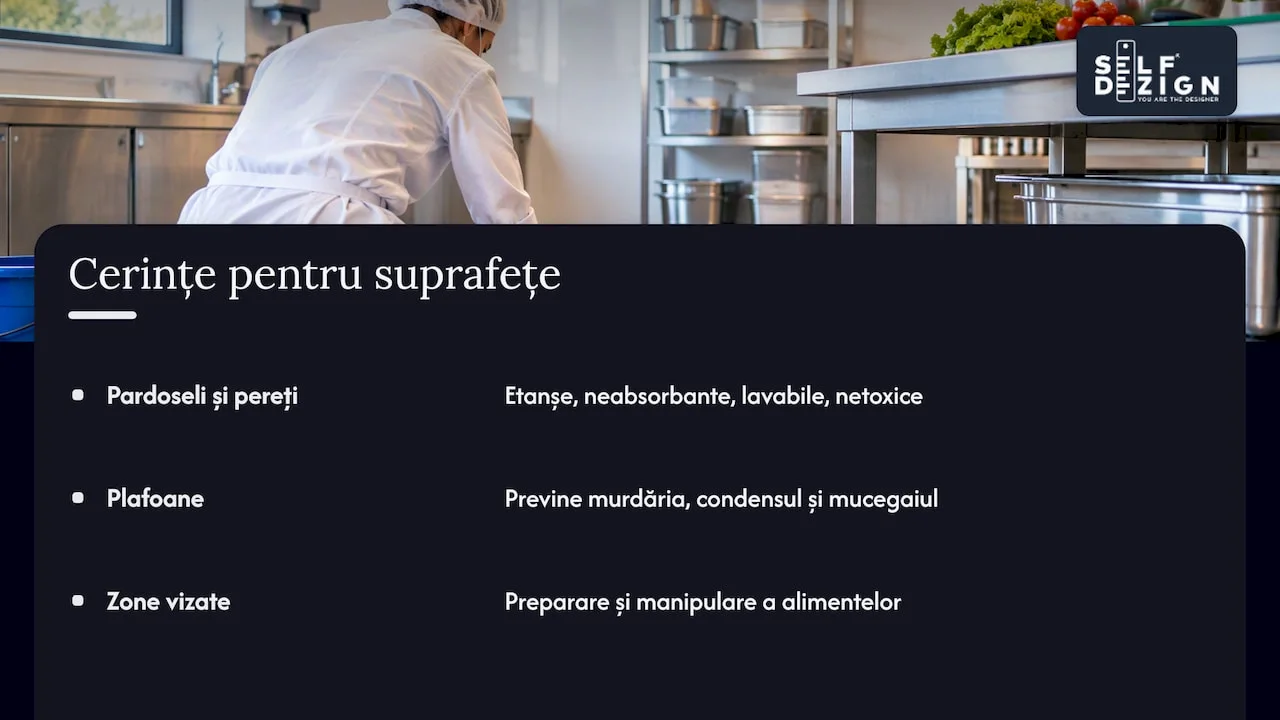
Important to remember: these requirements apply to food preparation and handling areas. Dining rooms have more freedom, which lets you build the atmosphere where the customer perceives it, without sacrificing compliance behind the service door. In practice, when opening a venue you will have to show the competent authorities, DSP (public health directorate) or DSVSA (veterinary and food safety directorate) as applicable, that the chosen materials meet these conditions. The datasheets and declarations of performance of the products are the documents that support you.
Durable finishes, zone by zone
The table below summarises the logic we apply when designing a HoReCa space. It is not a fixed recipe, but a map of priorities.
|
Zone |
Main stresses |
Suitable floor finishes |
Suitable wall finishes |
|---|---|---|---|
|
Hot kitchen |
water, grease, temperature, detergents, slipping |
non-slip epoxy or cement-polyurethane resins, technical porcelain stoneware |
ceramic tiles with epoxy joints, washable hygienic panels |
|
Storage and cold rooms |
cold, condensation, trolleys |
resins formulated for thermal shock, porcelain stoneware |
washable panels, finishes that do not retain moisture |
|
Dishwashing area |
constant water, chemicals, steam |
resin with integrated drain, non-slip stoneware tiles |
ceramic tiling over the full height of the wet zone |
|
Bar |
liquids, sugar, alcohol, citrus, impacts |
porcelain stoneware, resin, commercial LVT behind the bar only with caution |
countertops in composite stone, HPL, stainless steel |
|
Dining room |
traffic, chairs, stains, aesthetics |
porcelain stoneware, commercial-grade LVT, treated parquet in controlled zones |
washable paints, wall panelling, decorative HPL |
|
Restrooms |
water, disinfectants, hygiene |
non-slip porcelain stoneware |
ceramic tiling, large-format tiles with minimal joints |
|
Hotel rooms |
moderate traffic, luggage, quick maintenance |
LVT, commercial-grade carpet, laminated parquet |
washable paints, vinyl wallpaper |
The kitchen: where aesthetics come after hygiene
In a professional kitchen, the floor works the hardest. Resin systems are a frequent choice because they form a continuous surface, without joints where dirt can gather. For example, a two-component epoxy system such as Mapefloor I 300 SL can be applied self-levelling or in several coats, with a smooth or non-slip surface. Manufacturers also have dedicated ranges: Mapei's documentation on resin floors for the food industry describes epoxy and cement-polyurethane systems designed specifically for this type of space.
A well-written specification matters as much as the product. A model of a specification for a non-slip epoxy floor calls for, among other things, a three-component product with non-slip granules and a sanitary approval. These are the details that must appear in your project documentation, not only in the contractor's offer.
Technical porcelain stoneware remains a solid alternative, especially when the budget or the execution schedule does not allow a resin. The condition is that the joints are treated with epoxy grout and the junction between floor and wall is rounded, so that no hard-to-clean corners remain.
One detail we always check: sudden temperature differences. The area next to the ovens, the dishwashing area with boiling water and the cold room door put the material in very different situations a few metres apart. Many "durable" materials are not formulated for such variations, so resistance to thermal shock must be looked for explicitly in the datasheet.
Walls and ceilings in service areas
On walls, the rule is simple: washable up to a height that covers all splash zones, with no porous surfaces and no decorative details that collect grease. Ceramic tiles remain the standard, but the tiling must be installed correctly. For high-traffic areas and difficult substrates, a class C2 adhesive under EN 12004 provides the necessary bond, while in wet areas or on heated floors, deformable adhesives are used (class S1 or S2 under EN 12004), which absorb stresses without cracking the tiling.
For ceilings, choose washable, moisture-resistant systems, with no open cavities above cooking areas. Light fittings and ventilation grilles must be integrated so that they can be cleaned, not just replaced.
The dining room and the bar: durability that looks good
In the dining room, durability is negotiated with atmosphere. Here the customer touches the tables, looks at the floor and leans on the bar. Materials must withstand traffic and stains, but also build the identity of the place.
For floors, large-format porcelain stoneware and commercial-grade LVT are the most balanced options. If you are hesitating between warm floors, our comparison LVT vs parquet shows where each one works and where it fails. Natural wood can appear in the dining room, but in controlled zones, away from service routes and from the entrance from outside.
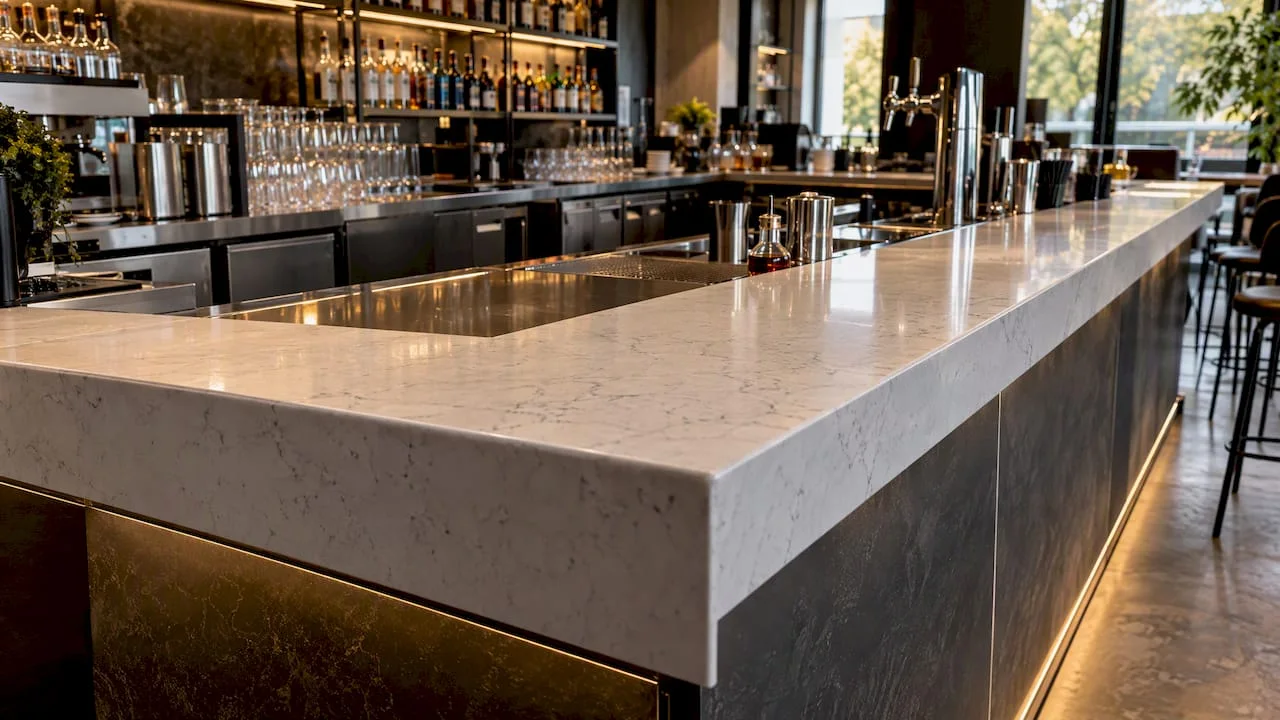
At the bar, the countertop is the most heavily used element in the whole space: liquids, citrus, alcohol, knocks from glasses and knives. Composite stone, stainless steel and HPL laminates are frequent choices. HPL has evolved a lot: some manufacturers offer laminates with a real metal surface, which bring character without the fragility of solid metal. For bar fronts and furniture, it is also worth reading the HoReCa furniture guide, because furniture finishes suffer as much as the floor.
Upholstery is often the weak link. Choose contract-grade textiles, with stain-resistant treatment and removable covers where possible. A beautiful banquette that cannot be cleaned becomes, within a few months, the most visible sign of wear.
The classifications you need to read in the datasheet
The commercial description says "durable". The classification says how durable and against what. These are the codes we look for when comparing products for a HoReCa project, as they also appear in the technical specifications manual for European Commission buildings:
|
Classification |
What it measures |
What to look for in HoReCa |
|---|---|---|
|
R10-R13 |
slip resistance of the floor |
higher classes in kitchens and wet areas, lower classes acceptable in the dining room |
|
Use class (e.g. 33, EN ISO 10874) |
traffic intensity, for resilient, textile and laminate floors |
33 for heavy commercial traffic; residential products have no place here |
|
UPEC |
wear, indentation (loading), water, chemical agents |
high scores for E and C in service areas |
|
Bfl-s1 (EN 13501-1) |
reaction to fire of the floor |
the required class is set by the project's fire safety scenario |
|
EN 13813 |
the standard for screeds and floor materials |
reference for resin systems and screeds |
|
C2 (EN 12004) |
performance of the tiling adhesive |
recommended minimum for tiles in high-traffic areas |
You do not have to become a specialist in standards. You only have to ask, for each proposed material, for the datasheet and the declaration of performance, and check that the figures match the zone where it will be installed. If a supplier cannot provide these documents, you already have your answer.
The mistakes that cost the most
The most expensive mistakes are not visible on opening day. They appear after a few months, when the venue runs at full capacity and any intervention means a temporary closure.
- Residential products in commercial spaces. They are cheaper to buy, but the technical specifications for buildings explain why the use class matters: a product designed for a home does not have the class 33 required for heavy commercial traffic and wears out faster. The real cost is not the new material, but the days when you do not sell.
- A single finish for the whole venue. Either you over-specify the dining room, paying for a durability you do not need, or you under-specify the kitchen.
- Ignoring the installation. Detachment and cracks often come from the adhesive, the screed or the joints, not from the tile.
- Choosing from a sample. A 20 x 20 cm sample on the supplier's desk does not tell you what the floor looks like after hundreds of washes.
- Decorative details in service areas. Profiles, deep joints and pronounced textures collect grease and complicate cleaning.
For a complete evaluation method, our guide to choosing finishes details the criteria we use before any decision.
Maintenance is part of durability
A finish is durable only under the conditions for which it was tested. And one of those conditions is the way it is cleaned. Mapei's documentation on resin floors shows that the resin system is chosen according to the chemical agents it comes into contact with, including acidic substances. Clean only with the products indicated in the system's datasheet.
What this means in practice:
- Ask the supplier for the maintenance instructions for each finish, in writing, at handover of the works.
- Pass them on to the cleaning team, do not leave them in the project file.
- Check the compatibility of the detergents you already use against the datasheets of the new materials. If you are not sure, ask the finish manufacturer or the professional cleaning product supplier directly, before first use.
- Schedule periodic inspections of the joints, silicone and junctions, because that is where degradation starts.
How we look at the durability of a HoReCa space
For us, a durable finish is not a product category, but a project decision. In many venues we see, the problem was not a weak material, but a good material put in the wrong place: a beautiful dining room floor laid on the waiters' route, an elegant countertop that cannot withstand citrus, a decorative ceiling above a steamy area.
That is why we start with how the venue works: where the staff move, where spills happen, where things are washed, what rhythm the service has at lunch and in the evening. Only then do we choose the materials, and we choose them so that durability supports the identity rather than replacing it. A restaurant does not have to look like an industrial kitchen to be durable. Every surface just has to be designed for what will happen to it.
We believe this effort shows over time. A space that ages well, without emergency repairs and without unplanned closures, is a space that works for the business, not against it.
— Toni
When it is worth getting a second opinion
If you already have a finishes offer or a project under way and are not sure that the proposed materials suit each zone, a consultancy with written conclusions gives you a clear assessment, at 500 lei for a 2-hour session, before you place an order. For a new restaurant, bar or hotel project, our HoReCa interior design team handles the concept, the technical design and the coordination of execution as a whole. If you live abroad and are preparing a HoReCa investment in Romania, SelfDezign Remote offers remote consultancy, from 450 EUR per session.
Sources
- Regulation (EC) No 852/2004 on the hygiene of foodstuffs, EUR-Lex
- Consolidated text of Regulation (EC) No 852/2004, EUR-Lex
- Manual of Standard Building Specifications, European Commission
- Resin floors for the food industry, Mapei
- Mapefloor I 300 SL technical datasheet, Mapei
- Ceresit CM 17, super flexible adhesive
- Specification: non-slip epoxy floor, Arhitectura.info