Site supervision: fee models and what it includes

There is no official tariff for site supervision: the price is negotiated in the contract, usually as a percentage of the investment value or as a daily rate. We found no current public benchmark, so we give no figures.
Before the price, it matters what kind of supervision you need. Three different things hide under the same word: the control required by law, the control done by the contractor, and the coordination that makes sure the space is built to the design. Below we separate them, show how the price is calculated and what to check in a quote.
In short
- The site supervisor represents the investor and is licensed by ISC, and Law 169/2026 requires that the works are checked by licensed site supervisors.
- There is no official tariff: the price is negotiated in the contract, as a percentage of the investment, a daily rate, a monthly sum or a sum included in the design fee.
- The price rises with the length of the works, the frequency of visits, the number of trades and the quality of the design the works start from.
- In an interior fit-out, design coordination checks something different from the site supervisor: details, finishes, dimensions, made-to-order furniture. One does not replace the other.
- A good quote states clearly how many visits it includes, which documents you receive, who is responsible and what happens if the works overrun.
Three roles hidden behind “supervision”
When you ask for “a quote for supervision”, you often get prices that cannot be compared, because each bidder understood something different. The site supervisor checks on your behalf that the works follow the design and the standards, the contractor checks its own crews, and the design coordinator makes sure the works follow the interior design.
The site supervisor is the licensed specialist, authorised by ISC, who checks the works are carried out correctly on behalf of the investor, meaning the developer or the beneficiary (Law 169/2026). The duties include knowing the design, taking part in checking the works and the determining phases, non-conformity reports, stopping the works when deviations or technical accidents occur, acting as secretary of the acceptance committee and drawing up the construction technical file. The ISC page on the supervisor's activity describes the same role, but it still cites Law 10/1995. ISC licenses site supervisors and keeps their public register.
The technical execution manager (RTE) is also a role required by law, but works on the other side of the table. ISC describes the RTE as an employee of the contractor, and Law 169/2026 says the RTE is an employee or subcontractor of the contractor. The RTE ensures the quality of the works from the builder's point of view. So the builder provides this role, not you.
Design coordination makes sure the works follow the interior design: dimensions, joint details, finish samples, the order in which the trades come in, made-to-order furniture. It is the beneficiary's choice and shows directly in the result, but it does not replace the site supervisor where the law requires one.
RoleWho they representWhen it appliesHow it is usually paidSite supervisorThe investorRequired by the Code; for works without a permit, confirm with the town hallA percentage of the investment, a daily rate or a monthly sumRTEThe contractorRequired by the Code, on the builder's sideEmployed or contracted by the builder, not by the investorDesign coordinationThe investor and the designAt the beneficiary's choice, mostly in interior fit-outsIncluded in the design contract, per visit or as a fixed sumWhen is a site supervisor mandatory?
Since 25 August 2026, the rule comes from the Code on spatial planning, urbanism and construction (Law 169/2026). The developer, meaning whoever finances and carries out the building works, ensures that the works are checked for correct execution by licensed site supervisors throughout the works. A developer can be an individual or a legal entity, public or private, and a beneficiary can take on this status. Failing to ensure this check by licensed site supervisors is an administrative offence. Many quotes and web pages still cite Law 10/1995 and Law 50/1991. The Code has replaced them.
For interior fit-outs, the useful question is whether your works need a permit, a notification or no formality at all. Law 169/2026 lists the works that need neither a permit nor a notification, outside protected areas. They include the repair or replacement of interior finishes and floors and the repair or replacement of interior installations. Technical rules and acceptance of the works remain mandatory. This rule does not apply in protected built-up areas and in monument protection zones. There, for buildings that are not listed monuments, these works need a notification and the written consent of the county culture service. For a listed monument, ask the culture service directly.
If you work on the structure or the facade, or change the use of the space, for example turning a flat into a medical practice or a former shop into a restaurant, ask the architect or the town hall's planning department before you budget. Some works, such as light non-structural partitions or certain changes of use, go through a notification, not a permit. For works without a permit, get a written answer from the architect or the town hall before you do without a site supervisor. We did not find an express exemption from a site supervisor for them in Law 169/2026. Even without a site supervisor, you need someone to check the works, and acceptance remains mandatory.
How is the price of site supervision calculated?
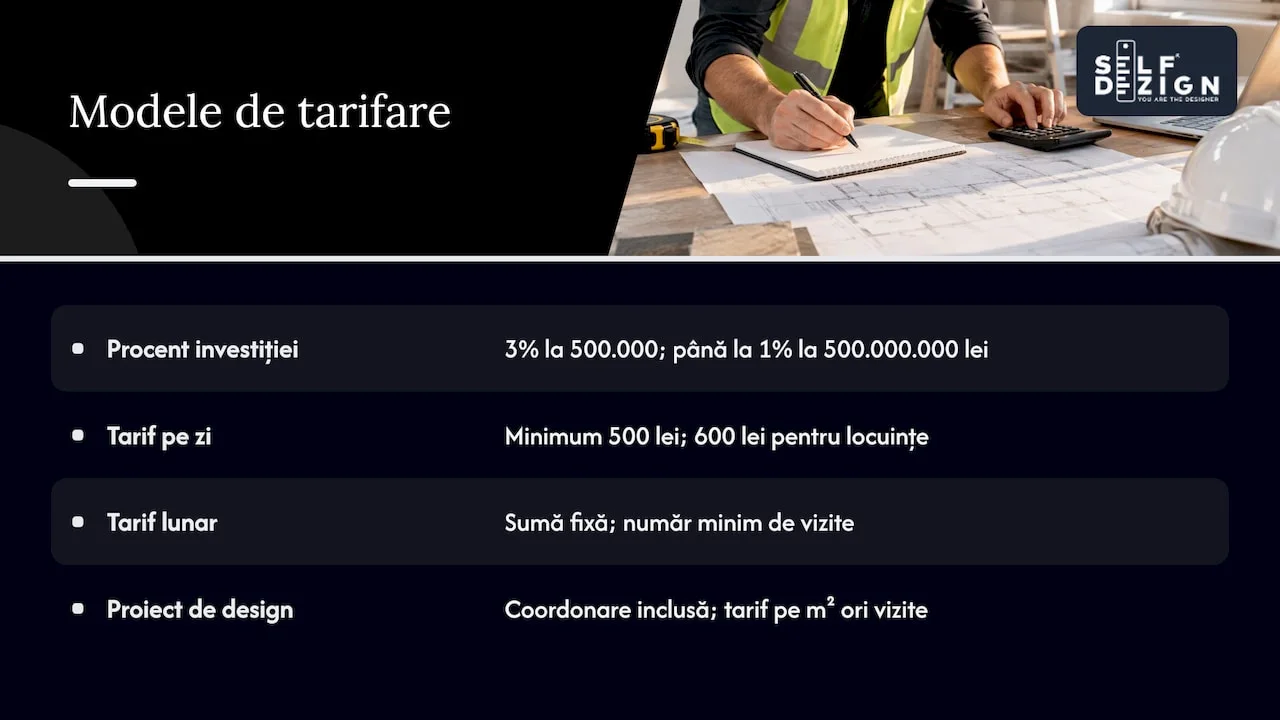
There are four pricing models. Each puts the risk in a different place, so it is worth knowing what you choose.
Percentage of the investment value
This is the classic model for site supervision. As a rule, the percentage falls as the investment value rises. The advantage is predictability. The risk appears when the investment value changes along the way: decide from the start whether the percentage applies to the value in the estimate or to the final value.
Daily or per-visit rate
A daily rate is calculated on the days of the supervision period and usually assumes daily presence on site. If you are offered a daily rate for visits only at the determining phases and for concealed works, ask what “a day” means: a one-hour visit or a full day on site.
Fixed monthly sum
On sites that last several months, you can negotiate a fixed monthly sum with a minimum number of visits. The budget is easy to follow, but a delay by the builder costs you directly: every extra month means another instalment.
Included in the design contract
In interior fit-outs, coordination of the works often comes with the design, either included in the price per square metre or as a separate stage with a set number of visits. We described how this cost is built up in the guide on the cost of site coordination for interiors. That guide covers the interior design fee, not site supervision.
Mind the VAT and old tariffs. Proposals by a professional association are not market prices and bind nobody. Ask for quotes explicitly with and without VAT, so you compare like with like.
Calculation examples
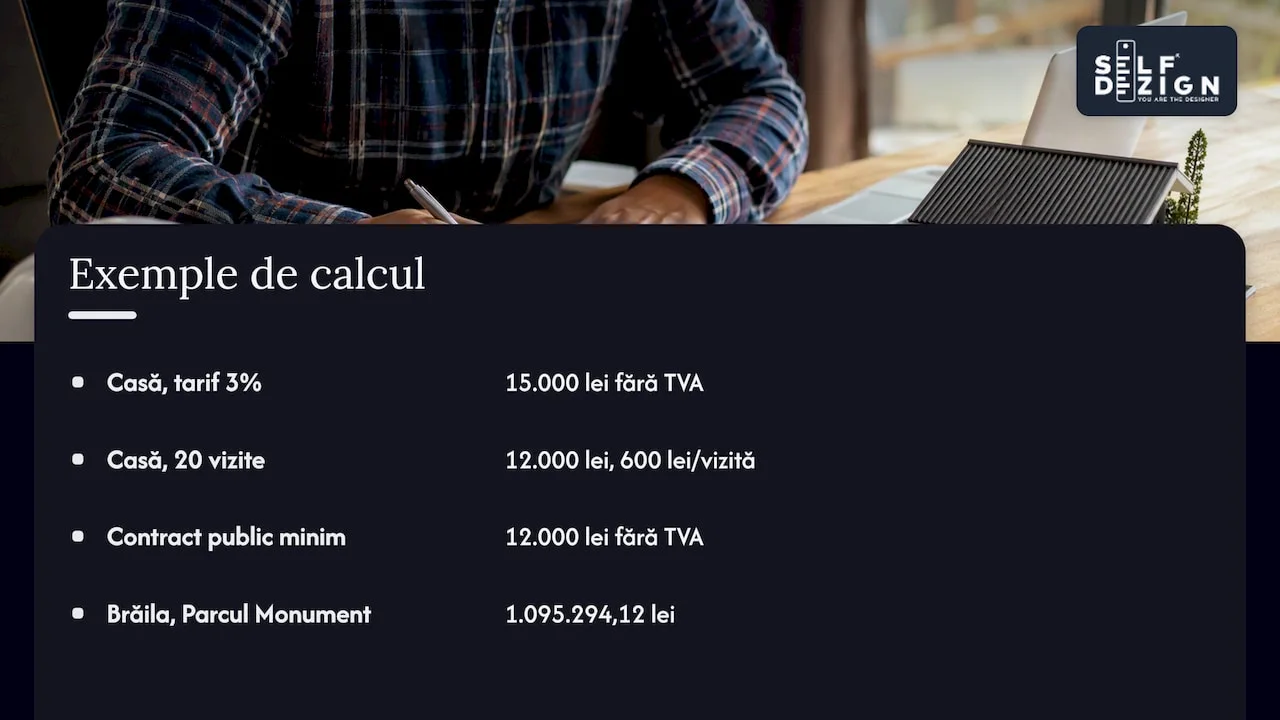
The examples below show how the pricing models compare. They are not quotes.
A house with a large investment and a long site period. Under the percentage model, the cost follows the value of the works. The daily rate cannot be compared directly with the percentage: the first is calculated on the length of the supervision, the second on the investment value. Ask the bidder for both calculations and the number of visits, not only the final sum.
A commercial fit-out without a permit. Say you are refurbishing a 200 m² space with no work on the structure and no change of use. Confirm with the town hall that the works need no permit and ask whether you are exempt from a site supervisor; we did not find an express exemption. In any case you need someone to check the works against the design. Here the cost is tied not to the value of the works, but to the number of visits, the acceptance stages and how complete the technical design is. For the full budget picture, see also how much it costs to remodel a commercial space.
What makes the supervision price rise or fall?
Two quotes for the same site can differ a lot, usually for concrete reasons:
- Length of the works. A site that runs for eight months instead of four costs more under any model, except the percentage of the investment.
- Frequency of presence. Daily presence, weekly visits and attendance only at the determining phases are three different services, with different prices.
- Technical complexity. The ventilation systems of a professional kitchen, the medical gases of a clinic or the data networks of an office call for specialised checks and, sometimes, several specialists.
- Quality of the design. A design with complete details reduces questions on site. When details are missing, the supervisor ends up making decisions on the spot, which means extra hours and extra risk. We explained why in the article on the role of technical details in design.
- Working hours. A restaurant or shop being fitted out at night, so it does not have to close, means visits outside normal hours.
- Distance. Travel is charged separately or included in the price. Ask from the start.
- Required documents. Written reports after each visit, photographs and signed minutes take time. They are worth paying for, but they must appear in the quote.
Supervision in an interior fit-out: a different logic
In interiors, the frequent mistakes are not about the strength of the building, but about a socket moved by ten centimetres that no longer lands behind the furniture, cladding fitted before the installation was tested, a finish swapped at the last minute because “it is the same, but cheaper”. Design coordination exists to catch these things while they can still be fixed.
In practice, well-done coordination covers:
- Handing the design over to the crews, explaining the sensitive points before the works start.
- Approval of samples of finishes, ironmongery and lighting before ordering.
- Stage checks: setting out the walls, installation routes before closing up, screed level, fitting of joinery.
- Resolving discrepancies between the design and the reality on site, with documented decisions.
- The snagging list at the end and acceptance room by room.
It is just as important that everyone works from the latest version of the drawings. A simple version discipline, with a single set of drawings in force, reduces rework. For the timeline of such a project, see also how long an office fit-out realistically takes.
What to check in a quote before you sign
A supervision quote is read like a liability contract. Before you sign, look for an answer to each point below:
- Exact role. Does it say “site supervisor” or only “supervision”? If you need a site supervisor, ask for the ISC licence and check that its field covers your works.
- Pricing model and basis of calculation. A percentage of which value, a daily rate for how many hours, a subscription for how many visits.
- Minimum number of visits and the mandatory moments: determining phases, concealed works, acceptance.
- Deliverables. Reports after each visit, photographs, minutes, attendance at acceptance, contribution to the technical file.
- Response time. How soon the supervisor comes if a problem stops the work.
- Extension. What happens to the price if the works take longer because of the builder.
- Travel and expenses included or invoiced separately.
- VAT, stated explicitly.
- Independence. The site supervisor represents you. Ask whether they have ties to the proposed builder.
- Liability. Under Law 169/2026, the parties carrying out the works are liable, according to their obligations, for hidden defects that appear within 10 years of acceptance. For defects of the load-bearing structure, liability lasts as long as the building exists, if they result from failing to follow the design or the execution standards in force when it was built. The site supervisor is among these parties. The Code requires the supervisor to take out professional liability insurance: ask for proof before you sign.
When the works end, keep all the supervision documents: they support your rights if defects appear. For the period after acceptance, see our guide on the warranty for interior fit-out works.
What the design changes in the price of supervision
The supervision fee is often treated as a cost to be cut to a minimum. The reflex is understandable, but expensive supervision often comes from an incomplete design. When the drawings do not say how the cladding meets the joinery or exactly where a pipe runs, someone has to decide on site, under time pressure. Those decisions are paid for twice: once in supervision hours, again in rework.
That is why we work continuously: concept, technical design and coordination of the works, with the same team. For us, coordination is how the concept thought out for a space reaches execution unchanged from the drawing. A restaurant that has to work from the first evening or a clinic where the patient must feel confident from the entrance leaves no room for improvisation.
Our advice: before you compare fees, compare what each bidder checks and which design they work from.
How we can help
If you are preparing a space and want the works to follow the design, SelfDezign handles the concept, the technical design and the coordination of the works for commercial spaces, HORECA, offices, homes and clinics. If you already have a design and want a second opinion before the works, a consultation with written conclusions lasts 2 hours. The details are on the SelfDezign services page. Tell us what space you have.