Themed cafe concept: from idea to a coherent space
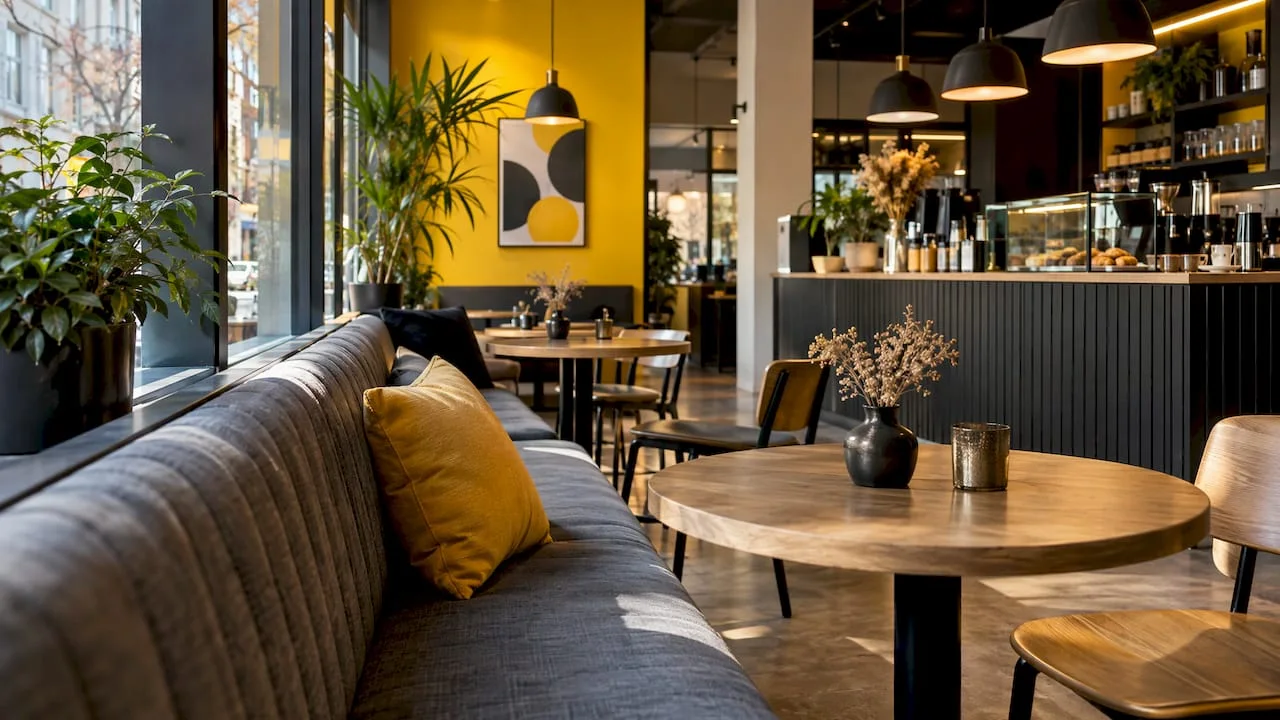
A themed cafe concept is a business decision translated into space, not a decor with a story stuck on the walls. It sets out who comes in, why they stay, what they order and why they return. The theme works when you recognise it in the furniture plan, the light, the menu, the cup your espresso arrives in and the way you are greeted at the bar. Below you will find how such a concept is built, how to make it fit a small cafe, what budget to prepare in Romania and what to check about the premises and the permits, including when you prepare the opening from abroad.
In short
- The concept comes before the theme. The theme is the visual vocabulary; the concept is the reason the cafe exists and the person it exists for.
- Coherence is built in layers: space, light, sound, materials, menu, tableware and team tell the same story.
- In a small cafe, the theme lives in a few strong gestures, not in many objects. Flow and the bar come first.
- The budget of a cafe depends on the location, the equipment and the level of the fit-out, so there is no figure that fits every project.
- Check the use class of the premises before you sign the lease. From abroad, the company can be set up through an authorised representative.
Concept, theme, style, decor: four things that are often confused
Many themed cafe projects start with an image: a saved photo, an interior seen on a trip, a colour. The image is a good starting point, but it is not a concept. If it stays the only reference, the result is a space that pleases in the first week and tires after the first month, because nothing in it answers a real need.
Think of the concept as the spine of a body: you do not see it, but it holds everything in position. The theme, the style and the decor are the muscle and the skin.
|
Level |
Which question does it answer |
Example for the same cafe |
|---|---|---|
|
Concept |
Why does the place exist, for whom, and what problem does it solve? |
A quiet place for long working mornings, in a neighbourhood with many offices |
|
Theme |
What story does the space tell? |
The reading room of an old library |
|
Style |
Through which visual vocabulary is the story expressed? |
Walnut wood, brass, heavy textiles, warm and low light |
|
Decor |
Which concrete objects make it visible? |
Shelves of books, green desk lamps, catalogue cards turned into a menu |
|
Trend |
What is fashionable now? |
It can be used in places, but it cannot replace any level above |
A simple test: if you can describe the cafe in one sentence without naming any object, you have a concept. “A cafe with plants and pink neon” is a list of decor. “A place where parents from the neighbourhood can sit for an hour with a small child without disturbing anyone” is a concept, and the theme, whatever it is, will have to serve that hour.
From theme to experience: the layers the customer feels
A theme becomes an experience when all the small decisions pull in the same direction. Crina Ciocian, co-founder of the Meron chain in Cluj-Napoca, says in an article in Business Magazin that the design is deliberate, as are the playlist, the lighting and the training of the team, and that it is not decorative but functional and emotional at the same time.
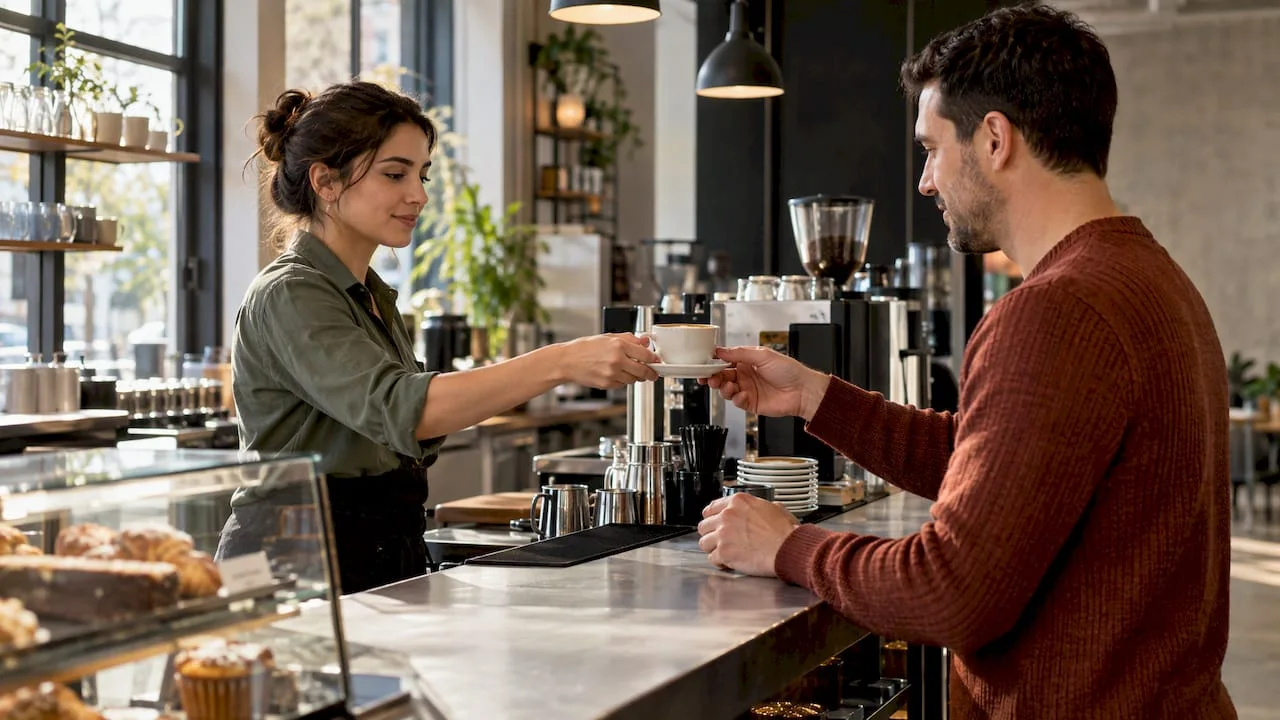
A recent Romanian example shows how strong a theme can be when it grows out of the place. Laboratorium turned the former Matia Corvin pharmacy in the Széki Palace, opened in 1893, into a contemporary coffee laboratory, with seasonal tastings and storytelling. The “laboratory” theme starts from the history of the building, a former pharmacy.
These are the layers we usually work on, in the order in which the customer meets them:
- The threshold. The shopfront, the door and the first two metres decide whether a passer-by understands what kind of place this is. Here the theme must be legible, not explained.
- Light. It sets the rhythm: diffuse, warm light for long stays, clearer light on the bar and the product display. The same theme can feel intimate or cold just from the colour temperature.
- Sound. Acoustics are easy to forget. A cafe with hard surfaces and a high ceiling becomes noisy at half capacity, however successful the theme.
- Materials and furniture. This is where the theme becomes tactile. The chair you sit on for 40 minutes says more about the concept than any painting. For choosing the pieces, our guide to types of horeca furniture goes through the dining room, the kitchen, the bar and custom furniture, and custom furniture is often where the theme gets a signature of its own.
- Menu and tableware. The menu is an extension of the theme. A cafe with a library theme can name drinks after chapters, serve filter coffee in heavy ceramic cups and have a signature drink that does not exist anywhere else.
- Team and ritual. The way coffee is prepared and served is also staging. An open bar, with preparation in view, shows the customer how the coffee is made.
How to fit out a small cafe without losing the theme
In a small space, every theme decision has to earn its metres. A good example comes from the projects presented at the National Architecture Biennial: Nish Speciality Coffee Shop, only 15 m², moves storage overhead to free the main area, replaces the classic counter with a shared table that is both a coffee preparation station and a meeting place with the barista, and puts the seats at the window and at the back.
The principles that keep a small cafe working are the same, whatever the theme:
- The bar is the operational centre. Behind the counter, think in zones: espresso machine, milk and finishing of drinks; filter or batch brewing; preparation and storage. We wrote about its sizing in detail in the article on the design of a functional bar.
- Flow does not cross. The queue to order, the pick-up point and the route to the table must not cut across the baristas' aisle or the door to storage.
- Storage is planned, not improvised. Crates of milk and sacks of coffee end up in the dining room if they have no place of their own. See how we think about storage in horeca spaces and the back of house area.
- Seating in three registers. A counter at the window for those in a hurry, a shared table for those who work, a few tables for two for meetings. This way you cover more types of visit on the same floor area.
- The theme in two or three gestures. A signature wall, a distinctive light fitting and one material that repeats are enough. A small space crowded with objects loses the very clarity the theme was meant to bring.
- Small services, from the start. Sockets, phone charging, a coat hook, space for a pram. Put them in the furniture plan from the start, not after opening.
What a themed cafe costs in Romania
The budget of a cafe includes the fit-out, equipment, stock, rent, permits, marketing and working capital for the first months.
A themed cafe can cost more than an ordinary one, for example when the theme calls for custom furniture or works in a historic building. How much more depends on the location and the level of restoration, so there is no single figure that fits every project.
|
Budget item |
What it includes |
What makes it grow |
|---|---|---|
|
Project and design |
Concept, technical design, execution details |
Complexity of the theme, custom furniture |
|
Fit-out |
Installations, finishes, furniture, lighting, acoustics |
Condition of the space, historic buildings, changes to the layout |
|
Equipment |
Espresso machine, grinders, water filtration, fridges, display cabinets |
Type of menu and expected volume |
|
Permits |
Approvals, registrations, possible expert reports |
Floor area, type of building, local requirements |
|
Launch and reserve |
Initial stock, marketing, working capital |
How quickly the cafe reaches its clientele |
Two observations from practice. First: the operating reserve is easy to underestimate, and a lack of cash in the first months can put pressure on an otherwise well thought out project. Second: a theme defined early reduces costs, because it removes rounds of changes on site. If you want concrete figures for the design part, read what horeca interior design costs and what a technical interior design project costs.
Before the lease: the premises and the permits
An expensive mistake is made when the lease is signed. A guide from 2018, written by a Mediaș City Hall adviser, recommends checking the use class of the premises in the land registry extract, the planning restrictions in the area, whether you can get the neighbours' consent and how far structural changes can be made, because public catering requires a certain structure of the spaces (the guide cites Order no. 976/1998). The guide predates the 2026 Code, so confirm today's rules at the city hall.
In short, before you sign, ask:
- Does the space have commercial use, or is it a dwelling that would need a change of use?
- Does the area allow public catering, with or without extra conditions?
- Can you obtain the neighbours' consent, if the space is in an apartment block?
- Does the owner accept the works that the theme and the bar need: new installations, partitions, air extraction?
- Is there room for a toilet, a changing room and storage?
The permit steps follow, broadly, this order:
- Setting up the company at the Trade Register, with the right activity for serving drinks.
- Designing and fitting out the space to the standards, before any application for approval. Here interior design and technical requirements must work together; our guide to the workflow of a horeca fit-out shows the order of the steps.
- Sanitary-veterinary registration at the DSVSA (county food safety and veterinary directorate), or the one for Bucharest, under the Norm approved by ANSVSA Order no. 111/2008. You obtain the registration document before the activity starts (art. 20 para. (10)).
- Fire safety. Government Decision no. 571/2016 sets the categories of buildings that need a fire safety approval and permit. Whether a cafe falls into them depends on the floor area and the type of building, so the list is confirmed with the county fire inspectorate (ISU) before design.
- The public health directorate (DSP) and, where relevant, the environment, depending on the activity and on local requirements.
- The operating consent from the city hall, which can have its own conditions, from opening hours to the terrace.
Requirements differ from one locality to another and from one space to another. Before you sign or start works, ask for confirmation from the sector or town city hall and from the county fire inspectorate, and work with a lawyer or a permits consultant on the file.
From abroad: what you can prepare from a distance
Some of those who open a cafe in Romania do so after years spent abroad, with a clear idea of what they missed at home. The legal part can be started from far away: applications to the Trade Register can be filed by a representative with a notarised special or general power of attorney or by a lawyer, on the basis of a lawyer's authorisation. For how to have the power of attorney certified where you live, ask the Romanian consulate or a notary.
What you can do well from a distance:
- The concept and positioning: who the cafe is for, in which neighbourhood, with what menu and what theme.
- The budget and the business plan, with the items above and a realistic reserve.
- Assessing premises: from plans, photos and legal checks made by someone you trust on site.
- The fit-out design, from the furniture plan to the bar details, so that the works can be priced correctly.
What needs presence or a representative on the ground: the final visit to the space, signing contracts, handover of the works and inspections by the authorities.
For this stage we created SelfDezign Remote, remote HORECA consultancy, from €450 per session. We work with you on the concept, on the space you are assessing and on the fit-out decisions, so that you arrive in Romania with a clear plan, not a list of questions. The details are on the SelfDezign Remote. If you are already in the country and want a focused review, consultancy with written conclusions costs 500 lei per session, and for the complete cafe project you will find details under HORECA interior design.
Our perspective
When an entrepreneur comes to us with a themed cafe, the first question we ask is not “which theme do you like?”, but “what has to happen in this space for the business to work?”. The theme comes after, as the language for an answer we already have.
We have often seen the same pattern: a strong visual idea, applied over a plan that ignores flow, the bar or storage. The result looks good in photos and tires the team every day. That is why we work the concept, the technical design and the coordination of the works as one thread, from the first sketch to handover.
We do not design by trends or by copied formulas. A trend can be an accent, but the personality of the place must come from the people who run it, from the neighbourhood and, sometimes, from the history of the building. A successful themed cafe is not the most spectacular one on the street, but the one where the customer understands at once where they have walked in and has a reason to come back.
The SelfDezign team
Sources
- Business Magazin: the Meron cafe chain in Cluj
- Business24: Laboratorium and the former Matia Corvin pharmacy
- UAR, National Architecture Biennial 2025: Nish Speciality Coffee Shop
- Guide to starting a business in public catering, Mediaș City Hall, April 2018 edition
- Norm approved by ANSVSA Order no. 111/2008, consolidated version of 19.07.2024
- ONRC: filing applications through a representative