Designing a rental apartment: a guide for owners
Designing a rental apartment starts with the tenant you want to attract, not with your own taste. First you choose the tenant profile and the rental regime, then you check the installations, and only last the finishes, furniture and accessories. The goal: the apartment rents quickly, supports the rent you ask and withstands years of use.
SelfDezign
Design the apartment for the right tenant
SelfDezign designs residential interiors, from concept and technical design to coordinating the works on site.
In brief
- The tenant profile decides almost everything. A student, a family and an employee sent by a company look for different apartments, and the budget starts from that profile.
- For long-term lets, durability matters; for hotel-style lets, the photo matters. They are two different projects, with different legal rules.
- Check the installations before the finishes. A pipe or circuit redone after the tiles are laid means broken finishes.
- The money goes into the kitchen, bathroom, floors, lighting and storage. Textiles and accessories are easy to change later.
- A neutral apartment is not an impersonal one. Visual coherence makes the apartment look well kept, and that helps it rent.
Start with the tenant, not the style
The most common mistake is to choose the style first (“modern”, “Scandinavian”, “industrial”) and only then ask who will live there. Style is only the visual vocabulary. The tenant profile is the sentence you build with it.
The landlord’s guide published by BLITZ starts from the same point: the area and the type of tenant dictate the fittings. At one end is basic functionality for students; at the other are the higher-grade finishes expected in corporate (“protocol”) apartments, which companies rent for their employees. Families look for stability and areas with schools and parks, so an apartment designed for them needs generous storage and finishes that withstand children, not a spectacular living room.
|
Tenant profile |
What they look for |
Where to invest |
What to avoid |
|---|---|---|---|
|
Students |
Price, close to the university, study space |
Sturdy furniture, a desk in each room, hard-wearing floors |
Delicate finishes, expensive objects |
|
Young professionals |
A functional kitchen, good internet, a well-kept look |
Kitchen, bathroom, lighting, a work area |
Eccentric pieces that divide opinion |
|
Families |
Stability, storage, safety |
Wardrobes, a storage room, washable surfaces |
Fragile furniture, sharp corners |
|
Corporate (company-let) |
Perceptible quality, complete fittings |
Higher-grade finishes and appliances |
Visible compromises in the details |
|
Hotel-style short lets |
Experience, good-looking photos |
Bed, linen, bathroom, lighting, simple check-in |
Objects that break or go missing easily |
If you hesitate between two profiles, pick the one that suits the area. An apartment next to a university campus, designed for corporate tenants, risks standing empty. A corporate apartment fitted out minimally loses exactly the tenant who would have paid more.
Long-term or hotel-style let: two different projects
The analysis by Economica.net on costs and yield makes a useful distinction. Long-term letting stresses functionality and durability. Short-term letting depends on visual appeal and the “photo factor”, because a booking is decided in a few seconds, on a phone screen.
|
Criterion |
Long-term let |
Hotel-style let |
|---|---|---|
|
Design priority |
Durability, storage, easy maintenance |
First impression, photos, hotel-level comfort |
|
Furnishing |
Basic; the tenant can bring some of their belongings |
Complete, down to the last teaspoon |
|
Wear |
Constant, predictable |
Heavy, with repeated cleaning |
|
Textiles |
Few, neutral |
Many spare sets, easy to wash |
|
Technology |
Good internet |
Automated check-in, digital codes, security |
In a hotel-style let, every arrival means luggage hitting the furniture, chairs pulled out dozens of times a month and the wall beside the bed touched constantly. That is why the headboard, the wall protection and washable covers are not details; they are part of the concept. The Skia guide to hotel-style letting notes that the fit-out includes complete equipment and systems such as automated check-in with digital codes. Plan from the start where the smart lock goes and where the router sits, so you do not end up with exposed cables and improvised holes.
Before you invest, check the legal side too. Letting as a private individual in a hotel-style regime has its own rules: Lovedeco, on hotel-style letting as a private individual mentions a tourist classification certificate, conditions involving neighbours and limits on the number of rooms. The rules change and depend on the type of building, so confirm them with the Ministry of Tourism and with a tax adviser or a lawyer before you buy furniture.
What to check before any finish
A rental apartment is judged by how it looks, but it lasts by how it works. The most expensive problems are the ones hidden in the walls.
- The electrical installation. Check the fuse board, the cable cross-section and the number of sockets. Today’s tenant has a laptop, a phone, air conditioning and appliances that all start at the same time. For any work on the board, call an electrician authorised by ANRE (the Romanian energy regulator), not a general handyman.
- The plumbing. Isolation valves, leaks, water pressure, the state of the riser. As Jurnal Plus on the order of a renovationnotes, problems found after the finishes are installed can mean breaking them open.
- Ventilation and damp. Mould in the bathroom or in the corners of the rooms is the first thing an attentive tenant sees and the first reason for a complaint. A hood that really extracts and a working bathroom fan cost little compared with repeated cleaning and repainting.
- Seals. Silicone at the bath and the sink, window gaskets, traps. The Constructiata guide to renovating for tenants names skimping on taps, traps and silicone as one of the classic false economies.
- The energy performance certificate. Ask an accredited energy auditor whether you need it for letting and what data must appear in the advertisement, before you publish it.
If the apartment is already occupied and you have invasive work to do, schedule it between two tenancies. It is cheaper than a rent reduction and simpler than a strained relationship with the tenant. For the order of the stages and a realistic schedule, use the renovation planning guide.
Finishes that stand up to tenants
The right finish for a rental apartment is neither the cheapest nor the prettiest. It is the one that looks just as good after the third tenant and can be repaired without replacing a whole room.
- Porcelain stoneware tile is the safe choice for the kitchen, bathroom and hall, thanks to its resistance to moisture and heavy traffic, as explained by Idei Casa si Gradina on high-traffic areas. Choose a medium format and a grey grout, which does not visibly darken.
- SPC and LVT vinyl are good choices for the rooms, because they resist water and scratches. They can often be laid over the old floor, if it is level, which shortens the job. You can find the differences from parquet in our comparison LVT vs parquet.
- Micro-cement allows quick renovations over existing layers, but it needs an experienced installer. Poorly applied micro-cement cracks and is hard to repair locally, so for a rental apartment it is worth it only if you have the right team.
- Good-quality washable paint on the walls, in warm, neutral shades. Stains wipe off, and touching up between tenants takes a few hours.
- Kitchen worktops that resist heat and stains. It is the most heavily used surface in the home and the one the tenant notices immediately.
The rule that helps us most often: every material needs a repair plan. If a tile cracks, do you have a spare? If a plank gets scratched, can you replace only that one? Keep a reserve of materials in the storage room. We wrote at length about how materials build the character of a space in the guide to the role of materials.
Furniture, storage, light and colour
Furniture is judged by its hardware
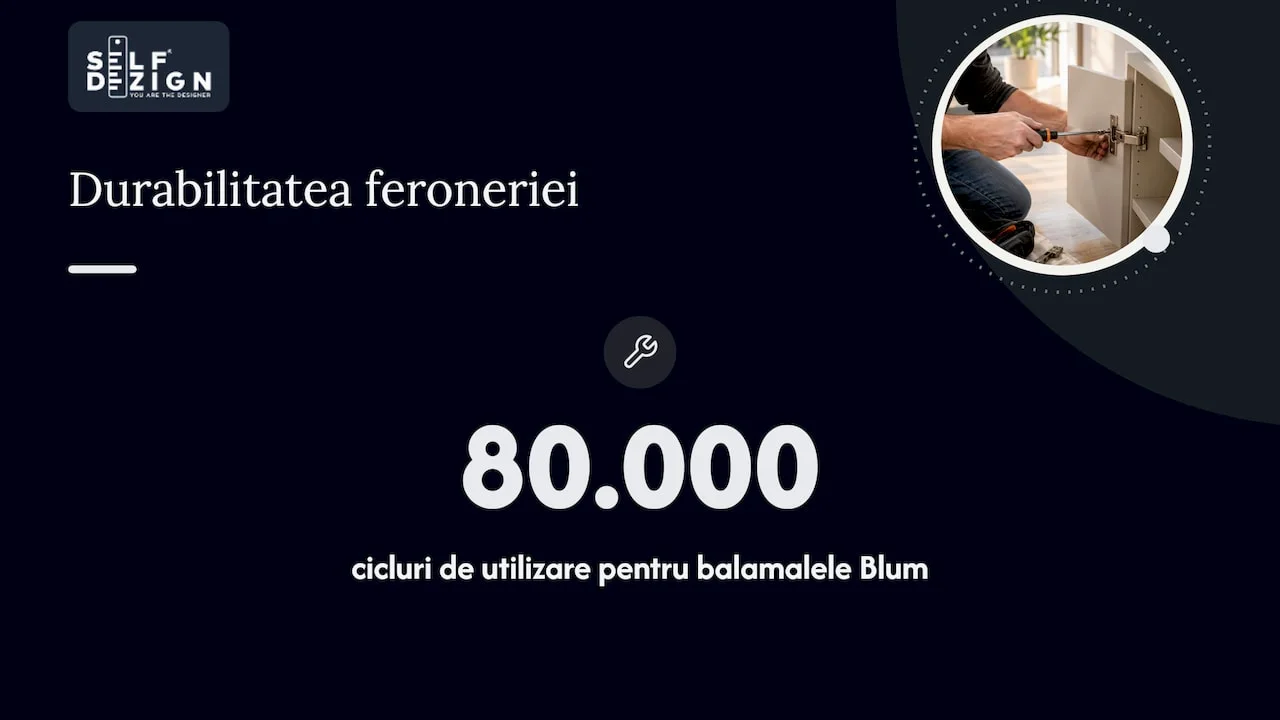
A kitchen cabinet opens several times a day, every day, for years. Forbes Romania on furnishing a rental home shows that the reliability of furniture depends first of all on its hardware, and gives the example of Blum hinges, which can reach 80,000 movements. In other words, ordinary chipboard with good hardware lasts longer than an expensive front mounted on cheap hinges. The sofa deserves a removable, washable cover, and the bed a good-quality mattress.
Storage makes the apartment feel larger
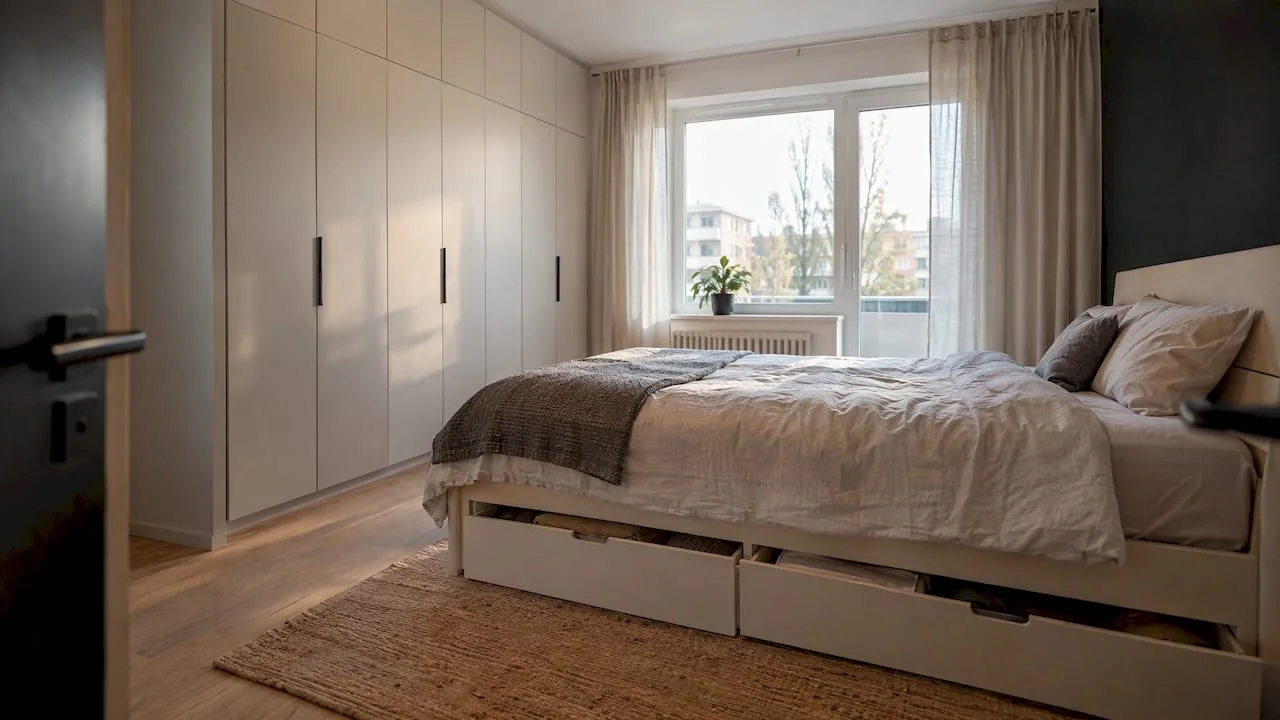
Tenants often visit apartments with few wardrobes, where belongings end up on chairs. A full-height wardrobe in the hall, drawers under the bed and a kitchen with wall units up to the ceiling make a 50 sq m apartment “fit”. An article by Lovedeco on 2026 preferences, marked as sponsored content, lists storage systems, durable worktops and good-quality light fittings among the areas where people invest more, and textiles and accessories among the elements that are easy to change.
Light and colour
A single cold ceiling light in the middle of the room makes any apartment look like an office. Think in at least two layers: general light and warm ambient light, with a bedside lamp or a wall light by the bed and an LED strip under the kitchen units. Warm light also makes the photos in the listing much more inviting.
As for colour, neutral (warm white, beige, warm grey, light wood) does not mean a lack of identity. It means a base on which every tenant can picture themselves. Identity comes from two or three coherent elements: a repeated wood texture, an accent of colour in the textiles, a well-chosen lamp. If you want to see how this coherence is built without excess, read the guide to the identity of residential spaces.
Where to put the money
You can find the breakdown of costs by scenario in the article on the cost of fitting out a rental apartment. Here the order of decisions matters: what gets budget first and what can wait. One published example shows how much made-to-measure furniture can weigh in a project.
- A complete fit-out, with made-to-measure furniture. A 54 sq m apartment in Timisoara, fitted out in 2022, cost 32,000 euro, of which about 19,000 euro was the made-to-measure furniture, as reported by Lovedeco on the Timisoara apartment. The architect of the project says that higher-grade materials last longer and attract tenants who care about details. It is a top-end example, not a market benchmark.
Do the honest sum. The extra rent is not the only gain. One month of vacancy avoided at each change of tenant is worth a full month’s rent. And an apartment that looks well kept attracts tenants who treat it the same way.
|
Area |
Impact on rent and letting |
Priority |
|---|---|---|
|
Kitchen (units, worktop, appliances) |
Very high, it is the first area assessed |
Invest |
|
Bathroom (fixtures, taps, ventilation) |
Very high, this is where most complaints arise |
Invest |
|
Floors |
High, they appear in every photo |
Invest |
|
Lighting |
High, it changes the perception of the whole space |
Invest |
|
Storage |
High for long-term lets |
Invest |
|
Interior doors |
Medium, they matter for the sense of quality |
Balance |
|
Textiles and accessories |
Low in the long term, easy to replace |
Save |
The mistakes that cost the most
- You design it for yourself. A bold wallpaper or the velvet sofa you love can narrow your audience. Personal taste belongs in your own home.
- You overload it visually. Many small objects mean more to clean, more things that can break and cluttered photos.
- You choose delicate finishes. Glossy surfaces, pure white on the floor, untreated solid wood in the bathroom: they look good for a month.
- You save where it rarely shows but often fails. Cheap taps, traps, silicone and hinges end up costing twice.
- You work without a plan. Purchases made one at a time, from different shops, give an incoherent apartment and a blown budget. A drawn plan, with material lists and quantities, is the cheapest control tool. If you work with several tradespeople, read also how to choose the fit-out team.
Our view: a rental apartment needs a concept
Many owners treat the rental apartment as a compromise. They buy what is on sale, choose “something neutral” and hope it will be enough. The result is not neutral, it is anonymous. And anonymity shows in the photos, in the viewings and, in the end, in the rent.
For us, a rental apartment is a space that has to work for a person you do not yet know. That takes more clarity, not less. We start from the context: the area, the type of tenant, the rental regime, the budget and how long you want the apartment to last without a new renovation. Only then do we choose materials and pieces. The concept is the backbone: every choice, from the floor to the bedside lamp, must support the same result.
We do not work from templates and we do not chase trends that go out of fashion before the first lease. A trend looks good for a summer; a coherent concept looks good for the fifth tenant. And because the apartment is an investment, our question is not “what is beautiful?” but “what will this space support in the long term?”.
How we can help
If you are preparing an apartment for letting and want to make the important decisions only once, we have two options. For the complete project, from concept to technical design and coordination of the works, the residential interior design service has a fee of 20–40 euro per sq m, as stated on the service page. As a rough guide, for a 50 sq m apartment the design fee would be between 1,000 and 2,000 euro. If you already have the team and only want a clear direction, consultancy with written conclusions costs 500 lei for two hours and leaves you a document you can use with any contractor. Tell us about your space and the tenant you want to attract.
Sources
- BLITZ: The landlord’s guide for rental apartments
- Economica.net: How to fit out an apartment for rent, costs and yield
- Skia: Hotel-style letting in Romania
- Lovedeco: Hotel-style letting as a private individual
- Jurnal Plus: What to change before a serious renovation
- Constructiata: Smart, fast and profitable renovation for tenants
- Idei Casa si Gradina: Resistant finishes for high-traffic areas
- Forbes Romania: Furnishing a rental home
- Lovedeco: Romanians’ preferences in home design in 2026 (sponsored content)
- Lovedeco: Fitting out a two-room apartment in Timisoara