Cafe materials: a comparison by zone, cost and wear
The right materials for a cafe are not chosen from a catalogue but zone by zone: the busy dining room, the bar where milk and espresso are spilled every day, the wall behind the counter that has to be washed, the chair where a customer sits for exactly as long as needed. The same tile can suit the entrance and be wrong next to the espresso machine, and a handsome upholstery can look tired after three months if it is not contract grade. Below you compare the options for each zone, with 2026 price benchmarks, and a specification by zone, written before ordering, keeps you from choosing piece by piece. This is how SelfDezign works through its HoReCa interior design: concept, technical project and coordination of the works.
In short
- Choose the floor by traffic and zone: porcelain stoneware or contract-grade PVC/LVT in the dining room, seamless or easy-to-sanitise surfaces at the bar, washable finishes in the preparation area.
- A furniture supplier recommends a metal or solid wood structure, a tabletop of 25–36 mm and stain-resistant upholstery rated at a minimum of 30,000 Martindale cycles.
- A supplier estimates 12,000–30,000 EUR for the furniture of a cafe with 40–50 seats, and the bar can reach 25–35% of the budget.
- The price per square metre of the material is only part of the cost: installation, cleaning and replacement decide what you actually pay.
- A technical specification by zone, written from the concept, makes the choices work together, not against each other.
Why cafe materials are chosen by zone
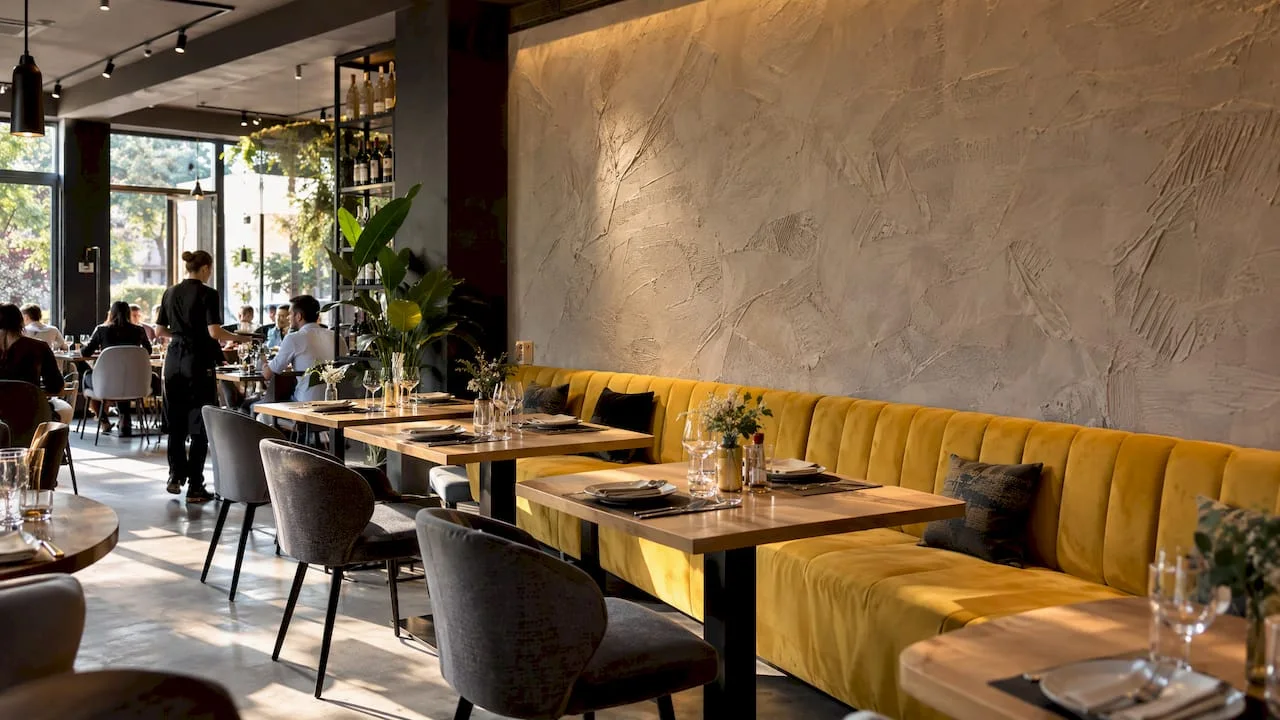
When an owner says “I want a warm cafe, with wood and concrete”, they have described a style, not yet a specification. The style is the visual vocabulary; the concept is the backbone that decides where each material goes, how much of it and in what role. Without it, you have a list of ingredients with no recipe.
A cafe has at least five zones with different demands:
- The entrance and circulation routes, where traffic concentrates, along with water from shoes in winter and grit.
- The dining room, with chairs dragged across the floor every day, tables wiped dozens of times and walls touched by chair backs.
- The bar and counter, where you work with water, milk, coffee grounds and high temperatures.
- The preparation and washing area, where hygiene rules require washable surfaces.
- The terrace, exposed to UV, rain and temperature swings.
If you choose a single material for all of them, you either pay too much for zones that do not need top performance or you save exactly where wear shows first. We also cover this logic in our guide to durable finishes for HoReCa.
The floor: comparing the options for a cafe
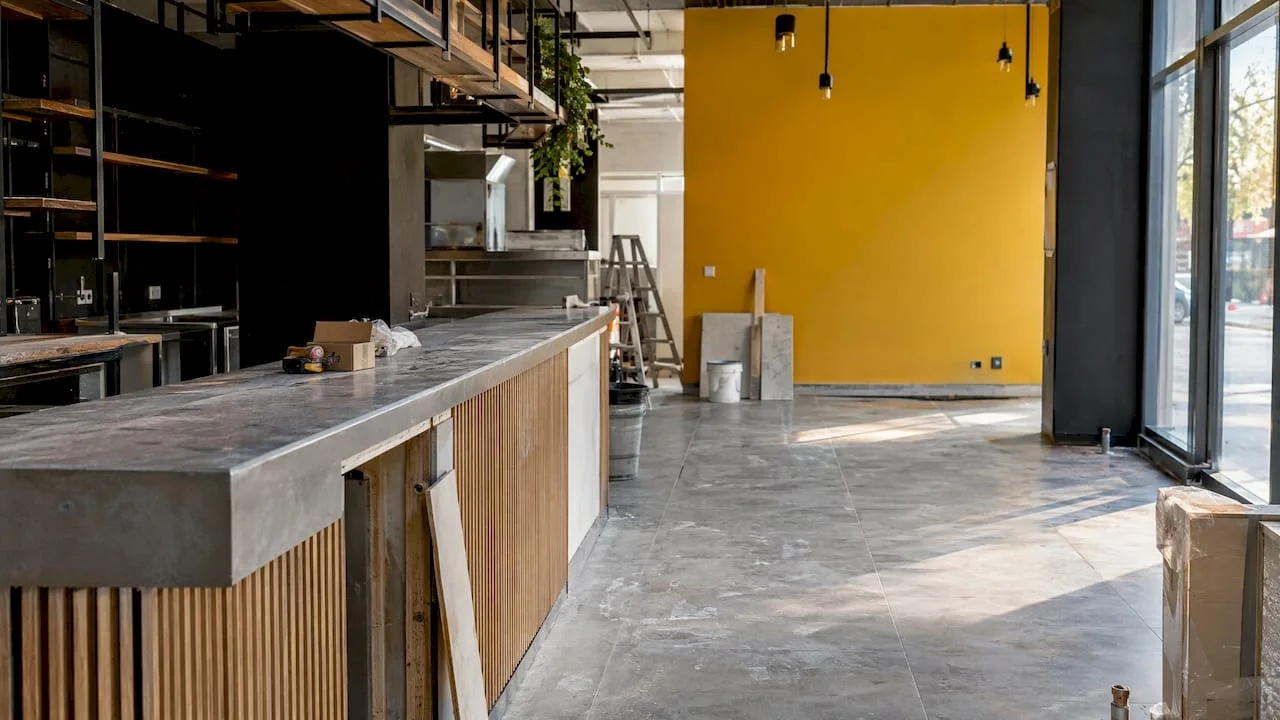
The floor is the hardest thing to change after opening: replacing it means days with the premises closed. That is why it deserves the closest comparison.
|
Material |
Traffic resistance |
Maintenance |
Where it fits |
Visual character |
|---|---|---|---|---|
|
Porcelain stoneware (PEI class 4–5) |
Very high |
Medium (grout lines need attention) |
Dining room, entrance, preparation area |
From classic to industrial, many formats |
|
Contract-grade PVC / LVT |
High |
Low to medium |
Dining room, lounge areas |
Warm, imitates wood or stone, acoustic comfort |
|
Microcement |
High, if properly sealed |
Medium, needs resealing |
Bar, display counters, dining room |
Continuous, seamless, minimalist |
|
Power-floated concrete |
Very high |
Low, after treatment |
Industrial spaces, dining room |
Raw, urban |
|
Rubber flooring |
Very good under impact |
Low |
Behind the bar, technical areas |
Functional |
|
Commercial carpet |
Medium |
High |
Only in places, in lounge corners |
Soft, very good acoustically |
A few notes the table does not make on its own:
The PEI class shows the wear resistance of the tile’s surface layer: classes 4 and 5 are the ones meant for commercial traffic. A beautiful class 3 tile looks tired on the route between the door and the bar long before the rest of the room.
Porcelain stoneware remains the safest choice for the dining room of a busy cafe. As a price benchmark, on ePardoseli a matt Tubądzin porcelain stoneware tile of 598×598 mm was listed in November 2026 at 137.53 lei/sqm, reduced from 171.92 lei/sqm. Installation is extra, and its price is requested in the quotes of the works crews.
Contract-grade PVC and LVT win on acoustic comfort and on how warm the space feels. You will find the differences between them and wood materials explained in the LVT vs parquet comparison.
Microcement gives visual continuity, with no grout lines where dirt can collect, which is why it is popular at the bar and on display counters. It does need a stable substrate and a sealant suited to the traffic. We compared the cost and timeline of the two options in the article microcement vs tile.
Whatever the material, check the condition of the screed: if the substrate has to be levelled, levelling adds cost and days to the schedule.
The bar and counter: the most expensive part of the furniture
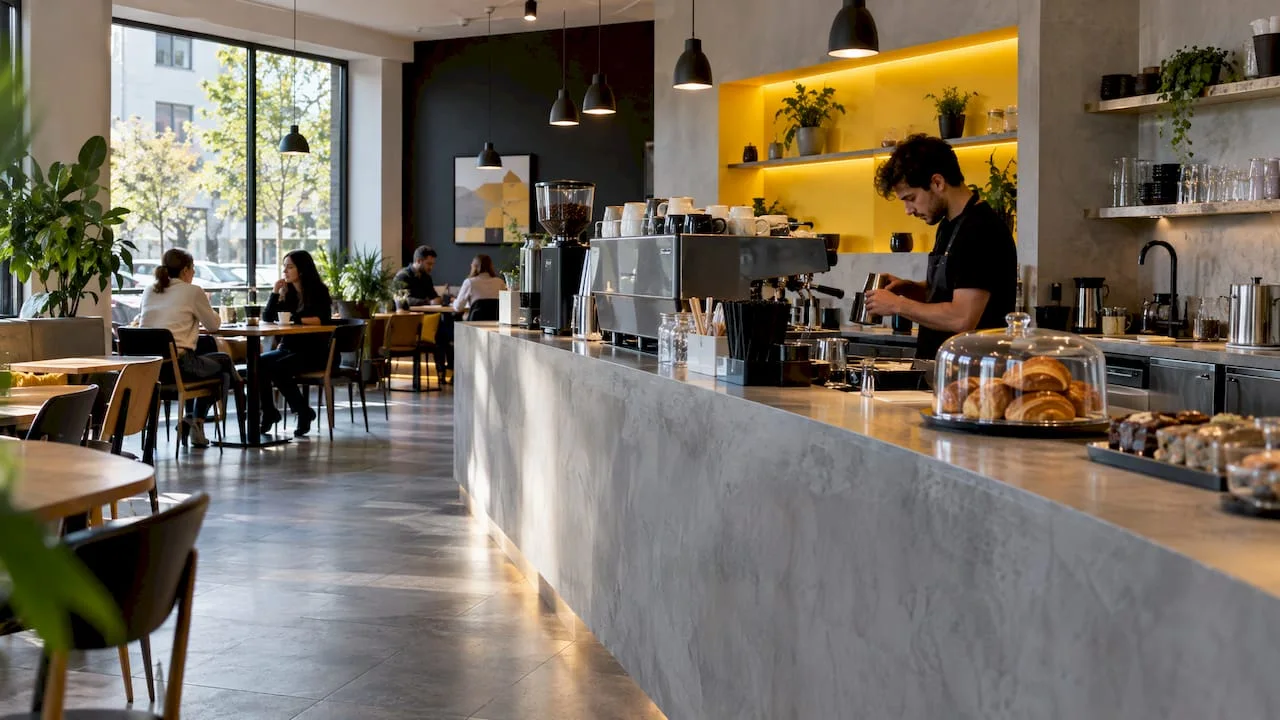
The bar is where the queue forms and where the barista works all day. According to a cafe furniture supplier, the bar can account for 25–35% of the total furniture budget of a cafe.
For the bar top, the usual options are:
- Sintered stone or quartz composite: hard, resistant to stains and heat, with an elegant look. They need attention at the joints and at the sink cut-outs.
- Stainless steel: hygienic, ideal behind the bar and in the preparation area, with a professional, laboratory character.
- HPL on a stable substrate: a balanced option on price, with many decors, resistant to scratches. What you choose between HPL and MDF depends on the zone and on exposure to water, and we described the scenarios in the HPL vs MDF guide.
- Solid wood: warm and authentic, suited to fronts and the serving area, with protective treatments applied periodically.
The front of the bar, the part the customer sees, can carry the identity material: wood, ceramic, perforated metal, decorative plaster. The back of the bar must, above all, be washable and easy to sanitise. Heights, depths and the barista’s workflow matter as much as the materials, so we covered them separately in the article on a functional bar design.
Walls: the dining room versus the preparation area
In the dining room, walls carry the atmosphere: high-quality washable paint, decorative plasters, wood panels, partial ceramic cladding or upholstered acoustic panels. The practical rule is to protect the band where chair backs and customers’ knees touch the wall, with a dado, a wainscot or a harder material.
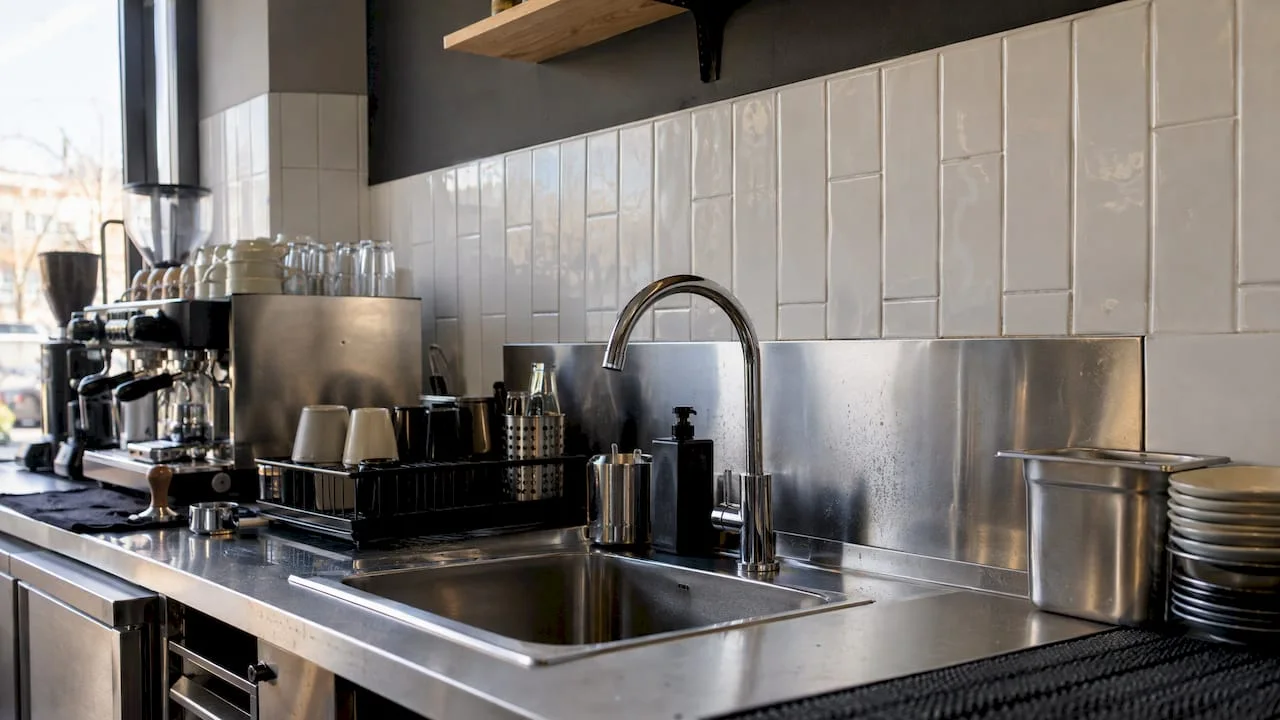
In the kitchen, laboratory and washing area, the logic changes. Regulation (EC) No 852/2004, Annex II, Chapter II, requires floors and walls in rooms where food is prepared to be made of impervious, non-absorbent, washable and non-toxic materials, and walls to have a smooth surface up to a height suited to the operations. Dining areas are excluded from this chapter. Tiles, stainless steel or epoxy paint are common options. A cafe falls under the sanitary-veterinary Norm approved by ANSVSA Order No. 111/2008, among retail units. The requirements for your unit are confirmed with the county sanitary-veterinary directorate before you order, not after an inspection. If you work with us, these requirements go into the technical project.
Furniture: tables, chairs and upholstery
Furniture is the part the customer touches directly, so it largely decides the perception of quality.
Tables. The homs.ro guide to cafe furniture recommends a load-bearing structure of metal, solid wood or a reinforced frame, a tabletop of at least 25–36 mm, finishes resistant to scratches and moisture, and electrostatic coating for metal parts. For indoors, the guide says that melamine chipboard or MDF tops on metal frames are chosen precisely because they wipe clean easily and resist stains, as long as they are not exposed to excess water. As a price benchmark, Zazui lists, in November 2026, HoReCa tables with a sintered stone top at 1,740 lei for the square Ora S model and 2,760 lei for the rectangular Ora M model.
Chairs. A cafe chair solves a contradiction: it must be comfortable enough for people to stay, but not so comfortable that a single order occupies the table for a whole afternoon. The practical option, according to the same supplier, is chairs with an upholstered back and a padded seat, not full armchairs. The decision here is not only about material but about the business model: a high-turnover specialty cafe and a coffee shop for working on laptops need different chairs.
Upholstery. For upholstery, the same source recommends:
- faux leather, easy to wipe, durable and available in many colours;
- contract fabric with a stain-resistant treatment, rated at a minimum of 30,000 Martindale cycles, the test that measures how much rubbing a material withstands before it wears out;
- contract velvet, for lounge areas, with periodic cleaning;
- to avoid: untreated cotton and linen, which absorb liquids.
Terrace. For outdoors, homs.ro suggests aluminium, stainless steel, electrostatically coated metal and teak. For the terrace floor, WPC composite decking is a low-maintenance option: on ePardoseli it was listed in November 2026 at 228.96 lei/sqm.
What cafe materials and furniture cost
The figures below are 2026 estimates from a furniture supplier, useful for a first estimate, not quotes. The source does not say whether the sums include VAT.
|
Type of cafe (40–50 seats) |
Indicative furniture budget |
What it usually includes |
|---|---|---|
|
Minimalist coffee shop |
12,000–16,000 EUR |
Simple chairs, tables with HPL tops |
|
Cafe with good-quality furniture |
12,000–30,000 EUR |
Full furnishing |
|
Cafe with a lounge area |
25,000–35,000 EUR |
Custom banquettes, upholstery |
Source of the estimates: a cafe furniture supplier, May 2026.
On top of this come the floor, walls, lighting and installations. A simple example for an 80 sqm dining room with the tile above: 80 × 137.53 lei/sqm comes to about 11,000 lei, at the listed price and before cutting waste. Labour, adhesive and grout are extra and are requested in quotes.
This leads to the most important rule: the real cost of a material is its cost over its whole period of use, that is, purchase, installation, daily cleaning, maintenance and the moment it has to be replaced. A cheaper floor that is replaced after three years, with the premises closed for a week, can end up costing more. For the cost of design itself, we gathered the figures in the article how much interior design for HoReCa costs.
Who helps you choose: three routes compared
Materials can be chosen in several ways, and the difference between them is not one of taste but of who answers for the coherence of the whole.
|
Criterion |
Interior design studio (SelfDezign) |
Directly from a showroom or supplier |
With the works crew only |
|---|---|---|---|
|
Starting point |
The concept and the business goals |
The product available |
What is easy and quick to install |
|
Coherence between zones |
Thought through from the start, across the whole cafe |
By product category |
Depends on the crew |
|
Technical specification (traffic classes, upholstery, washable finishes) |
Included in the technical project |
For their own products |
Depends on the crew |
|
Coordination of the works |
Included |
No |
The crew’s own execution |
|
Identity of the space |
Built on the personality of the brand |
Depends on what is chosen |
Depends on what is chosen |
A supplier sells you the furniture, and the works crew installs the floor. Rarely does anyone answer whether all the materials work together for the experience your cafe wants to sell. That is what design is for, and in the article on the advantages of professional HoReCa fit-out we detailed what you gain in practice.
What to check before ordering materials
Before any order, run each material through these questions:
- Real traffic per zone. How many customers come in each day and where do they walk? The door-to-bar route needs a different resistance class than the lounge corner.
- The traffic class declared by the manufacturer. For tile, the PEI class; for PVC and LVT, the commercial use class; for upholstery, the number of Martindale cycles. An attractive material with an insufficient class looks worn too soon even if it is installed perfectly.
- The substrate. Does the existing screed allow direct installation or does it need levelling? The difference can change the budget and the schedule.
- The cleaning routine. Which products does your team use in the evening? Some sealants and some woods do not tolerate harsh detergents; homs.ro recommends non-abrasive solutions, no excess water on chipboard and MDF, and periodic treatments for wood.
- The sanitary requirements for the preparation area, confirmed with the county sanitary-veterinary directorate before ordering, not after an inspection.
- Coherence with the concept. Does each material have a role in the story, or is it there only because it looked good in the showroom?
For a complete evaluation method, you can also use the guide to choosing materials for commercial spaces.
How we work on a cafe
At SelfDezign we design the cafe from concept to site: the interior concept, the technical design, in which each material is specified by zone, and the coordination of implementation. Commercial interior design is charged per square metre, between 25 and 55 EUR/sqm, so for an 80 sqm cafe the fee falls between 2,000 and 4,400 EUR. If you first need clarity, a consultation with written conclusions costs 500 lei per session, and if you live abroad and are preparing a cafe in Romania, SelfDezign Remote offers remote HoReCa consultation, from 450 EUR per session. All services are described on the Servicespage.
The SelfDezign view
Most questions about cafe materials begin with “what is the most durable?” or “what is fashionable now?”. We prefer to begin with a different question: what should your customer feel in the first ten seconds, and what should your barista be able to do without thinking?
A material is neither good nor bad in itself. Microcement can be exactly what a specialty cafe with a minimalist concept needs, and it can be wrong for a neighbourhood bistro with families and prams. That is why we do not work with templates or with solutions copied from the season’s trend: we start from the real context of the business, from the personality of the brand and from the goals the space has to support.
For us, choosing materials is the moment when the concept becomes concrete. Done with clarity, this stage helps the cafe look good even after three years, and every leu invested supports the customer’s experience.
The SelfDezign team
Sources
- Tables and chairs for cafes: a complete selection guide (homs.ro)
- Cafe furniture: how to set up a coffee shop
- Online flooring: tile, decking (ePardoseli)
- HoReCa furniture with a sintered stone top (Zazui)
- Sanitary-veterinary Norm, ANSVSA Order No. 111/2008 (legislatie.just.ro)
- Regulation (EC) No 852/2004 on the hygiene of foodstuffs (EUR-Lex)