Durable commercial flooring: how to choose for each space
No floor is “the most durable” in general. A commercial floor lasts when the material suits the real traffic, the water and cleaning products that reach it, the substrate it is laid on, and how the space has to look in five years. Porcelain stoneware, SPC, PVC sheet, resins or microcement can each be the right choice or an expensive mistake, depending on context. At SelfDezign we treat the floor as a project decision: we set it in the interior concept, detail it in the technical design and follow it on site.
In brief
- Durability is read in the data sheet, not in the sales description: use class, wear layer thickness, slip class (R), behaviour with water and with underfloor heating.
- Each type of space has a different “enemy”: in a shop, abrasion at the entrance; in hospitality, grease and water; in a clinic, disinfectants and hygienic joints; in an office, acoustics and chair castors.
- The substrate decides how long the finish lasts: a commercial-class SPC plank laid on an uneven or damp screed fails sooner than a lower-class plank laid correctly.
- Real cost is lifecycle cost: material, substrate, installation, cleaning and the moment it has to be replaced, not only the shelf price per square metre.
- A good decision comes from the project: a floor chosen together with the flows, the lighting and the identity of the space lasts both functionally and visually.
What a “durable” floor means in practice
The word “durable” appears on almost every package. For a commercial space it breaks down into five precise questions, and the answers are in the manufacturer's documentation.
1. Does it withstand traffic? For vinyl, textile and laminate floors, manufacturers declare a use class (EN ISO 10874). Classes starting with 3 are for commercial spaces: 31 for moderate use, 32 for general use, 33 for heavy use and 34 for very heavy use. For example, the Rusty SPC floor is listed in the supplier's data sheet as class 33/AC5, with a 0.55 mm wear layer, which is the transparent top layer that takes the actual friction of footsteps.
2. Is it safe when wet? The slip class is marked with R, on a scale from R9 to R13, under the German standard DIN 51130, measured on an inclined plane. The higher the number, the better the grip on a wet or contaminated surface. There is no single right value for the whole space. A wet entrance, a professional kitchen and food preparation areas need higher values than a dry sales floor. The value is confirmed in the data sheet and with the designer.
3. Does it withstand water and chemicals? Not only the material matters, but also the joints. A waterproof plank with joints that let water through does not make a waterproof surface.
4. Is it compatible with the substrate and the services? Underfloor heating, an uneven screed or residual moisture completely change the list of options.
5. Does it keep its appearance? A floor that does not break, but stains, goes dull on the main routes or shows every wheel mark does not “last” for a brand that also sells through its image.
Here is the first difference between buying a material and specifying it. A designer reads the data sheet against the scenario of use: how many people pass daily, where, in what footwear, with what trolleys, with what cleaning schedule.
The real options, compared
The table below summarises how each family of materials behaves in commercial conditions. It is a starting point for discussion, not a decision: the same family has products of very different classes.
|
Material |
Heavy traffic |
Water and chemicals |
Upkeep |
Comfort and acoustics |
Where it suits best |
|---|---|---|---|---|---|
|
Porcelain stoneware |
Very good |
Very good, with well-chosen joints |
Simple, watch the joints |
Hard and cold, poor acoustics |
High-traffic retail, hospitality, wet areas |
|
SPC (rigid-core vinyl) |
Good to very good in class 33 |
Water-resistant on the surface |
Simple |
Warmer and quieter than stoneware |
Shops, showrooms, offices, quick renovations |
|
Glued LVT |
Good in class 33 |
Good |
Simple |
Good |
Offices, retail, areas with irregular shapes |
|
Heterogeneous PVC sheet |
Good |
Good, with welded joints |
Very simple |
Good |
Offices, corridors, educational spaces |
|
Homogeneous PVC sheet |
Very good |
Very good, with welded joints and coved skirting |
Very simple, can be refurbished |
Good |
Clinics, surgeries, laboratories |
|
Epoxy resins |
Very good |
Very good, continuous surface |
Simple |
Hard |
Technical areas, industrial retail, some kitchens |
|
Microcement |
Good, depends on sealing |
Good with a suitable sealer |
Needs periodic resealing |
Hard |
Retail and hospitality concepts with a strong identity |
Porcelain stoneware
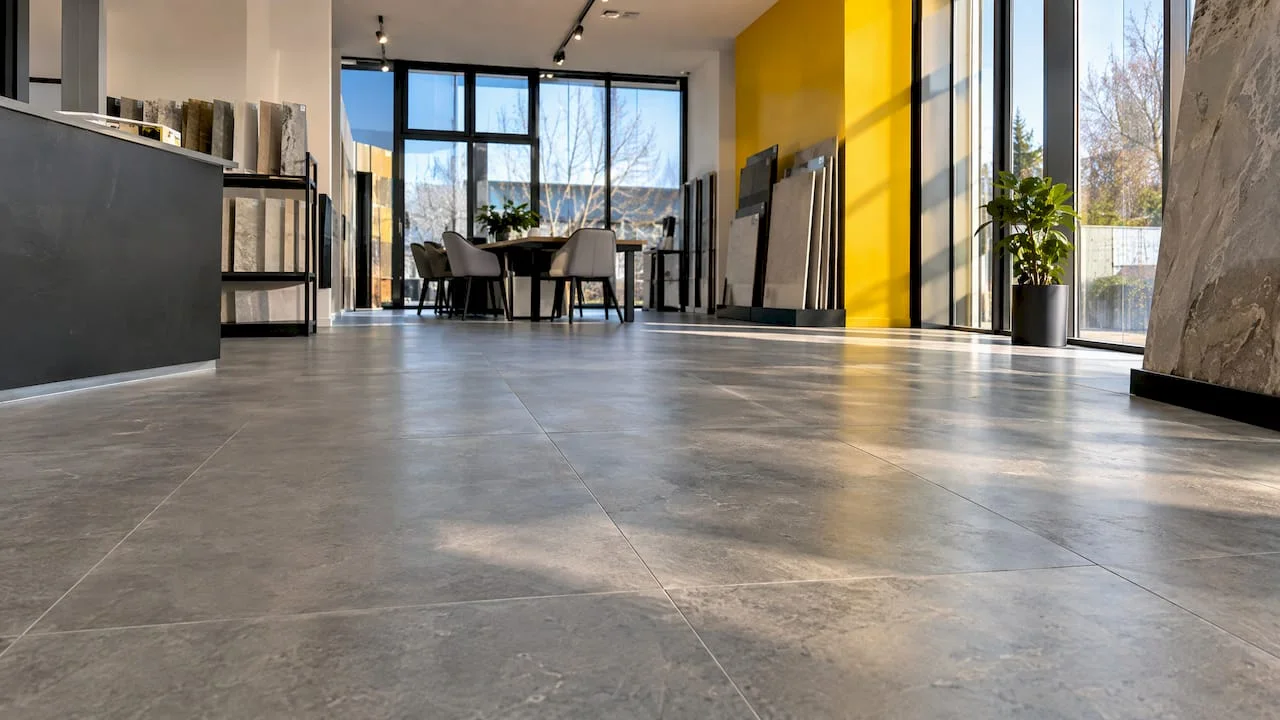
It is the classic benchmark for durability: dense, barely absorbent, scratch-resistant and resistant to most professional detergents. Its sensitive point is the system: the adhesive, the grout joint and the flatness. Large formats reduce the number of joints and give a cleaner look, but need an almost perfect substrate. On underfloor heating, stoneware works very well; we detailed the trade-offs in the comparison parquet or stoneware on underfloor heating.
SPC and LVT
SPC has a rigid mineral core, resists water and tolerates small substrate imperfections better than flexible LVT. An example of a data sheet relevant for commercial use: the Vilo Rusty 600 × 600 mm plank, 5 mm thick, with a 0.55 mm wear layer, class 33/AC5, slip class R10, click joint and the option of floating or glued installation. Glued LVT, on the other hand, is quieter and more stable under rolling loads. We explained the differences by type of space in SPC vs LVT and in LVT vs parquet.
Heterogeneous and homogeneous PVC sheet
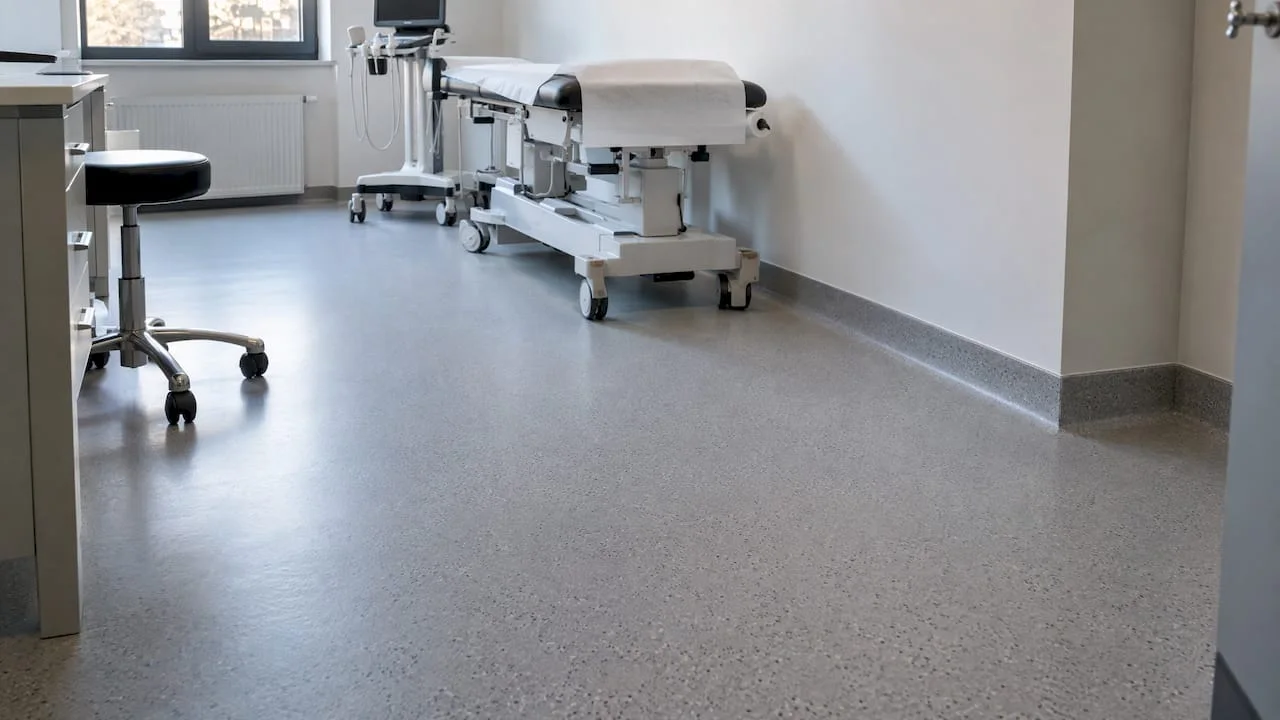
PVC sheet in rolls is often the most pragmatic choice for large areas. The heterogeneous type has a decorative layer protected by a wear layer; the homogeneous type has the same composition through the whole thickness, so wear does not “erase” the pattern and the surface can be refurbished. Installed with heat-welded joints and turned up the wall as skirting, it forms a continuous surface that is easy to sanitise.
Resins and microcement
Both create jointless surfaces with a strong visual character. Epoxy resins are the technical choice for areas with heavy mechanical and chemical loads. Microcement is rather a concept choice, which needs experienced installers and a maintenance plan. You can find the cost and schedule comparison in microcement vs stoneware.
Which floor suits each type of space
The same stoneware can be perfect in a bistro and unsuitable in a physiotherapy room. Here is how we read each type of space.
Shop and showroom
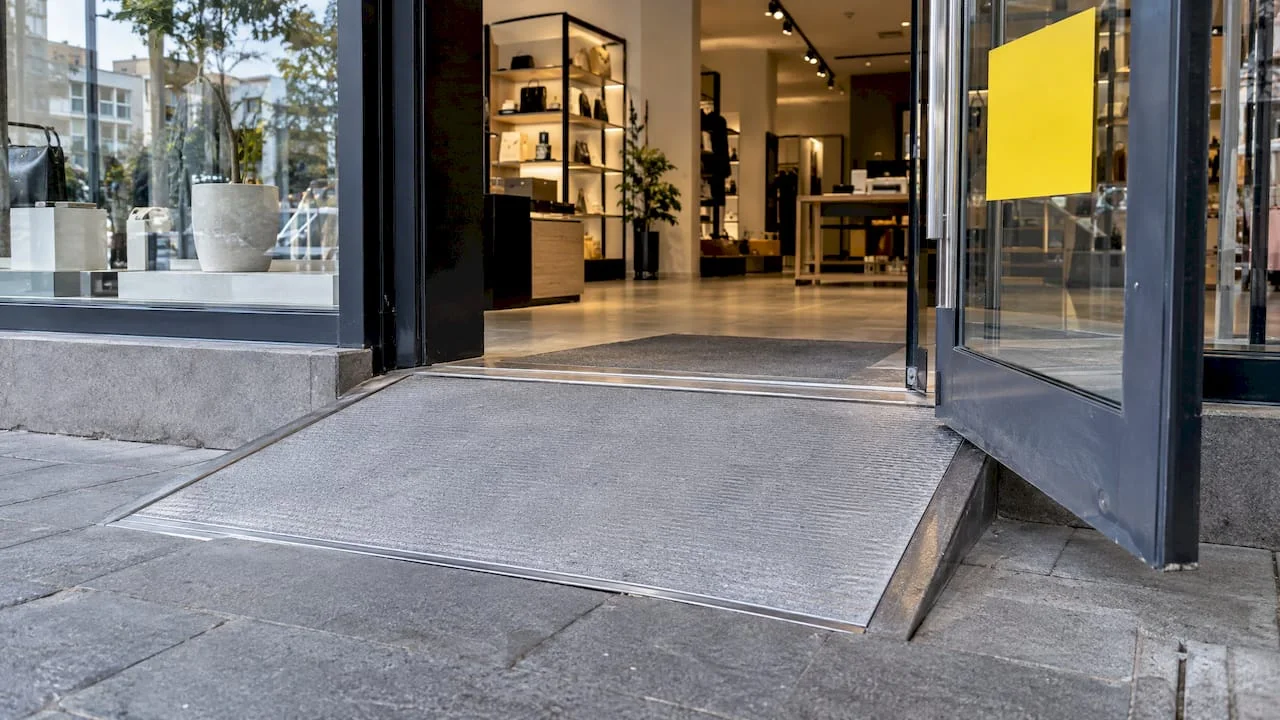
The first metres from the entrance take most of the wear: sand, water, winter salt. Here we recommend the hardest material in the project and a recessed entrance mat, flush with the floor. In the sales area, the floor becomes part of the brand experience: its colour and reflection change how the product looks under light. Routes for pallet trucks and trolleys need joints that do not open under rolling loads. For a wider view of finishes, see the guide to choosing materials for commercial spaces.
Restaurant, cafe, hotel
In hospitality, the floor has two different lives. In the service area, atmosphere, acoustics and resistance to chairs dragged hundreds of times a day matter. In the kitchen and preparation areas, the rules are sanitary. Regulation (EC) No 852/2004 requires, for rooms where food is prepared or processed (not for dining rooms), a floor in good condition, easy to clean and, where necessary, to disinfect. The rule calls for impervious, non-absorbent, washable and non-toxic materials, unless the operator shows the competent authority that another material is appropriate. The floor must also allow adequate drainage where necessary. This limits decorative finishes and calls for attention to joints, drains and the junction with the walls. We detailed the zones and criteria in durable finishes for HoReCa.
Office
Offices have constant but less aggressive traffic; the real problems are noise, chair castors and frequent reorganisations. Glued LVT, PVC sheet and technical carpet tiles suit well, and floors with quick installation allow partitions to change without major demolition. A well-designed office also uses the floor to mark out zones: focus, collaboration, reception.
Medical clinic and private practice
In a clinic, the floor communicates trust before the patient speaks to anyone. Technically, it has to withstand disinfectants, not hold dirt in the joints and allow complete cleaning of the corners. Homogeneous PVC sheet with welded joints and coved skirting is a common choice for surgeries and treatment areas; our guide to medical floors also compares the other options, zone by zone. In reception and waiting areas, warmer materials can be used, which reduce the feeling of a cold clinical space. What the law requires for each type of unit, step by step, you will find in the guide to fitting out a clinic in 2026.
The substrate: the part nobody sees
A commercial floor often fails because of what lies under it. Manufacturers ask for a flat, stable, clean and sufficiently dry substrate. For the Vilo Rusty plank, the product sheet asks, for floating installation, for a substrate that is “very flat, stable, clean and sufficiently dry”, and says that unevenness is levelled before installation. In practice, this means checking flatness, residual moisture of the screed, room temperature and cleanliness of the surface before installation.
In renovations, where time means rent paid with no income, dry floor systems are a serious option. fermacell floor elements are laid without water, can be walked on immediately and, after 24 hours, are ready for finishing under parquet, tiles, vinyl, natural stone or large formats, according to the manufacturer. Not every element suits every use: for the fermacell 2E11 and 2E22 boards, the manufacturer states thicknesses of 20 mm and 25 mm, weights of 23 kg/sq m and 29 kg/sq m and different standard load categories (2 and 3 respectively). These differences are chosen in the technical design, according to the loads of the space.
What a commercial floor really costs
The shelf price is only the first line of the budget. As a reference, on suppliers' pages on 24 November 2026, the Rusty SPC floor from Romtec Invest costs 119 lei/sq m including VAT, the Vilo Rusty SPC plank from Decolandia costs 146.78 lei/sq m (211.36 lei per box of 1.44 sq m), and the Tarkett iQ Zenith homogeneous PVC sheet costs 15.48 EUR/sq m. Prices change often; check the supplier's page for the current value.
On top of these come:
- substrate preparation: self-levelling compound, repairs, moisture barrier or a dry system;
- installation, very different between a click plank, a heat-welded PVC sheet and a poured resin;
- accessories: skirting, transition profiles, entrance mats, expansion joints;
- the cost of interrupting trading, often higher than the cost of the material;
- maintenance and replacement: a cheap material that has to be replaced after three years costs more than a dearer one that lasts ten.
That is why we compare options over their lifecycle, not per square metre. For the full picture of a renovation, see what it costs to remodel a commercial space.
How to choose, step by step
- Describe the real scenario of use. How many people come in per day, where they walk, what loads are moved, what substances reach the floor, how and how often it is cleaned. The common mistake: the choice starts from a Pinterest image, not from this scenario. In design consultancy, this is the first thing we clarify with you.
- Divide the space into zones. Entrance, sales or service, wet areas, storage, offices. Rarely is one floor right everywhere; a few well-joined materials work better.
- Set the minimum technical requirements per zone. Traffic class, wear layer, slip class, sanitary requirements where the law imposes them.
- Check the substrate. Flatness, moisture, underfloor heating, available heights at doors and thresholds.
- Choose within the concept. The colour, texture and reflection of the floor must work with the lighting, the furniture and the brand identity. This is where the right technical material also becomes the right aesthetic choice.
- Detail it in the technical design. Junctions, joints, skirting, profiles, tile layout. Details that are not drawn get improvised on site.
- Follow the execution. Substrate preparation and installation to the manufacturer's requirements are checked on site, before mistakes are covered by the finish. Coordinating execution is part of our services.
How we help at SelfDezign
If you have a commercial space, a hospitality venue, an office or a clinic in progress, the floor is one of the decisions we integrate into the complete project of commercial interior design, from concept to technical design and coordination of implementation. Design costs 25–55 EUR/sq m + VAT. If you only need clarity before deciding, the consultation with written conclusions costs 500 lei per session and stays with you as a working document. For entrepreneurs in the diaspora preparing a venue in Romania, SelfDezign Remote offers remote HoReCa consultancy, from 450 EUR per session.
Our perspective
When a client asks us for “the most durable floor”, the question we ask back is: durable against what? Against the sand brought in from the entrance, the grease in the kitchen, the disinfectant used four times a day, or the office reorganisation in two years? Each answer leads to a different material.
The floor is the backbone of a commercial interior: you do not notice it when it works, but you feel it at once when it fails. That is why we choose it together with the rest of the project. We start from the context and the objectives of the space and tie the floor to the flows, the light and the brand identity.
A correct material, laid on a correctly prepared substrate and drawn down to the last skirting board, lasts both technically and visually. For us, that is the definition of a durable commercial floor.
The SelfDezign team